❌

Vue normale

  • ✇Yanko Design
  • LiberNovo’s motorized office chair reclines to 160 degrees, has seat cooling, and is up to 42% discount
    In 1976, two designers gave the office a chair that moved when you did. The Met calls Emilio Ambasz and Giancarlo Piretti’s Vertebra the first automatically adjustable office chair. Fifty years later, plenty of us still tug knobs and crank levers like we’re docking a spaceship. LiberNovo’s Maxis picks up that old idea and sizes it for bigger frames. Its Black Friday sale opens November 19, with up to 42% off in the US. The Maxis is LiberNovo’s first line built from the ground up for big and tal
     

LiberNovo’s motorized office chair reclines to 160 degrees, has seat cooling, and is up to 42% discount

9 novembre 2026 à 21:45

In 1976, two designers gave the office a chair that moved when you did. The Met calls Emilio Ambasz and Giancarlo Piretti’s Vertebra the first automatically adjustable office chair. Fifty years later, plenty of us still tug knobs and crank levers like we’re docking a spaceship. LiberNovo’s Maxis picks up that old idea and sizes it for bigger frames. Its Black Friday sale opens November 19, with up to 42% off in the US.

The Maxis is LiberNovo’s first line built from the ground up for big and tall users, rated to 399 lbs (181 kg) and certified to BIFMA X5.11, and fitted for people between 5’10” and 6’7″ (178 to 200 cm). Instead of scaling up a standard chair, LiberNovo resized the parts that tend to fail on larger bodies, from the seat depth to the headrest travel. It comes in three versions: Manual, Electric, and Airflow. List prices run $1,299, $1,799, and $1,859, which makes for one big leap and one tiny hop. Let’s walk the staircase one step at a time.

Designer: LiberNovo

Click Here to Buy Now: Black Friday Deals End Soon!

What all three Maxis versions share

Maxis Manual

All three versions of the Maxis share the same big-body frame. The seat is 20.5 inches (52 cm) deep, with a multi-density cushion that runs firmer at the rear and softer at the front edge, where the backs of your thighs rest. The backrest spans 16.9 inches at the shoulders and flares to 20.5 inches at the waist. The U-shaped headrest travels 5.5 inches up and down and 4.7 inches in and out. Arc-shaped armrests open from 15.7 to 23.6 inches wide, so they don’t crowd your waist.

Lean back in a Maxis and the neck support, backrest, armrests, and seat all move together, a many-jointed cousin of the Vertebra’s idea. The eight-panel backrest flexes on 14 dual-link points and 16 ball joints. Six springs engage progressively by angle and weight, which LiberNovo says keeps the recline smooth under a heavier load. Five stops run from 105 degrees (Deep Focus) to 160 degrees (Spine Flow), and LiberNovo suggests 115 to 125 degrees for most of the day. Do the four-step setup once, and LiberNovo says you’ll rarely touch the controls again.

What the $500 step from Manual to Electric adds

Maxis Electric

The Manual keeps lumbar support on a dial, with no motor and no battery, which suits anyone who wants a chair that never needs charging. The Electric swaps that dial for the ErgoPulse motor and carries a 2,200 mAh battery. The motor moves the lumbar zone in or out until it meets your lower back, forming an S-curve, so there’s no reaching behind you to twist a knob. Lumbar is step one of the Maxis setup, so you’ll feel this feature on day one. That’s the first half of what the extra $500 buys.

OmniStretch is the other half, a five-minute motorized stretch sequence that runs while you’re in deep recline. Both the Electric and the Airflow include it, and the Manual skips it. LiberNovo describes it as an in-chair stretch and reset, which makes it a handy pause between long work sessions and the walk to the kitchen. Whether it’s worth a share of $500 depends on how often you’d actually use it. If the honest answer is every afternoon, the math gets friendly fast.

The $60 Airflow upgrade, and how the sale works

Maxis Airflow

The Airflow adds a seat fan to everything the Electric does. A 4,000 RPM centrifugal fan pulls air through a five-layer seat on two levels, and an occupancy sensor pauses it when you stand up, so it never spins for an empty chair. The battery grows from 2,200 to 3,000 mAh, and LiberNovo lists fan noise under 45 dB. The upholstery is Danish Gabriel Atlantic fabric, rated by its maker at more than 100,000 abrasion rubs. At list price, all of that sits $60 above the Electric, which is the easiest call on the page.

LiberNovo’s holiday sale opens November 19 and builds toward Black Friday and Cyber Monday, with up to 42% off in the US. Eligible purchases carry 30-day price protection, so buying early comes with a safety net for qualifying price changes. Every LiberNovo chair is backed by a 6-year frame warranty and a 2-year warranty on electronics. Orders unlock gift tiers by spending, topping out at a travel kit with an inflatable neck pillow, eye mask, and earplugs. US buyers can split the bill into four 0% Klarna payments. Fifty years after the Vertebra, the best pitch for a chair that moves with you is still the simplest: you stop thinking about it.

Click Here to Buy Now: Black Friday Deals End Soon!

The post LiberNovo’s motorized office chair reclines to 160 degrees, has seat cooling, and is up to 42% discount first appeared on Yanko Design.

  • ✇Yanko Design
  • 8BitDo’s $40 Xbox controller has a cable, a headphone jack, and drift-resistant sticks
    Wired earbuds staged a comeback a couple of years ago, helped by Gen Z deciding a dangling white cable looks cooler than an AirPods case. Wired gaming controllers could use some of that goodwill. 8BitDo’s new Ultimate 3C+ Wired Controller for Xbox skips the battery entirely and plugs straight into your console over USB-C. It costs $39.99, carries an official Xbox license, and brings tunable TMR sticks to the lowest-priced model in the Ultimate 3 family. You trade a little freedom of movement fo
     

8BitDo’s $40 Xbox controller has a cable, a headphone jack, and drift-resistant sticks

9 novembre 2026 à 18:30

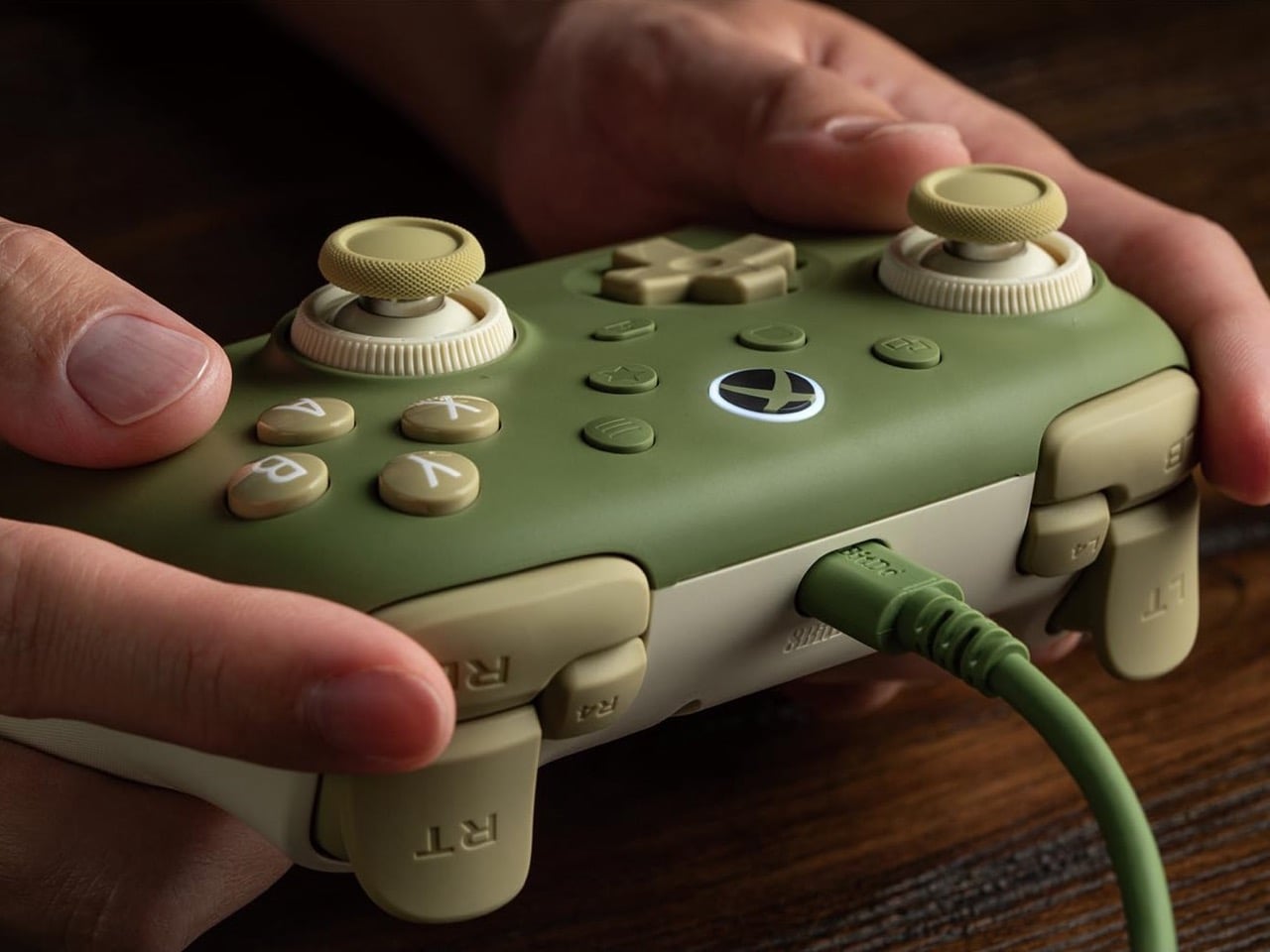
Wired earbuds staged a comeback a couple of years ago, helped by Gen Z deciding a dangling white cable looks cooler than an AirPods case. Wired gaming controllers could use some of that goodwill. 8BitDo’s new Ultimate 3C+ Wired Controller for Xbox skips the battery entirely and plugs straight into your console over USB-C. It costs $39.99, carries an official Xbox license, and brings tunable TMR sticks to the lowest-priced model in the Ultimate 3 family. You trade a little freedom of movement for a controller that never needs charging, pairing, or a panicked hunt for a dongle.

There’s no battery to degrade over years of late-night Call of Duty sessions, and a 3.5mm jack sends game audio straight to your headset. The controller works with Xbox Series X|S, Xbox One, and Windows 10 or later. It arrives a few weeks after the wireless Ultimate 3C+, which launched in October for PC and Android at the same price. The Xbox version is built for console players who would rather never think about charge levels again. The included cable stretches 8.2 feet (2.5m), so measure your couch distance accordingly.

Designer: 8BitDo

TMR sticks you can tune for shooters or racing

8BitDo’s Dual Force Ring sticks combine adjustable tension with a soft-stop silicone ring under each stick to cushion the moment it hits the edge of its travel. Increase the tension if you prefer firmer resistance when aiming in shooters, or loosen it for the long, sweeping inputs of racing games. A 12-bit ADC sampling chip and a 216MHz processor read the stick position, which 8BitDo says improves precision and response. The sensors are TMR, short for tunneling magnetoresistance, and track stick position magnetically, without sliding electrical contacts. Potentiometer sticks rely on contacts that physically wear, which can cause stick drift.

Earlier this year, 8BitDo’s fanciest stick tech lived in controllers costing $99 and up. The Ultimate 3 series kicked off at CES 2026 with the $149.99 Ultimate 3E, and the $99 Ultimate 3 for Xbox brought force rings along in May. Now that adjustable tension sits inside a $39.99 controller with a cable hanging off it. Compare that with Microsoft’s Xbox Nano Controller, a $49.99 pocket pad that still ships with conventional potentiometer sticks. If your last Xbox controller died of drift, that difference in sensor tech may be the most persuasive line on this spec sheet.

Switchable triggers, extra bumpers, and lockable back buttons

A switch flips the triggers between linear Hall Effect mode and short micro-switch mode. Linear gives you the full analog pull for feathering a throttle, while micro-switch turns each trigger into something closer to a mouse click. Impulse Trigger rumble lives inside the triggers, with more vibration tucked into the grips. 8BitDo says a dedicated rapid-stop chip cuts vibration off quickly, so a gunshot’s rumble doesn’t linger. The idea is that when an explosion fades on screen, your palms stop buzzing too.

Two extra bumpers, labeled R4 and L4, join the standard shoulder buttons and can be remapped without software. Two back buttons sit under the grips, and a lock disables them when you would rather not trigger a reload by accident. 8BitDo describes the D-pad as clicky but smooth, says it has refined the ABXY buttons, and lists wear-resistant stick rings. It also widened the grip angle compared with the older Ultimate C Wired, stretching the body to 5.96 inches (151.5mm) long. It weighs 7.9 ounces (224g), just 8 grams more than its predecessor, with the revised grip intended to offer a more relaxed hold.

Ten dollars less than the Xbox Nano

Compared with the wireless 3C+, the Xbox model drops the turbo function and its sibling’s polling rate of up to 1,000Hz. It also skips the cardboard DIY stand that ships in the wireless box, a minor tragedy for anyone who enjoys a little arts and crafts with their unboxing. In return, you get the headphone jack, full Xbox console support, and an official license. Competitive players chasing every millisecond may miss the higher polling rate. For couch play, cable reach is likely to be the more immediate concern.

At $39.99, the 3C+ Wired undercuts the $49.99 Xbox Nano by ten dollars and Microsoft’s standard $64.99 controller by twenty-five. It also costs just $5 more than the older Ultimate C Wired for Xbox, which paired Hall Effect sticks with an RGB light ring. 8BitDo swapped that light show for tunable TMR sticks, which seems a useful trade for anyone more interested in stick feel than desk glow. Pre-orders are live on the 8BitDo eShop and Amazon in the US, with Matcha Green and Charcoal Gray units shipping November 16.

The post 8BitDo’s $40 Xbox controller has a cable, a headphone jack, and drift-resistant sticks first appeared on Yanko Design.

  • ✇Yanko Design
  • The $179 Magic Screen gives any MacBook a touchscreen with stylus support
    Hidden around a modern MacBook display are magnets used to tell the laptop you shut the lid. Intricuit, a small hardware startup, looked at those magnets and saw a free mounting system. Its Magic Screen uses them to snap a touch-sensitive glass panel over your display, adding tap, swipe, and pinch controls to the MacBook you already own. It costs $179 on Kickstarter. Apple’s approach is the new MacBook Pro with PROLED XDR Display, which starts at $2,899, or roughly sixteen Magic Screens with ch
     

The $179 Magic Screen gives any MacBook a touchscreen with stylus support

9 novembre 2026 à 15:20

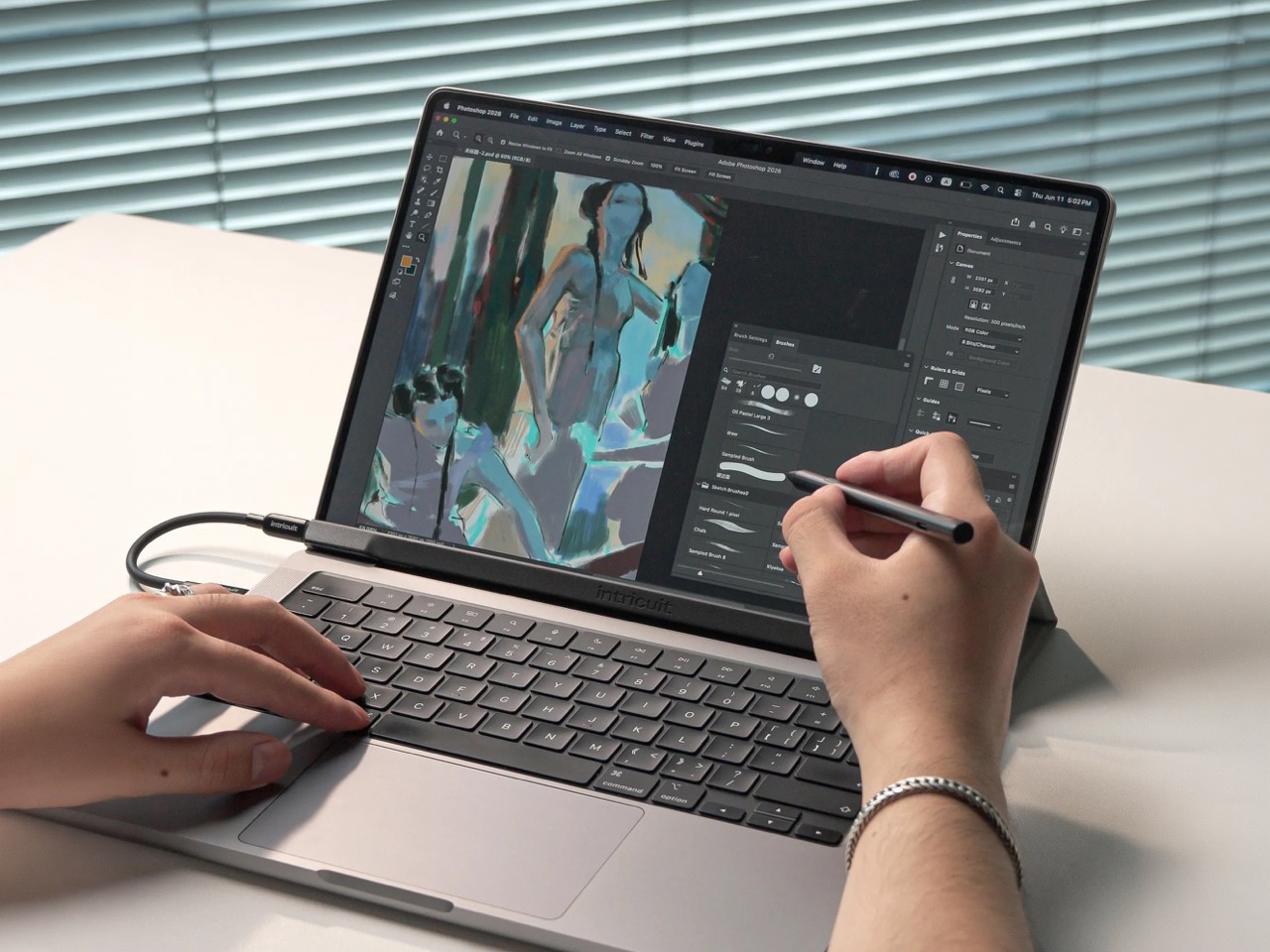
Hidden around a modern MacBook display are magnets used to tell the laptop you shut the lid. Intricuit, a small hardware startup, looked at those magnets and saw a free mounting system. Its Magic Screen uses them to snap a touch-sensitive glass panel over your display, adding tap, swipe, and pinch controls to the MacBook you already own. It costs $179 on Kickstarter. Apple’s approach is the new MacBook Pro with PROLED XDR Display, which starts at $2,899, or roughly sixteen Magic Screens with change left over for snacks. That’s a whole laptop rather than an accessory, but it’s a steep entry price if touch is all you’re after.

Apple integrates the touch sensor into a tandem OLED panel and uses a stiffer hinge designed to limit screen bounce when you tap it. It also supports zero styluses, Apple Pencil included, which is a little funny coming from the company that sells the Apple Pencil. The Magic Screen ships with a pen that reads 4,096 pressure levels, previews its tip position as it hovers, and supports palm rejection while you draw. Intricuit lists compatibility with M1 and newer MacBook Pros, M2 and newer Airs, and even the $599 MacBook Neo, bringing that last combination to $778.

Designer: Intricuit

Snap, Plug, Tap: How the Glass Registers Your Fingers

The panel is tempered glass with a capacitive digitizer built in, the same kind of touch technology your phone uses, tracking up to ten fingers at once. Intricuit lists transparency at 99% or better and a response time of 8ms. A single USB-C cable carries the touch data and draws a claimed 0.6 watts from your MacBook, so there’s no extra battery to babysit. The 14-inch MacBook Pro version weighs 4.3 ounces (122.8 grams), and the 16-inch version comes in at 6.1 ounces (172.6 grams). Basic touch works without the app; Intricuit’s software for macOS Sonoma or later adds further controls.

Tom’s Guide spent three weeks with a Magic Screen and came away convinced macOS is far more touch-ready than Apple ever let on. Taps open apps, a press-and-hold summons the right-click menu, and familiar trackpad gestures carry over to the glass. Intricuit demos it triggering clips in Resolume Arena, orbiting models in SketchUp, and shoving sticky notes around Miro boards, all situations where reaching for something directly has an obvious appeal. It also works with iPhone Mirroring, letting you tap through your phone’s apps on the larger display. Fingerprints land on the overlay rather than directly on your MacBook’s screen.

The Stylus Apple Skipped Comes in the Box

The included pen uses USI 2.0, the Universal Stylus Initiative standard supported by compatible Chromebooks, and reads 4,096 levels of pressure. That gives you control over line weight, from a light hairline to a fat brushstroke, while palm rejection is designed to let you rest your hand on the glass as you draw. Hover detection starts about 0.4 inches (10mm) away, previewing the tip’s position before it touches down. Intricuit rates the battery at 100 hours, with a 40-minute USB-C recharge and no Bluetooth pairing required. Your Apple Pencil isn’t compatible, though it won’t work on Apple’s new MacBook Pro either.

Pop the Magic Screen off and it becomes a flat pen tablet, a familiar setup for anyone who has used a Wacom. Drawing on an upright laptop screen means working against gravity and a hinge, while laying the panel on a desk lets you rest your arm. The folio case folds into a stand for this mode. When the panel goes back on your display, the case braces against the lid to reduce wobble under your fingers. Apple’s Sidecar offers another route to drawing on a Mac, but requires an iPad and an Apple Pencil alongside the laptop. Intricuit puts the touch panel and pen in one $179 box, provided you already own a compatible MacBook.

What $2,899 Gets You at the Apple Store

Apple’s price buys a complete laptop with a tandem OLED panel rated to peak at 2,000 nits and an integrated touch sensor. The hinge is stiffer, the 14-inch body weighs 3 pounds, and the glowing Apple logo is back on the lid for the nostalgics. That package costs $400 more than the equivalent standard MacBook Pro. The Magic Screen comes with its own compromises: a cable occupying a port and a panel you need to remove before closing the lid. Intricuit built a stopper into the bottom edge to keep the lid from closing onto it, a bit of idiot-proofing that could save an expensive mistake.

The Magic Screen is available for $179 after a successful crowdfunding run, a $60 discount off its planned $239 retail price. Pick your size carefully, since each of the five versions is fitted to a specific MacBook display, and the M1 MacBook Air sits this one out. Each box includes the panel, stylus, folio case, USB-C cable, and a polishing cloth for the inevitable fingerprints.

The post The $179 Magic Screen gives any MacBook a touchscreen with stylus support first appeared on Yanko Design.

  • ✇Yanko Design
  • This Logitech Surgical Kit Concept Turns XR Controllers Into Medical Instruments
    Before a pilot flies you to Cancún, they’ve logged hours in a simulator crashing planes that don’t exist. Surgical training has had a harder time getting there, and residents often get thin hands-on practice before working on living patients. Niklas Andreasen, a graduate of Sweden’s Umeå Institute of Design, set out to fix that with MX Surgical, a mixed reality training kit he developed with Logitech. It pairs replica surgical instruments with a headset, so trainees can rehearse procedures anyw
     

This Logitech Surgical Kit Concept Turns XR Controllers Into Medical Instruments

9 novembre 2026 à 14:20

Before a pilot flies you to Cancún, they’ve logged hours in a simulator crashing planes that don’t exist. Surgical training has had a harder time getting there, and residents often get thin hands-on practice before working on living patients. Niklas Andreasen, a graduate of Sweden’s Umeå Institute of Design, set out to fix that with MX Surgical, a mixed reality training kit he developed with Logitech. It pairs replica surgical instruments with a headset, so trainees can rehearse procedures anywhere they can open a case. Call it a flight sim for scalpels, and a lot more portable than the six-figure simulator rigs some hospitals bolt to the floor.

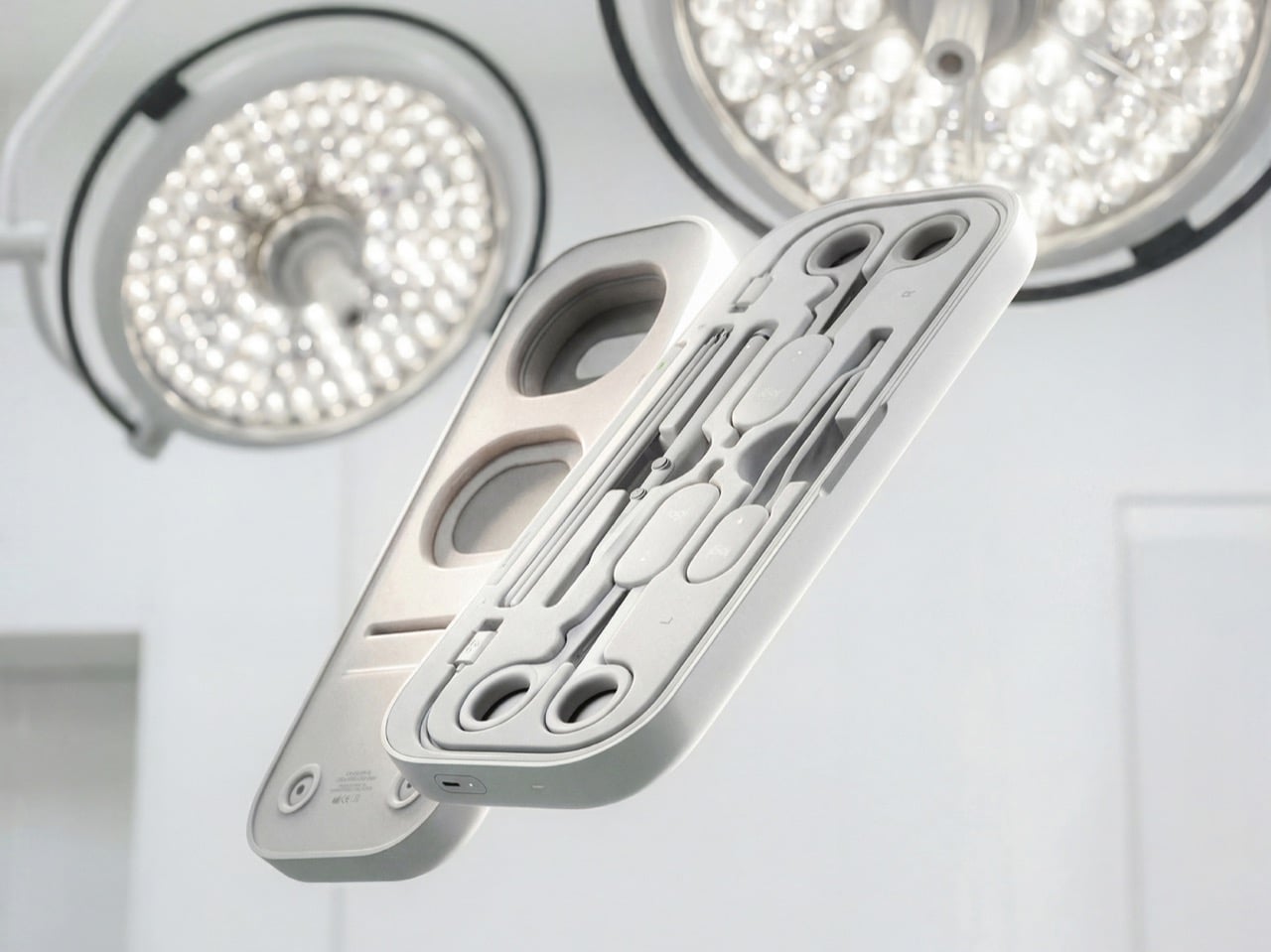
Andreasen grouped surgical tools into three mechanical families (ring-handled scissors and clamps, forceps, and pen-grip instruments), then designed one reconfigurable controller for each. Sensors and adjustable resistance mechanics inside recreate how each tool pushes back in your hand, and layered pads give you something to actually cut into. The headset handles the anatomy, while a companion platform scores you on precision, force, and timing like a very strict video game. It’s a concept for now, with no pricing or launch plans. Even so, it has already picked up Emerging Product Designer of the Year at the 2026 European Product Design Awards, three Core77 student wins, and a nomination for Red Dot’s Peter Zec Prize.

Designer: Niklas Andreasen (Umeå Institute of Design, in collaboration with Logitech)

Three Controllers, One Entire Instrument Tray

A real surgical tray can hold dozens of instruments, and building a replica of each one would turn the kit into a hardware store. Andreasen sidestepped that by mapping what instruments have in common mechanically. Scissors, needle holders, and clamps all pivot on a ring-handled scissor action. Forceps pinch, and scalpels and probes ride in a pen grip. Each MX Surgical controller covers one of those families, tuning its spring tension and range of motion in real time so the same body can feel like a fine dissecting scissor one minute and a stiff clamp the next.

Logitech has spent over four decades shaping mice, keyboards, and controllers around human hands, and the collaboration shows. The kit wears the MX family’s soft radii and matte warm grays, so anyone who owns Logitech’s MX Ink stylus for Meta Quest will feel right at home. Three mentors from Logitech, Nick Jinkinson, Andreas Connellan, and Aidan Kehoe, guided the project. The cutaway renders show a rotary mechanism tucked right at the pivot, where the resistance needs to happen, inside ring handles your fingers already know from the real tool. Compare that with FundamentalXR, a leading haptic surgical platform that has traditionally relied on desk-mounted haptic arms.

Layered Pads Handle the Feel, the Headset Handles the Gore

Haptics can only fake so much, so MX Surgical gives your hands something physical to work on. Layered training pads stand in for tissue at different depths, and they slot into a die-cut tray inside the case. As you work through a procedure, the mixed reality overlay progressively reveals deeper layers of anatomy and shifts to match what you’re doing. Hospitals and universities can stock a material library of swappable pads and components, tailoring the kit to a specialty or a specific case. Residents without a headset aren’t stuck either, because a simpler screen-based version handles the visual side.

This hybrid approach borrows from both ends of current surgical training. On one end are cheap suturing pads that residents practice stitches on at home, which feel real but teach nothing about context. On the other end are VR simulations that show you an entire operating room but feel like waving a remote around. MX Surgical splits the job, letting the pad handle touch and the headset handle everything you need to see. The whole thing packs into a slim carry case, which makes it something you can take home, practice with at 11pm, and toss in a bag for your next rotation.

A Scorecard for Skills Surgeons Used to Pick Up by Osmosis

Every practice session gets logged by the companion platform, which tracks motor patterns, motion efficiency, accuracy, force control, and response timing. Those numbers describe the stuff a senior surgeon notices from across the room, like a hand that hesitates or grips too hard. The platform adjusts difficulty as you improve, keeps a digital anatomy atlas on hand, and lets mentors review your sessions remotely. Residents can train alone or in teams, then sit down with an attending to go through the results together. Andreasen’s own framing is that this data captures knowledge residency has always passed down person to person without ever writing it down.

That puts MX Surgical in direct conversation with William Halsted, who founded the surgical residency program at Johns Hopkins in 1890 around a simple motto: see one, do one, teach one. A century later, a design student added a fourth step, practice one, and made it look like something that belongs next to your keyboard. Andreasen built it through interviews and observation sessions with surgeons and educators in Sweden and Germany, with mentors from Logitech, Intuitive Surgical, and IDEO. In a Red Dot interview, he said he looks for ideas that “earn and defend their place.” A kit that lets a resident make their first mistake on a pad instead of a person sounds like one of those ideas.

The post This Logitech Surgical Kit Concept Turns XR Controllers Into Medical Instruments first appeared on Yanko Design.

  • ✇Yanko Design
  • Lift Ocean’s ONE Lifts Boats Above Water Without a New Hull
    A speedboat that rises above the water is an easy visual sell. The less glamorous question is what happens to the perfectly usable boat someone already owns. Replacing an entire vessel to get a smoother, more efficient ride is a fairly extravagant upgrade path. Norwegian company Lift Ocean is working on another option: ONE, a hydrofoil system designed to fit conventional boats rather than demand a completely new hull. I like that starting point. ONE is a tested system, but it isn’t a weekend in
     

Lift Ocean’s ONE Lifts Boats Above Water Without a New Hull

9 novembre 2026 à 10:20

A speedboat that rises above the water is an easy visual sell. The less glamorous question is what happens to the perfectly usable boat someone already owns. Replacing an entire vessel to get a smoother, more efficient ride is a fairly extravagant upgrade path. Norwegian company Lift Ocean is working on another option: ONE, a hydrofoil system designed to fit conventional boats rather than demand a completely new hull. I like that starting point.

ONE is a tested system, but it isn’t a weekend installation project for individual owners. According to New Atlas’s November 8 report, orders are currently limited to boat manufacturers and fleet operators, with shipping expected in 2027. That makes the immediate story a supplier offering foiling technology to the industry, rather than an accessory you can order for next Saturday’s lake trip. The distinction matters before anyone starts clearing space in the garage.

Designer: Lift Ocean

The hardware has an understandable layout: one foil assembly at the bow and two at the stern, flanking a single outboard motor. Each assembly places a movable underwater wing at the bottom of a vertical mast. As speed builds, those wings generate lift and raise the hull above the water. It’s an unusual-looking arrangement, but the logic is straightforward. Less hull moving through the water means an opportunity to reduce resistance.

Keeping that arrangement stable takes more than attaching wings. Lift Ocean’s active control system automatically adjusts their angles to maintain ride height and manage banked turns. The driver still uses steering and throttle, rather than learning to balance the boat manually. To me, that’s the right place to put the complexity: inside the controls, where it can do useful work, instead of turning a familiar activity into a new skill test.

The retractable wings are equally important, although they’re less likely to get top billing than the flying-boat footage. Lift Ocean says retracting them allows conventional planing, reduces marine growth, and makes maintenance easier. Its CEO also says the arrangement accommodates a conventional trailer. Those are sensible priorities. A boat still has to come home, sit unused, and get cleaned. I’d judge the design partly by how gracefully it handles those unphotogenic hours.

Compatibility is another appealing decision. ONE is designed to work with gasoline or electric outboards, so adopting the system doesn’t inherently require changing energy sources. An automatic engine lift bracket moves the motor vertically to keep its propeller submerged while the boat rises. That detail deserves attention: lifting the hull is only useful if propulsion continues working properly. The bracket addresses a problem created by the very feature everyone came to admire.

The efficiency claim is substantial. Lift Ocean told New Atlas that measurements from its test boats and client samples showed roughly a 50 percent reduction in fuel consumption, while emphasizing that results vary between boats. I’d treat that as a company-reported result, not a guaranteed discount at the fuel dock. Still, reducing the energy needed to move an existing hull is a compelling direction. It makes efficiency a question of how the boat travels, alongside what powers it.

I also appreciate that Lift Ocean acknowledges installation differences. In an interview with Marine Industry News, CEO Petter Mørland Pedersen explained that some modifications are normally required, depending on the vessel. “Bolt-on” shouldn’t be mistaken for universally effortless. Manufacturers still have integration work to do, and a standardized system doesn’t erase the individual boat’s structure or proportions. That caveat makes the proposition more credible to me, because it leaves room for the actual engineering.

Before calling ONE a practical upgrade, I’d want to see the installed price, maintenance requirements, and fuel savings on a specific boat. But as a design proposition, it has my attention. The appeal is being able to improve a familiar object without treating the entire object as obsolete. If boatbuilders can make that integration convincing, the most satisfying feature might be the hull you didn’t have to replace.

The post Lift Ocean’s ONE Lifts Boats Above Water Without a New Hull first appeared on Yanko Design.

  • ✇Yanko Design
  • 8 Best Desk Accessories of October 2026 to Upgrade Your Workspace
    Your desk does not need another gadget simply because there is room for one. The worthwhile additions are the ones that change how the space works or feels: a light that leaves the surface clear, a mouse that packs flat, or a notebook alternative that lets your ideas move around. Sometimes, the right accessory does something less practical but equally personal, giving an otherwise ordinary setup a little more character. These eight designs approach the workspace from different directions, balan
     

8 Best Desk Accessories of October 2026 to Upgrade Your Workspace

9 novembre 2026 à 07:40

Your desk does not need another gadget simply because there is room for one. The worthwhile additions are the ones that change how the space works or feels: a light that leaves the surface clear, a mouse that packs flat, or a notebook alternative that lets your ideas move around. Sometimes, the right accessory does something less practical but equally personal, giving an otherwise ordinary setup a little more character.

These eight designs approach the workspace from different directions, balancing useful everyday tools with objects that make sitting down feel more inviting. Sony’s miniature 3D display leads the selection, joined by adaptable storage, sculptural stationery, thoughtful lighting, and portable technology. The connecting thread is considered design rather than a matching aesthetic, with each accessory offering a distinct reason to claim some space beside your computer, sketchbook, or morning coffee cup.

1. Sony ELF-MN1 Spatial Reality Display

Sony’s ELF-MN1 takes the familiar desk collectible and replaces the physical figure with a digital character on a six-inch display. Its glasses-free 3D presentation makes compatible content appear to have depth without asking you to wear a headset. The transparent stand keeps the enclosure visually light, which suits an object intended to sit beside a monitor rather than compete with it. This is the personality piece of the group, not another screen pretending to be essential office equipment.

The interesting design decision is making digital collecting feel more like displaying an object than opening another window on your computer. Eye tracking adjusts the stereoscopic image for the viewer, although the effect is intended for one person rather than everyone around the desk. You will need a compatible smartphone or PC and supported content, so this is not a universal digital picture frame.

What we like

  • The combination of a compact enclosure and glasses-free depth gives digital collectibles a distinctive desktop presence.
  • It adds personality without requiring a headset.

What we dislike

  • The stereoscopic effect is intended for a single viewer.
  • Compatible hardware and content are required, and the product is not shipping yet.

2. MagBoard Clipboard

A notebook gives your thoughts a home, but it also decides where every page belongs. The MagBoard Clipboard takes a more flexible approach, using a magnet and lever mechanism to secure loose sheets inside a simple cover. Pages can be removed, replaced, or rearranged as a project develops. For a desk covered with sketches, meeting notes, and half-finished ideas, that makes it an appealing middle ground between a conventional bound notebook and an increasingly unruly stack of loose paper.

Designed by Hirock Design Office and made in Japan, the clipboard has a rigid cover that also provides a writing surface away from your desk. The shop specifies a capacity of up to 30 sheets, enough for a focused working collection rather than an entire archive. A5 and A4 sizes let you choose between compact notes and larger drawings. Available configurations start at $45, making this the simplest selection for readers who would rather reorganize their paper than digitize everything.

Click Here to Buy Now: $45.00

What we like

  • Loose pages can follow the changing order of a project.
  • The rigid cover provides support when a tabletop is unavailable.

What we dislike

  • The stated 30-sheet capacity limits how much material it can hold.
  • It costs more than a basic clipboard and still requires managing individual sheets.

3. Divoom Astrotoo

The Divoom Astrotoo looks like a tiny computer from a future imagined several decades ago. Its rounded housing, raised keys, and joystick give it a tangible character that a plain speaker grille rarely achieves. Behind that playful appearance sits a 20W speaker and a 3.95-inch display for photographs, clock faces, pixel art, and music visualizations. It offers a way to bring music and personal imagery into the same small object, rather than adding separate accessories to your desk.

Physical controls handle everyday interactions, while the Divoom app manages visual customization. That division gives the buttons a purpose beyond completing the retro look, although the phone remains part of the experience. Divoom lists Bluetooth, WiFi, microSD playback, and battery operation, with up to six hours claimed between charges. At $199.99 and listed in stock, Astrotoo is a substantial purchase for its size. Its appearance is easy to appreciate; sound quality needs listening rather than assumptions based on its specifications.

What we like

  • The physical keys and joystick make the retro styling functional.
  • Music playback and a customizable display share one compact enclosure.

What we dislike

  • Visual customization still involves a phone app.
  • The claimed six-hour battery life does not cover a full eight-hour workday.

4. BenQ iScreenBar

A desk lamp can improve a workspace while also becoming another object you have to work around. BenQ’s iScreenBar removes the base from that equation by attaching to a compatible iMac through a magnetic mounting system. The aluminum body follows the computer’s restrained material language, while cable management helps keep the addition visually contained. It is a particularly relevant accessory for an already crowded desk, where the best place to put another useful object may be above the work surface.

The mounting arrangement is designed to leave the camera, microphones, and speakers unobstructed, while asymmetric optics direct illumination toward the desk. BenQ also provides automatic brightness adjustment and software controls, giving the light more flexibility than its minimal appearance suggests. The important qualification is compatibility: the magnetic clip supports iMac models from 2021 onward, not earlier iMacs or Apple’s standalone displays. Listed at $189, it makes sense as a tailored lighting solution, not as a universal recommendation for every computer.

What we like

  • The mounted design leaves the desktop free of a lamp base.
  • Its attachment and cable routing are designed specifically around the iMac.

What we dislike

  • Compatibility excludes earlier iMacs and Apple’s standalone displays.
  • The specialized mounting makes it less transferable if you change computer setups.

5. Levitating Pen 3.0

Most pens disappear into a drawer until they are needed. The Levitating Pen 3.0 makes putting one down part of its appeal. Supported magnetically, it balances on a pinpoint at a 60-degree angle, creating a poised silhouette above its pedestal. The effect gives an ordinary writing instrument the presence of a small kinetic sculpture. Beside Sony’s digital display, it offers a different kind of desktop spectacle, using a physical balance mechanism rather than another illuminated screen to attract attention.

The pen remains a writing tool, which matters when the novelty wears off. The available 2-in-1 configuration can switch between fountain and rollerball formats by changing the grip, offering a practical reason to look beyond the stand. That version was listed at $149 when checked, while standalone fountain and rollerball variants were marked sold out. Its strongest appeal is the relationship between object and holder, so consider whether you want to dedicate permanent desk space to the pedestal.

Click Here to Buy Now: $149.00

What we like

  • The magnetic balance turns storage into a distinctive part of the design.
  • The available 2-in-1 version offers fountain and rollerball configurations.

What we dislike

  • The pedestal occupies more space than simply storing a pen in a tray.
  • At $149 for the available configuration, its sculptural appeal carries a premium.

6. DailyObjects Node Charging Ecosystem

Charging accessories often arrive one device at a time, eventually leaving a desk with several unrelated stands and cables. Designed by LAYER for DailyObjects, Node treats them as components of a shared system instead. A dock supports interchangeable modules, allowing the arrangement to change with the devices and routines around it. The collection includes a wireless phone stand, charging disk, Apple Watch stand, and portable lamp. Its rounded forms make the charging setup feel like a deliberate group of objects.

The flexibility extends beyond rearranging pieces on a base. LAYER describes modules that can work independently, with a battery-equipped phone stand and portable lamp allowing selected functions to move elsewhere. That could suit someone who works at a desk during the day and wants the same accessories nearby later. The distinction between configurations matters, since a pictured collection should not be mistaken for one included package. Current pricing and regional purchase availability could not be independently confirmed during checking.

What we like

  • Interchangeable modules allow the setup to respond to different needs.
  • The phone stand and portable lamp bring mobility into a usually stationary category.

What we dislike

  • Buyers need to check exactly which modules a configuration includes.
  • Current pricing and regional availability remain unconfirmed.

7. Orbitkey Grid Desk Organizer

A fixed compartment organizer works beautifully until the things you need to store change. Orbitkey’s Grid Desk Organizer makes that limitation its starting point, using movable dividers that snap into a perforated tray floor. Instead of finding objects that fit the compartments, you arrange the compartments around your objects.

That is a useful distinction for a desk that alternates between stationery, charging cables, earbuds, and small tools, where yesterday’s tidy arrangement can quickly become today’s awkward collection of empty spaces. Stackable trays add another layer of adaptability, while the lid can serve as a phone stand. The design is promising, but its production status needs to stay visible beside the attractive imagery.

What we like

  • Movable dividers let the storage layout follow the objects.
  • Stackable layers offer a way to organize vertically.

What we dislike

  • Accessing lower trays involves moving or sliding the layers above them.
  • Fulfillment remains pending, so it is not an immediate desk upgrade.

8. OrigamiSwift Mouse

The OrigamiSwift Mouse addresses a familiar frustration with portable work tools: the shape that suits your hand rarely suits your bag. Its folding body opens into a raised mouse form, then flattens for storage when the workday moves elsewhere. The triangular geometry gives that transformation a visual logic rather than disguising the folds. Designed by Horace Lam, it belongs on this list because the mechanism changes how the object travels, not simply because its appearance differs from a conventional mouse.

Bluetooth connectivity and USB-C charging keep the practical specifications familiar, while the listed 40-gram weight reinforces the portability story. The shop claims up to three months of use per charge, a figure that should be treated as a product claim rather than a tested result. Black and Gray versions are listed at $85, with Titanium Silver at $95. The folding design is appealing for shared tables and mobile setups, although comfort over long sessions still needs individual assessment.

Click Here to Buy Now: $85.00

What we like

  • The folding mechanism reduces thickness for packing and storage.
  • Its lightweight construction suits a workspace that moves between locations.

What we dislike

  • Folding flatter does not necessarily mean occupying less tabletop area.
  • The unusual shape warrants a personal comfort check before replacing an everyday mouse.

A Better Desk Does Not Need Everything

The most convincing desk upgrade is usually the one that answers a specific frustration. MagBoard gives loose notes a more flexible home, BenQ moves lighting off the work surface, and OrigamiSwift changes what a mouse needs to occupy inside your bag. None requires the rest of the collection to make sense. Choosing one useful improvement is a better starting point than assembling an entire setup around a photograph you admire.

There is also room for objects that make the desk feel more personal, whether that means a magnetically balanced pen or a digital character beside your monitor. The distinction is knowing what you are buying and why. Check compatibility, available configurations, and delivery status before committing, particularly with forthcoming designs. A considered workspace should reflect the way you actually spend time there, with enough room left for the work itself.

The post 8 Best Desk Accessories of October 2026 to Upgrade Your Workspace first appeared on Yanko Design.

  • ✇Yanko Design
  • A $25 Water Bottle That Packs Snacks Without an Extra Bag
    A water bottle in one hand and a bag of trail mix in the other works perfectly well until you need your phone. Then the snack bag gets stuffed into a pocket or buried somewhere inconvenient. The FLPSDE XR Dual Chamber Water Bottle tackles that small but familiar packing problem by giving your drink and your snacks separate spaces inside one bottle. I like the premise: fewer loose things to keep track of, without abandoning the snacks. Designed by Ben Bazis, whose name appears on FLPSDE’s contai
     

A $25 Water Bottle That Packs Snacks Without an Extra Bag

9 novembre 2026 à 05:15

A water bottle in one hand and a bag of trail mix in the other works perfectly well until you need your phone. Then the snack bag gets stuffed into a pocket or buried somewhere inconvenient. The FLPSDE XR Dual Chamber Water Bottle tackles that small but familiar packing problem by giving your drink and your snacks separate spaces inside one bottle. I like the premise: fewer loose things to keep track of, without abandoning the snacks.

Designed by Ben Bazis, whose name appears on FLPSDE’s container patent, the XR is a retail product rather than a concept waiting for production. It’s the plastic version of the brand’s dual-chamber bottle, with drinking access at the top and storage accessed by flipping it over. That arrangement makes sense for an afternoon out when bringing a whole lunch bag feels excessive, but pretending you won’t get hungry feels optimistic.

Designer: Ben Bazis

The capacity needs a little unpacking. FLPSDE lists 32 ounces overall, but that’s divided between a 25-ounce drinking chamber and a 7-ounce storage compartment. You’re not getting a full 32-ounce water supply plus a bonus snack container. Some of the bottle’s interior is committed to storage, which seems like a reasonable exchange for short outings. For a longer walk with limited refill opportunities, I’d give water capacity priority over the convenience of consolidated packing.

Visually, the XR makes its unusual construction easy to understand. The product image shows a snack chamber nested inside the lower portion of a translucent blue body, with water occupying the space above and around it. You can see the contents rather than treating the base like a mystery compartment. I prefer that openness here. Seeing the remaining cashews is a useful reminder that you packed them, and an equally useful warning that you’re almost out.

The lid gets attention, too. FLPSDE includes a straw, a carry handle, and a wide opening for adding ice, along with the option to drink without the straw. Those are sensible accommodations for different habits, although the storage is still the reason this bottle deserves a look. I’m more interested in that practical combination than in another bottle asking me to appreciate its color alone. The XR does offer colors you can mix and match, if that’s your thing.

The lower compartment isn’t restricted to food. FLPSDE suggests keys or lip balm, and says it can also hold a separate cold drink, including electrolytes or cold coffee. The company describes the chambers as independently sealed. I’d use it for dry snacks first, simply because that’s the clearest benefit for my own packing preferences. A small second beverage has its appeal, but keeping a handful of nuts from disappearing into the bottom of a backpack feels more broadly useful.

Cleaning is where a clever container can become a chore. FLPSDE says the XR disassembles completely and that all parts are top-rack dishwasher safe. That matters more to me than the prospect of carrying two drinks. A bottle that holds food needs to be approachable after the outing, too. Disassembly is a sensible design choice, though it also means more pieces to wash and reassemble. Combining containers doesn’t make their maintenance disappear; it brings the jobs together.

At a listed $24.98, the XR is priced modestly enough to make its extra function worth considering. FLPSDE gives dimensions of 10.25 inches tall and 3.25 inches wide, and says it fits most cup holders. That last detail is worth checking against your own car or bag rather than assuming every holder agrees. The useful question is whether its shape fits the places where you already carry a bottle.

I wouldn’t replace a perfectly good bottle solely to acquire a snack compartment. But for someone already shopping, the XR offers a specific reason to choose it: the food travels with the water. Its appeal depends on how you pack, not how enthusiastically you collect drinkware. If a bottle is already coming along, giving it responsibility for the trail mix seems like a fair assignment.

The post A $25 Water Bottle That Packs Snacks Without an Extra Bag first appeared on Yanko Design.

  • ✇Yanko Design
  • Someone built a PlayStation arcade cabinet on ebay, and now I want to play Tekken
    The PlayStation 5 is having a wild autumn. Modders have cracked it wide open, and people are now hauling Steam games onto the console and PS5 games onto their PCs, like two neighbors who swapped houses just to see what happens. Meanwhile, an eBay seller called arcadeplug has gone in the opposite direction, building a PlayStation-themed bartop arcade cabinet that plays the original PS1 library old-school style, standing up with a joystick in hand. It runs on a Raspberry Pi 4 with RetroPie, uses
     

Someone built a PlayStation arcade cabinet on ebay, and now I want to play Tekken

8 novembre 2026 à 21:45

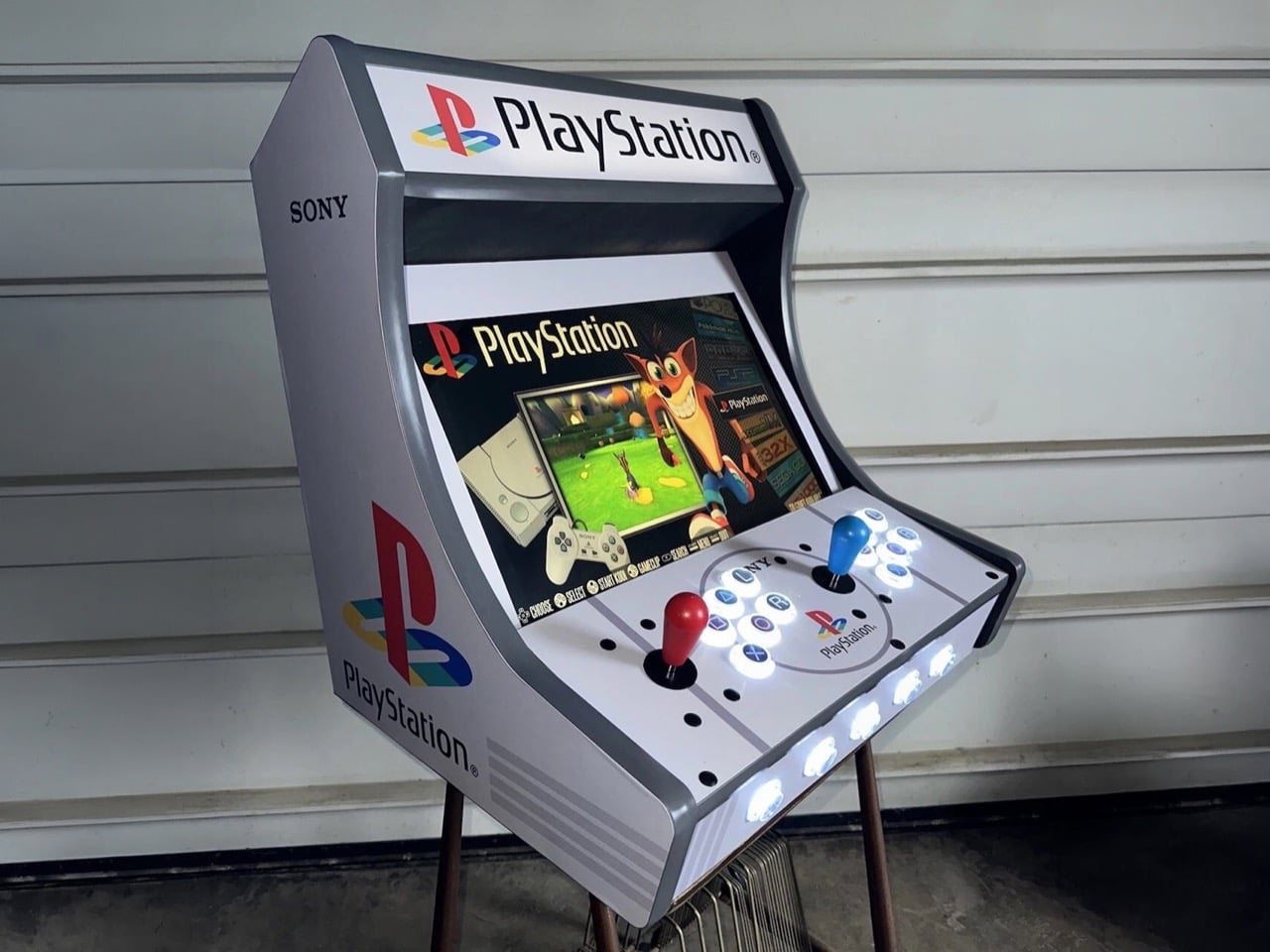
The PlayStation 5 is having a wild autumn. Modders have cracked it wide open, and people are now hauling Steam games onto the console and PS5 games onto their PCs, like two neighbors who swapped houses just to see what happens. Meanwhile, an eBay seller called arcadeplug has gone in the opposite direction, building a PlayStation-themed bartop arcade cabinet that plays the original PS1 library old-school style, standing up with a joystick in hand. It runs on a Raspberry Pi 4 with RetroPie, uses a 19-inch screen, and costs $1,029.99. Sony never made this machine. Somebody with a lot of vinyl and a free weekend decided the universe needed it anyway.

I’ll admit the first photo got me. The gray body, the four-color PS logo on the side, and the glowing triangle, circle, cross, and square buttons hit the same part of my brain that still remembers the PS1 boot-up sound. It’s a fan build in official-looking clothes, and the clothes are excellent. The funny part is the history, because PlayStation hardware actually powered ’90s arcade cabinets, running Tekken on Namco’s System 11 board months before the console launched. Those machines wore other companies’ art. This one wears Sony’s art with zero Sony hardware inside, which is a deliciously backwards way to close the loop.

Designer: arcadeplug

Sony Snuck the PlayStation Into Arcades Before It Hit Living Rooms

Tekken’s road to the arcade ran through a 1993 meeting where Sony’s Ken Kutaragi walked Namco’s Shegeichi Nakamura through the early PlayStation specs. Namco had been building Tekken for its pricey System 22 board, a machine meant to slug it out with Sega’s Virtua Fighter 2. After that meeting, the project moved to System 11, a cheaper board built on PlayStation architecture. The plan was simple economics, leaving Sega the big arcades while Tekken chased the smaller ones that couldn’t afford premium hardware. Bringing the game home was easy, since the arcade board and the console were basically siblings. An upgraded System 12 followed, debuting with Tekken 3 in March 1997.

Sony also built its own arcade boards, the ZN-1 and ZN-2, and handed them to studios like Capcom, Taito, and Tecmo. Street Fighter EX, Battle Arena Toshinden 2, and Tetris: The Grand Master all ran on PlayStation-derived silicon, though nothing on the cabinets told you so. Sony kept the boards unbranded, letting each publisher put its own name and art on the outside. My favorite slip comes from Acclaim, whose NBA Jam Extreme manual casually calls it the “Sony Play Station Arcade Board.” Sony’s arcade boards were PlayStations in disguise. This cabinet is the disguise with no PlayStation inside.

Why the PS1’s Graphic Design Looks This Good Blown Up

Teiyu Goto, the designer behind the original PlayStation and its controller, picked shapes for the face buttons because every rival was using letters. Each shape carried a meaning, with the circle and cross standing for yes and no, the triangle for a viewpoint, and the square for a sheet of paper or a menu. He gave them colors too, and had to convince management that the red circle and blue cross were intentional. Three decades later, those four shapes work as a logo in their own right. On this cabinet, they sit on translucent arcade buttons lit from within, and you can read them from across the room.

Manabu Sakamoto’s 1994 PS logo takes over the side panels, printed big enough to study how it works. Sakamoto wanted the mark to suggest 3D without simply adding thickness, so he stood the P upright and laid the S flat behind it, using four primary colors. At cabinet scale, that illusion of depth looks better than it ever did on a console lid. The body borrows the PS1’s light gray, and a ring around the center of the control panel frames another PS logo, which reads to me like a nod to the original console’s round disc lid. All of it is laminated vinyl, and it sells the fantasy completely.

A Raspberry Pi, Six Buttons, and a $1,029.99 Price Tag

Inside sits a Raspberry Pi 4 with a 128GB build running RetroPie, the open-source software that bundles emulators for the Pi. Games play out on a 19-inch LCD, backed by a pair of 4-inch speakers, Sanwa-clone joysticks and buttons, and LED lighting throughout. Each player gets one stick and six buttons, the four PlayStation symbols plus an L and an R. That layout drops the original controller’s second pair of shoulder buttons, which suits Tekken and Street Fighter Alpha far better than a 40-hour Final Fantasy run. You’ll also be standing the whole time, which feels right for a fighter and slightly brutal for a JRPG.

On eBay, the Custom PlayStation Multicade cabinet goes for $1,029.99 or best offer, shipping from Ohio with a one-year warranty covering the speakers, buttons, and Pi. For scale, Arcade1Up’s licensed Street Fighter II cabinets run roughly $350 to $650, and a SuperStation One FPGA console costs about $210 to $250 if you just want PS1 games on a TV. Neither comes dressed like this, though. The timing makes me smile, because Sony is ending physical game disc production in 2028, and here’s a shrine to the console that made CDs the default for a generation. Modders are prying the PS5 open to see what it can become. Somebody in Ohio gave the PS1 the arcade cabinet it never had.

The post Someone built a PlayStation arcade cabinet on ebay, and now I want to play Tekken first appeared on Yanko Design.

❌