Vue normale

Claude Code Espionage Campaign Exposes a New Enterprise AI Risk

10 juillet 2026 à 14:17

Anthropic’s AI-run espionage report shows why enterprises need stronger governance for AI agents, MCP connectors, and enterprise data access.

The post Claude Code Espionage Campaign Exposes a New Enterprise AI Risk appeared first on TechRepublic.

Massive Telstra Outage Hits Mobile Networks, Rail, and Payments in Australia

10 juillet 2026 à 13:31

A Telstra software defect disrupted mobile services, rail communications, payments, and emergency calls across Australia, exposing infrastructure risks.

The post Massive Telstra Outage Hits Mobile Networks, Rail, and Payments in Australia appeared first on TechRepublic.

Meta’s Custom AI Chip Timeline Just Got More Interesting

9 juillet 2026 à 17:10

Meta reportedly plans to deploy its fourth custom AI chip by September as it looks to cut AI costs and reduce reliance on Nvidia and AMD.

The post Meta’s Custom AI Chip Timeline Just Got More Interesting appeared first on TechRepublic.

Amazon Raises $25 Billion in Bond Sale as AI Spending Accelerates

9 juillet 2026 à 16:50

Amazon raised $25 billion through a bond sale as AI infrastructure spending accelerates, highlighting the growing cost of competing in the AI race.

The post Amazon Raises $25 Billion in Bond Sale as AI Spending Accelerates appeared first on TechRepublic.

  • ✇Yanko Design
  • This USB-C Dongle Just Let You Control an iPhone From Windows
    Remote work has fundamentally changed how often people need access to devices they aren’t sitting in front of. The tools built for this, however, haven’t kept up. Software-based remote access drops the moment a device sleeps or the screen locks, traditional KVMs demand a tangle of HDMI, USB, power, and Ethernet cables, and phones and tablets have been left out of the picture entirely. GL.iNet, the Hong Kong-based networking company behind a range of popular OpenWrt routers, has built the Comet
     

This USB-C Dongle Just Let You Control an iPhone From Windows

Par : JC Torres
27 juin 2026 à 21:45

Remote work has fundamentally changed how often people need access to devices they aren’t sitting in front of. The tools built for this, however, haven’t kept up. Software-based remote access drops the moment a device sleeps or the screen locks, traditional KVMs demand a tangle of HDMI, USB, power, and Ethernet cables, and phones and tablets have been left out of the picture entirely.

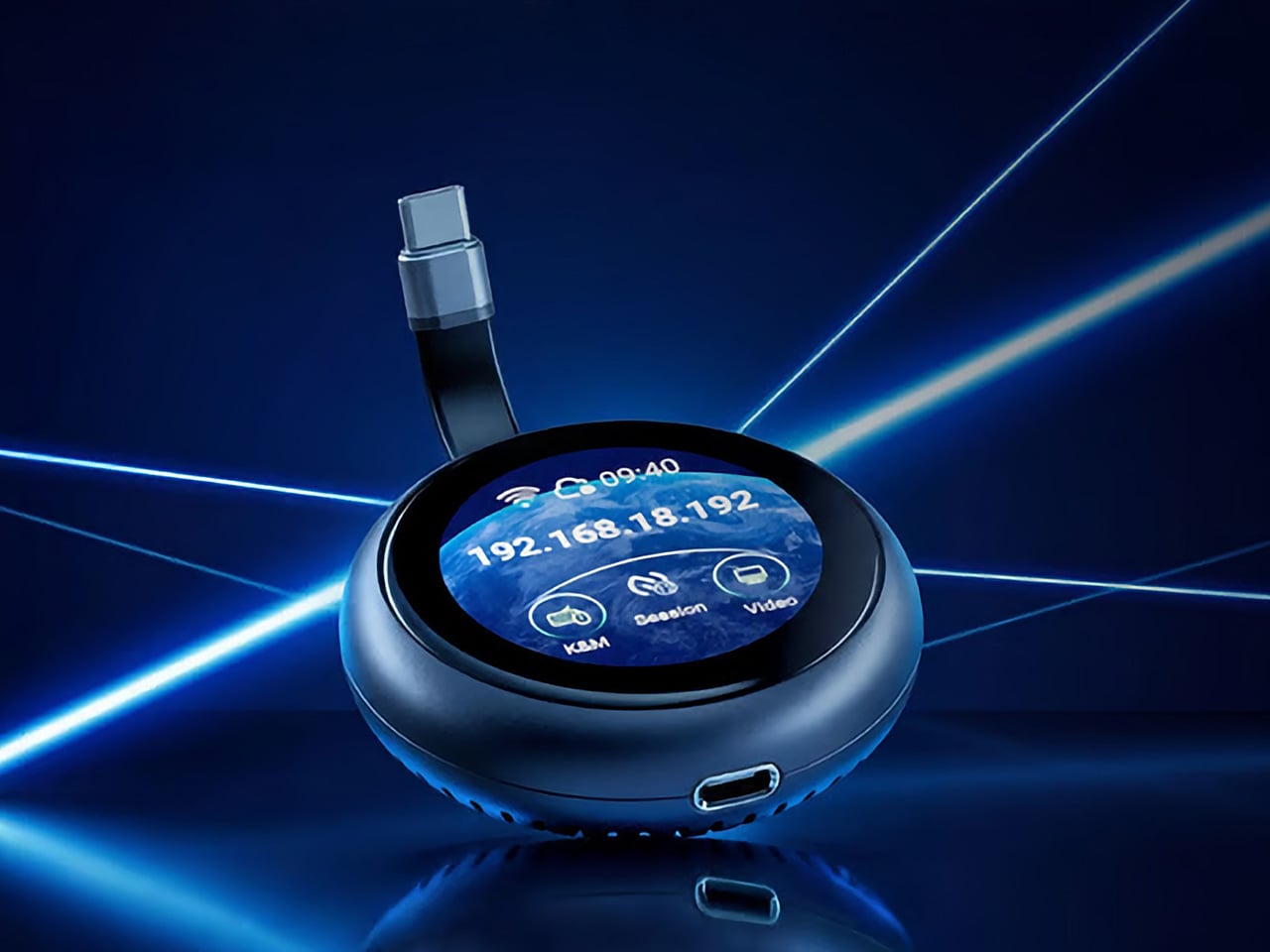
GL.iNet, the Hong Kong-based networking company behind a range of popular OpenWrt routers, has built the Comet Q to tackle all three of those problems at once. Officially designated the GL-RMQ1, it’s described as the world’s first browser-based, pocket-sized remote-control device built specifically for USB-C devices, covering laptops, phones, tablets, and Mac minis. You plug it in, open a browser, and you’re in.

Designer: GL.iNet

Click Here to Buy Now: $89 $129.9 (31% off). Hurry, only 866/2500 left! Raised over $1 million.

What sets the Comet Q apart is that it operates at the hardware level, not through software installed on the target device. That distinction matters more than it sounds. Traditional remote desktop software relies on the operating system and an active network connection, failing the moment a device sleeps, locks, or loses Wi-Fi. The Comet Q keeps working through all of that, as long as the device stays powered on and hasn’t entered a hibernation state that cuts off its HDMI/USB output.

That control comes through a single USB-C cable that simultaneously carries video, data, and power, doing away with the HDMI dongle and USB hub that traditional KVMs require. Video output reaches up to 2K at 60 fps with two-way audio, and a built-in USB-C passthrough port means the device being controlled stays charged throughout the session. It’s a genuinely pocket-sized setup that actually earns that description.

Where the Comet Q breaks new ground is with mobile devices. No KVM was ever built for them, and if something went wrong remotely, there was no clean solution short of being physically present. It connects directly through the USB-C port, working with iPhones from the iPhone 15 onward (excluding the iPhone 16e and later budget models), iPads, and a wide range of Android phones and tablets, provided the port supports DisplayPort Alt Mode.

All of that also means the OS combination no longer matters. Users can control an iPhone from a Windows PC, a MacBook from an Android tablet, or an iPad from a Linux machine. Developers can manage test devices without being at their desks, IT teams can monitor a fleet of phones from one interface, and content creators can run a dedicated recording device from anywhere in the same room.

There’s a surprisingly personal side to this. If you’ve ever tried walking a parent through a tech problem over the phone, knowing you could take over their screen remotely would have saved everyone a lot of stress. The Comet Q makes that possible, and since Wi-Fi credentials can be preset before shipping the device, the person receiving it doesn’t need to set it up.

Accessing the Comet Q doesn’t require any downloads. From a laptop or desktop, any browser pointed to glkvm.com is enough to take full control, with no account creation needed. When controlling from a phone or tablet, the GLKVM app, available on Windows, macOS, App Store, and Google Play, handles touch gestures more precisely. A 1.8-inch circular touchscreen on the device also makes initial setup possible without opening a laptop.

Security runs through every layer of the design. Each session ends the moment the Comet Q is physically disconnected, leaving no residual access or background processes behind. Built-in support for Tailscale, ZeroTier, and WireGuard VPN keeps remote connections encrypted and firewall-friendly, while two-factor authentication adds yet another layer on top. Remote access that works through hardware rather than software has been a long time coming for phones and tablets.

Click Here to Buy Now: $89 $129.9 (31% off). Hurry, only 866/2500 left! Raised over $1 million.

The post This USB-C Dongle Just Let You Control an iPhone From Windows first appeared on Yanko Design.

Apple Overhauls Chip Roadmap, Ditches M6 Pro and Max for M7 Generation

26 juin 2026 à 13:25

Apple may skip the high-end M6 chips and shift premium Macs to AI-focused M7 processors, making the upgrade decision tougher for power users.

The post Apple Overhauls Chip Roadmap, Ditches M6 Pro and Max for M7 Generation appeared first on TechRepublic.

Apple Raises Prices on Macs, iPads as Data Centers Drive Memory Shortage

26 juin 2026 à 11:02

Apple raised prices on Macs, iPads, and other devices as AI data center demand drives up memory chip costs across consumer electronics.

The post Apple Raises Prices on Macs, iPads as Data Centers Drive Memory Shortage appeared first on TechRepublic.

Chinese AI Models Challenge OpenAI and Anthropic on Cost and Enterprise Risk

26 juin 2026 à 10:26

Chinese AI models are undercutting OpenAI and Anthropic on price, but enterprise adoption depends on security, compliance, and data-governance trade-offs.

The post Chinese AI Models Challenge OpenAI and Anthropic on Cost and Enterprise Risk appeared first on TechRepublic.

Samsung Reportedly Starts OLED Panel Production for Apple’s First Foldable iPhone

25 juin 2026 à 13:13

Apple reportedly cleared Samsung Display to make OLED panels for its first foldable iPhone, with hinge issues still shaping launch timing.

The post Samsung Reportedly Starts OLED Panel Production for Apple’s First Foldable iPhone appeared first on TechRepublic.

Interpol: Cybercrime Hits 30% of Recorded Crime in Surveyed APAC Countries

25 juin 2026 à 11:13

Interpol’s latest Asia and South Pacific cybercrime assessment shows how phishing, ransomware, DDoS attacks, infostealers, and AI-enabled scams are raising security risks across APAC.

The post Interpol: Cybercrime Hits 30% of Recorded Crime in Surveyed APAC Countries appeared first on TechRepublic.

  • ✇Korben
  • Dropbox se branche à Claude Code et lui permet de lire vos fichiers
    Dropbox vient de sortir un plugin pour Claude Code , et leur idée c'est de pouvoir brancher vos fichiers Dropbox directement dans vos sessions de dev Claude Code / Cowork. Alors je me suis demandé à quoi ça pouvait bien servir et voici ce que j'ai compris. Une fois que le plugin est en place, ça permet à Claude Code d'aller piocher dans votre Dropbox vos docs techniques, vos cahiers des charges, votre code...etc pour s'en faire du contexte. Tout devient de la matière fraiche pour corriger ou gén
     

Dropbox se branche à Claude Code et lui permet de lire vos fichiers

26 juin 2026 à 12:22

Dropbox vient de sortir un plugin pour Claude Code , et leur idée c'est de pouvoir brancher vos fichiers Dropbox directement dans vos sessions de dev Claude Code / Cowork.

Alors je me suis demandé à quoi ça pouvait bien servir et voici ce que j'ai compris. Une fois que le plugin est en place, ça permet à Claude Code d'aller piocher dans votre Dropbox vos docs techniques, vos cahiers des charges, votre code...etc pour s'en faire du contexte. Tout devient de la matière fraiche pour corriger ou générer du code et quand c'est fini, ce qui est produit peut être à son tour stocké sur Dropbox.

Le plugin sait récupérer les fichiers en fonction de leur nom, de mots clés, de leur emplacement et bien sûr en fonction de leurs méta données. Même vos liens partagés il sait comment les gérer. Bref, il fait tout simplement le passe-plats entre tout le bordel que vous stockez sur Dropbox et Claude Code.

Cela dit, gardez la tête froide parce que tout ce que l'IA lit part sur les serveurs d'Anthropic pour être traité. Donc évitez quand même de le lâcher sur le dossier qui contient vos contrats, vos mots de passe ou vos données clients. Lui autoriser juste un dossier dédié avec ce que vous acceptez de partager, ce sera plus sain.

Pour l'installer, ça se passe dans Claude Code sur le web. Vous filez dans le menu Personnaliser, Connecteurs puis vous cherchez Dropbox en parcourant les plugins et vous cliquez sur ajouter. Une auth OAuth plus tard (vos identifiants Dropbox habituels), c'est branché. Un petit /reload-plugins et le plugin s'active alors dans la session en cours.

En plus de ce plugin, Dropbox propose également un serveur MCP classique en ligne de commande qui est un peu plus souple et surtout peut se brancher dans Cursor, Claude Desktop ou Devin.

Un bémol quand même, c'est pas open bar... sniiif. Eh oui, Dropbox plafonne tout ça à 5 Mo par fichier lu ou créé via l'intégration, et le contenu pondu par Claude ne se sauvegarde qu'en texte (.txt, .md, .html, .py), et pas en image ni en PDF. Quant aux limites de débit de l'API, on ne les connaît pas.

Bref, pour les gros fichiers ou les binaires, faudra donc passer par autre chose.

Si vous vivez dans Claude Code et que votre vie est rangée dans Dropbox, ça vaut peut-être le coup de jeter un œil ici.

  • ✇Korben
  • OS9Map - OpenStreetMap sur votre Mac de 1999
    Un dev prénommé Yllan vient de sortir OS9Map , une application qui affiche OpenStreetMap directement sur Mac OS 9. Oui, je parle bien du système d'exploitation de 1999 qui ronronnait sur nos vieux PowerPC. Pour l'installer, c'est un bon vieux fichier .sit à décompresser (StuffIt Expander sur la machine d'époque, The Unarchiver si vous passez par un Mac moderne), et il vous faudra un PowerPC sous OS 9 avec 16 Mo de RAM (32 recommandés) et une connexion qui passe par Open Transport. Une fois lancé
     

OS9Map - OpenStreetMap sur votre Mac de 1999

26 juin 2026 à 02:14

Un dev prénommé Yllan vient de sortir OS9Map , une application qui affiche OpenStreetMap directement sur Mac OS 9. Oui, je parle bien du système d'exploitation de 1999 qui ronronnait sur nos vieux PowerPC.

Pour l'installer, c'est un bon vieux fichier .sit à décompresser (StuffIt Expander sur la machine d'époque, The Unarchiver si vous passez par un Mac moderne), et il vous faudra un PowerPC sous OS 9 avec 16 Mo de RAM (32 recommandés) et une connexion qui passe par Open Transport. Une fois lancé, vous avez alors une recherche d'adresses qui tape dans Nominatim, le moteur de géocodage d'OpenStreetMap, et vous pouvez mettre vos endroits favoris en signets pour y revenir d'un clic depuis le menu. Bref, un vrai petit client carto !

Et c'est là que je trouve ça beau puisque 16 Mo de RAM pour afficher une carte mondiale interactive, c'est très peu. Pour vous situer, un seul onglet Chrome aujourd'hui c'est plusieurs centaines de Mo, donc faut saluer l'exploit d'Yllan.

Maintenant si l'idée d'une carte minimaliste vous parle, dans le genre bien dépouillé j'avais aussi joué avec MapSCII qui balance le monde entier en ASCII dans un terminal. OS9Map joue dans une autre cour, mais on retrouve un peu la même philosophie.

Le truc qui rend tout ça possible, c'est évidemment OpenStreetMap qui propose toutes ses données en accès libre ! Alors rien que pour ça, merci à OpenStreetMap et ses contributeurs.

Et puis si vous n'avez plus de PowerPC qui traîne au grenier, vous pouvez quand même goûter à OS 9 dans votre navigateur via Infinite Mac .

OS9Map est en version 1.0.0 et se télécharge gratuitement sur le site de yllan .

Anthropic Upgrades Claude Design With Real Editing, Design System Imports, and Claude Code Sync

Par : Nisha
18 juin 2026 à 02:04
Anthropic is taking its design-focused AI tooling to the next level. The latest update to Claude Design introduces capabilities that many designers and developers have been requesting since the feature launched earlier this year: support for importing real design systems, a hands-on visual editor, and two-way synchronization with Claude Code. The update is currently rolling […]

Apple to Work With Intel on US Chip Production, Trump Says

19 juin 2026 à 14:58

Trump says Apple will work with Intel on US chip production, a potential foundry win that could shift Apple’s supply chain options and US chip strategy.

The post Apple to Work With Intel on US Chip Production, Trump Says appeared first on TechRepublic.

As the World Claims Tech Sovereignty, Where Does Australia Stand?

19 juin 2026 à 04:10

Australian enterprises remain dependent on foreign technology infrastructure, while major economies treat that dependency as a strategic liability.

The post As the World Claims Tech Sovereignty, Where Does Australia Stand? appeared first on TechRepublic.

Anthropic Adds Brand Controls, Code Sync to Claude Design

18 juin 2026 à 10:25

Anthropic updated Claude Design with design system imports, Claude Code syncing, canvas editing, and more export options for enterprise teams.

The post Anthropic Adds Brand Controls, Code Sync to Claude Design appeared first on TechRepublic.

G7 Critical Minerals Push Targets AI and Chip Supply Chain Risk

18 juin 2026 à 09:38

The G7’s critical minerals push is putting AI hardware, chip supply chains, data centers, and APAC manufacturing under sharper scrutiny as governments look for ways to finance alternatives to China-linked supply chains.

The post G7 Critical Minerals Push Targets AI and Chip Supply Chain Risk appeared first on TechRepublic.

❌