❌

Vue normale

Reçu — 3 novembre 2026 ⏭ Windows Central - News, Forums, Reviews, Help for Windows 10 and all things Microsoft.

Former Xbox COO Helen Chiang denies violating policies in parting LinkedIn post

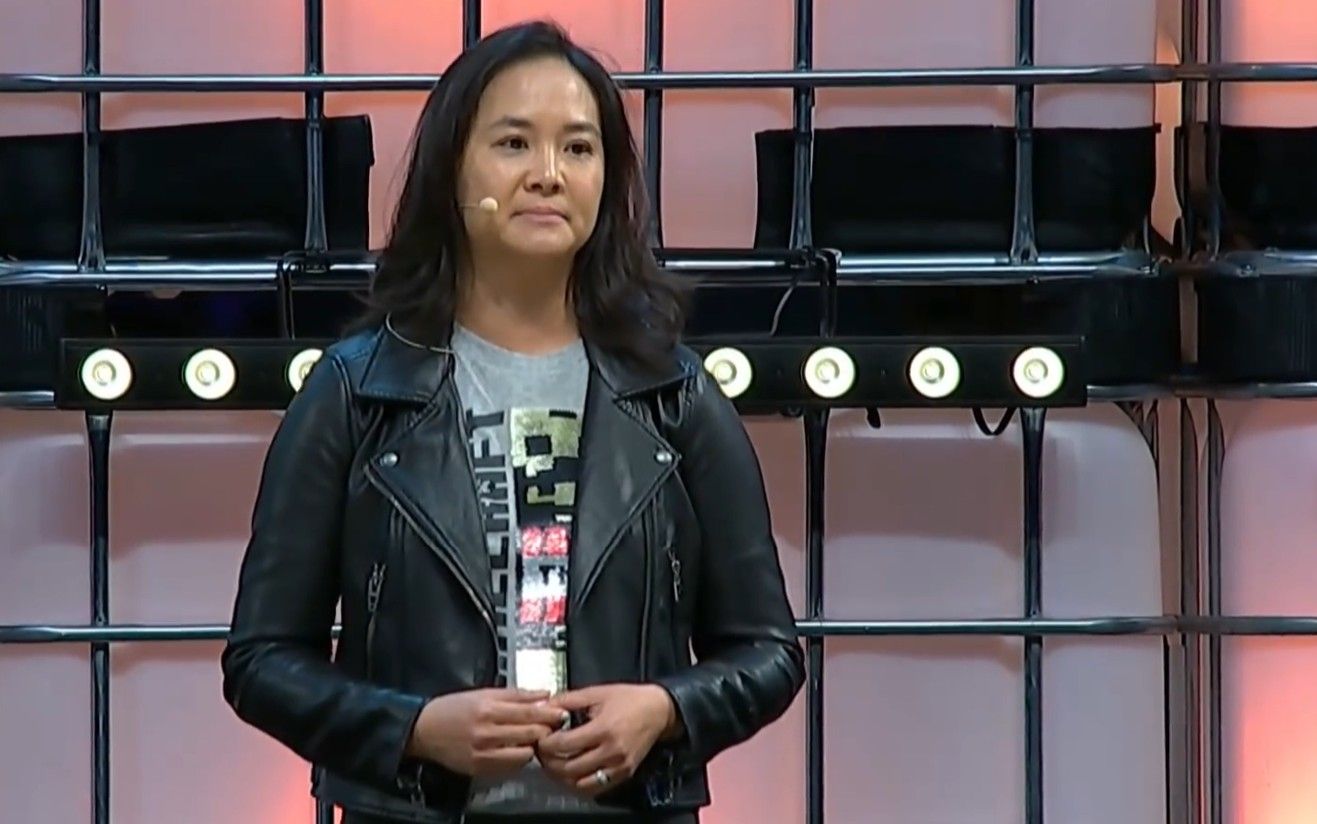
Microsoft's COO Helen Chiang was fired from Xbox a few weeks ago, after 27 years of top-level leadership spent across the org, most prolifically at Minecraft.

The removal was abrupt and somewhat confusing on the face of it. Chiang was widely respected across the Microsoft stack and is a trusted figure, described to me as "by the book" by our own sources. When it emerged that she had been fired for "policy violations," it added an unexpected twist that left us with more questions than answers, ultimately.

Now, Helen Chiang has responded to the incident on LinkedIn, titled "Clarity is Kindness," which is a comment Xbox CEO Asha Sharma made to the WSJ while discussing the health of Microsoft's gaming business recently.

There has been some speculation about my abrupt departure from Microsoft, including claims that I was “fired for a policy violation”. That’s not accurate," Chiang writes, "silence should not be mistaken for agreement. What has been said about my departure, and what has been left unsaid, has created a picture of me that I hardly recognize. It’s important to me to set the record straight."

In the full post shared below, Chiang denies that she leaked information, sought employment at Microsoft competitors, engaged in insider trading, bullying, or embezzlement, or that she left because she didn't get the CEO job. She says that she always hoped to stay at Microsoft and "keep building," and this departure wasn't what she envisioned.

"I share this because I don’t want my departure reduced to an inaccurate story about incompetence, ambition for the next big job, or a Nelson-level scandal."

As to not paraphrase, I've included the full text from the post below.

"Clarity is Kindness

There has been some speculation about my abrupt departure from Microsoft, including claims that I was “fired for a policy violation”. That’s not accurate and while I won’t turn this into a play-by-play, silence should not be mistaken for agreement. What has been said about my departure, and what has been left unsaid, has created a picture of me that I hardly recognize. It’s important to me to set the record straight.

First, I did not leak confidential company information to the press. I have never communicated with any journalist outside the limited, company-authorized interviews I’ve done as part of my job. That includes every journalist who reached out this week seeking my side of the story.

Second, I did not leave XBOX to join a competitor. You don’t spend two decades somewhere without developing a deep loyalty to the people, teams, and businesses you’ve helped build. XBOX was never just another stop in my career. My end game was always to keep building here.

Third, I did not engage in discrimination, bullying, harassment, insider trading, embezzlement, or other fraudulent activity. I stand by my record: both the results I delivered and the way I have treated people throughout my career. I won’t let speculation define my character or erase that record.

Lastly, I did not leave because I was passed over for a bigger role. Since having children, I’ve been intentional about how I define ambition and success. I haven’t actively sought out bigger roles or increased responsibilities, and the last time I interviewed for a job was in 2011. My reputation and results paved the way for the opportunities that followed. I went where the company believed I was needed and where I could have the greatest impact. I did not ask for my most recent role, either. I was promoted into it in July.

I believe in fairness, accountability, and holding ourselves to the standards we expect of others. Those standards only mean something when they’re applied consistently. I have serious concerns about how they were applied in my case, and I believe those concerns deserve to be taken seriously.

I share this because I don’t want my departure reduced to an inaccurate story about incompetence, ambition for the next big job, or a Nelson-level scandal. My story is about staying true to your core values, especially when it is hard. That’s the legacy I hope to leave behind.

To everyone who has reached out with hugs, love, and support: thank you. So many of you have reminded me of the wonderful times we’ve shared over the past 20 years and the impact we’ve had on one another. Some of you I haven’t been in touch with for several years, yet you still took the time to check on me. Others are people I’ve never even met, but you reached out anyway. That speaks volumes about the care and humanity in our industry and the connections that transcend where we work.

This is not how I ever imagined my story here would end. And it is not the whole story." — Helen Chiang, former Xbox COO.

Helen Chiang's somewhat unceremonious departure comes amidst widespread upheaval at Xbox as Microsoft restructures its gaming org, which has led to thousands of layoffs, divestitures, and studio closures. Microsoft managed to return some studios to independent ownership and has sold others to publishers, as it tries to rein in spending in general.

The Coalition has been put on the hook for $500 million per Microsoft's finance auditors, who only see the dollars and not the complexity of game development, the impact the pandemic had on the development of games between Gears 5 and E-Day, and other mitigating factors.

Xbox CEO Asha Sharma has returned the brand's focus to its core customers in recent months, with a return of exclusive games, boosting investment in the existing console infrastructure, and improving things on the back end for game developers.

I suspect there'll be more disruption before things calm down ... as the industry in general reels from an overabundance of content, reduced consumer spending, and the AI-fostered RAMpocalypse.

Click to join us on r/WindowsCentral

Join us on Reddit at r/WindowsCentral to share your insights and discuss our latest news, reviews, and more.

Gears of War: E-Day's "$500m budget" story oversimplifies the situation

From around July, rumors began to swirl that Gears of War: E-Day had cost upwards of half a billion dollars, raising questions about the state of AAA game development.

I can confirm at my end that Microsoft's financial auditors have attributed upwards of $500 million to The Coalition between Gears of War 5 and Gears of War: E-Day. But through multiple sources, I have a clearer picture of how that money has been spread and allocated over the past 6-7 years, and why there are even some internal disagreements over how exactly attribution should be distributed.

The Coalition has cost Microsoft "$500 million~" but is that the full story?

A stern, armored soldier grips a large futuristic rifle amid a devastated urban ruin, under a cloudy sky; the scene feels gritty and tense.

Gears of War has been under a microscope first. (Image credit: Xbox Game Studios)

The reports of Gears of War: E-Day costing upwards of half a billion emerged first via Tom Henderson of Insider Gaming, and were later corroborated by Kotaku's Ethan Gach, with an extra $100 million on top.

I pushed back against the claims on my own show with preliminary information I'd received over the summer that The Coalition's budgeting situation is more complex than simply "Gears of War: E-Day cost half a billion dollars."

Multiple sources familiar with, but unauthorized to speak with us on, Microsoft's plans helped us flesh out a picture of why The Coalition has been hit with a $500 million price tag, and why, ultimately, debates over "how" the money has been allocated are ultimately academic.

Indeed, I am told by a variety of trusted sources that The Coalition has been contributing to a variety of other Xbox flagship titles that use Unreal Engine, including games like Avowed and State of Decay. Former senior Xbox staffer Derek Reese elaborated further recently on BlueSky, noting that The Coalition is "on the hook" for Microsoft's bespoke tools and pipelines for Unreal Engine.

So much of that cost is The Coalition being on the hook for the Microsoft branch of Unreal and one of the flagship titles.I should know, I tried to get leadership to support a plan to have other studios adopt it and write off the support costs.Same problem with Turn10 and ForzaTech.

— @derekree.se (@derekree.se.bsky.social) 2026-11-02T09:20:12.402Z

However, the situation goes a bit further than tooling and collaborative work on first-party Xbox games.

The Coalition also spent a great deal of time working with Epic Games on the "Matrix Awakens" Unreal Engine demonstration, as well as the Alpha Point demo, both of which were intended to showcase the potential of UE5 on next-gen consoles and PCs. The tools and techniques developed for these demonstrations were later deployed across a range of other first and third-party products Windows Central understands, during the period between 2020 and 2021.

Rod Fergusson formally left The Coalition in early 2020, and during the transition, it put the studio into a bit of a dormant state for a period, while Microsoft figured out how best to move the studio forward. The pandemic was also in full swing, creating chaos for game development pipelines that were designed for office work rather than remote work.

During this time, The Coalition worked for over a year and a half on a prototype project for Xbox that Windows Central understands was ultimately canceled. The Coalition also worked on Avowed, Hellblade 2, Clockwork Revolution, State of Decay 3, Grounded and Grounded 2, and has even contributed to the upcoming StarCraft reboot. Eventually Mike Crump was solidified as the new studio head, and E-Day development began in earnest.

Gears of War: E-Day hasn't been a huge success story against what Microsoft auditors and spreadsheets deem to be The Coalition's budget today. It runs afoul of a common theme surrounding Xbox in the post-pandemic period with an unclear accounting structure for contributions towards other projects.

I've previously heard from studio heads at Xbox, both past and present, who didn't have clarity over how their team's contributions to Xbox Game Pass fed back into their costing structure and how it affected investment from the Microsoft mothership.

Either way, it's true that game dev in North America has become incredibly costly ... and times are hard for many consumers

Xbox Helix logos

What will Xbox do next? (Image credit: Microsoft | XBOX)

Either way, even if The Coalition didn't spend $500 million specifically on E-Day over the past half-decade — it's a lot of money to invest without a specific structure in place to explain why some of these costs were worthwhile to Microsoft auditors. A common theme in industry discussions revolves around the month-over-month cost of AAA game development in North America, vs. the willingness to spend on the part of core gamers therein. Competition from free-to-play titles, the sheer volume of content, and even non-gaming hobbies are thought to have reduced the opportunity.

Microsoft CEO Satya Nadella previously said Xbox had to become "sustainable" over the summer, while also stating that it will "always" invest in gaming as a company. Nadella lamented that video platforms like YouTube were doing a better job at monetizing Xbox than Microsoft itself. He's not exactly wrong, but I'd argue that's on Microsoft's lack of innovation at the top level, and tendency to cut and run rather than work through building up new businesses. The Xbox business is heavily constrained right now due to the component rout that Microsoft itself has had a hand in engineering. It doesn't bode well for the upcoming Xbox Helix, widely expected to be the most expensive retail video game console ever.

Xbox Series S GTA 6 styled

GTA 6 should be a huge moment for Xbox, but Microsoft says it can't get any stock to sell beyond its core U.S., UK markets. (Image credit: Windows Central)

I argued in a piece in the summer that Microsoft's Xbox studios shouldn't be forced to bear the pain of previous decisions or market situations that are no longer viable ... alas, in our economic system it's naïve to expect corporations to behave this way.

RELATED: Xbox gamers shouldn't be on the hook for Gears of War: E-Day's retail success

I can't help but feel like the "$500 million" figure being shared around internally is being used to justify potential cuts, layoffs, or worse, a studio closure targeting The Coalition. Perhaps to "soften the blowback", should Microsoft target the studio. For what it's worth, I've not heard that Xbox is planning to close The Coalition. But Microsoft has already laid off thousands at Xbox, and has signaled plans to continue.

It's hardly a good look if Microsoft's first true, full Xbox exclusive in years results in mass layoffs at one of its core pillar studios. Gears of War has a TV show and a movie on the docket, and Gears of War: E-Day reviewed incredibly well. It's also true that Gears: E-Day is squashed beneath Call of Duty: MW4, GTA 6, WoW: Forever, and a variety of other major games that launched between August and now.

There's only so much $$$ to go around for one thing, and for many, even less free time to hit all these games.

Click to join us on r/WindowsCentral

Join us on Reddit at r/WindowsCentral to share your insights and discuss our latest news, reviews, and more.
OpenAI sociopath Sam Altman says it's "terrible" that your PC, Xbox, etc. have RAM that could be used for his AI

You don't hate OpenAI and Sam Altman enough.

Sam Altman is among a variety of tech bros known for making absurd, often outright evil comments about the state of the world and the future of technology. The spectacularly tone-deaf and generationally ignorant Altman recently appeared on a podcast, Cheeky Pint (via Tom's Hardware) where he made some fresh comments about his hatred of consumer-owned compute.

"From a global allocation perspective, actually, it's quite terrible to have everybody have a bunch of the world's limited supply of DRAM sitting in their own computer and being used 5% of the time," Altman whined without a hint of irony. The supply is, of course, constrained because of Altman and his ilk, pushing generative AI platforms without so much of a whiff of realized benefits, either social or fiscal. Most AI companies are billions, if not trillions in debt, as none have actually delivered a business model that can seemingly make money.

"You want maximum utilization in the cloud if you're trying to deal with this very supply-constrained environment. And somehow many people's intuition is the opposite of that."

I wonder why people's intuition is the "opposite" of what Altman and his billionaire buddies want. What is this utter insanity?

Altman is rightfully getting dragged on social media, but this isn't the first time he's made comments like this.

Dude who caused the DRAM shortage is now scolding people for hoarding memory inside their own laptops instead of giving it all to him.October 29, 2026

lol my lawn mower is only used 1x a week. Should I rent one from OpenAI instead?Also, who caused the DRAM shortage? It wasn't consumers...October 29, 2026

This is literally just “people want to own their own property but they shouldn’t be allowed to do that” lol. I was expecting there to be some other layer to it but there just isn’t.October 29, 2026

Previously, Altman said that he hoped OpenAI would one day be able to effectively rent out compute "on a meter" like a utility, such as water or electricity. "We see a future where intelligence is a utility like electricity or water, and people buy it from us on a meter and use it for whatever they want to use it for."

It feeds a prevailing and genuinely worrying possibility that one day, tech companies like OpenAI, Amazon, Microsoft, Oracle, etc. could essentially monopolize compute, and rent it back to us in the form of subscription or ad-based cloud services. Everything from laptops, to video game consoles have become astronomically expensive in recent years because of fake money being used to inflate RAM prices for the "AI infrastructure build out."

Microsoft lamented the RAM supply issue when it shared its Xbox financials this week — the issue it and its buddies literally caused with this sprint to gen-AI products that have yet to prove themselves even vaguely worthwhile or cost effective.

RELATED: Jeff Bezos hopes you will rent your PC some day

For me, I would argue the issue is less that RAM is going into people's PlayStations, phones, Xboxs, PCs, etc, and more that 95% of the AI cloud inference is being spent on total bullshit like cat memes, next-level generative spam, LinkedIn Thought Leader™️ slop, and engagement-bait grift. Perhaps it's OpenAI that should be more thoughtful about how it allocates its resources (those resources generally being other people's money).

Wasn't this shit supposed to cure cancer and solve cold fusion? Maybe they just need more RAM.

These people are supposed to be smart man ... I can't even anymore.

Click to join us on r/WindowsCentral

Join us on Reddit at r/WindowsCentral to share your insights and discuss our latest news, reviews, and more.

A year later: Xbox Ally X re-review — Is it worth $1,000 a year in?

It has been a year since the Xbox Ally X launched, so I figured it was about time we did a re-review.

We have FSR 4.1 on the Xbox Ally X now, a big Xbox app revamp is around the corner, and I'm probably one of the few content creators who actually uses this device on an almost daily basis. So, I really want to answer that burning question for Xbox ecosystem users: is it actually still worth a thousand big ones, even now, one year later?

How has the battery life stacked up? Is Windows 11 actually functional for handheld PC gaming yet? Does FSR 4.1 make for a killer feature?

Let's discuss.

FSR 4.1 is, indeed, a killer feature for the Xbox Ally X

Xbox Ally X shots

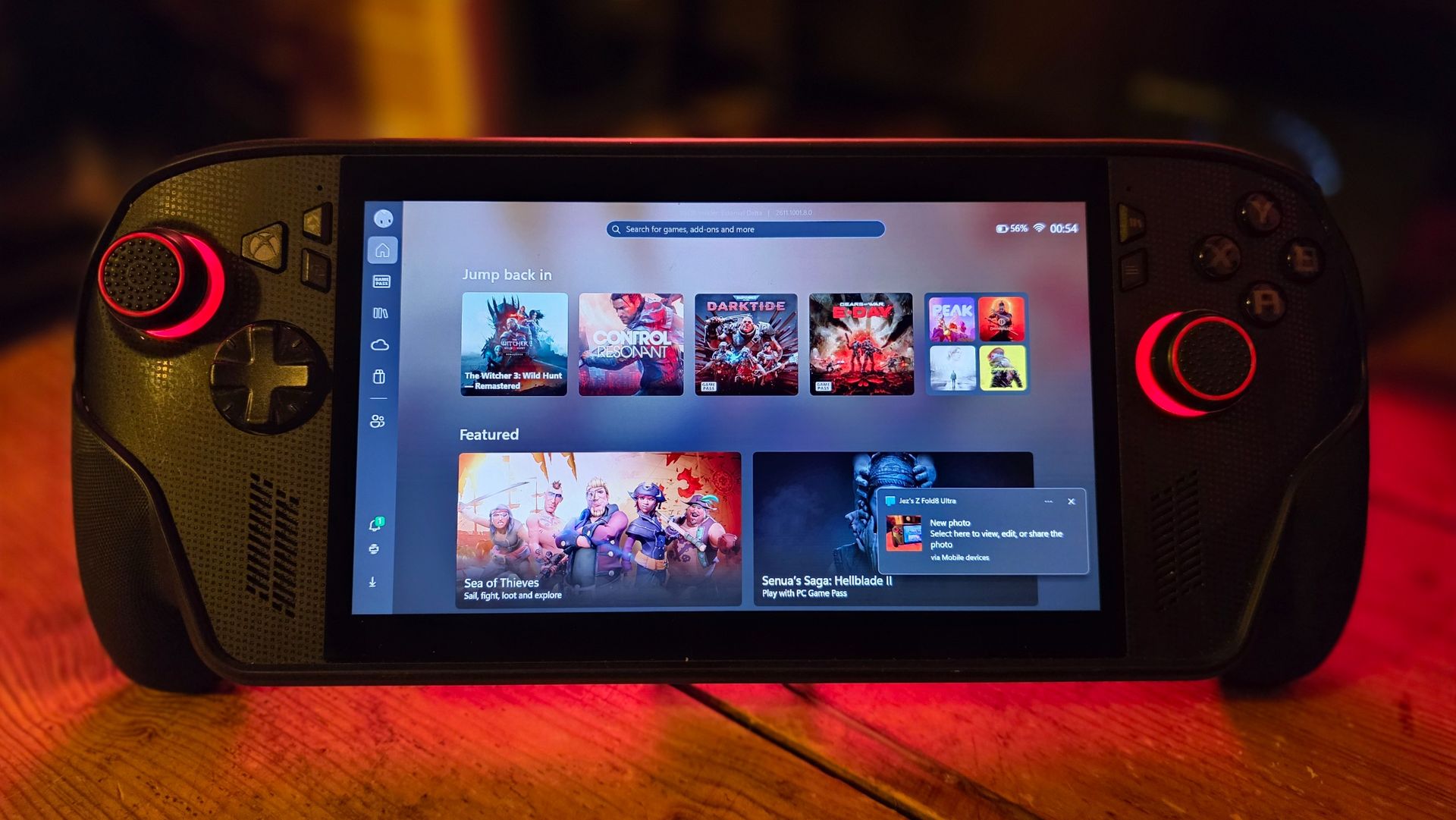
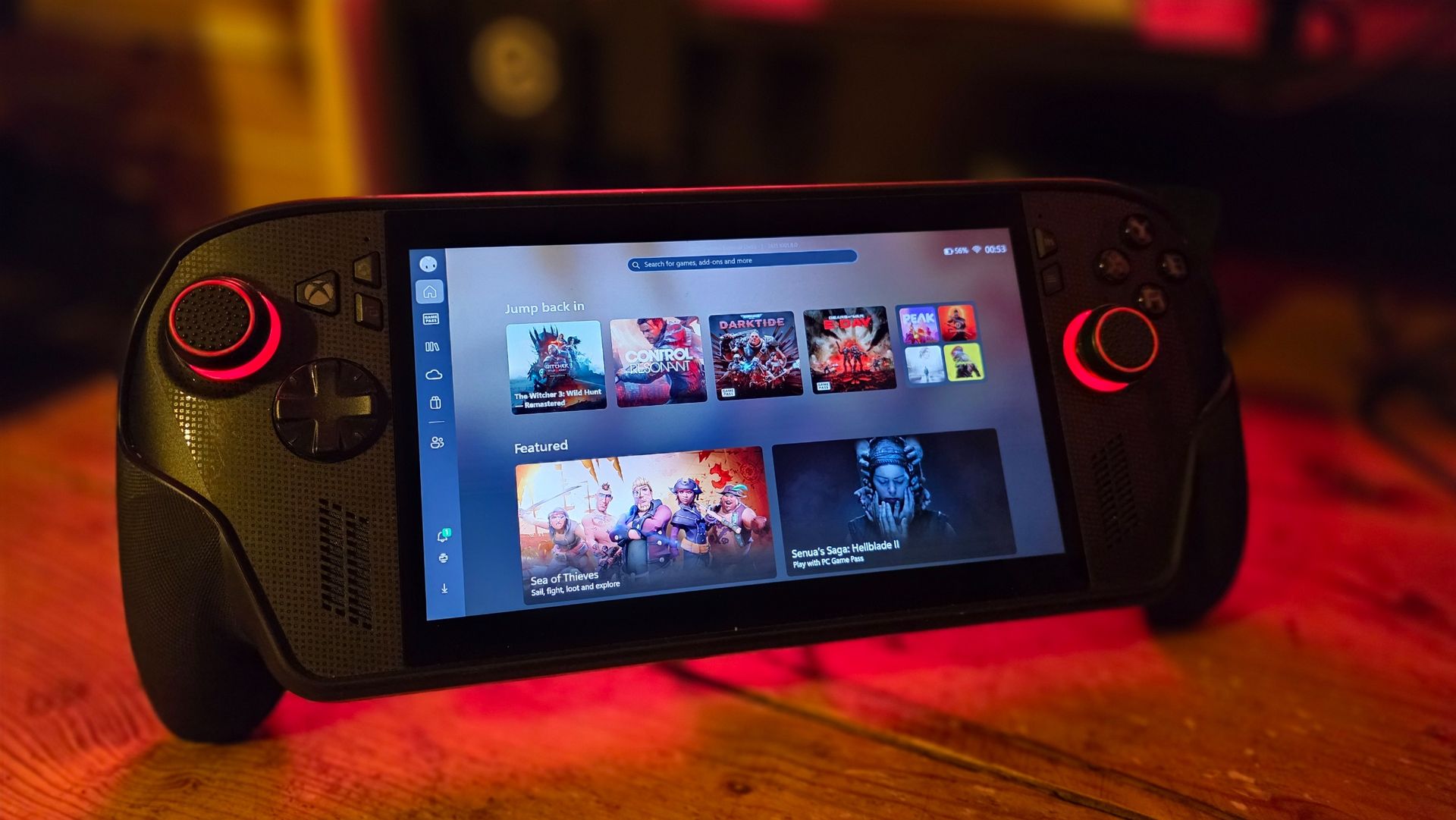
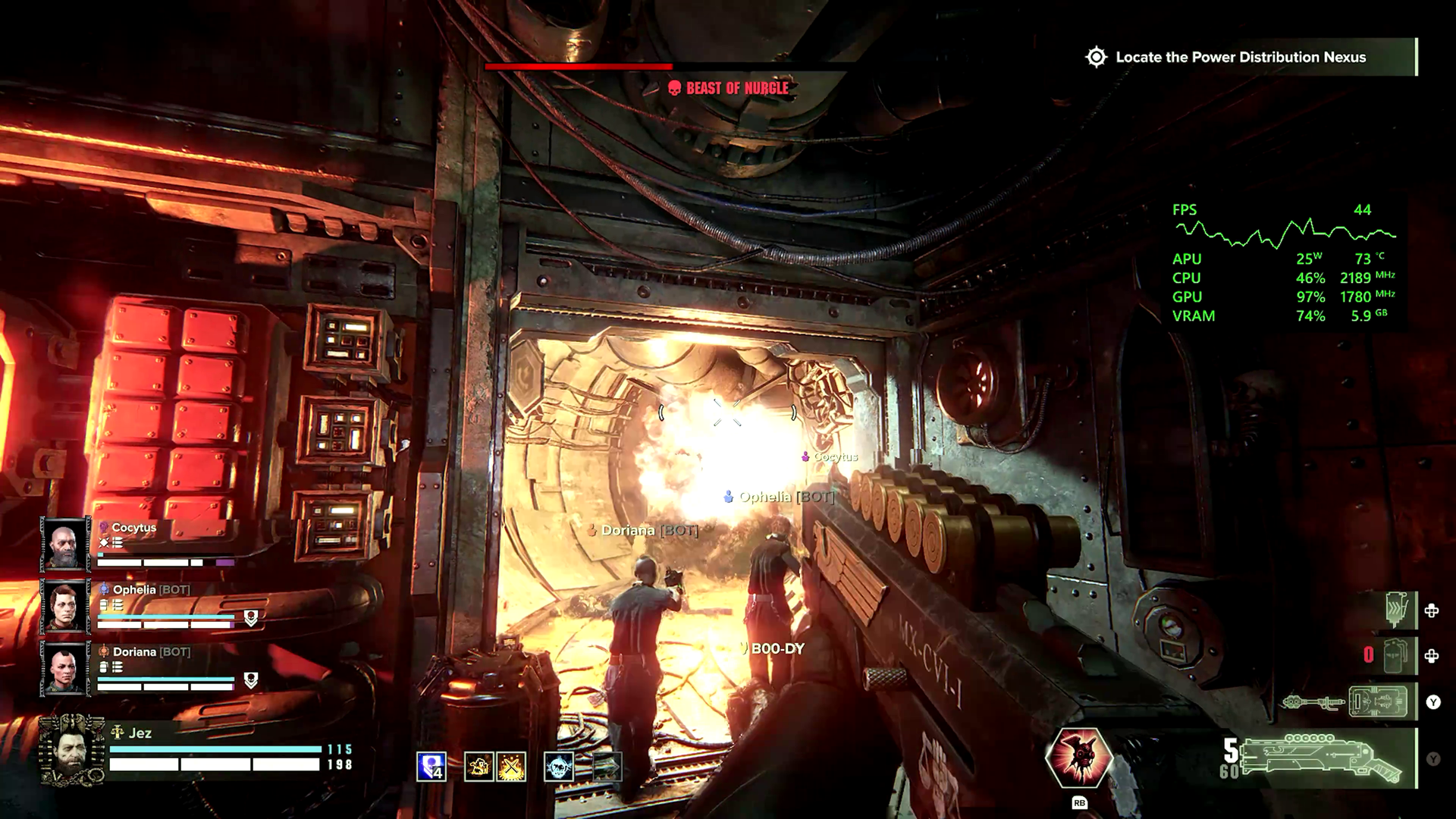
Games like Warhammer 40K Darktide and Control Resonant benefit from huge image quality boosts from FSR 4.1. (Image credit: Windows Central | Jez Corden)

The Xbox Ally X launched around this time last year (depending on your market) in partnership between Microsoft and ASUS. I'll do a write-up and a video on its less powerful Xbox Ally Z2A cousin in the future too. But we're looking at the $1,000 Xbox Ally X today. It was the first device to sport the Z2 Extreme chipset from AMD, making it the most powerful handheld at the time. AMD's new FSR 4.1 tech has given it a further boost on top of that as well.

FSR 4.1 is a heavier upscaling model than FSR 3, but it's all about boosting image quality, giving you more flexibility over how you play. You can now run quality modes that would previously look too ugly and blurry to bear, and still maintain a good level of performance. This extends to very graphically intensive games like Control Resonant, Cyberpunk 2077, Gears of War: E-Day, and games like Warhammer 40K Darktide, which have lots of enemies on-screen at any one time. FSR 4.1 will be adopted natively by more games over time, potentially extending the lifespan of the device even further. AMD has a list of games that already support it over here.

Xbox Ally X shots

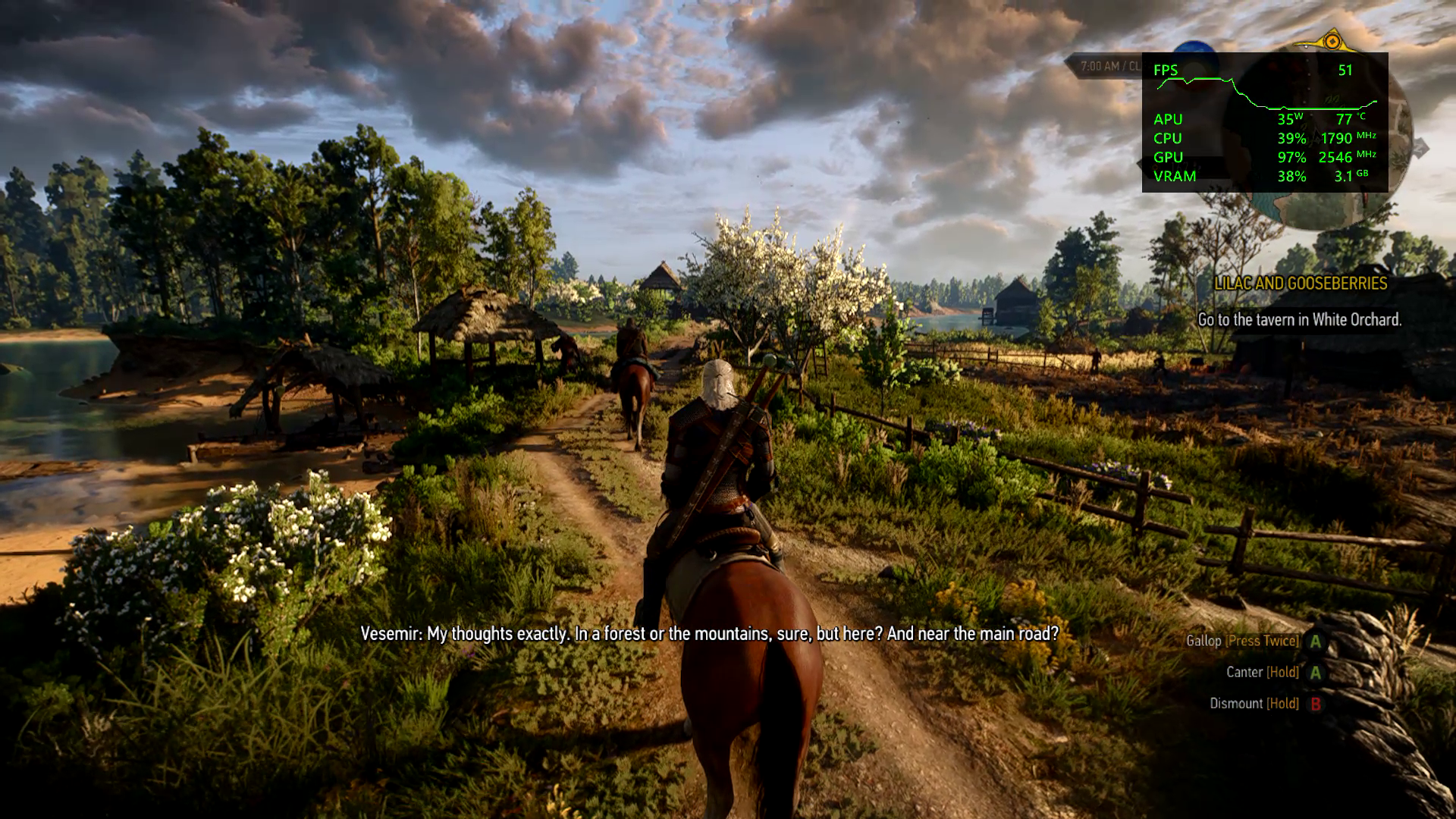
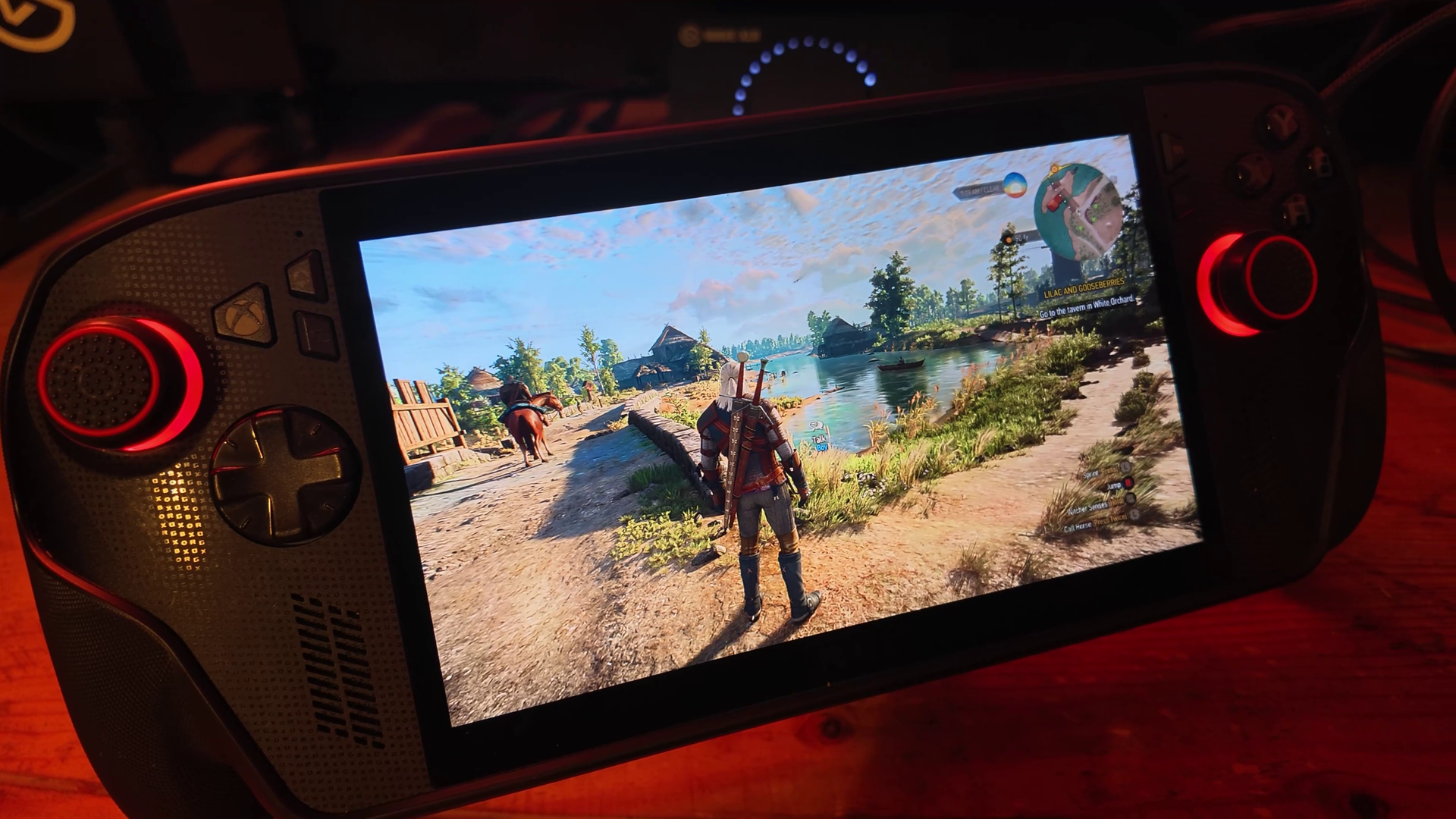
Annoyingly our website system compressed the pictures here, but in the video above you can get a good look at how crisp and smooth Witcher 3 looks on devices like this now. (Image credit: Windows Central | Jez Corden)

Using Performance and Turbo modes for maximum power, you're easily getting anywhere between 40 and 60 FPS at 1080p for most games out of the box. Heavier games will benefit more from FSR 4.1 being set to performance mode, which appears as crisp as quality mode did on FSR 3 models. I find FSR Frame Generation is also a good way to loop in more frames at the cost of some latency, although in most games I tried it was barely perceptible.

Heavily-optimized games like Death Stranding and the new Witcher 3 enhanced edition look absolutely stunning on this device, both in high and low power modes. Games with FSR 3 automatically benefit from FSR 4.1, which are presently in beta testing on the Xbox Ally X here. Witcher 3 absolutely sings on this device, although games with heavy reliance on ray tracing, like Silent Hill 2, still struggle a bit.

Either way, FSR 4.1 is going to vastly improve the lifespan of compatible devices like this, and it'll be interesting to see how it boosts the base Xbox Ally Z2A model (and Xbox Series X|S platform) in the future.

The hardware holds up, but Windows 11 still needs work

Xbox Ally X shots

Absolutely no issues with the hardware on my end, but I have seen other pronble (Image credit: Windows Central | Jez Corden)

On the topic of lifespan, I'm someone who uses this handheld very regularly, at least every other day before bed. I've been using it mostly to grind Darktide recently, but I will also be using it for WoW: Forever in the coming weeks since it now supports a controller.

The hardware itself has held up incredibly well for me, but it would be neglectful not to mention the quality issues I've seen with the thumbsticks online and on Reddit. I think ASUS could've done a bit more to reinforce the sticks here, but if you go gently on it, I guess, like I do, perhaps you'll be okay. The most wear I have is that the paint on some of the buttons is beginning to wear off, but besides that, my Xbox Ally X seems rock solid.

I find that even a year in, the battery life is still decent on the Xbox Ally X too. I use Battery Care mode religiously to keep the charge topped off at around 80% to protect the lifespan of the cell, but when fully charged at 100% you're easily getting 4-5 hours in 13w silent mode in 2D games, and maybe 2-3 hours in 17w performance mode in a more intensive game, with trade-offs. If you go turbo mode, then yes, the battery will drain out in an hour or so. However, I find that when traveling these days on planes or trains, there's usually an outlet available to give you some extra juice.

There are a lot of games that offer a solid 3D experience even in silent 13w mode, if you're willing to compromise on visual quality and performance to maximize the Ally's longevity.

What is perhaps less solid is the operating system experience. This isn't ASUS' fault, of course, but more on Microsoft and Windows. Xbox and the Windows teams have been collaborating to improve the experience for users on devices like this, but the results have been mixed. The Xbox Ally X is particularly painful to use when hooked up to a TV in a Switch-like "docked" setting. Sometimes the controller loses the focus window, and there's no way to get it back without tapping the screen.

Basic parts of Windows still aren't navigable without a mouse, and the Xbox PC app still leaves a lot to be desired whether docked or not. Luckily, Microsoft is shipping a big update to the Xbox PC app in the coming weeks, and Windows 11 itself is picking up further refinements. It still feels overall like you're a bit of a beta tester for the OS itself, but you do get the full power of Windows as a trade-off, able to turn this device into a work laptop if you so desire (as I've done while traveling myself). You can run any launcher without hassle, like Steam or GOG, and you can connect any accessory that's compatible with Windows, including gamepads, mice, keyboards, and even printers.

The bottom line: I still adore the Xbox Ally X

Xbox Ally X on a desk with Xbox PC app open

My favorite piece of tech (Image credit: Windows Central)

But the bottom line is this: when you're actually in a game, this device absolutely sings. In Turbo mode at 35W, it will provide a solid 1080p 30~ish experience in the heaviest AAA games, even on a medium or even high quality setting, particularly with FSR 4.1 tweaks injected. You can get up to 60 FPS if you're willing to compromise on quality, generally speaking. There are many higher-end games that have been well-optimized for handhelds that deliver a 1080p 60 FPS experience too, such as The Witcher 3 Enhanced Edition.

I've never encountered a scenario where I couldn't get a satisfactory experience from a game, which cannot be said about the Steam Deck and other older or lower-end handhelds.

Given the state of the RAMpocalypse and component market in general, I expect it might be a while before developers push their visuals beyond what is available today. The Xbox Series X|S, PS5, Switch 2, and devices like this are probably going to be the baseline for a longer period than usual. If you were to buy the Xbox Ally X today, I expect you're going to get at least 3 to 4, maybe 5 years of solid use out of it before it might start feeling obsolete.

This is a fantastic device, a perfect companion for any Xbox player with a big Xbox Play Anywhere library. Even if you're dedicated to Steam, you can set Big Picture Mode as your default launcher and skip the Xbox ecosystem entirely if you fancy it.

For gaming evenings in bed, portable co-op with friends, or even as an emergency workhorse, the Xbox Ally X is a fantastic PC companion that I hope will be a staple of my gaming experience for a long time to come. And I would absolutely recommend it — as long as you think you'll get a good amount of use out of it.

Click to join us on r/WindowsCentral

Join us on Reddit at r/WindowsCentral to share your insights and discuss our latest news, reviews, and more.
❌