Vue lecture

People are paying $2,599 for MSI’s latest handheld gaming PC because apparently RAM shortages, AI demand, and fiscal self-preservation are all optional now

When I reviewed the MSI Claw 8 EX AI+ a few months back, I noted how it was a generational jump over AMD’s latest Zen 2 chips found in competing handheld gaming PCs, and when combined with Intel XeSS, it really gave gamers the ultimate handheld we’ve been yearning for.

But there were two problems. One was price. Due to RAM and NAND shortages due to demand for AI compute, MSI had to jack the price by at least $500, putting it at an MSRP of $1,799, which is kind of absurd.

The other was, surprisingly, extremely tight supply. Despite being sold at Best Buy, Amazon, Newegg, and B&H, it sold out everywhere within 24 hours (often due to preorders).

Since its release, that resupply still hasn’t happened. All those retailers are still listing it as out of stock as of me writing this today, and this seems to regularly happen with MSI and its Intel-based handhelds (whether it’s MSI's or Intel’s fault, I’m trying to find out).

So, out of curiosity, I checked eBay to see what that scene was like for the MSI Claw 8 EX AI+, and sure enough, some online stores are selling the hard-to-find handheld, but at an even more exorbitant $2,599 – which is an $800 surcharge over retail!
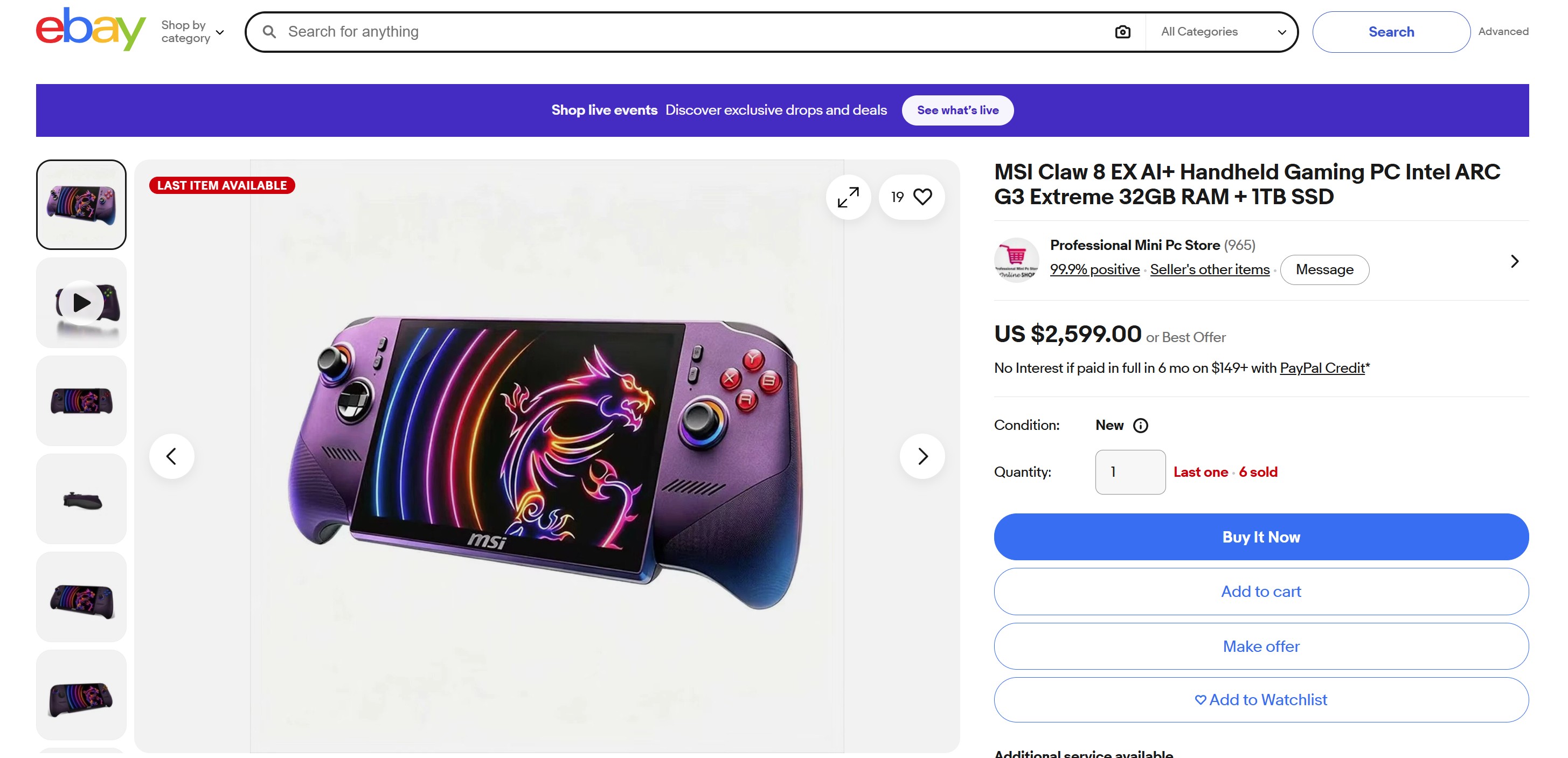
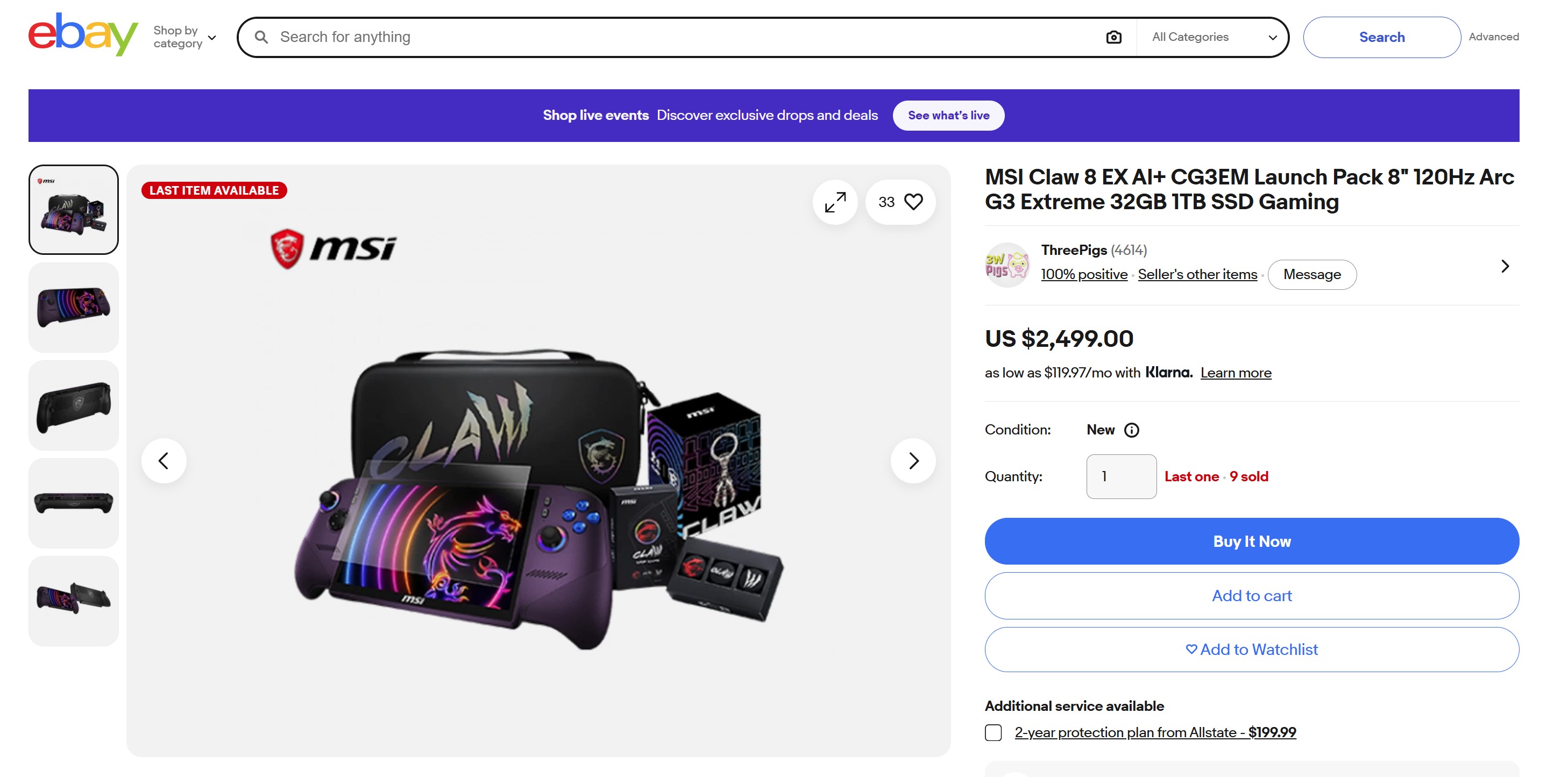
Listings on eBay for auctions of the MSI Claw 8 AI EX+ handheld gaming PC.
ebay | MSI
Listings on eBay for auctions of the MSI Claw 8 AI EX+ handheld gaming PC.
ebay | MSI

You may be thinking, but sure, it’s eBay, and people can list items for any price, but are people buying them? The answer appears to be yes. One retailer, seen in the above screenshot, had seven of them in stock but has already sold six, giving a real FOMO to anyone eyeing that last one.

To be fair, I did find a seller with one in stock for $2,299.99 (after coupon, plus $20 shipping), so you’re “only” paying $500 over MSRP. Another seller had nine available, with one remaining for $2,499.
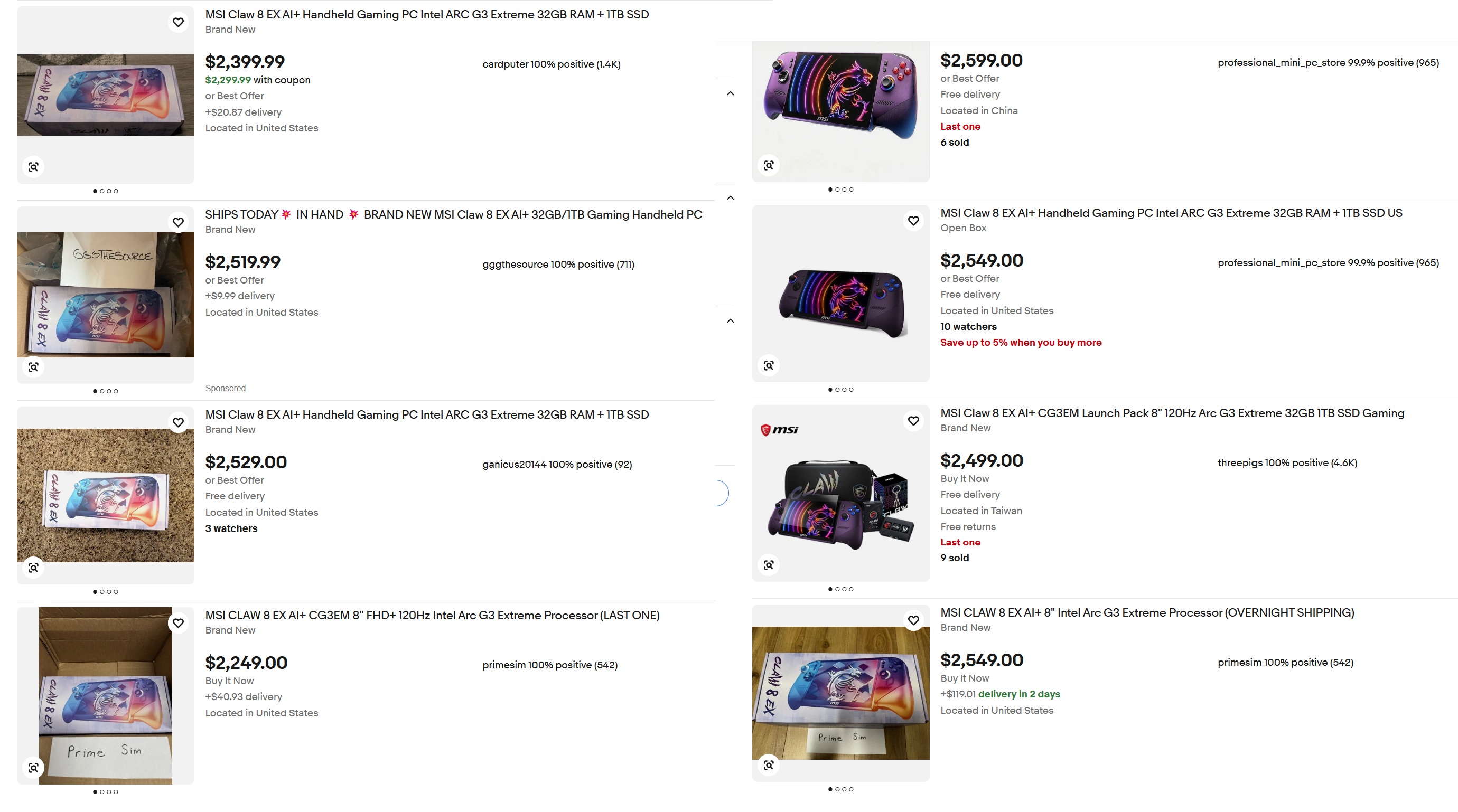
Listings on eBay for auctions of the MSI Claw 8 AI EX+ handheld gaming PC.

Some of the many hard to find MSI Claw 8 AI EX+ handheld gaming PC auctions on eBay. (Image credit: ebay | MSI)

But you get the point. Not only is the MSI Claw 8 EX AI+ insanely expensive at retail, but its shortage is driving up its price by $500 to $800, with people buying it. It’s why I’ve always noted on our podcast that PC gaming is recession-proof. No matter how bad the economy gets, or how high prices go, there is usually someone willing to pay for it.

Not the first time this has happened

Back in December, I noted a similar trend for Lenovo’s excellent Legion Go 2 with its giant 8.8” VRR OLED display and removable controllers. It’s a killer combo of a device, even if it’s better suited for your couch than travel.

For whatever reason, Lenovo can’t keep it in stock, so much so that it eventually removed it from its own website despite excellent reviews and, yes, demand for it, as people were paying $650 over retail just to have one.

Interestingly, ASUS has been the king of “you want it, just buy it,” as the original ROG Ally and the newer ROG Xbox Ally and Ally X are still widely available online and at your local Best Buy. Moreover, ASUS hasn’t even raised the price, keeping them at $599 and $999, respectively.
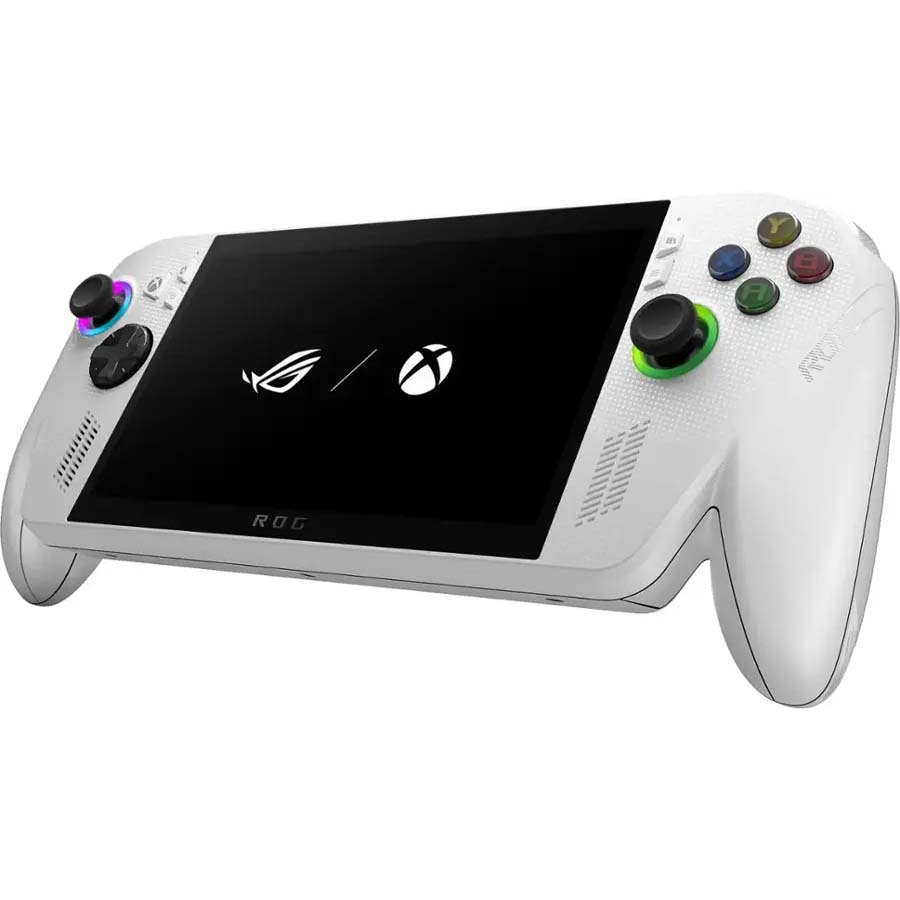
The ROG Xbox Ally features a 7-inch 1080p, 120Hz touchscreen and includes an AMD Ryzen Z2 A processor, 16GB LPDDR5 RAM, 512GB PCIe 4.0 SSD, and a 60Wh battery. It's designed for PC gaming across various services.

👉 Order at: Antonline | Best BuyView Deal
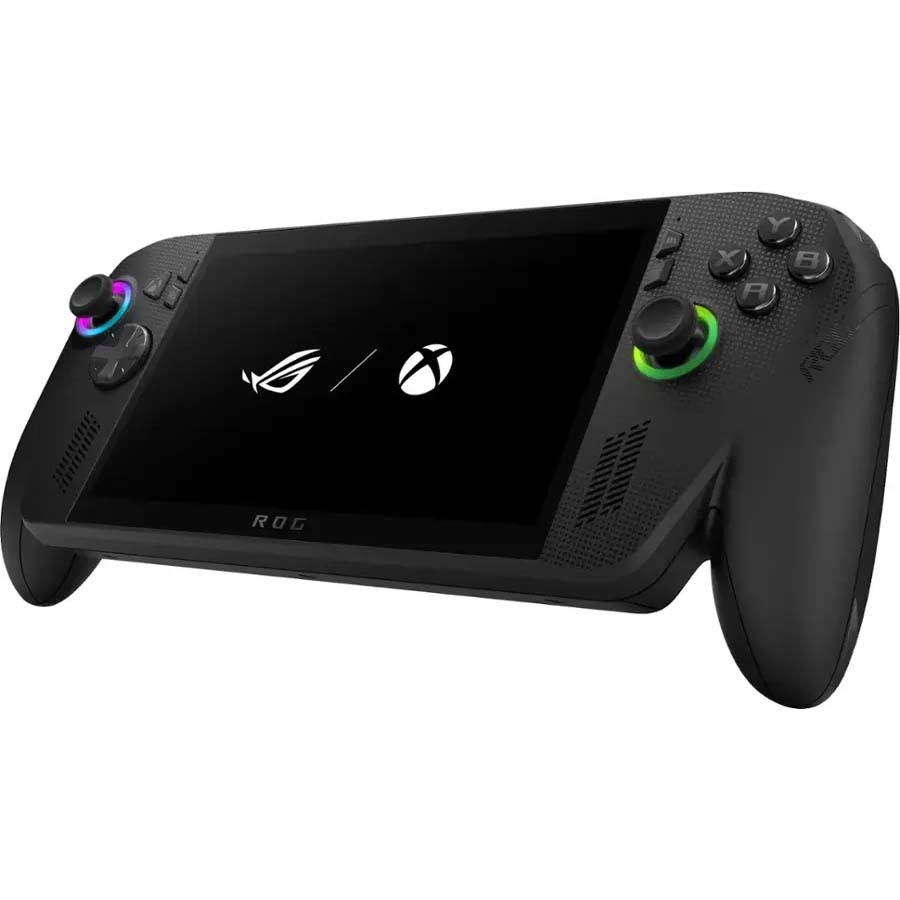
The premium Xbox Ally X has a more powerful AMD Ryzen AI Z2 Extreme processor, 24GB RAM, 1TB SSD. It's a better choice for people who want to play more graphically demanding PC games.

👉 Order at: Best BuyView Deal

I hope ASUS can maintain those stock and price levels, as both devices are really solid choices for those looking into handheld gaming. Sure, the Ally X pales in performance to the new MSI Claw 8 EX AI+, but it’s still a really good experience with an outstanding design (a design that will improve with the forthcoming Xbox Ally X20 anniversary edition that features a larger OLED display and many smaller fixes; I expect to be reviewing that when it releases, so stay tuned).

So where does that leave you in this silicon soap opera? Has the RAM/NAND crunch shoved your handheld plans into “maybe in 2028” territory, or are you already rationalizing a purchase with phrases like “long-term investment” and “I deserve this”?

Let me know in the comments what your breaking point is for handheld pricing — and whether $2,599 is where you draw the line, or merely where your wallet starts quietly begging for mercy.

Click to join us on r/WindowsCentral

Join us on Reddit at r/WindowsCentral to share your insights and discuss our latest news, reviews, and more.

Front shot of the MSI Claw 8 EX AI+ under vibrant pink lighting, displaying the Windows 11 taskbar and a neon dragon wallpaper on its large screen.
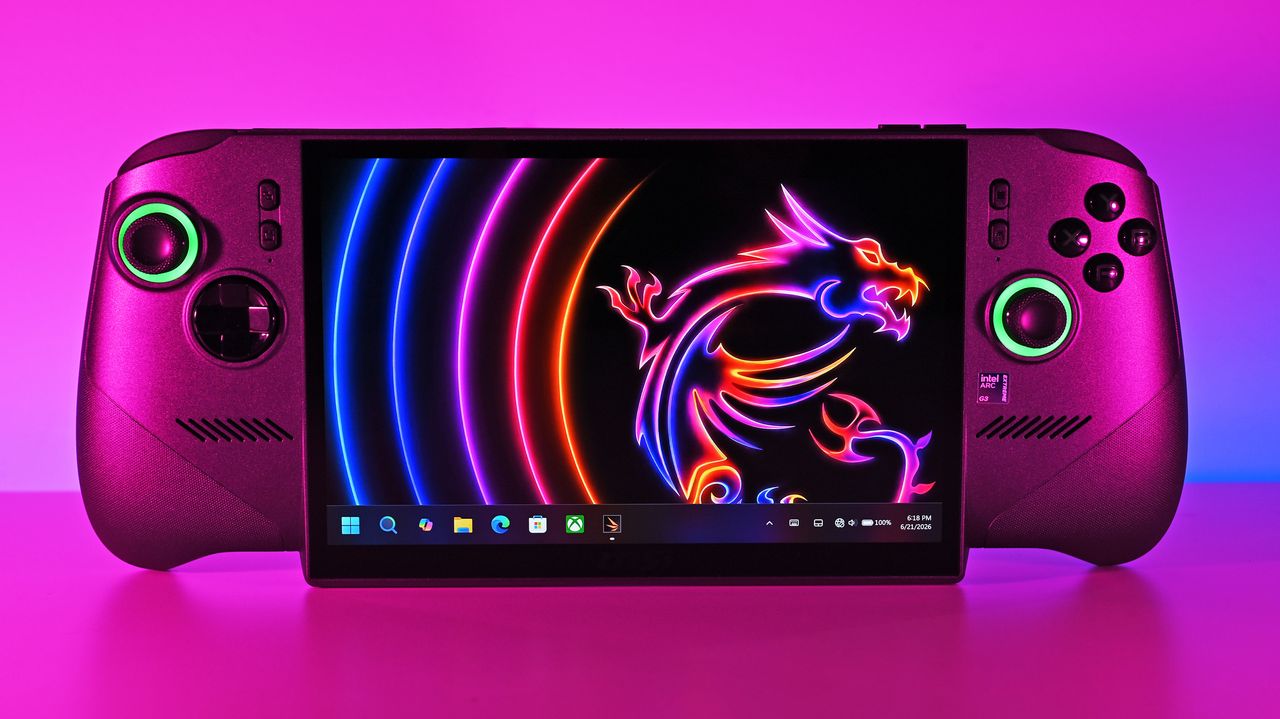
Front shot of the MSI Claw 8 EX AI+ under vibrant pink lighting, displaying the Windows 11 taskbar and a neon dragon wallpaper on its large screen.

  •  

Claude va glisser un filigrane invisible dans tous ses textes

Anthropic a annoncé que ses modèles Claude allaient intégrer un filigrane invisible directement dans les textes qu'ils produisent. Vous ne le verrez pas, il ne change ni le sens ni la qualité de la réponse, mais il est là, et il suit le texte au copier-coller.

Anthropic, l'éditeur de Claude et concurrent direct d'OpenAI, a signé le code de bonnes pratiques adossé à l'AI Act, le règlement européen sur l'intelligence artificielle, dont les obligations de transparence s'appliquent depuis le 2 août. Le texte impose que les contenus générés par IA soient identifiables par une machine.

Google, Meta, Microsoft, OpenAI ou encore Synthesia ont signé le même document. Anthropic va plus loin que le minimum demandé, puisque son marquage sera déployé partout dans le monde, et pas seulement en Europe.

Dans la pratique, les modèles lancés dans l'Union européenne à partir du 2 août embarquent le marquage dès leur sortie, et les plus anciens y passeront ensuite, sans calendrier précis. Le filigrane s'appliquera sur le site de Claude, dans l'API, dans Claude Code et jusque dans les versions hébergées chez Amazon, Google et Microsoft.

Anthropic ne détaille pas sa recette. Les filigranes de texte qu'on connaît déjà, le SynthID de Google par exemple, biaisent discrètement le choix des mots pendant la génération, et le motif statistique qui en ressort ne se voit pas à l'œil nu mais se retrouve avec le bon détecteur. La marque survit au copier-coller. Pour la faire sauter, il faudrait réécrire le texte en profondeur, et encore, Anthropic admet ne pas savoir où placer le curseur.

Les images et les fichiers y auront droit aussi, via des métadonnées signées au standard C2PA que les fabricants d'appareils photo utilisent déjà pour tracer l'origine d'un cliché.

La marque signale en fait qu'un texte est passé entre les mains de Claude, sans rien dire de qui tenait le stylo au départ. Votre propre prose, confiée au robot pour une simple relecture ou une traduction, ressortira du coup tatouée pareil qu'un texte généré de bout en bout. Anthropic le reconnaît direct.

Sur les réseaux, l'accueil est un peu agacé, pas mal d'utilisateurs digérant mal l'idée d'une signature cachée glissée dans leurs documents de travail.

OpenAI a signé le même code de bonnes pratiques et marque déjà ses images, ses vidéos et son audio depuis fin juillet. Pour les textes de ChatGPT, rien pour le moment, mais ça viendra peut-être.

Source : TechCrunch

  •  

33 secondes pour lancer un MP3 ? C'est pas VLC, c'est Windows Defender

Hé oui, ENCORE LUI !!

Jonathan Blow, le développeur de Braid et de The Witness, a annoncé hier (le 12 août) sur X qu'il laissait tomber VLC... La raison c'est 33 putain de secondes d'attente entre un clic sur un fichier MP3 et le début de la lecture, sous Windows (évidement). C'est vrai qu'une demi-minute pour lancer un son sur une machine récente, c'est abusé ! Du coup, il est repassé au bon vieux lecteur multimédia de Microsoft.

Son point de vue c'est que "tout un secteur du logiciel open source est dans un état franchement embarrassant" dès qu'il s'agit de tourner Windows. Je peux pas lui donner tord, c'est vrai que le ralentissement est réel sous Windows 11, sans qu'on sache vraiment pourquoi...

Mais heureusement, la réponse de VideoLAN ne s'est pas faite attendre et a replacer correctement le débat. Pour l'équipe de VLC, la lenteur vient d'un bug de Microsoft Defender arrivé avec une mise à jour de Windows 11, qui a mis le cache de plugins de VLC en quarantaine. L'antivirus maison de Windows a donc classé comme suspect, puis mis de côté, un fichier que VLC génère lui-même. VideoLAN écrit qu'il s'est retrouvé là "comme par magie".

Pour remettre VLC d'aplomb, VideoLAN propose donc de réinstaller le logiciel ou de régénérer ce cache. Mais pas besoin d'aller jusqu'à la réinstallation, puisque l'installeur Windows officiel dispose déjà d'un raccourci qu'il faut dans le dossier VideoLAN du menu Démarrer, "VLC media player - reset preferences and cache files".

Ce raccourci lance vlc.exe avec les deux options de remise à zéro, la configuration et le cache de plugins, puis referme aussitôt le lecteur. Ça devrait faire le taf même si attention, vos préférences partent aux chiottes avec le reste, donc si vous avez bricolé vos réglages de sortie audio, vos raccourcis clavier ou vos sous-titres, vous les perdrez. Mais ensuite, le cache, lui, se reconstruira au lancement suivant.

Après régénérer le cache n'empêche pas Defender de le rechoper par la suite. L'autre option, c'est donc d'exclure une bonne fois pour toutes vlc.exe de la liste d'analyse de l'antivirus.

Bref, ce genre de faux positif n'est pas nouveau chez Windows Defender, qui y'a pas longtemps a même pris des certificats DigiCert pour un cheval de Troie, sans parler des ISO Linux qui se font flagger régulièrement .

Voilà, hormis la comm de VLC pour le moment, personne n'a encore publié de détails techniques, et Microsoft n'a rien dit.

Source

  •  
❌