Vue lecture

I've played over 50 hours of Euro Truck Simulator 2 and American Truck Simulator this month, and it's cured my gaming burnout

Earlier this week, my colleague, Alex Cope, wrote a piece detailing how a surprise game had turned around his growing ill feelings towards gaming. It resonated with me because it mirrors a lot of the same feelings I've been having myself.

There's a huge selection of great games out there, don't get me wrong, but the whole state of the industry weighs heavy. Not to mention I'm really burned out on live service gaming and the constant grift.

Thanks to another of my colleagues, Ben Wilson, I finally opened up a couple of games I've had sitting in my Steam backlog for actual years: American Truck Simulator and Euro Truck Simulator 2.

I. Am. Hooked.

I've always known how popular these games are, but I finally get it. You're given an enormous sandbox to play in, and you can make of it what you wish. Play the game, make your own game, change it with add-ons, or play with others on community servers.

These are old games but still get new content regularly and, at some point, will finally arrive on console, too. If you look at them and think it might be a tedious gameplay loop, you couldn't be more wrong.

For me, it's all about the drive
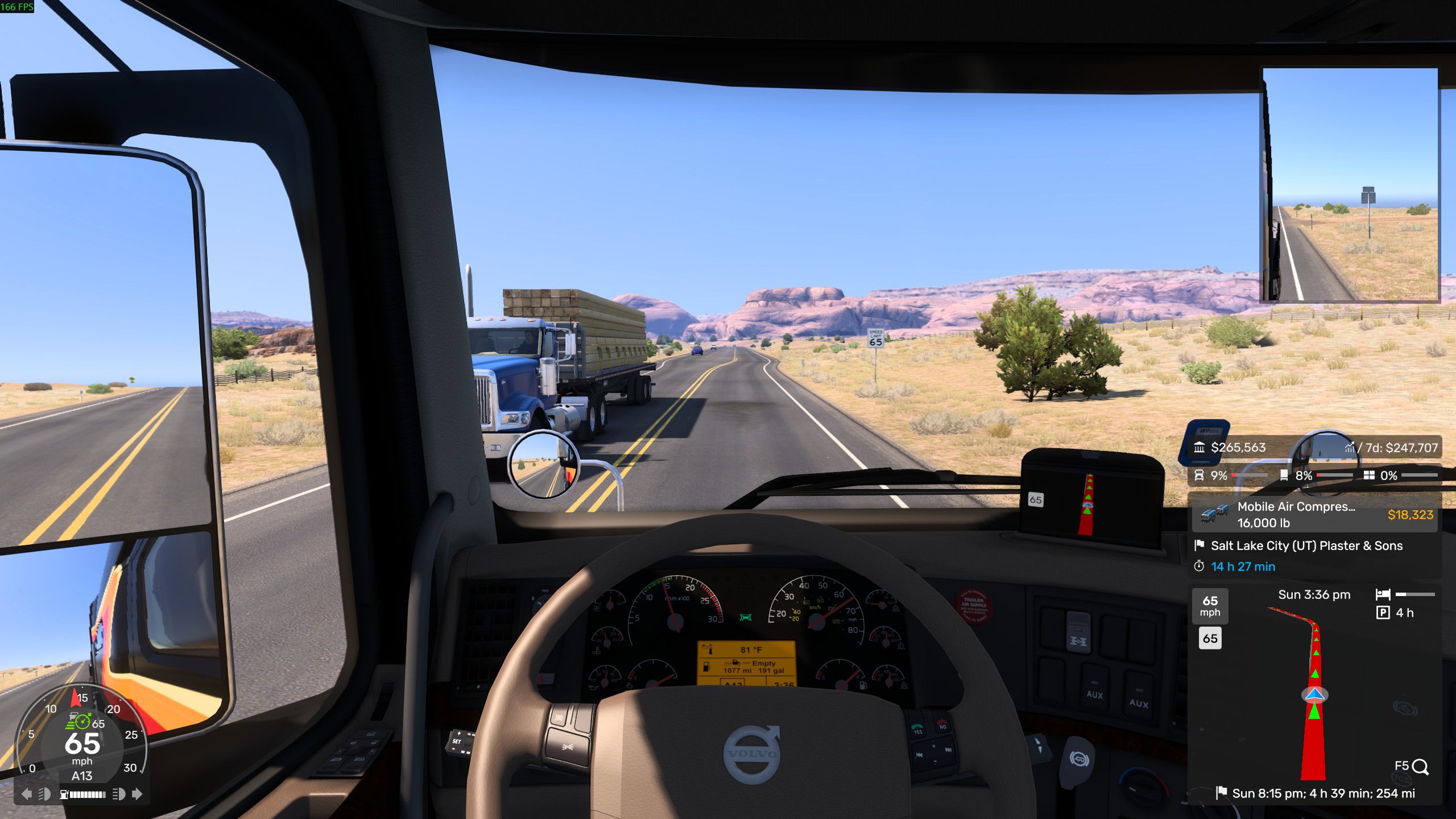
A screenshot from American Truck Simulator inside the cab of a 2014 Volvo VNL 730 driving along a road in Utah.

It's just you, your trailer, and the open road. (Image credit: Windows Central)

You can pretty much make of Euro Truck Simulator 2 and American Truck Simulator what you want. There's no campaign to speak of, and from the off you're able to drive anywhere on any of the maps you own.

For me, it's the driving that's completely sucked me in. I could easily be making money faster, buying more trucks, hiring more drivers, and building my own virtual empire, but I'm not really driven that way.

It's all about the road trips. Leveling up to open up bigger, more valuable cargo earns more monetary reward, but it also opens up longer drives. It's one of the most relaxing video games I've ever played.

Sure, AI traffic at times acts dumb and produces a bit of the old virtual road rage, but mostly it's me, my trailer, and the open road. Stick on some music from the selection of in-game but still real-world radio stations, settle in, and admire the surroundings.
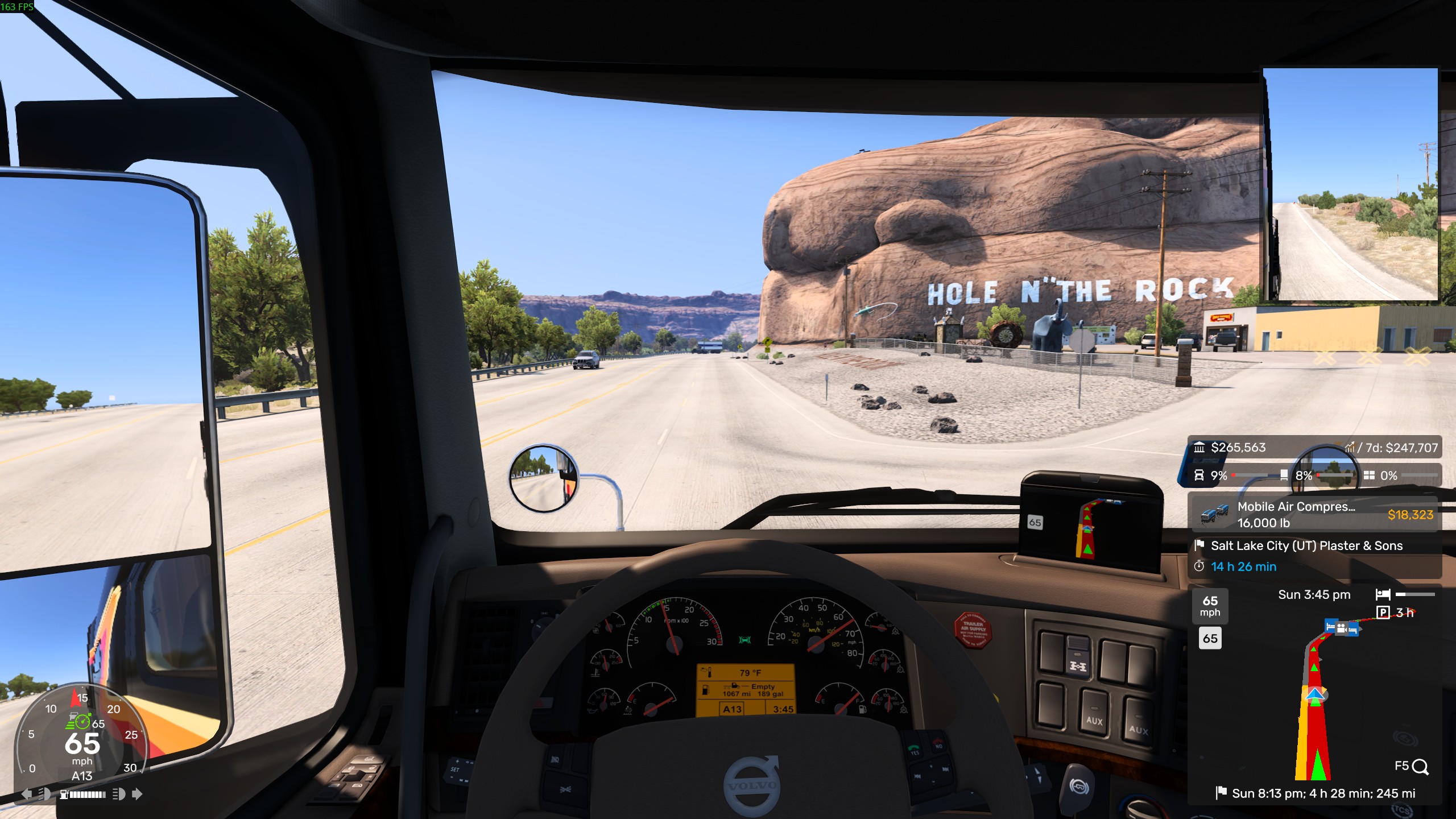
A screenshot from American Truck Simulator inside the cab of a 2014 Volvo VNL 230 driving past Hole N' The Rock in Utah.

There's plenty of sightseeing to be done without ever havign to go outside. (Image credit: Windows Central)

It can be challenging, too. Navigating tight roads gets the brain matter working, and I'm still not very good at reversing a trailer, but it also never feels frustrating. There's a real sense of satisfaction when you do it right and don't crash into everything around you.

Hours just fly past. Thinking, "Oh, I'll just jump on and do a few short deliveries," suddenly becomes driving across the entire map. I don't even have all the DLCs for either of the games, but without consciously thinking about it, I'm accepting a 1,000-mile+ drive from New Mexico up to Oregon.

I've spent more time in American Truck Simulator than I have in Euro Truck Simulator 2 purely because I think the drives are better. I've seen plenty of real-life Europe in my years on the planet, and it's nice, but it's not quite the same as some of the spectacular scenery in the U.S.

It feels more like a real road adventure to me.

Both games have limitless potential for customization
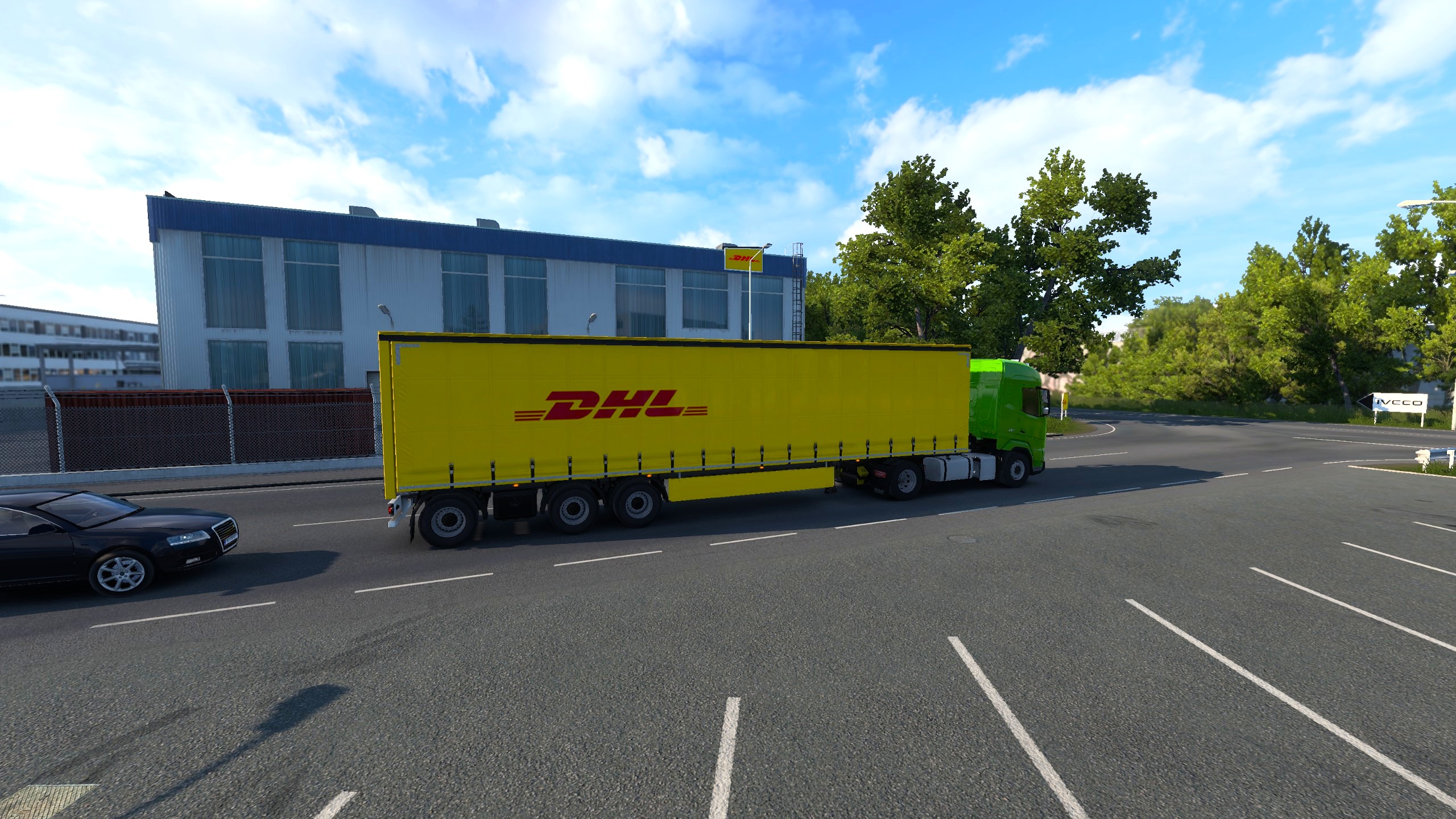
A screenshot from Euro Truck Simulator 2 driving a green DAG XG towing a DLH trailer in front of a DHL depot.

A simple mod to add some immersion is to add real-life companies to replace the fake standard ones. (Image credit: Windows Central)

Besides the quantity of official DLCs, both American Truck Simulator and Euro Truck Simulator 2 have quite ridiculous mod support. Both from the Steam Workshop and external sources.

I've barely scratched the surface of this yet, but it's mindboggling how far you can go. You can add real-life companies to replace the standard, fake ones. You can download new vehicles, including those not officially in the game. There are graphics mods, physics mods, weather mods, mods to customize your trucks, and mods to change the traffic.

If you can think of it, there's probably already a mod for it.
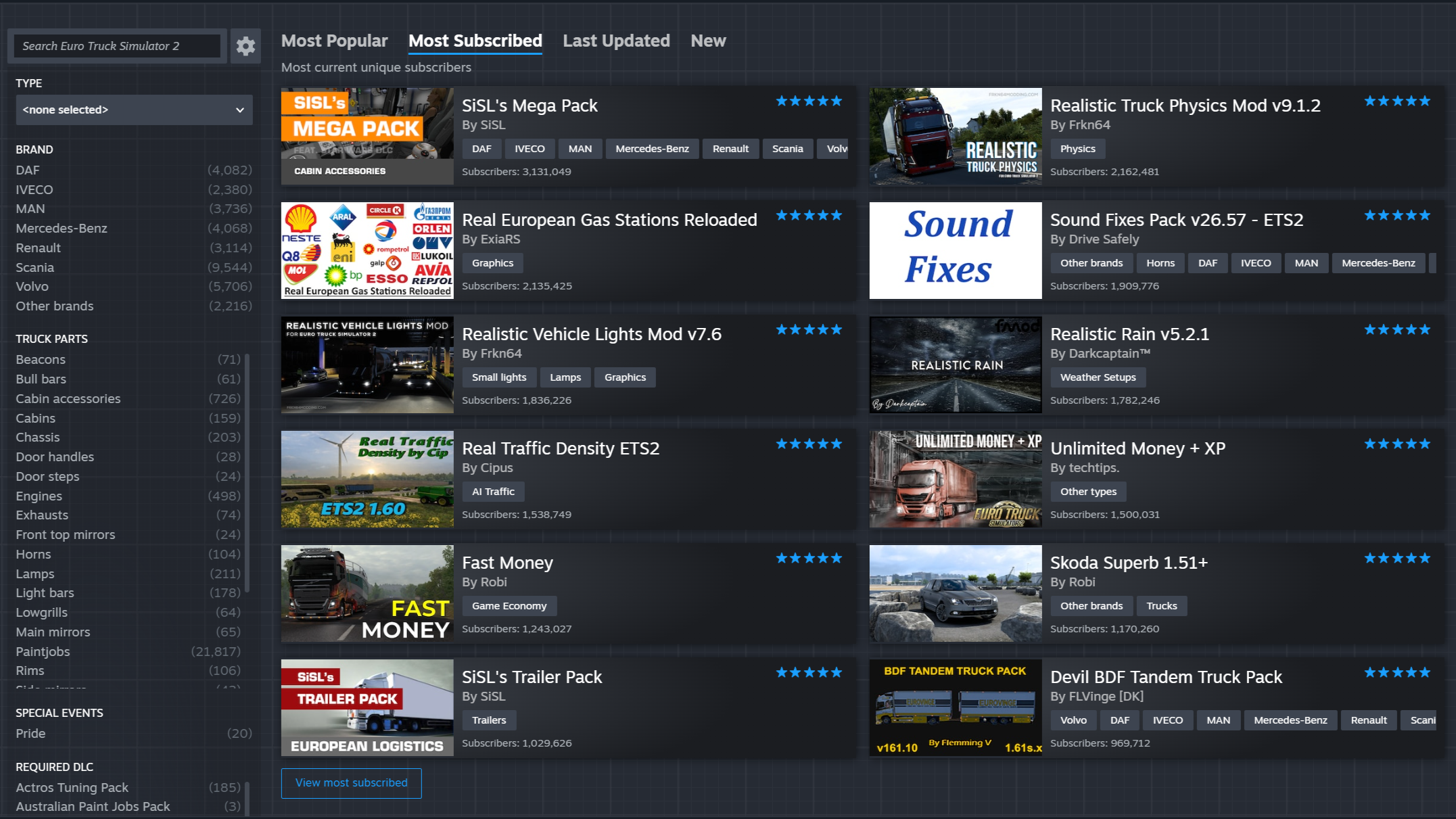
A screenshot of the Steam Workshop most subscribed to mods for Euro Truck Simulator 2.

There are a ridiculous number of mods available for both games. (Image credit: Windows Central)

There are also ways to play with others. Inside the game, there are convoys that you can join in with, but there are also external options, with the most well-known being TruckersMP.

This is a mod that allows you to drive on dedicated servers alongside other real people rather than AI traffic, and there's a whole community built around it. I haven't yet dipped a toe in the multiplayer waters, so I can't speak with any authority, but the option is there.

Ultimately, you can make the experience your own. If you want to go down the hyper-realism route, you can. If you're happy just trucking by yourself using the official content, you can do that too. Or any step in between.

Both Euro Truck Simulator 2 and American Truck Simulator play great on handhelds
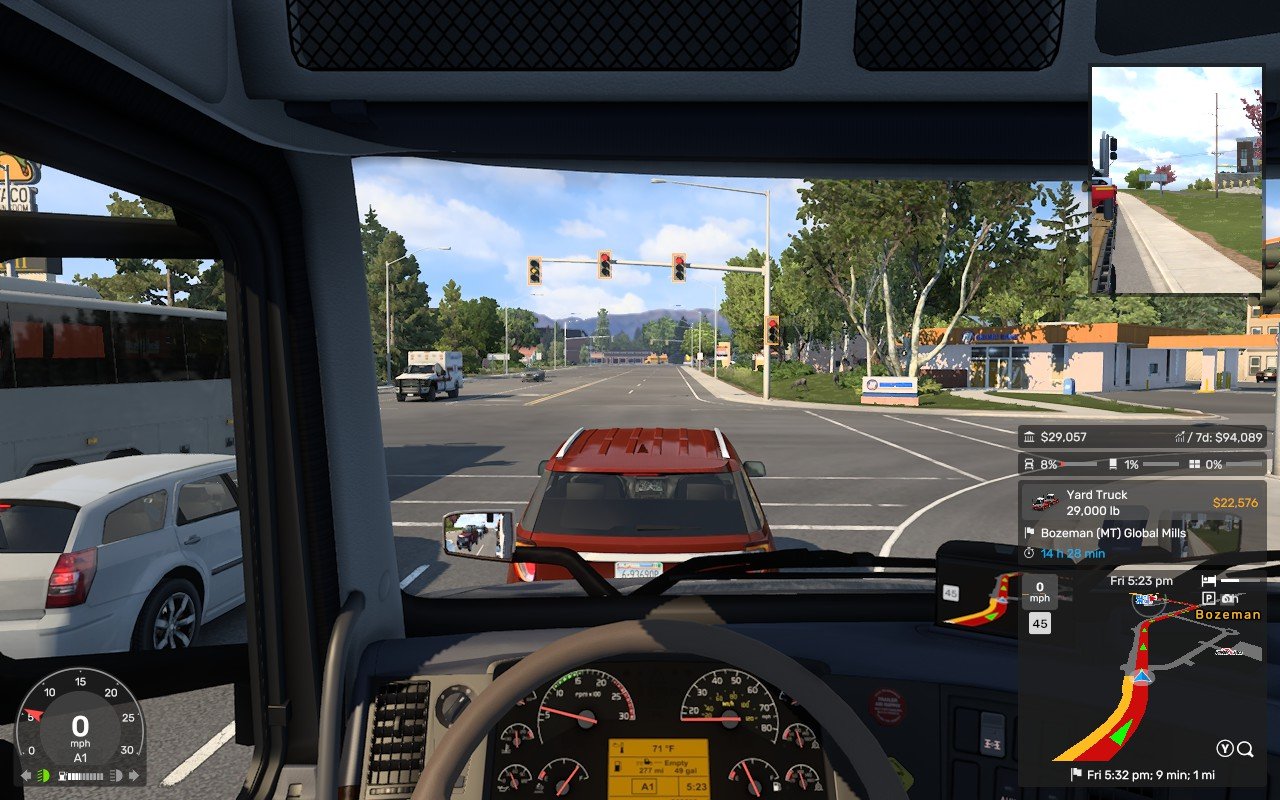
A screenshot from American Truck Simulator played on a Steam Deck showing an in-cab view from a 2014 Volvo VNL truck at a set of traffic lights.

This is American Truck Simulator on the Steam Deck and it still looks pretty good. (Image credit: Windows Central)

Most of my time trucking so far has actually been spent on my Steam Deck, feet up on the sofa. One day I'm going to get more serious with a wheel and probably a button box, but it's perfectly enjoyable with a controller and a handheld.

Both games actually have a native Linux version you can enjoy on the Steam Deck, and both are still being kept up to date with the Windows equivalent. I've been playing it through Proton instead, and I do think it's a little better overall. But you don't have to. They're as pick-up-and-play as it can be on SteamOS.

There are limitations, and frame rate will drop in some of the newer DLCs and the bigger cities, but overall, it's superb. I'm not even playing on the lowest settings, either. Some are set to low, but most are on medium, and it's working just fine. It looks good enough to still feel impressive on those long drives through the countryside.

Both are perfect games to play on a handheld, and for me at least, I get added relaxation from moving away from my gaming PC. The one I spend all day in front of while I'm working. These two truck sims plus the Steam Deck are a perfect antidote.

Mostly, I'm wondering why I waited so long. I said the same about Microsoft Flight Simulator 2024, too.

I've always loved games where you can explore, and what's better than a huge open map to drive across as you please?

If you've ever been even curious, I definitely recommend checking out at least one of them. The base games are cheap, and while there's a lot of DLC map add-ons, there's enough road in each of the base maps to help you get a feel for it.


"Experience legendary American trucks and deliver various cargoes across sunny California, sandy Nevada, and the Grand Canyon State of Arizona"

✅ Steam Deck VerifiedView Deal


"Travel across Europe as king of the road, a trucker who delivers important cargo across impressive distances! With dozens of cities to explore, your endurance, skill and speed will all be pushed to their limits."

✅ Steam Deck VerifiedView Deal

Click to join us on r/WindowsCentral

Join us on Reddit at r/WindowsCentral to share your insights and discuss our latest news, reviews, and more.

MOZA TSW Truck Wheel with Euro Truck Simulator 2 on PC
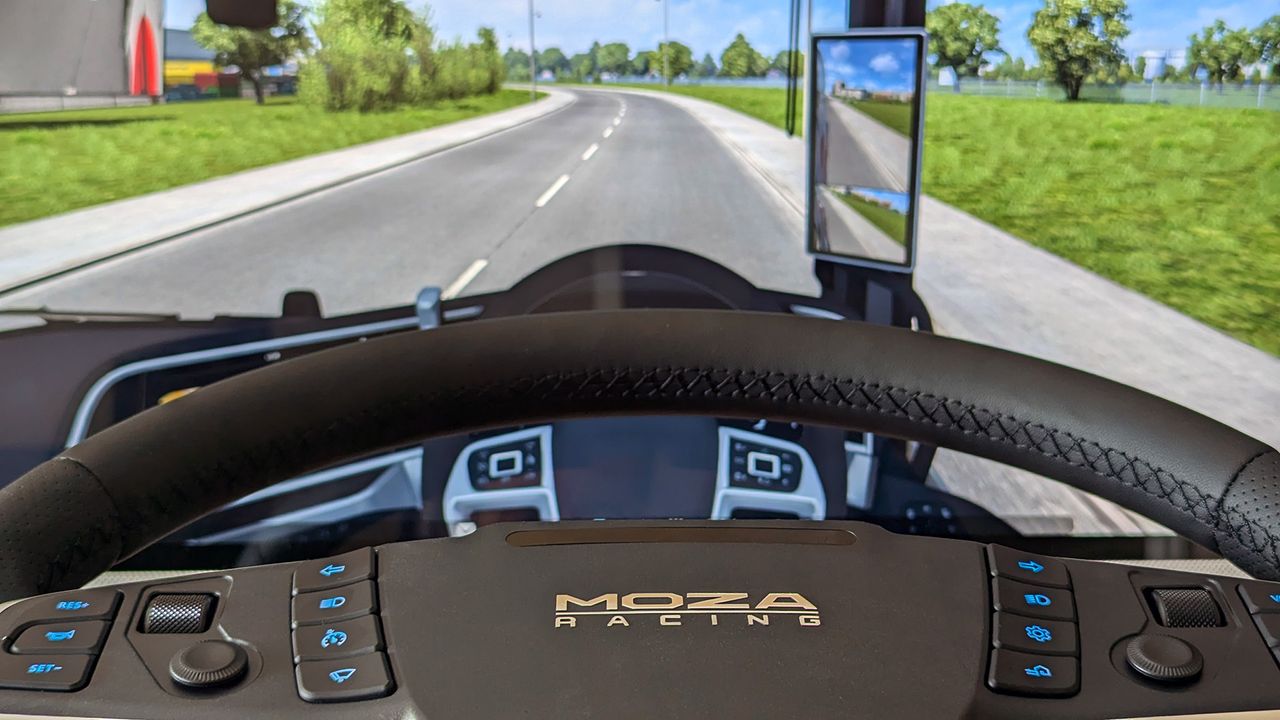
Hours just fly by hitting the open (virtual) road.

  •  

After years of PC-building snobbery, I'm ready to admit pre-builts are no longer taboo — Here's why I'm rethinking my DIY stance

For many years, "pre-built PC" almost felt like a slur in some gaming circles, and I'll admit that I used to consider myself above the pre-built market.

Cale Hunt

Cale Hunt

(Image credit: Future | Edited with Gemini)

What I'm working on this week: I'm in the process of testing the HP OMEN 45L pre-built gaming PC, and outside of work, I'm catching up on garden care when it's not too hot to breathe.

Who would buy a system built by someone else? That might not have proper airflow? That might have a ton of bloatware installed out of the box? That might use proprietary parts you can't upgrade yourself? That charges a premium price compared to building your own? To put it bluntly, pre-built gaming PCs had a poor reputation.

These things used to cross my mind before I regularly started testing pre-built PCs here at Windows Central, before I had a ton of experience with the pre-built market, and before the PC market's recent changes.

I won't pretend that I don't still prefer building my own gaming PC. Watching it power on and run my favorite games is a small joy that I love to repeat. But the time when building your own PC was cheaper and better than picking up a pre-built is coming to an end.

I've spent the past several months testing a wave of new pre-built gaming PCs here at Windows Central, and I can no longer pretend that they're inferior. Some of these machines are genuinely good. Not just "good for a prebuilt" — genuinely good and bordering on better than I could do myself.

The proof is in the pre-built PC

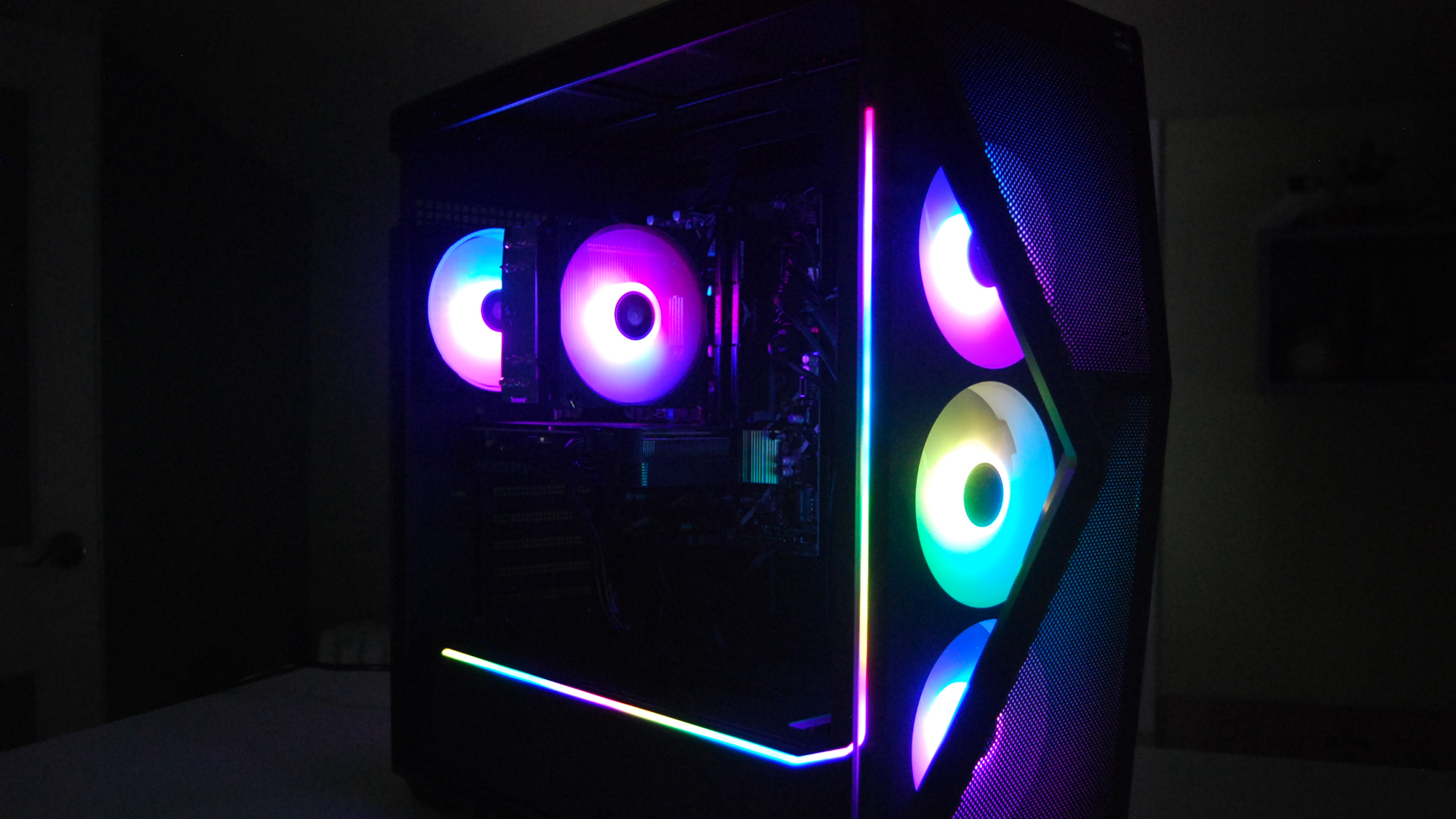
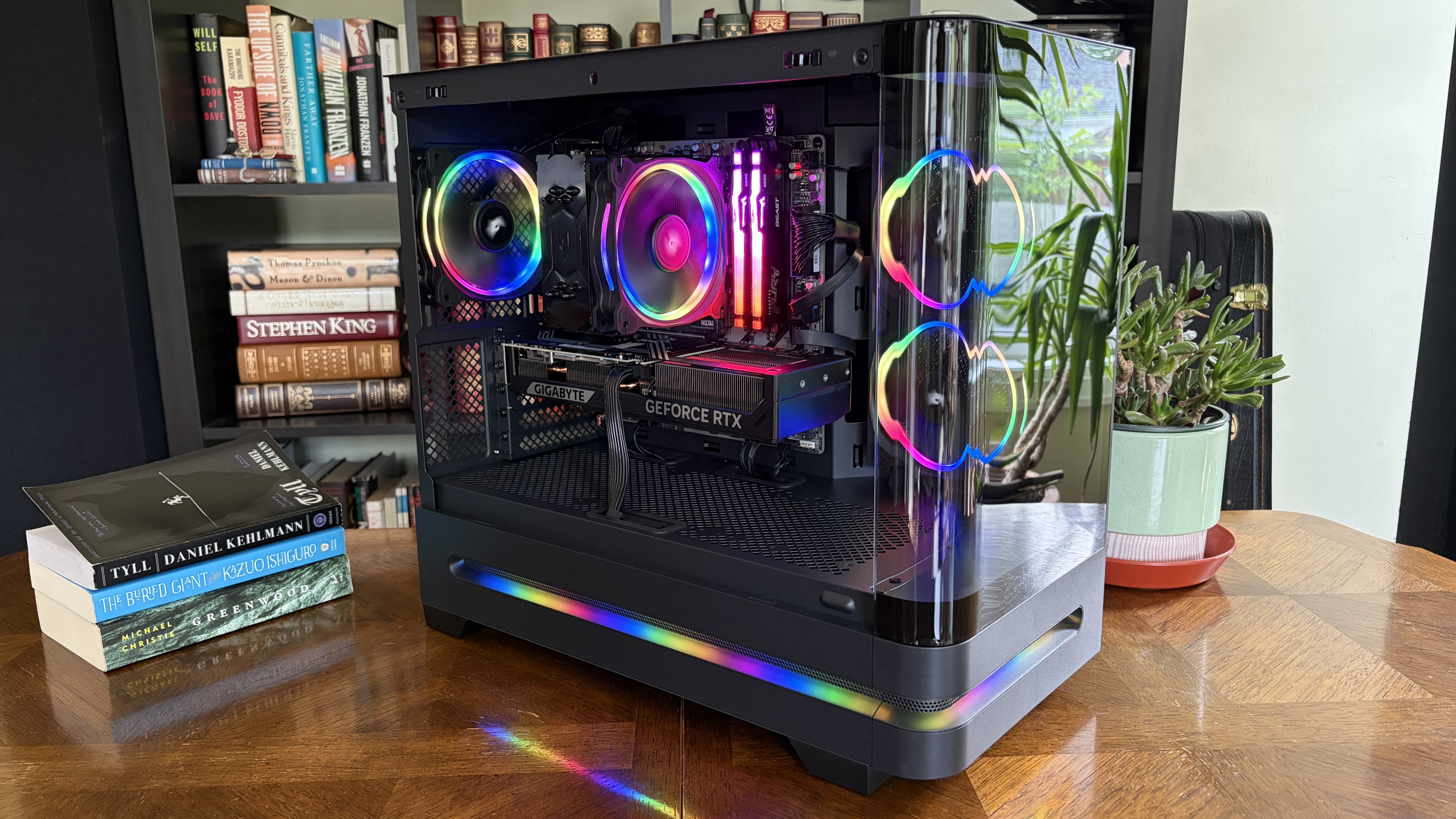
A modern Acer Nitro 65 desktop computer in a glass case with RGB lighting, showcasing internal components like a graphics card and cooling fans, alongside a bookshelf and a potted plant.

Acer's Nitro 65 pre-built gaming PC impressed me more than I expected. (Image credit: Future)

It was Acer's Nitro 65 pre-built gaming PC that finally spurred me to write this article. It's the most recent pre-built I reviewed — I'm also testing the HP Omen 45L right now — and I went in expecting the usual compromises often found in big-brand pre-built systems.

It turns out that, aside from a non-modular PSU tucked away out of sight, the PC is something I'd easily recommend to anyone looking for an upgrade.

Acer's Nitro 65 surprises with a clean build, a gorgeous case (mostly), regular components, and a competitive price compared to building your own similar system. It has some quirks, but they don't keep me from recommending it as an above-average pre-built option.

Acer Nitro 65 review

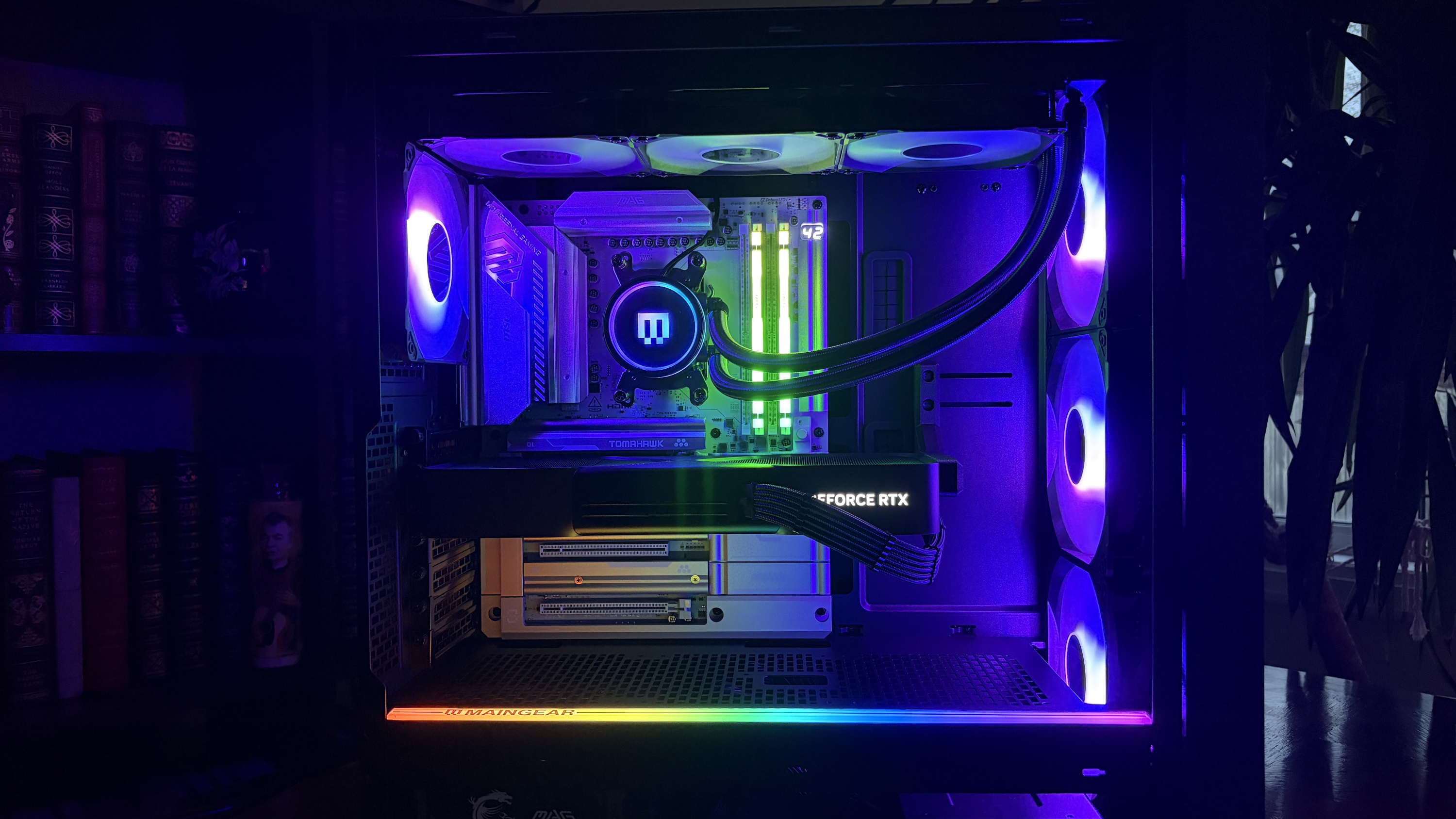
I saw a similar story play out on the boutique end. I tested Maingear's MG-1 MK.II earlier this year, handing it five stars and a Windows Central Editor's Choice award.

A Maingear MG-1 MK.II gaming PC with RGB lighting illuminates the interior. It features a GeForce RTX graphics card and vibrant cooling fans, creating a futuristic vibe.

Maingear's MG-1 MK.II is an incredible pre-built gaming PC. (Image credit: Future)

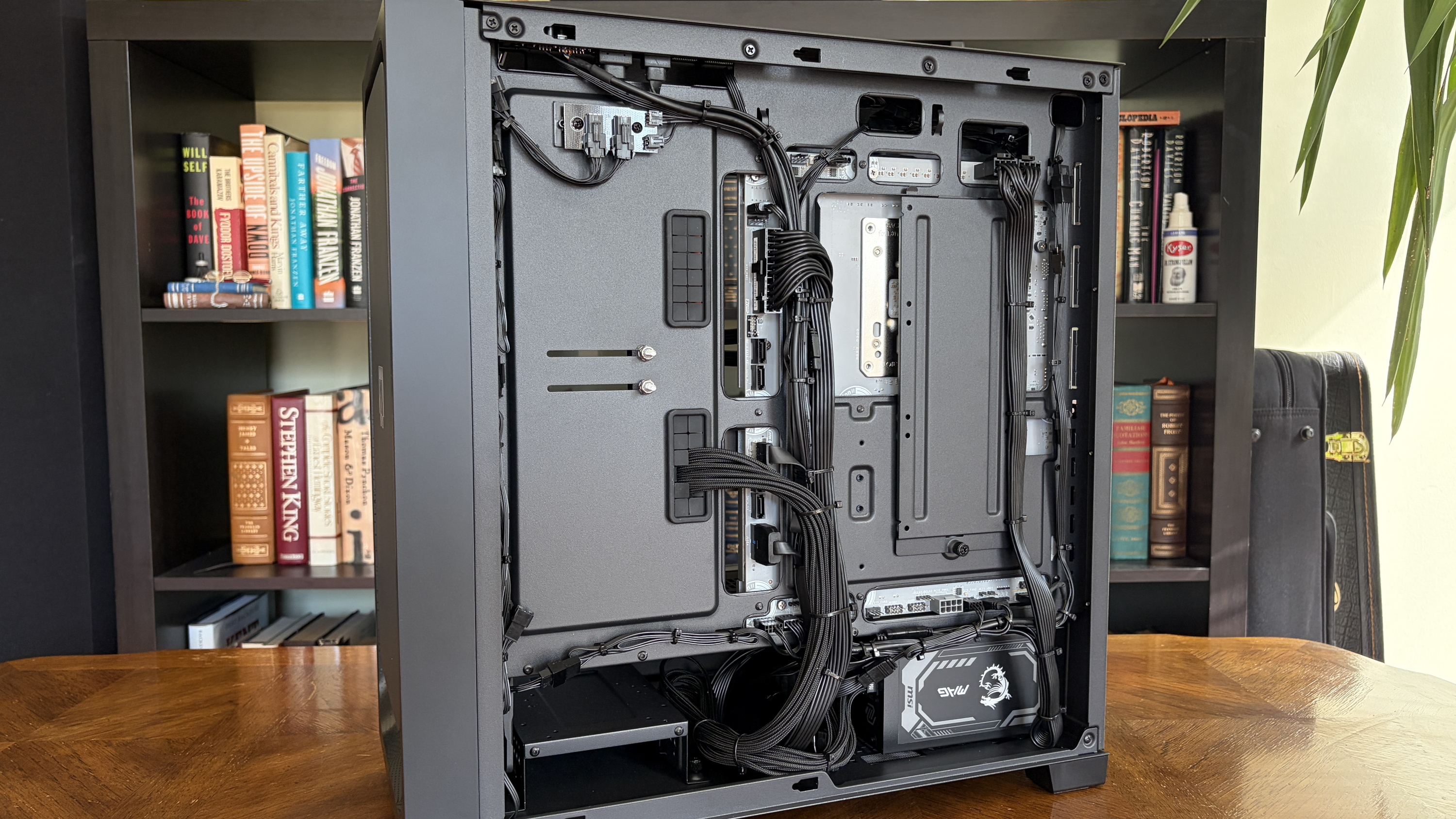
It's an expensive PC to be sure, but not much more than putting your own system together with everything considered. These PCs are assembled by hand by people who clearly have a passion for this type of thing, and I don't think I've ever paid as much attention to cable management and RGB lighting as what's found in Maingear's flagship.

Maingear took customer feedback from the original MG-1 and fed it into the development of the MG-1 MK.II. The result? An outstanding gaming pre-built that I have a hard time knocking for anything other than minor infractions.

Maingear MG1 MK.II review

The iBuyPower Slate 8 Mesh that I reviewed last year is another relatively affordable gaming PC that balances power and price quite well, and it regularly costs less than $1,500.

iBuyPower RDY Slate 8MP 004

iBuyPower's Slate 8 Mesh pre-built PC is still available for a great price. (Image credit: Future)

This leads me to the Steam Machine's launch, when I went looking for prebuilts that could best it on price and performance. This was during Amazon's Prime Day event, but it quickly became clear that the five PCs I chose could outperform Valve's box while also costing less.

This is really where I imagine PC purists are having a hard time: pre-builts are increasingly upping build quality, maintaining convenience, and winning on value.

Not every pre-built gaming PC is a winner

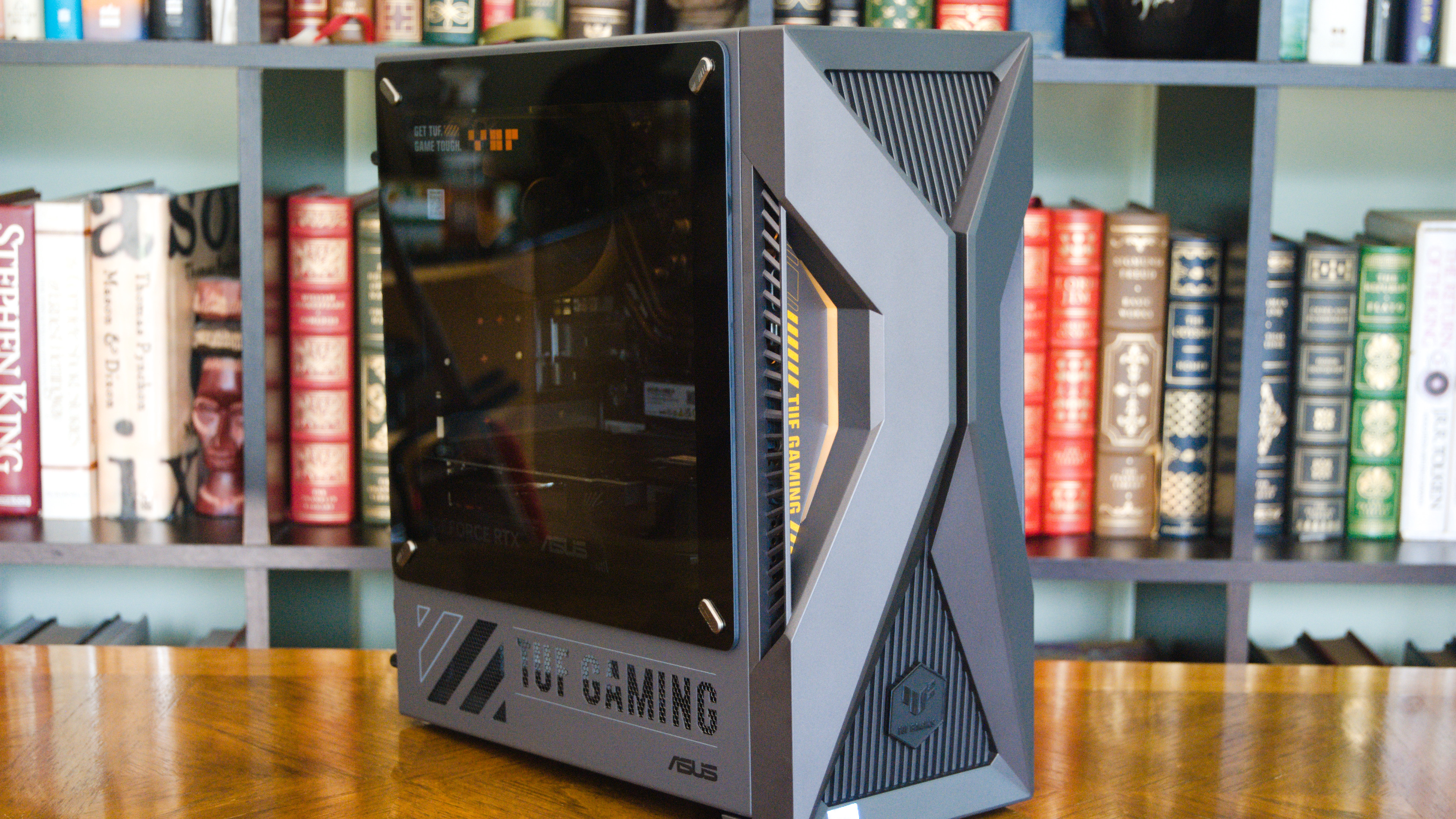
ASUS TUF Gaming T500

The ASUS TUF Gaming T500 is an interesting idea that I don't think landed. (Image credit: Future)

As I said, I'd still recommend anyone with the time and inspiration to put together their own system. If hardware prices weren't being completely skewed by the ongoing RAM and storage crisis, I might not be writing this piece.

And although I've had some positive experiences of late, I don't want to oversell pre-built PCs. There are certainly still a lot of oddities to be found in the market.

Take the ASUS TUF Gaming T500 that I reviewed as an example. It's built around a laptop-class mobile CPU stuffed into a desktop chassis, and, in my opinion, the mash-up didn't work.

It took the worst pre-built habits, including poor upgradeability, and added new problems on top. It's ultimately proof that pre-builts still aren't guaranteed to be winners, and that the ceiling has risen without the floor following.

A hybrid mobile/desktop pre-built gaming PC is an interesting idea, but the execution fails to impress. A desktop-class GPU doesn't make up for throttled mobile CPU performance and poor upgradeability. I recommend building your own PC or checking out a pre-built with a true desktop CPU inside.

ASUS TUF Gaming T500 review

That's the distinction that matters. Just a few years ago, the odds of landing a quality pre-built PC that was upgradeable and assembled properly weren't great. Enough so that using a blanket "just build your own PC" response was reasonable.

Those odds have shifted. More and more companies are shipping systems that hold up against self-assembled PCs in terms of price, component quality, and thermals.

My advice to gamers shopping for a new pre-built PC

The image shows an open MG-1 MK.II computer case on a wooden table, revealing neatly organized cables and components. Bookshelves with books appear in the background.

Cable management on the Maingear MG-1 MK.II is nearly perfect. (Image credit: Future)

Those shopping for a pre-built gaming PC shouldn't trust the entire category. Instead, trust specific reviews. Check what PSU is inside and whether an upgrade is necessary. Check what parts the case can fit inside. Check how much bloatware you're dealing with on day one.

Just a few years ago, I would have told a friend building their first gaming PC to skip pre-builts entirely. Now, I'd tell them to read a few reviews first, because there's a real chance the better deal is already sitting on a store shelf.

Click to join us on r/WindowsCentral

Join us on Reddit at r/WindowsCentral to share your insights and discuss our latest news, reviews, and more.

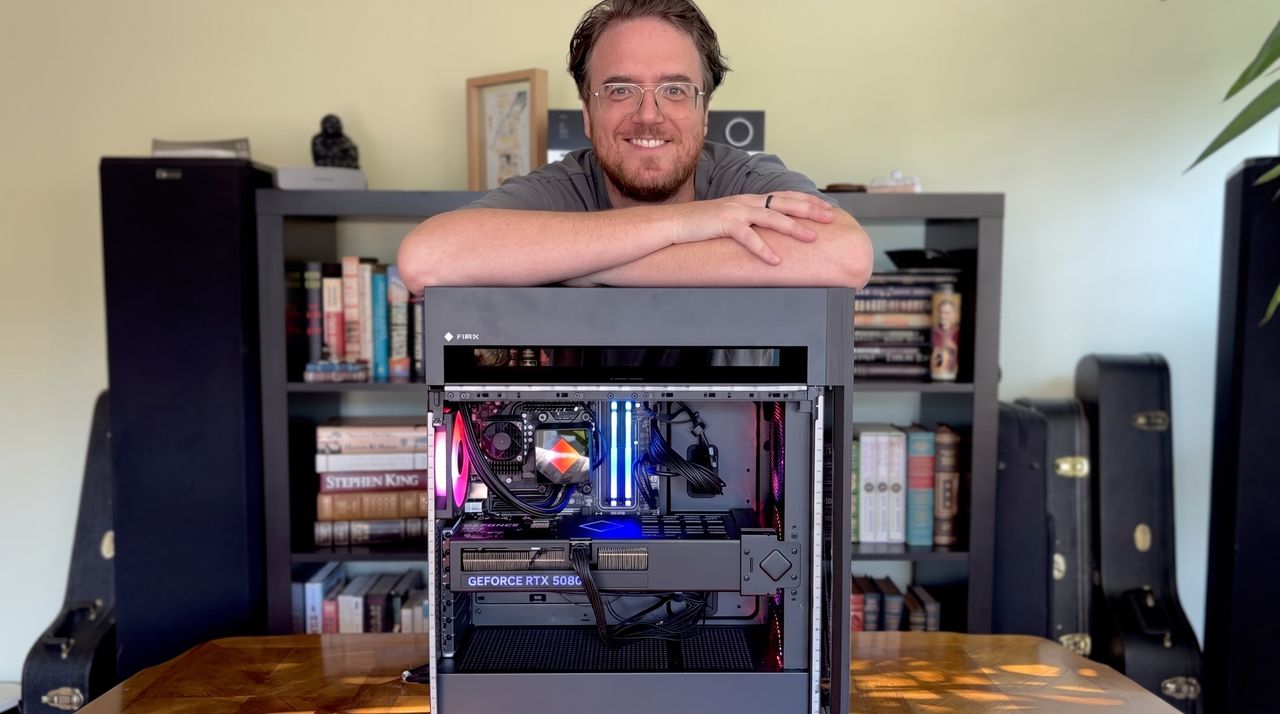
A smiling man leans over a computer case showing colorful internal components, with a bookshelf filled with books in the background.

A smiling man leans over a computer case showing colorful internal components, with a bookshelf filled with books in the background.

  •  
❌