❌

Vue lecture

The 8 Best Tech Gadgets of November 2026

A phone with a screen beside its rear camera is a literal way to improve a selfie. A mouse that folds flat takes a direct approach to an overstuffed laptop bag. Our November gadget selection starts with those practical ideas, then moves through music players, a camera, a keyboard, and a handheld console that makes its electronics part of the view. Each earns its place through a specific design decision.

These are our editorial picks for November 2026, not eight November launches or winners from a comparative test. The selection includes products offered for purchase, announced hardware, and projects still working toward production, with those differences identified below. We’ve favored useful mechanisms, distinctive controls, and objects that offer something beyond another spec upgrade. Consider it a guide to what deserves attention, with availability treated as carefully as the industrial design itself.

1. Acer Sospiro A70 5G Phone
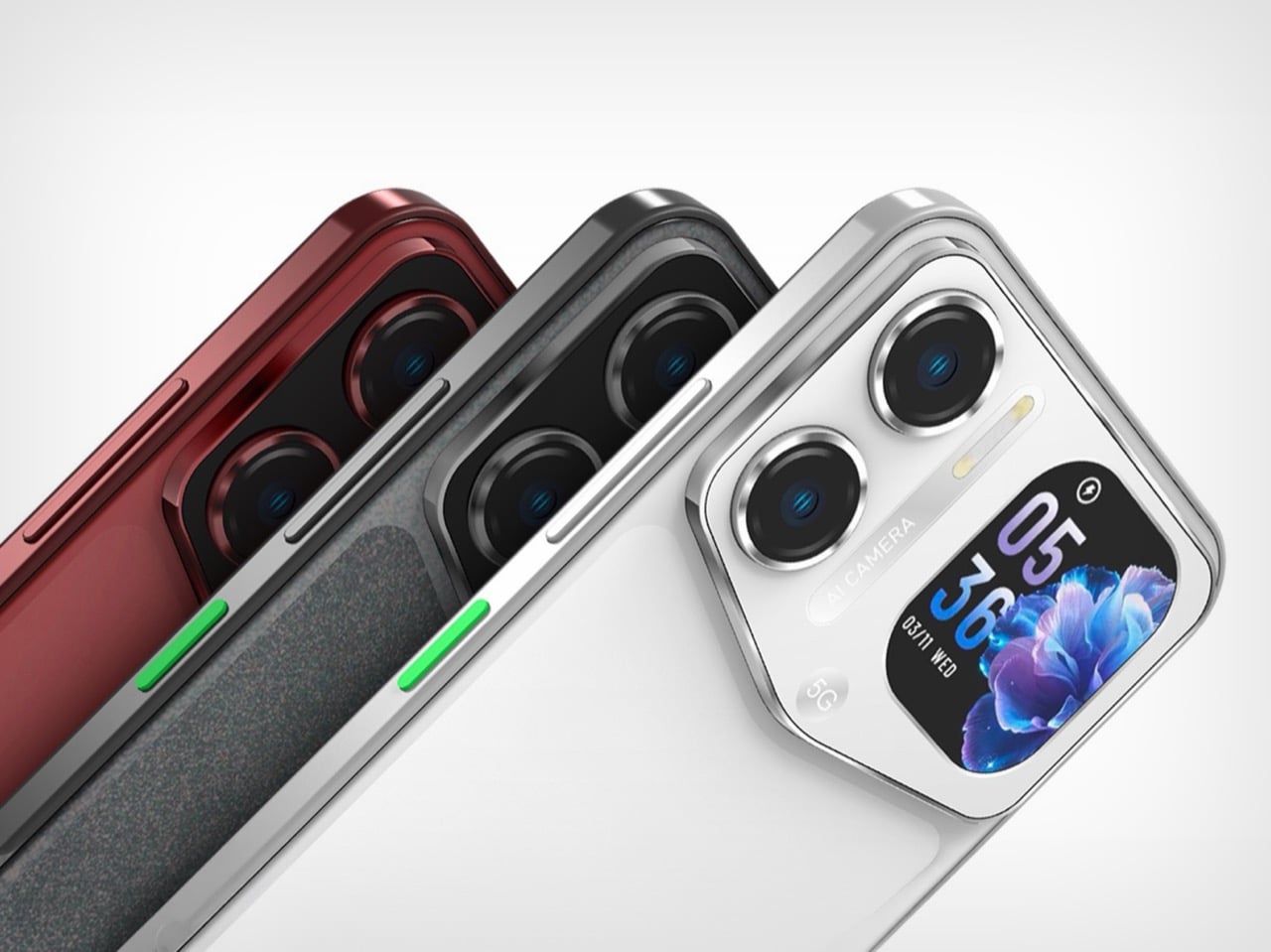
The Acer Sospiro A70 gives its rear camera a useful companion: a 1.88-inch display that doubles as a selfie viewfinder. Instead of guessing your framing when using the 64MP main camera, you can check it on the back of the phone. That small screen sits inside a broad, V-shaped camera module, giving the handset an identity beyond its logo. Senwa Global, which licenses the Acer name for phones in Latin America, is the company behind this particular Acer-branded 5G model.

The rest of the hardware preserves options many buyers still value: a 3.5mm headphone jack, 256GB of storage, and microSD expansion up to 1TB. A 5,000mAh battery accompanies the 6.67-inch main display, although its 120Hz refresh rate comes with a modest 720 × 1600 resolution. That’s the compromise behind the feature list. Pricing and the launch date remain unconfirmed in our sources, and a US release hasn’t been established, so this belongs on a watchlist rather than a shopping cart.

What we like

  • The rear display provides framing when taking selfies with the main camera.
  • A headphone jack and expandable storage preserve useful everyday options.

What we dislike

  • The main screen pairs a large panel with relatively low resolution.
  • Pricing, launch timing, and US availability remain unresolved.

2. OrigamiSwift Folding Mouse

A conventional mouse is awkward luggage because its useful shape becomes wasted volume when you close the laptop. Horace Lam’s OrigamiSwift addresses that with a folding, origami-inspired body that rises into a working mouse and flattens for storage. At 40 grams, it adds little weight to a mobile setup. The more interesting achievement is giving the mouse two distinct shapes for two different jobs, rather than asking you to work all afternoon with a permanently shrunken travel accessory in hand.

Bluetooth 5.2 handles the connection, while USB-C recharges a battery that rates for up to three months of use. The $85 asking price buys a more considered packing solution, not a promise that every hand will prefer its angular form. There’s also a dimensional catch worth understanding: the flattened body spreads to roughly 4.8 by 5 inches, and the sensor housing stays thicker than the panels. It’s better suited to a slim laptop sleeve than a tiny pocket.

Click Here to Buy Now: $85.00

What we like

  • Folding construction reduces the thickness needed for storage.
  • Its 40-gram weight makes it a modest addition to a laptop bag.

What we dislike

  • The flattened shape still occupies an almost five-inch-square footprint.
  • The thicker sensor housing prevents a uniformly flat profile.

3. OnePlus Ice Card Mini
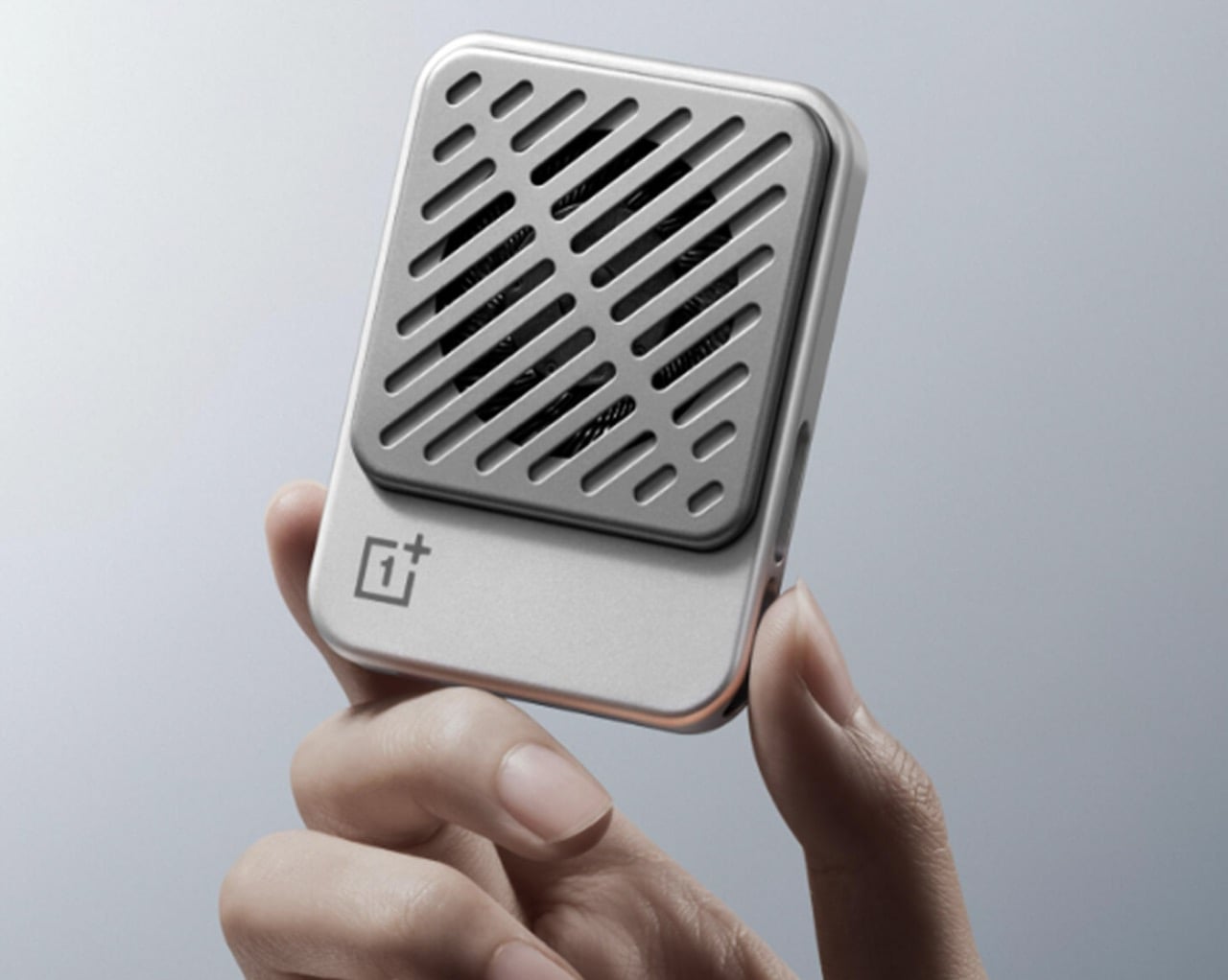
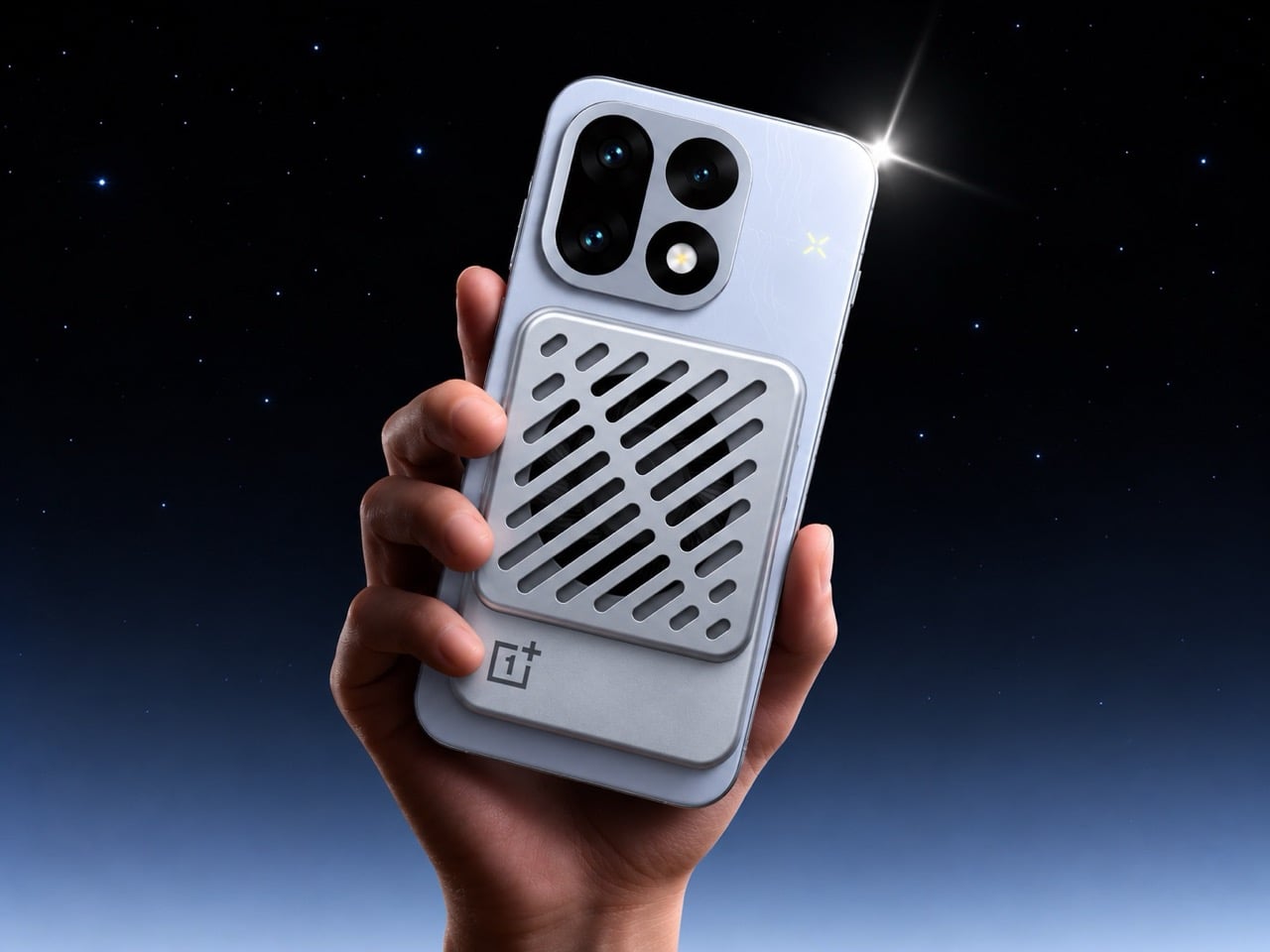
OnePlus’s Ice Card Mini is a China-listed magnetic phone cooler with a refreshingly restrained shape. At about 50 grams and 70 by 53.4mm, it resembles a small card accessory more than the clip-on fans associated with gaming phones. Inside, thermoelectric cooling works alongside an air-cooling system. The appeal is straightforward: an external accessory intended to manage heat without turning the phone into something that needs its own carrying case. It’s a focused answer to an accessory category prone to bulk.

The Mini takes power over USB-C, drawing up to 3.5W according to the published specifications. You can power it from the phone, a power bank, or an adapter, but that means the magnetic attachment doesn’t make the setup wireless. An included magnetic plate extends compatibility to phones without built-in magnets. That flexibility is welcome, especially if you change handsets regularly. The remaining questions are practical ones: case compatibility, the effect on your games, and availability outside its initial Chinese market.

What we like

  • The compact magnetic format avoids a bulky clamping mechanism.
  • USB-C power allows several options beyond a wall outlet.

What we dislike

  • It requires a power connection during use.
  • Cooling performance and US availability need confirmation.

4. ClearFrame Speaker CD Player
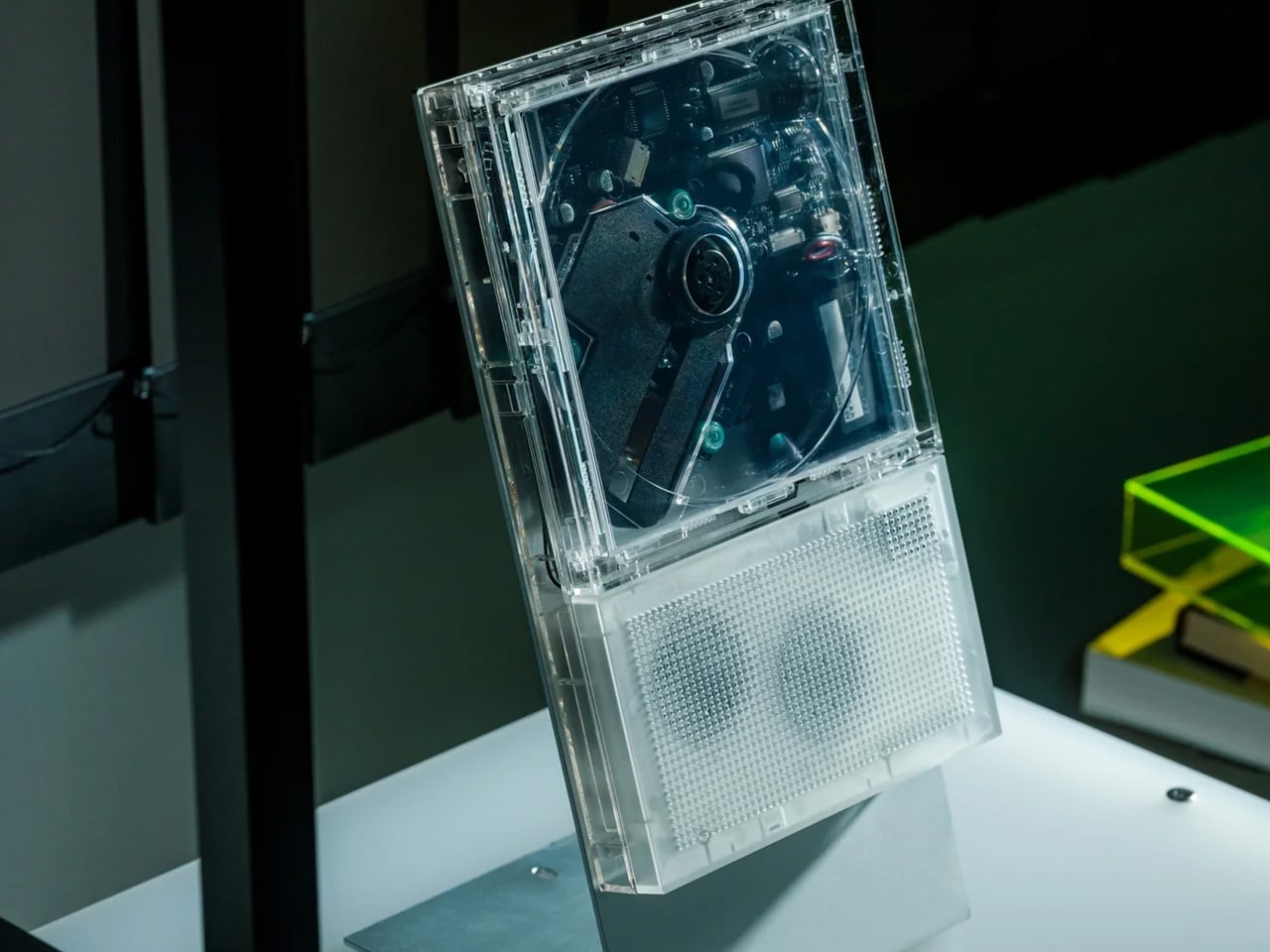
The ClearFrame Speaker CD Player gives an album two jobs: something to play and something to display. Its transparent body reveals the spinning disc and circuitry, while an included tray lets you insert the album artwork instead. That makes its appearance change with your listening rather than stay fixed behind a manufacturer’s grille. This is the speaker-equipped version of ClearFrame, with a built-in 40mm driver and bass diaphragm, so it can play your CDs without an additional speaker beside it.

At 27mm thick, the $240 player has proportions closer to a book than a conventional stereo component. It features six to seven hours of speaker playback, with USB-C charging and a 3.5mm headphone output. Bluetooth 5.3 sends CD audio to compatible headphones or speakers; it doesn’t receive music from your phone. That distinction matters if you’re imagining a transparent Bluetooth speaker. A display stand and wall mount cost extra, so budget for the arrangement you want at home.

Click Here to Buy Now: $240.00

What we like

  • Album artwork becomes part of the player’s appearance.
  • The built-in speaker removes the need for a separate listening setup.

What we dislike

  • Bluetooth transmits CD audio but cannot receive music from a phone.
  • Display accessories and wall-mounting hardware aren’t included.

5. Sudo Music Player

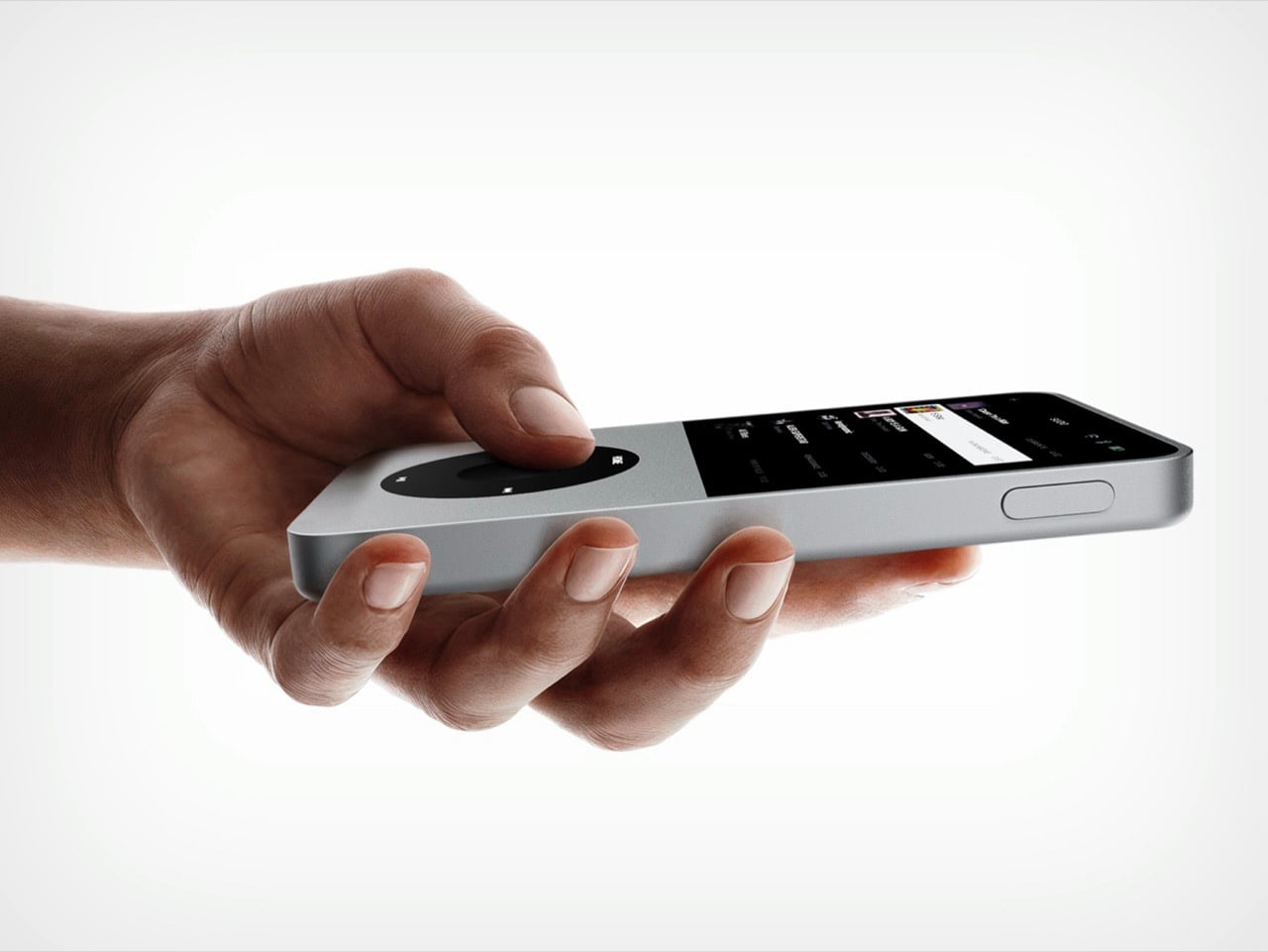
Tangerine Sudo music player shown from front and back, with playlists menu on screen and tactile wheel below

Silver Sudo music player held in one hand, thumb resting on the tactile wheel

New Matter’s Sudo revisits the dedicated music player with an interface built around a capacitive scroll wheel and haptic feedback, paired with a touchscreen. The appeal is choosing an album on a device whose main purpose is listening, rather than opening another destination on your phone. Planned hardware includes a Cirrus Logic DAC, a 3.5mm headphone jack, and USB-C digital audio output. This is upcoming hardware, though, with New Matter expecting the first batch to ship in early Q4 2027.

The specification gives that familiar format room to grow: 64GB of internal storage, microSD expansion up to 2TB, and support for formats including FLAC, MP3, and WAV. New Matter also lists Wi-Fi and Bluetooth, so the throwback controls don’t mean abandoning connectivity. A refundable $50 reservation goes toward an expected $249 purchase price, rather than buying a finished player today. For anyone rebuilding a local music library, it’s worth following, but the production schedule makes patience part of the proposition.

What we like

  • A dedicated wheel gives music navigation its own control surface.
  • Expandable storage accommodates a growing local library.

What we dislike

  • Expected shipping is in Q4 2027, not this November.
  • The $249 price remains an estimate, not a finalized retail figure.

6. AULA Neos 75 Keyboard
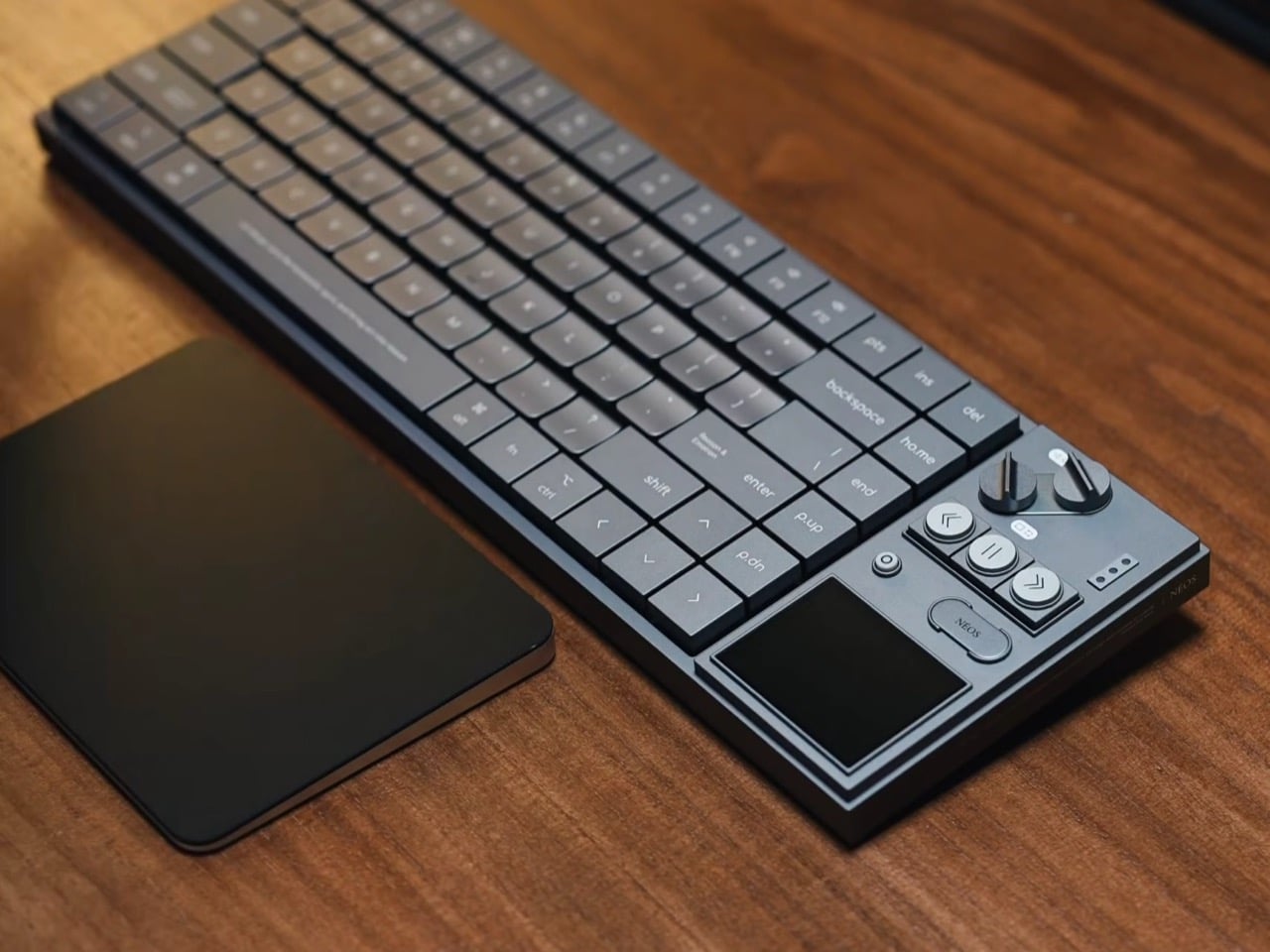
AULA’s Neos 75 puts a small control console beside an otherwise compact keyboard. Two metal knobs, round media buttons, and a 2.3-inch color display give the right edge the look of a miniature hi-fi component. The useful part is having volume and playback controls where your hand already works, without requiring another desk accessory. Designed by AULA.New Renaissance, the 84-key board also uses a CNC-machined aluminum chassis and aluminum keycaps, extending that hardware-focused approach across the surface you actually touch.

Custom low-profile Kailh switches sit in hot-swappable sockets, letting you change switches without soldering. A gasket mount supports the typing assembly, and wired, Bluetooth, and 2.4GHz connections offer different ways to connect your devices. China preorders opened in October, while wider regional availability needs checking before purchase. The physical compromise is right there in the layout: a compact 75% key arrangement doesn’t produce the smallest possible keyboard when a separate control console occupies the space along its entire right edge.

What we like

  • Dedicated knobs and media buttons put frequent controls within reach.
  • Hot-swappable switches leave room to change the typing setup.

What we dislike

  • The side console expands the footprint of the compact key layout.
  • A confirmed official US rollout remains unclear.

7. Fujifilm Instax Mini Evo 2
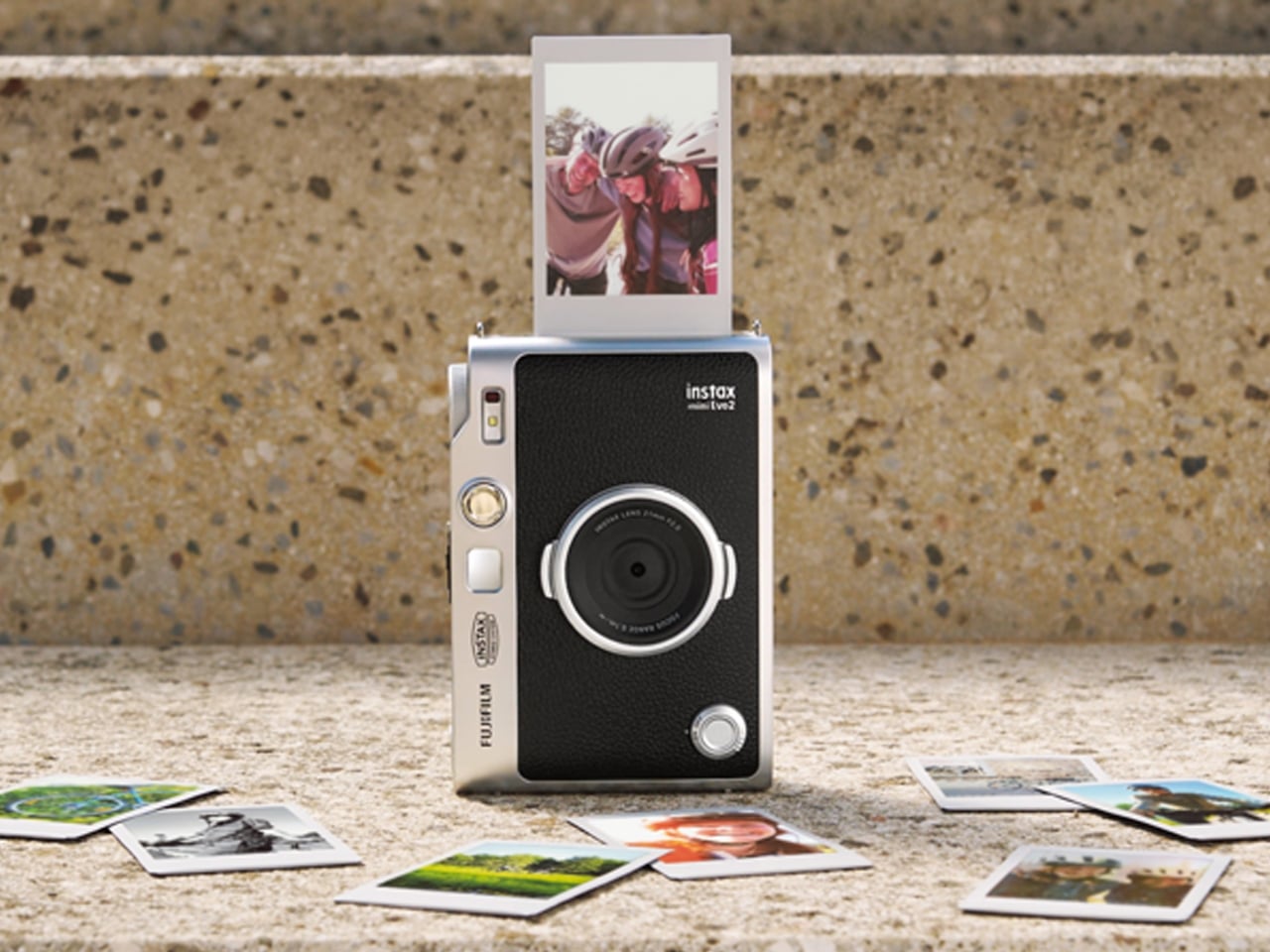
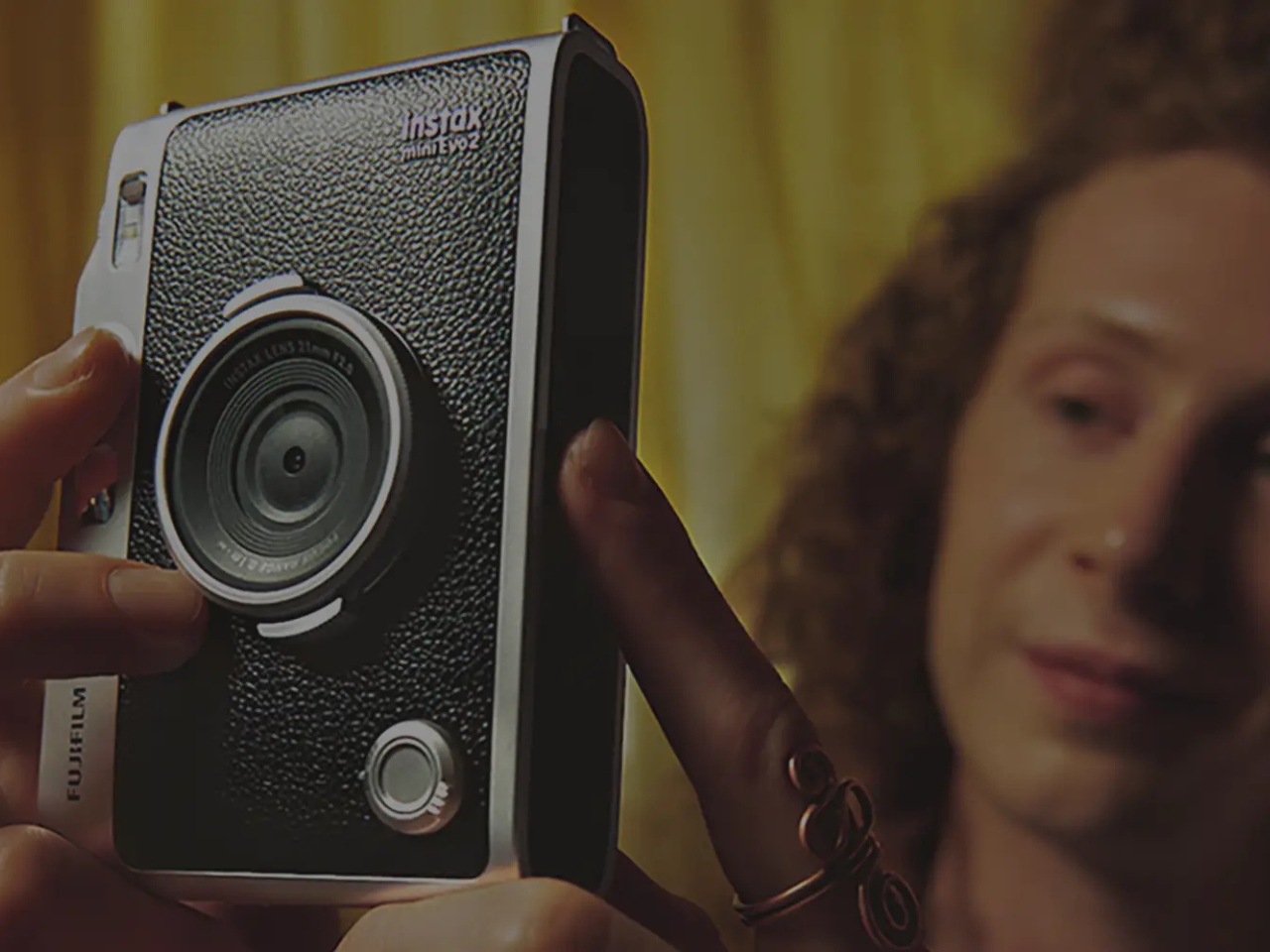
Fujifilm’s Instax Mini Evo 2 makes printing a choice rather than the unavoidable outcome of pressing the shutter. The hybrid camera lets you review and adjust a digital image before committing it to Instax Mini film. Its lens-effect dial, film-effect dial, and print lever preserve physical actions alongside a 4.5-inch touchscreen. For someone who likes the idea of instant photography but hates wasting film on an accidental exposure, that division of labor makes more sense than nostalgia on its own.

The camera offers 10 lens effects and 10 film effects, giving you 100 combinations before printing. Expanded View shows the area beyond the intended print frame, while the updated app supports printing smartphone photos and remote shooting. Fujifilm lists a US MSRP of $289.95, with availability expected toward the end of November. Film remains a separate purchase, and the new short-movie feature needs a microSD card. Those ongoing costs deserve just as much consideration as the camera’s appealing physical controls.

What we like

  • Reviewing images before printing gives you control over film use.
  • Physical effect dials complement the touchscreen rather than disappearing into it.

What we dislike

  • Instax Mini film adds an ongoing expense.
  • The short-movie feature requires a separately purchased microSD card.

8. Arduview Transparent Gaming Handheld
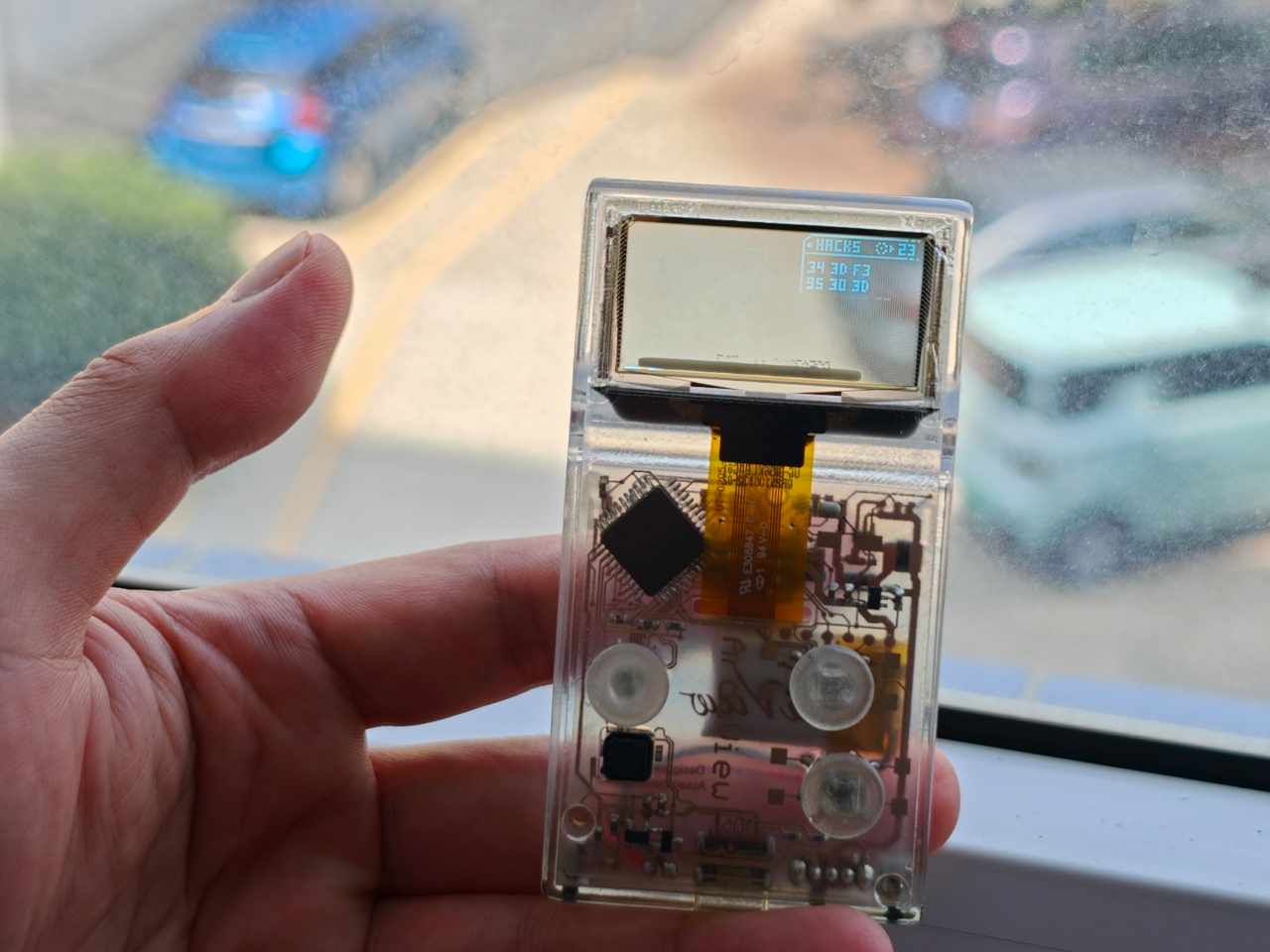
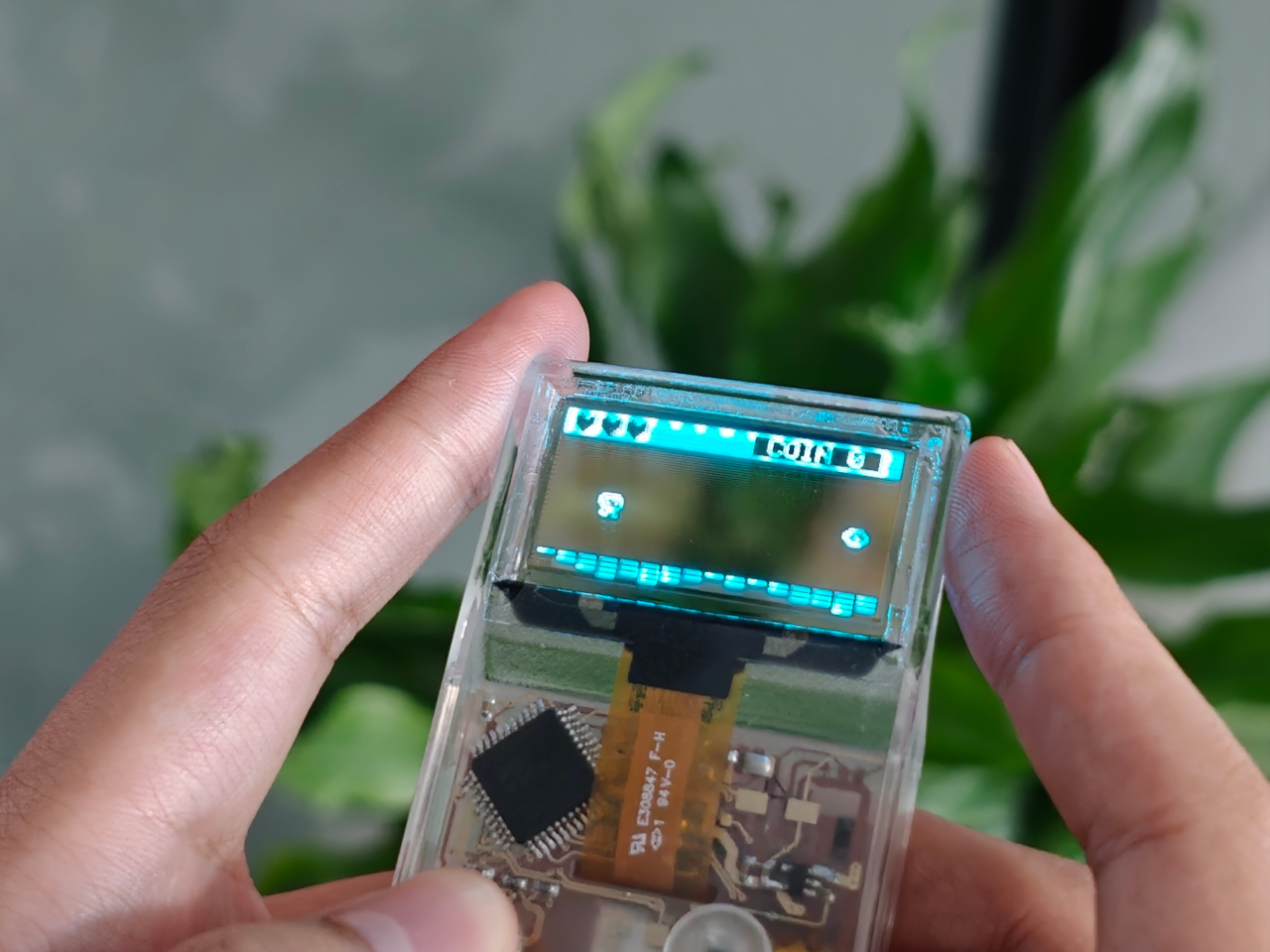
Arduview takes transparent electronics beyond a clear shell. Louis Huang’s handheld also uses a see-through circuit board and display, leaving the background visible around its illuminated cyan pixels. It’s an unusually direct way to turn the workings of a gadget into its visual identity. This isn’t only a rendering trick: VGC reports using a working unit and confirms that the transparent screen functions as shown. The project is now crowdfunding, rather than sitting on a shop shelf ready for delivery.

Built on the open Arduboy platform, the 50-gram device is pitched around 400 preloaded games and USB-C charging. That makes it a small, focused alternative to a phone full of gaming apps, with room for enthusiasts to explore the underlying platform. Arduview’s maker projects February 2027 shipping for early supporters, rather than November availability. Its appeal rests on a deliberately narrow gaming experience and a display construction; neither should be confused with the capabilities of a larger, mainstream handheld console.

What we like

  • Transparency extends to the screen, not merely the enclosure.
  • The open Arduboy platform offers scope for tinkering beyond preloaded games.

What we dislike

  • February 2027 shipping is a projection, not immediate availability.
  • Its niche Arduboy library won’t suit someone seeking mainstream console games.

Match the Gadget to the Habit

The most useful way to approach this list is to start with a recurring annoyance, not an empty spot on the desk. A mouse that packs differently has a clear job. So does a CD player that lets an existing collection leave the cupboard. More specialized hardware needs a closer match to your habits: a phone cooler only matters if heat is a problem you actually encounter while using it.

Timing deserves the same scrutiny as design. A reservation, a crowdfunding pledge, and a retail order are different commitments, even when the product photography makes them look equally finished. If you need something for this month, check the version, delivery estimate, and accessories before paying. If you’re following an upcoming design, keep the expected date in view. An interesting object can be worth watching without being the right purchase today.

The post The 8 Best Tech Gadgets of November 2026 first appeared on Yanko Design.

  •  

NOX Cordless Lamp Lets You Carry the Beam Without the Base

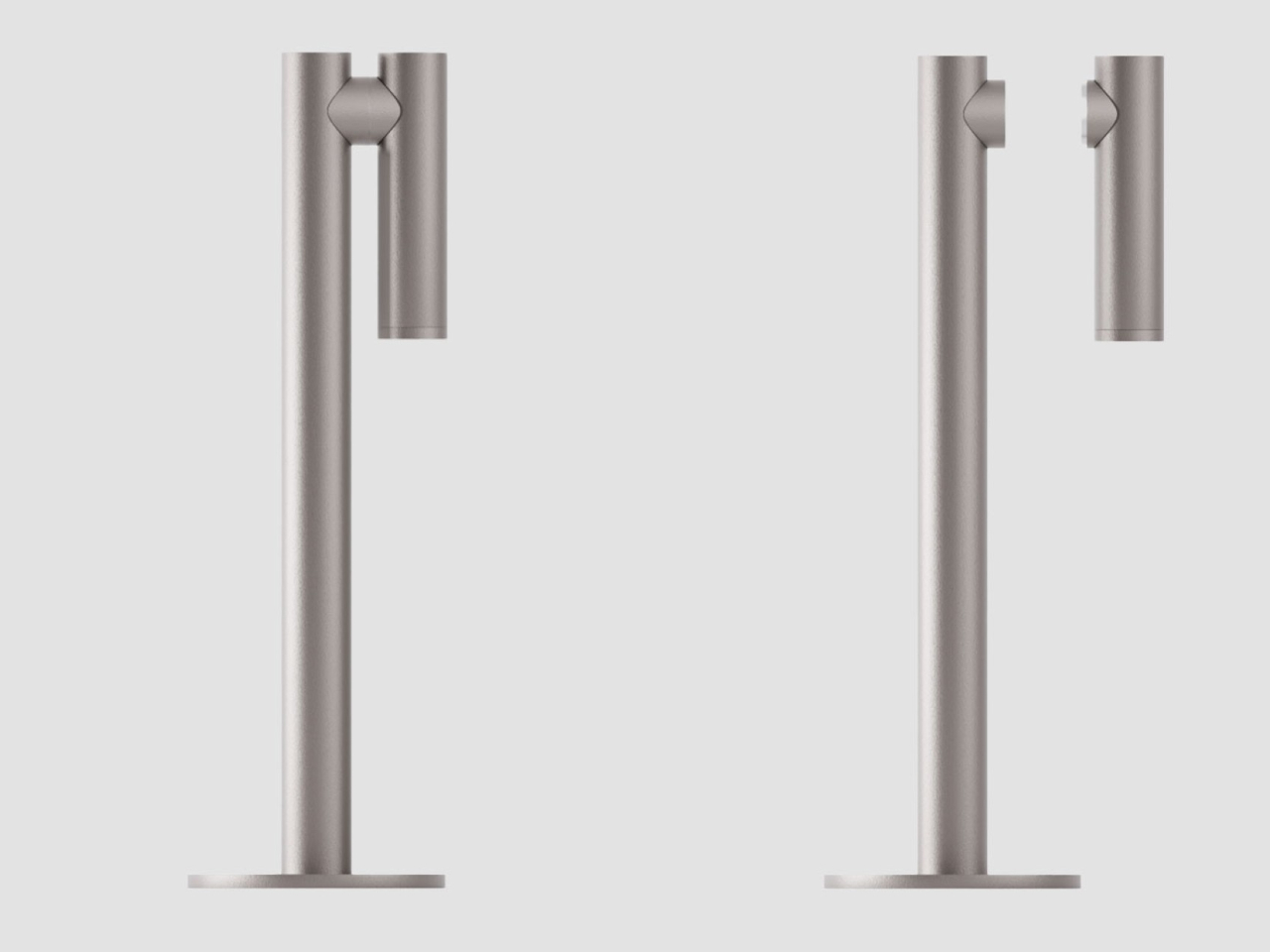
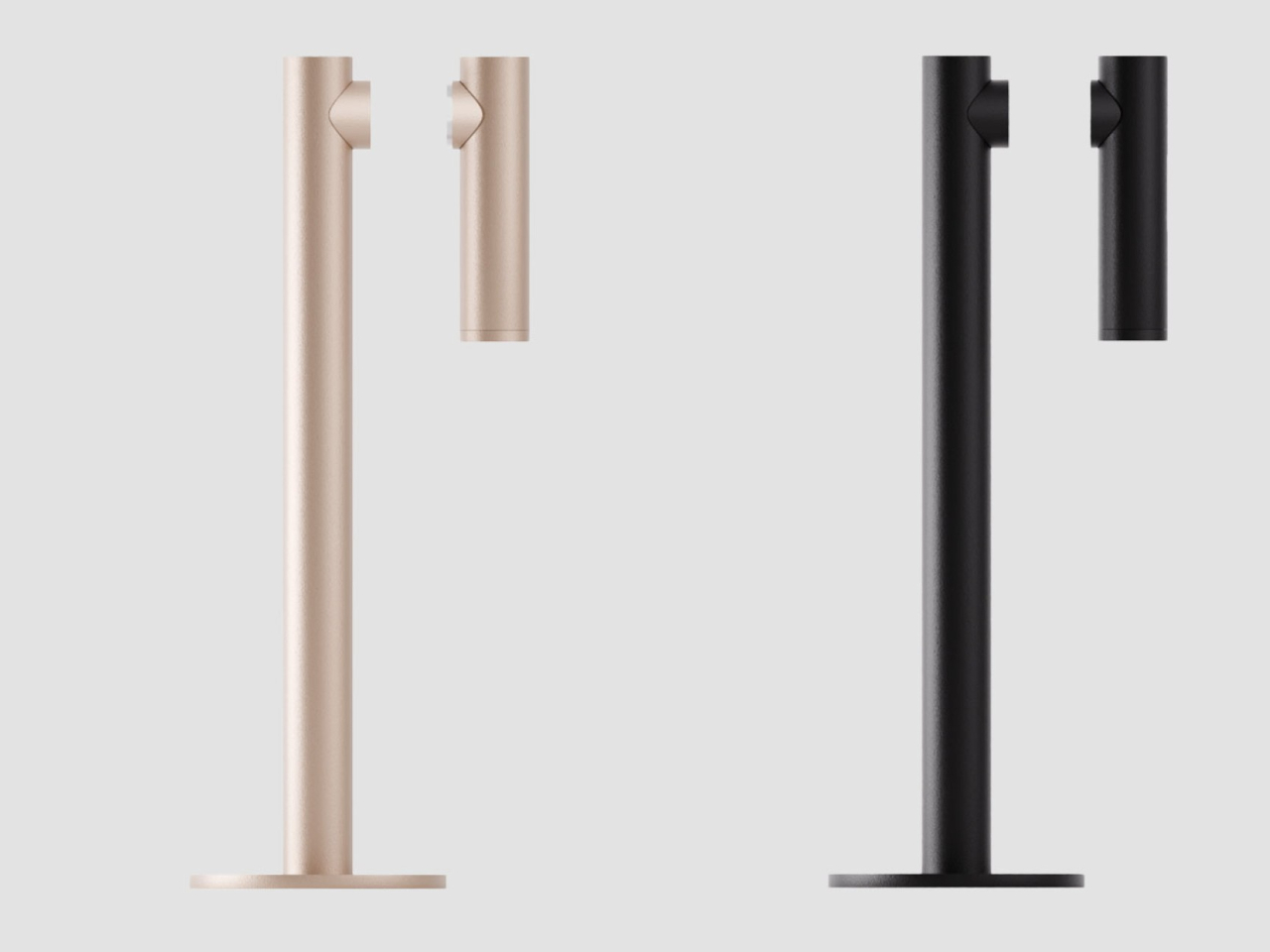
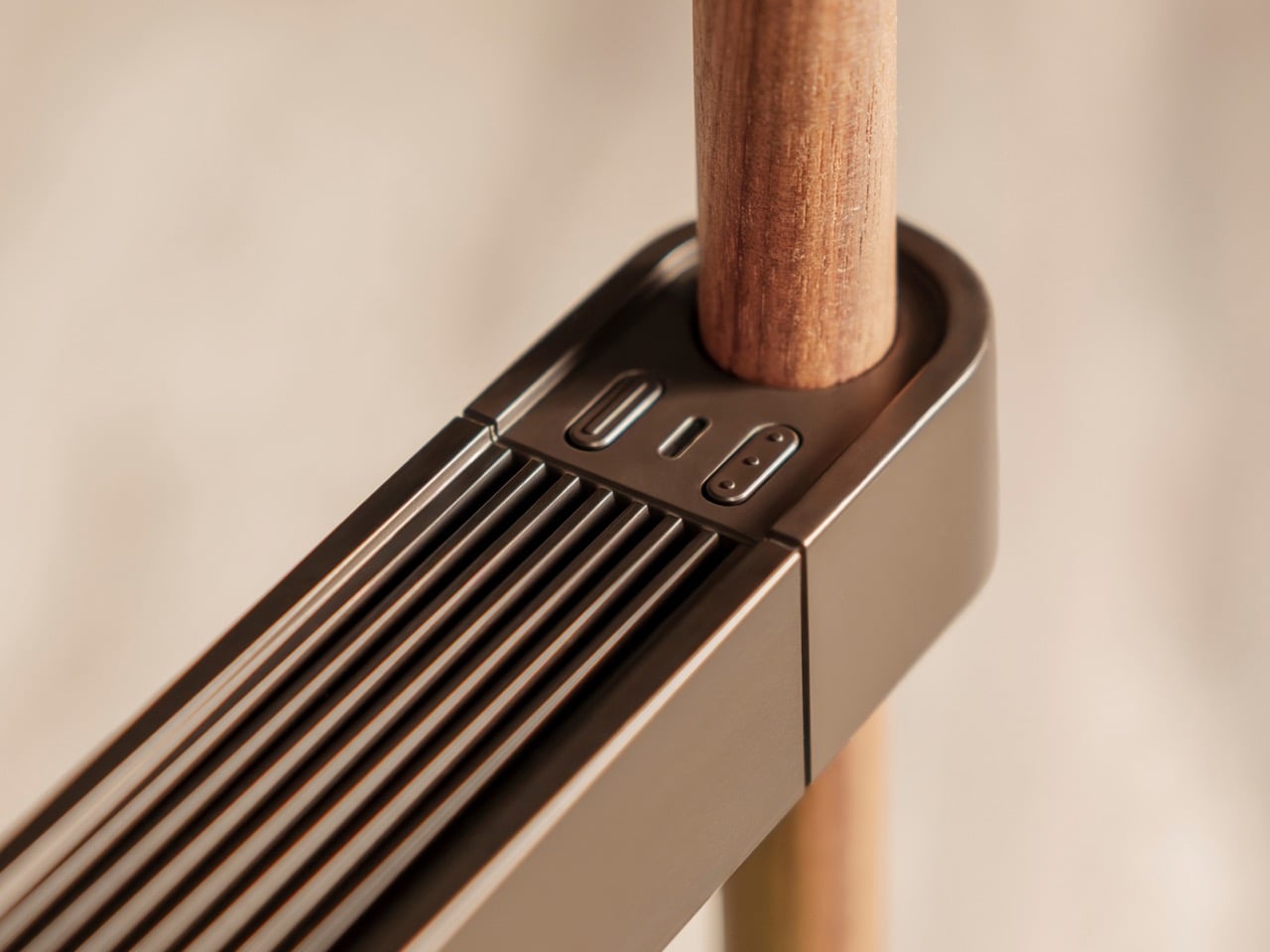
Cordless table lamps let you move the whole fixture, but sometimes you only need to take the light. Studio Apure’s NOX makes that distinction with a magnetic head that lifts away from its stand and becomes a small flashlight. The stand can stay beside your chair while its illuminated tip follows you down a dark hallway, without carrying the base along for company.

The shape gives that arrangement a surprisingly tidy home. A slender upright rises from a flat circular foot, with a shorter cylinder attached near the top. There’s no broad shade or long articulated arm competing for space above a bedside table. Onyx Black, Nimbus Grey, and Dune Beige keep the finish choices subdued, letting the changing angle of the head supply most of the character.

Designer: Studio Apure (via The Curation)

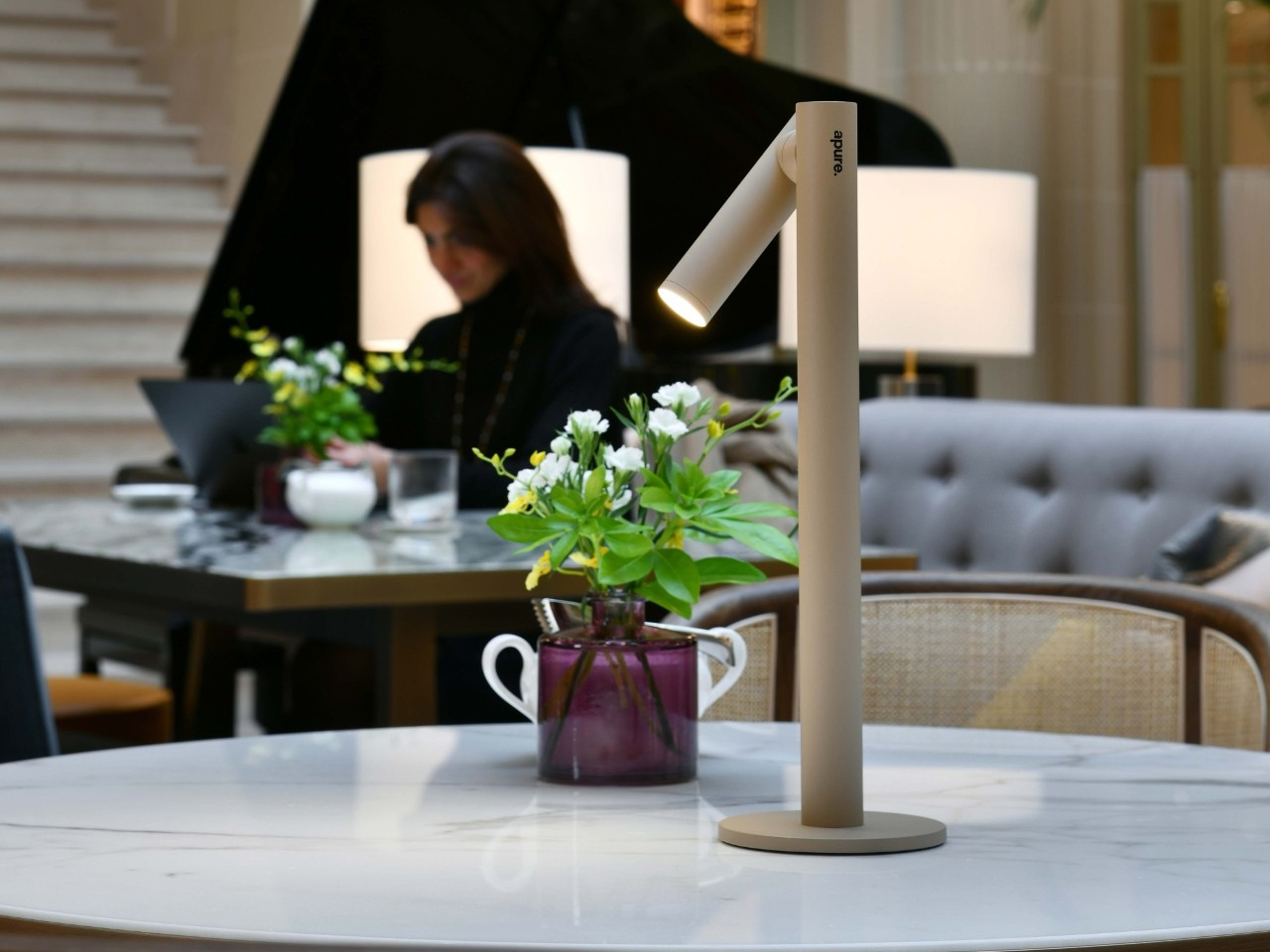
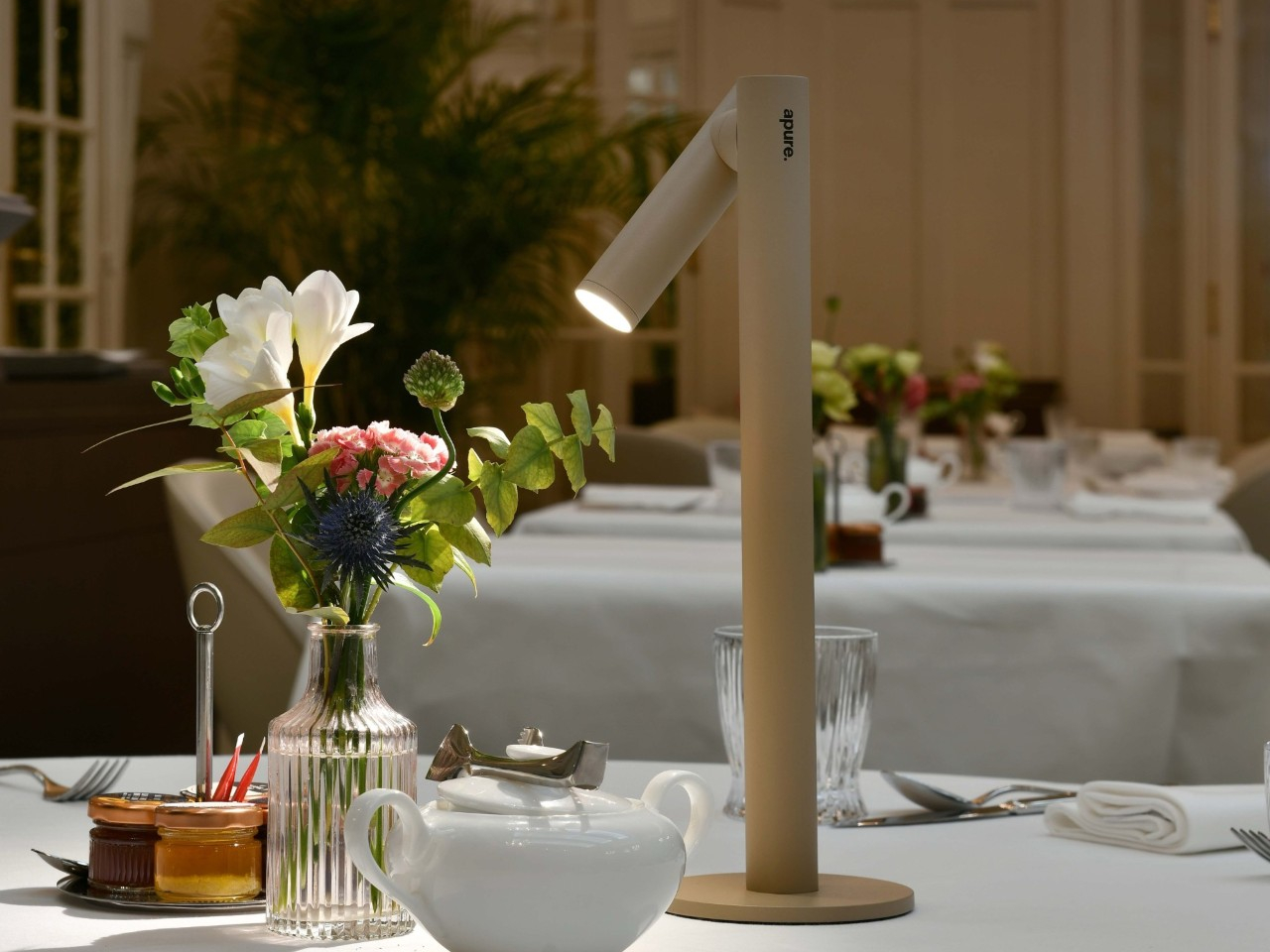
That head rotates through 360 degrees, so you can redirect the beam without shifting everything else on the table. An adjustable lens changes its spread from a broad glow to a concentrated spot. You might keep the light wide during dinner, then narrow it toward a book afterward, giving the same small fixture two different jobs without changing where the stand sits.

Brightness gets its own adjustment, separate from the beam’s width. Tap the top of the head to switch the LED on or off, and hold to dim it between 5% and 100%. Its 140-lumen output has a warm 3000K color temperature. The touch control stays with the detachable head, so it remains accessible when you’re carrying the light without its supporting stand.

Taking it off the stand changes the scale of what you’re carrying. You can check behind a sofa or retrieve something from a dark closet without balancing an entire lamp in one hand. Return the head to its magnetic attachment, and its battery recharges from the stand. That gives the removable part a parking spot, which is useful for something so small.

Studio Apure estimates 12 to 14 hours of cordless operation for the complete lamp and up to an hour for the detached flashlight, both at full brightness. Recharging the lamp takes about seven hours using the supplied dock and adapter. The stand is therefore the longer-lasting arrangement, while the little light you pull away is better suited to shorter trips around home.

Outdoor trips still come with a few restrictions. NOX carries an IP54 rating, but Studio Apure restricts it to indoor or covered outdoor settings and advises avoiding direct water contact. A sheltered patio table fits that brief; leaving it exposed in the garden doesn’t. Cordless operation removes the outlet from the seating arrangement, not the need to bring the lamp under cover.

Listed at $385, NOX puts a substantial price on that flexibility. Its 2.03-pound weight still lets you carry the whole lamp when you want light somewhere else, while a flashing red ring warns you when it’s time to recharge. You’ll just need to return the head to its stand, since a magnetic connection can’t recharge something you’ve abandoned in a kitchen drawer.

The post NOX Cordless Lamp Lets You Carry the Beam Without the Base first appeared on Yanko Design.

  •  

LEGO Bauhaus Chess Concept Has Hidden Clues to Its Moves

A knight’s horse-shaped head is easy to recognize, but it offers no clue about that peculiar L-shaped move. That’s a small frustration with learning chess: identifying the pieces and remembering what they do are two separate tasks. I like the idea of giving their shapes a little more responsibility, especially when the alternative is explaining the knight’s movement for the fifth time.

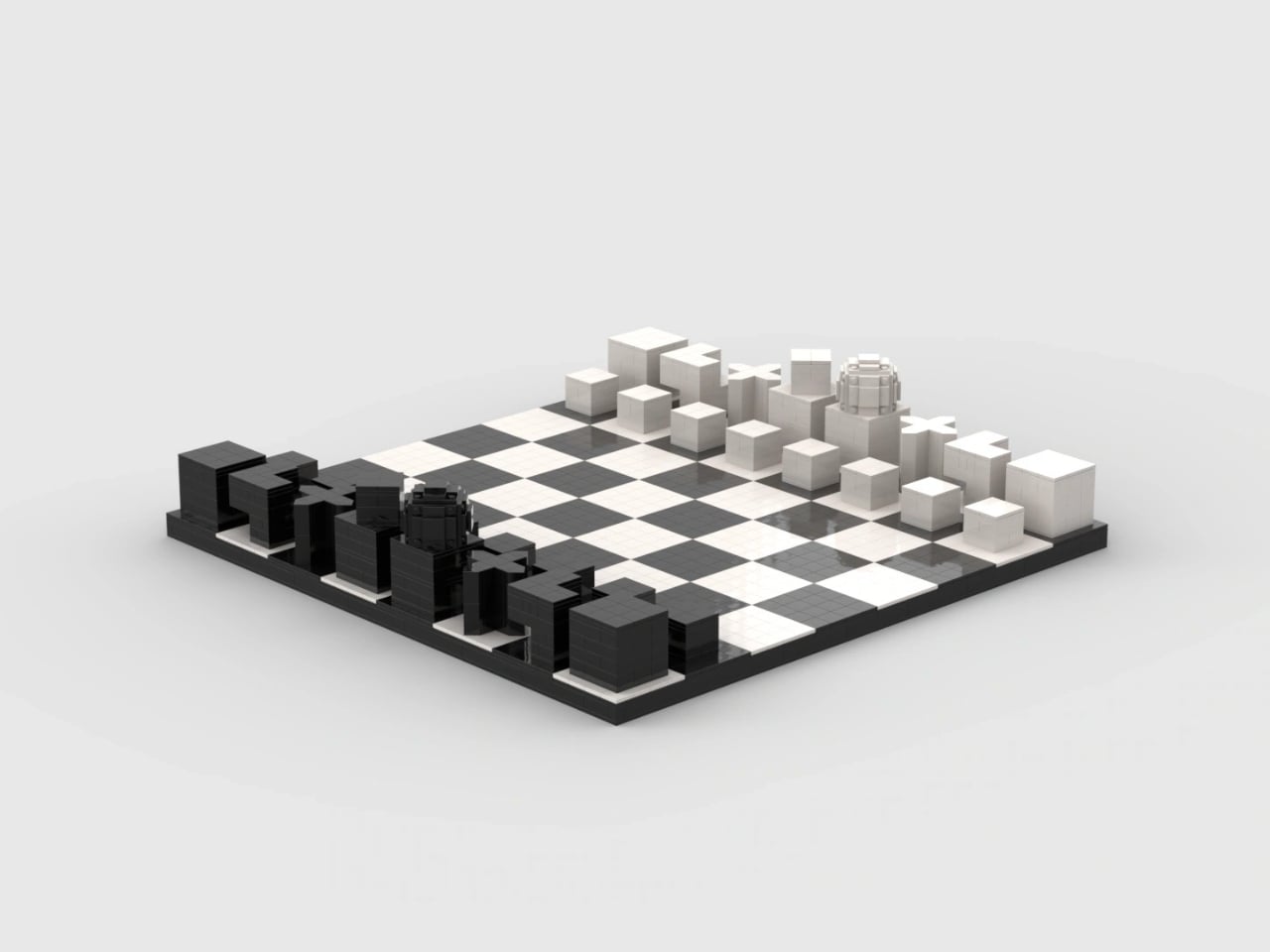
Pinke Gans’s Bauhaus Chess Set, a LEGO Ideas fan concept, takes that possibility as its starting point. According to the designer, the idea emerged during a summer visit to the Bauhaus Museum in Weimar, Germany, where Josef Hartwig’s geometric chess pieces brought LEGO bricks to mind. It’s an appealing connection: a construction system built around basic shapes meets a chess set designed to make those shapes meaningful.

Designer: Pinke Gans

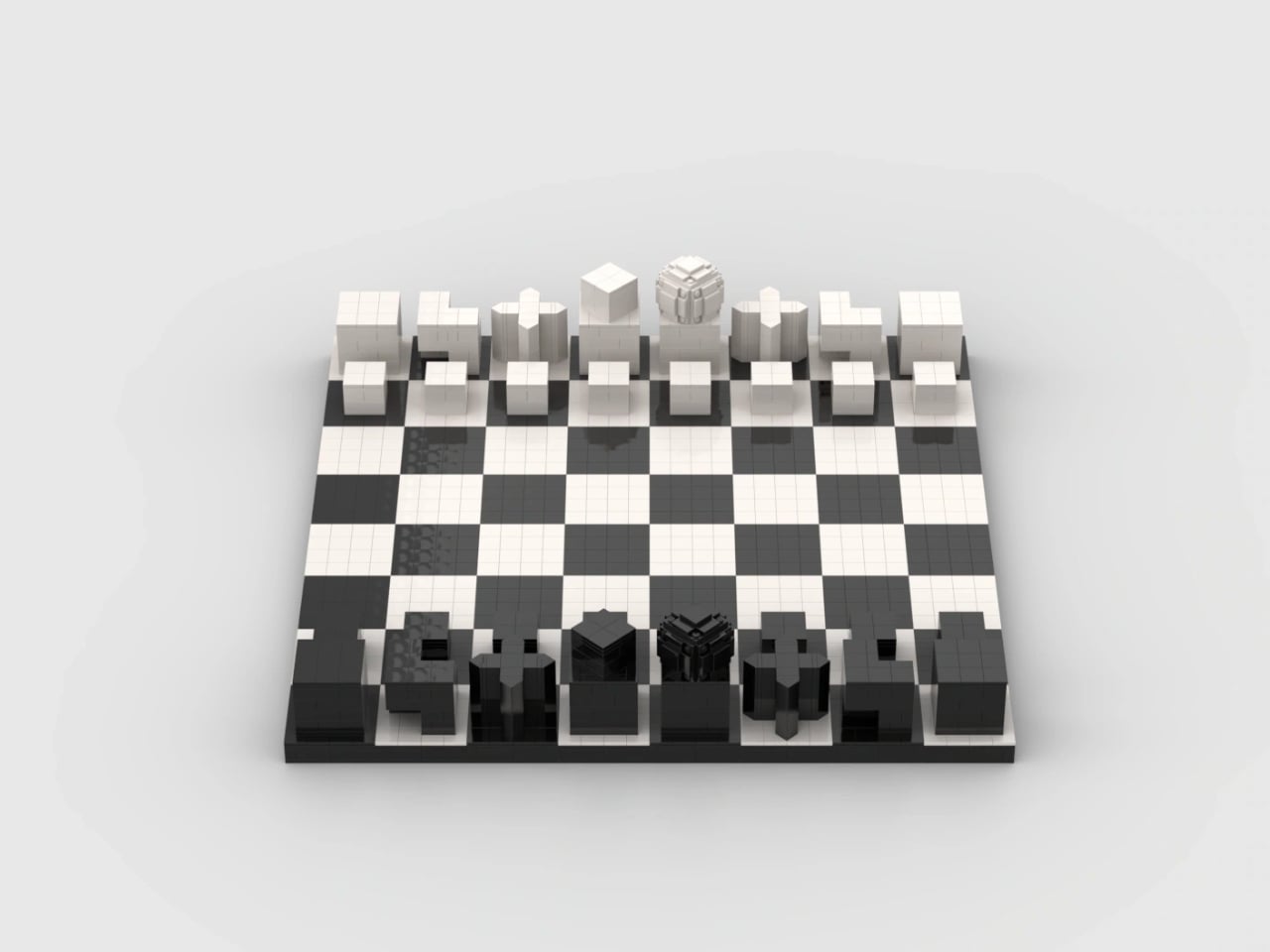
Hartwig designed his Bauhaus chess set in 1923, while working at the school in Weimar. Its abstraction wasn’t simply a matter of removing decorative details. The pieces used their forms to communicate their movement, replacing familiar figures with a geometric vocabulary. A minimalist chess set can still leave you memorizing arbitrary symbols; Hartwig’s approach gives some of those symbols a practical explanation.

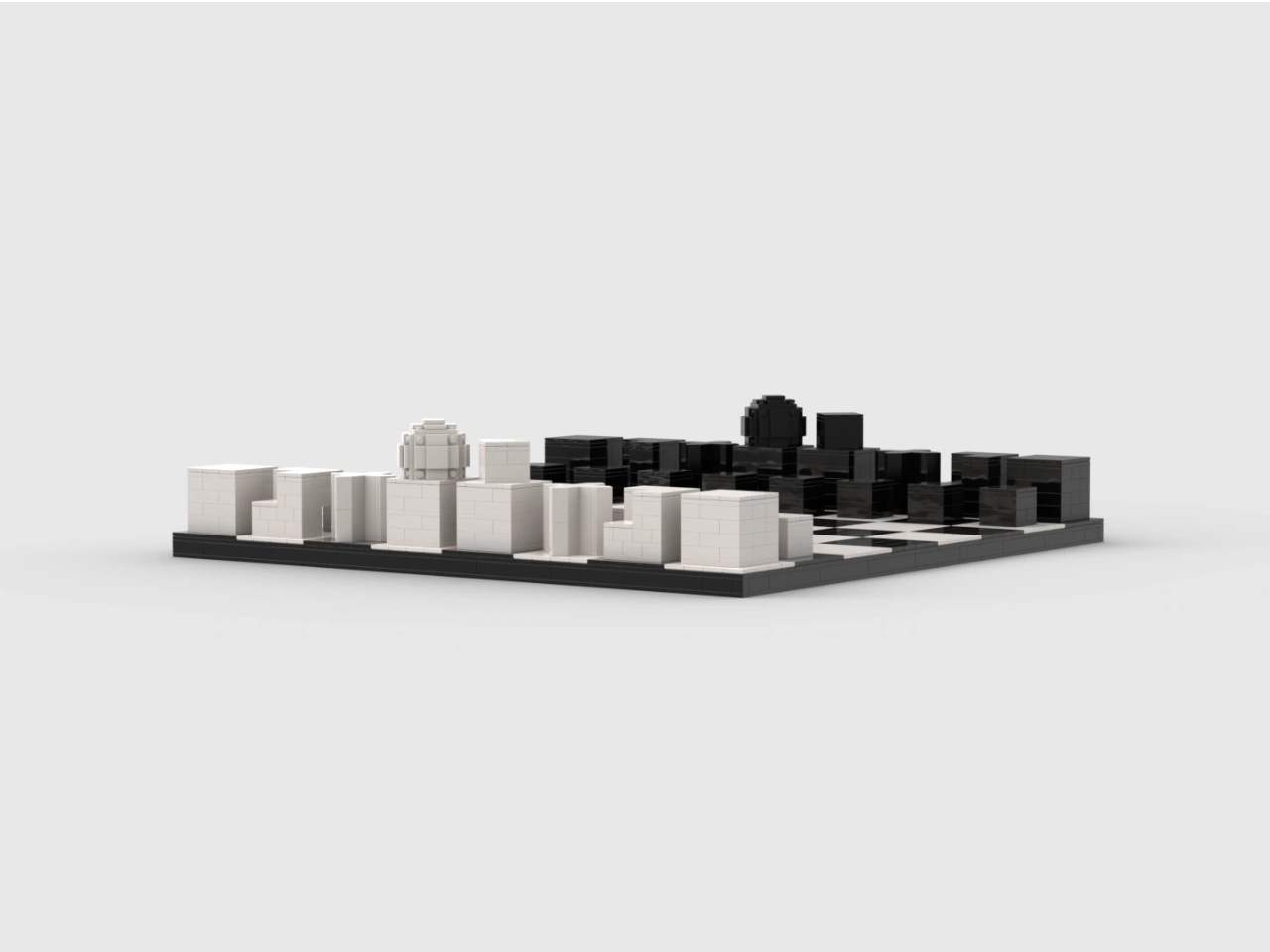
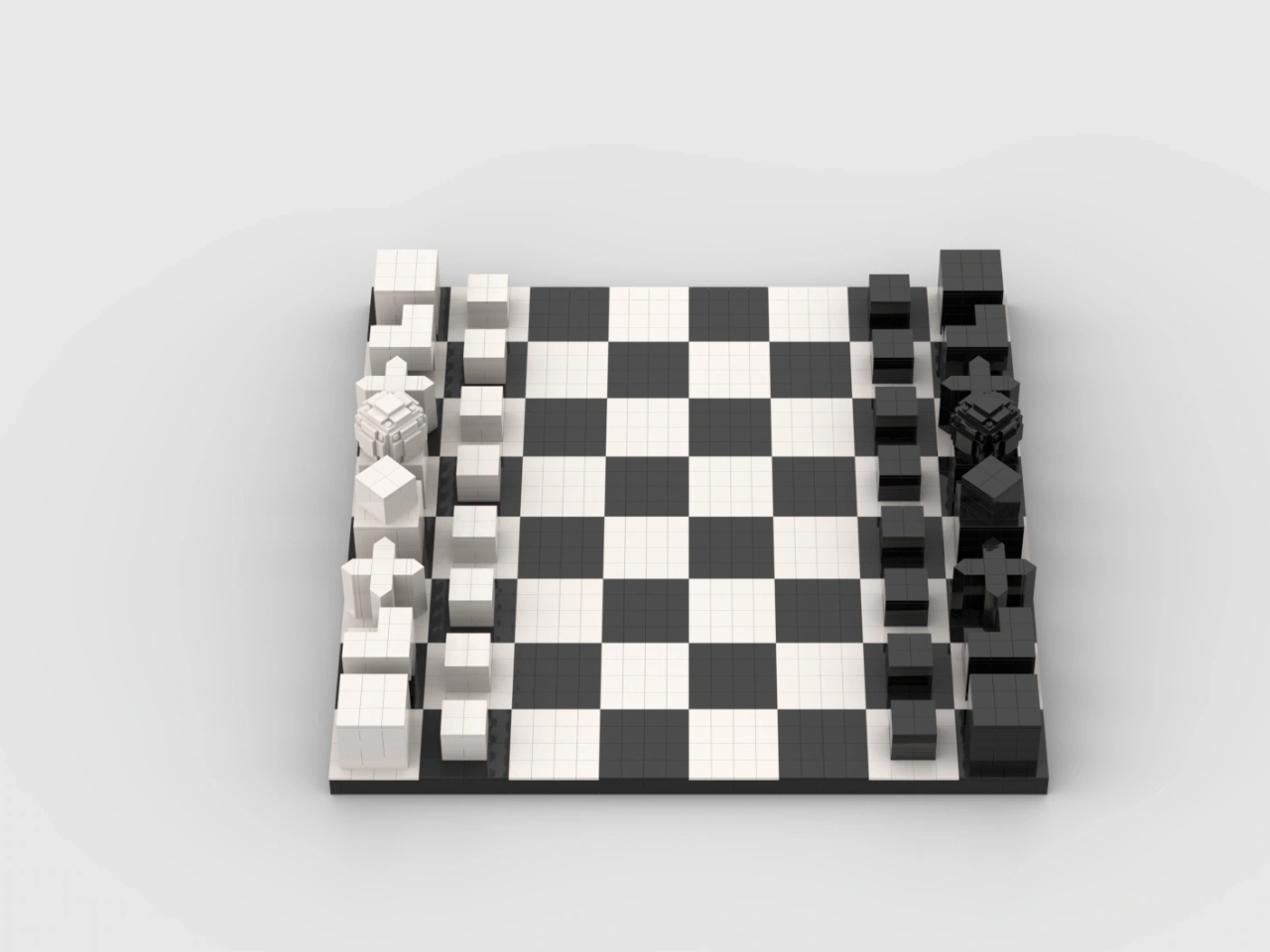
The knight is the clearest example. Its stepped shape echoes its L-shaped movement, while the bishop’s diagonal cross relates to its diagonal paths across the board. Pinke Gans’s version carries those recognizable forms into bricks. These are useful memory cues, not a complete substitute for learning the rules. Nobody should expect a small cube to explain every complication of a pawn’s first move or capture.

In the supplied images, the queen provides the most conspicuous departure from all those straight edges. Its rounded top becomes a faceted, layered construction, with individual elements visible around its surface. Nearby, the king has a smaller cube turned relative to its base. Together, they introduce enough variation to interrupt the rows of blocks. The brick-built approximation of a sphere gives the queen a texture of its own.

That translation is more interesting to me than a perfectly smooth replica would be. Historical examples of Hartwig’s set were made in wood, so rebuilding the forms in LEGO changes how their surfaces read. Here, joints and tile seams remain visible. They establish a second, finer grid within the larger chessboard pattern, making the construction legible even where exposed studs don’t dominate the design.

The board itself stays restrained: black and white squares, a dark perimeter, and no elaborate scenery competing with the pieces. From the lower viewing angles, the arrangement resembles a small collection of architectural models. I could see this earning its place on a living room table because the visual interest comes from proportion and repetition, rather than decoration.

There is a potential usability tradeoff, though. If you already recognize conventional chess silhouettes instantly, a geometric set asks you to learn a different identification system before its logic becomes helpful. A blocky king and a rounded queen might be clear once explained, but that doesn’t establish faster recognition during play. The images also can’t tell us how securely the pieces hold together when repeatedly picked up.

The project is presented as a LEGO Ideas proposal, rather than an announced retail set. That distinction deserves to stay attached to the enthusiasm. Fan product ideas that reach 10,000 supporters may be considered for production, but reaching that threshold doesn’t itself put a box on store shelves. This submission shouldn’t be treated as a confirmed release or given an imagined price.

For me, the strongest reason to want it is the opportunity to assemble the shapes before playing with them. Building a knight’s stepped form could make its design rationale more tangible than simply reading an explanation beside a finished piece. You’d still need to learn chess. But spending a little time constructing the thing that represents a move seems like a particularly appropriate introduction to Hartwig’s idea.

The post LEGO Bauhaus Chess Concept Has Hidden Clues to Its Moves first appeared on Yanko Design.
  •  

Hal Jordan has to recharge his ring, but the NoxTi titanium EDC lantern glows for decades

Every Green Lantern has the same annoying chore. Once a day, the ring needs a top-up, so our cosmic cop has to press his fist against a glowing green lantern and recite a whole poem before it’ll charge. Imagine your iPhone demanding spoken word every night before you plug it in.

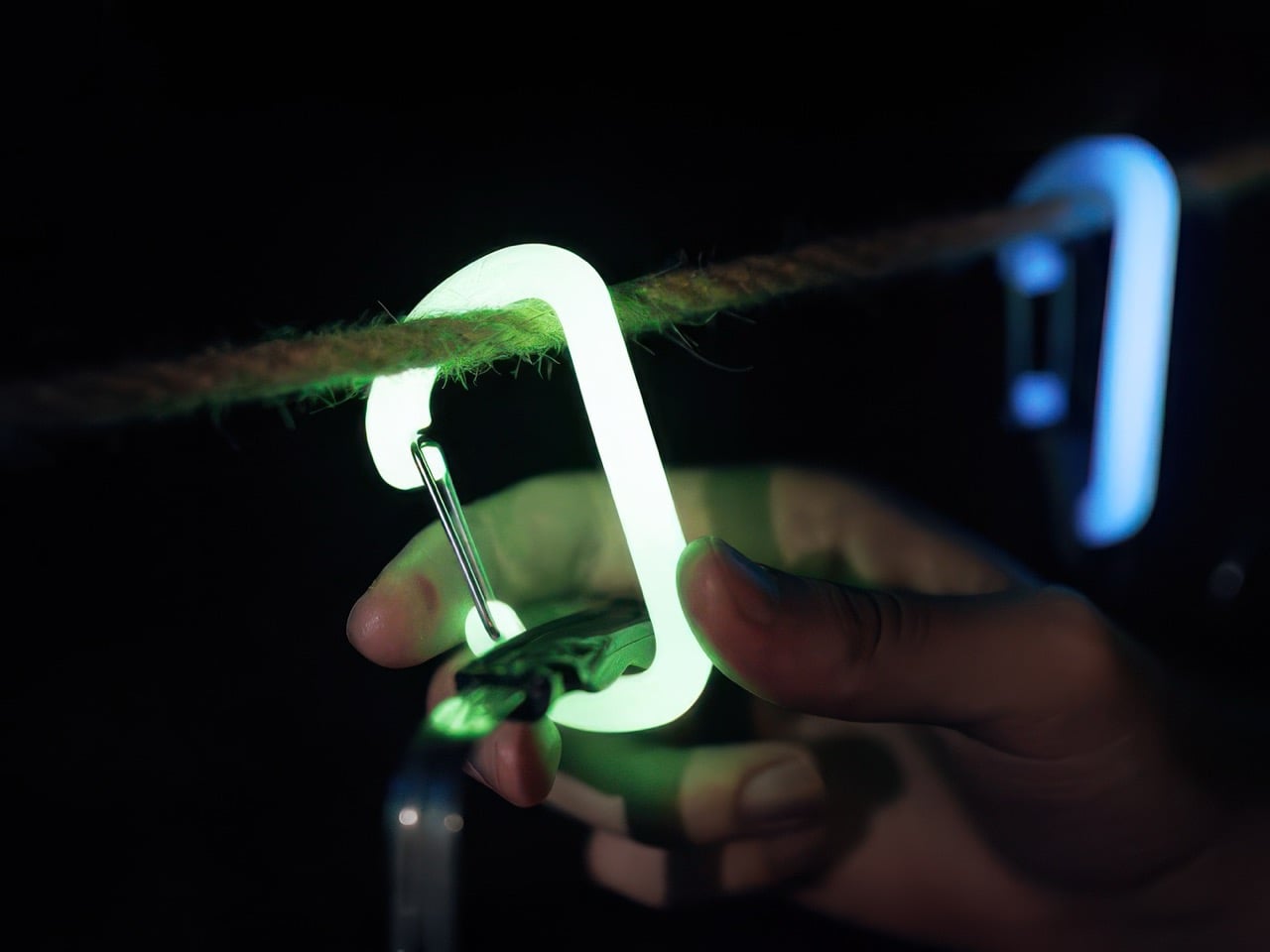
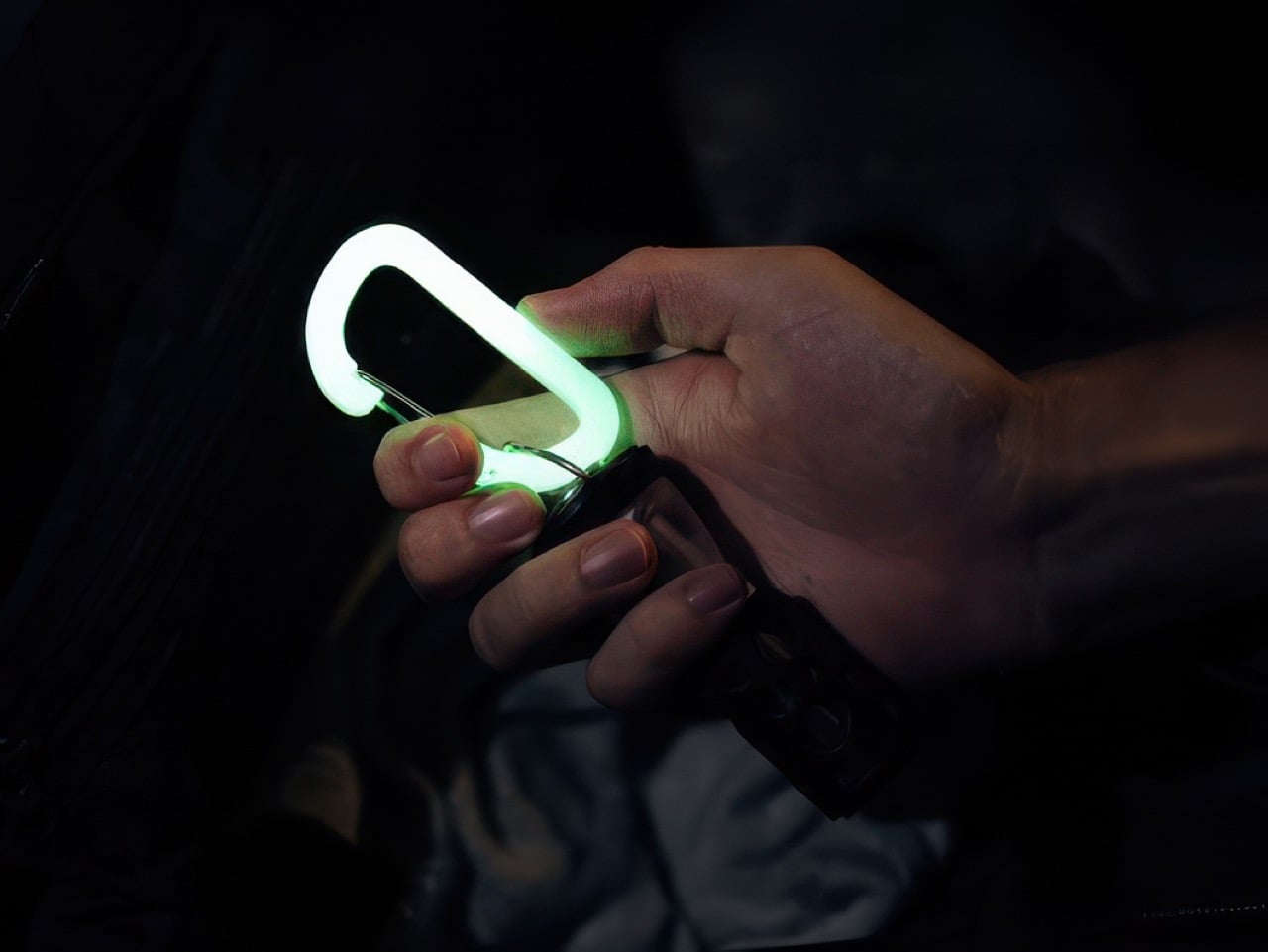
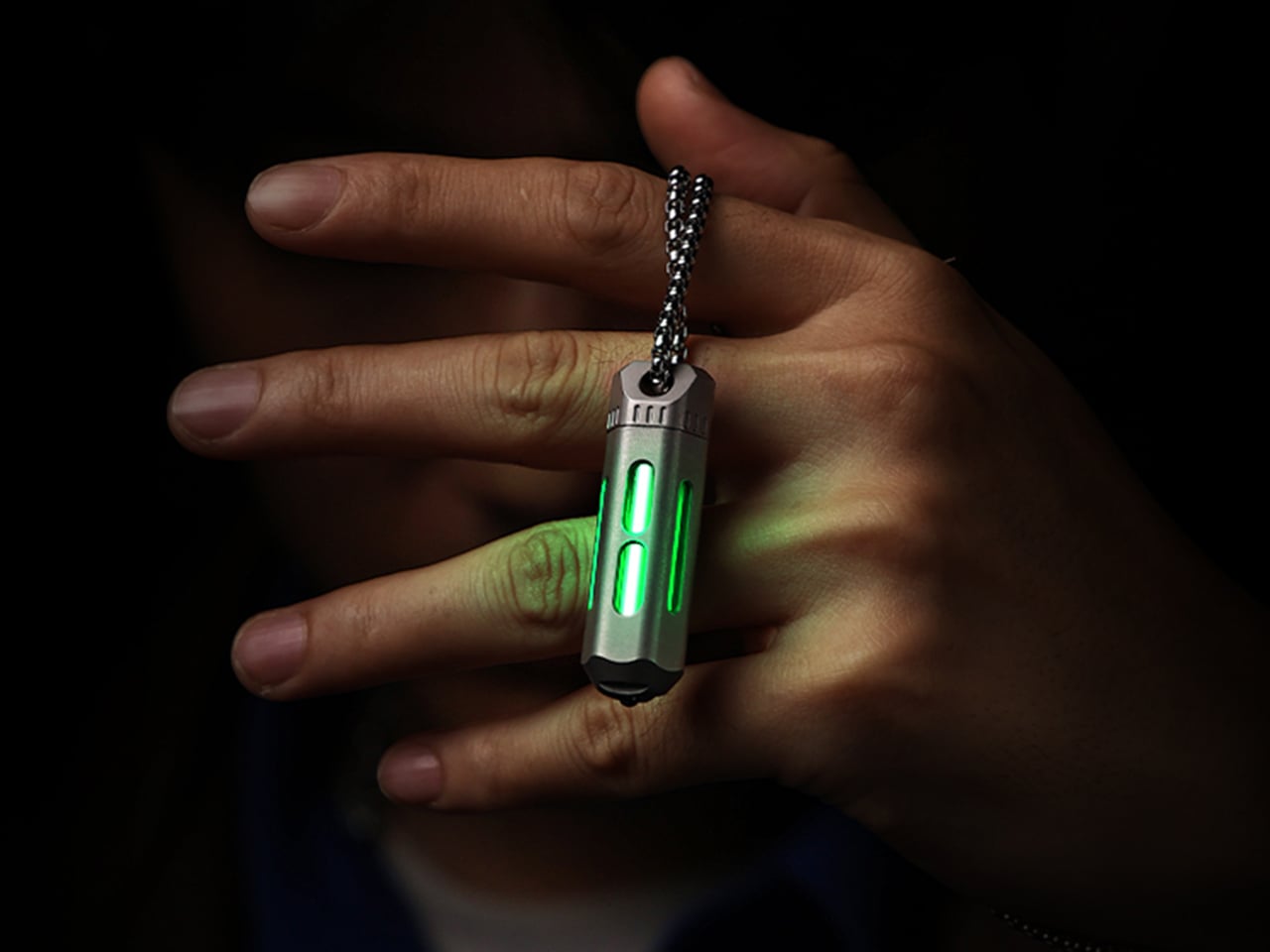
Xedge’s NoxTi TRI skips the ritual. It’s a pocket-sized lantern in Grade 5 titanium that hangs off your keys or around your neck, with three glow tubes tucked inside. Fit it with tritium tubes and it glows without charging, a switch, or poetry, slowly dimming over a couple of decades. Prefer something non-radioactive? Photoluminescent tubes absorb light and glow after dark. Hal would be jealous.

Designer: Xedge

Click Here to Buy $35 $55 (36% off). Hurry, only a few left! Raised over $81,000.

Three Tubes, One Glowing Core

NoxTi TRI holds three 3 x 22.5mm glow tubes spaced 120 degrees apart to keep the glow visible from more angles, whether the capsule is dangling from a keyring or lying in a cupholder. The tubes sit in a custom carrier made of optical-grade PMMA acrylic, for which Xedge claims around 97 percent light transmission. The carrier is designed to use total internal reflection to distribute the light, making the three tubes appear as one luminous core behind the titanium windows.

Six colors are on the menu: Apple Green, Ice Blue, Ocean Blue, Red, Violet, and Sunset Orange. Run one across all three slots for a uniform glow, or mix them. Yes, that means three Lantern Corps on one keyring. Tritium is the set-and-forget option. Its half-life is about 12 years, so the glow gradually dims rather than switching off, with Xedge describing a usable lifespan of about two decades. That’s still a better deal than any battery I own. The tritium is sealed inside glass vials, and Xedge reports a radiation-meter reading of 0.07 µSv/h. Photoluminescent tubes are the cheaper, non-radioactive option, recharging through exposure to light.

Titanium Outside, Shock Absorbers Inside

The shell is CNC-machined from Grade 5 titanium, an alloy also used in aircraft parts and bone implants. Its corrosion resistance should suit the sweat and daily handling of life on a crowded keyring. It measures 47mm long and 14.3mm across, and weighs 15.8 grams, roughly the weight of three US nickels. Inside, a quartz sleeve surrounds the glowing core to help keep dust out and the view clear, while O-rings seal the threaded body. Xedge says it tested the design at temperatures from minus 20°C to 100°C. It comes in sandblasted raw titanium or a stealthier Black DLC finish. I’d pick the black, purely because the glow stands out more against it.

The more interesting detail is how the design cushions those glass tubes. Each one rests on a 3mm silicone ball, and a stainless steel spring under the core is intended to absorb jolts from dropped keys or a swinging pendant. That spring sits on a magnetic base to help keep it in place when you unscrew the body to swap tubes, reducing the chance of tiny parts bouncing across the kitchen floor. A machined Tri-Index Cap keeps all three tubes aligned with their windows. Xedge says every component is accessible and replaceable, giving the titanium shell a chance to outlive several sets of tubes.

Wear It, Clip It, Break Glass With It

The attachment hole at the top takes a split ring, a quick-release clip, or a chain, so the TRI can live on your keys, hang off a bag zipper, dangle from a phone strap, or ride around your neck as a pendant. The kit supports both single-tube and triple-tube setups, so you can switch between them. On the opposite end sits a ceramic glass-breaker bead, intended for breaking car windows in an emergency, which I sincerely hope nobody ever needs. Keep expectations calibrated, though: this is a locator glow for finding your keys or bag in the dark. It won’t light up a trail.

The NoxTi TRI Kickstarter campaign lists a retail price of about $55 (HK$429) per unit. Pledge pricing starts at $35 for the launch special, followed by $39 for Super Early Bird and $45 for Early Bird, with two-packs from $65 and a four-pack at $119. Glow tubes are separate add-ons: tritium costs $20 per tube or $60 for three, while photoluminescent tubes are $7 each or $15 for three. Extras include the Black DLC upgrade ($15), a stainless steel necklace ($12), a titanium quick-release clip ($15), and titanium split rings ($12 for three). Shipping is listed as free worldwide, with deliveries planned for February 2027. Xedge hasn’t published warranty terms yet.

Click Here to Buy $35 $55 (36% off). Hurry, only a few left! Raised over $81,000.

The post Hal Jordan has to recharge his ring, but the NoxTi titanium EDC lantern glows for decades first appeared on Yanko Design.
  •  

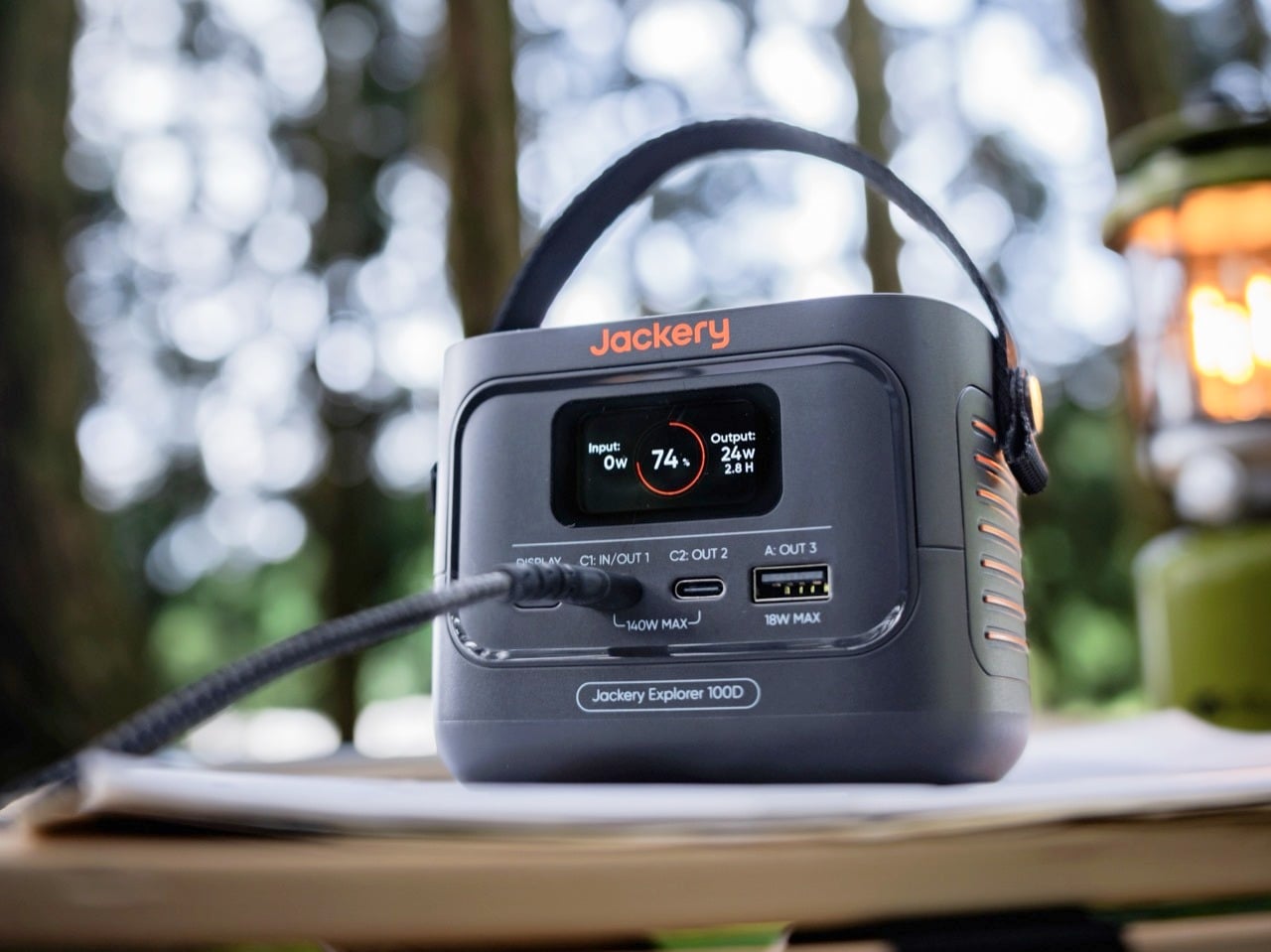
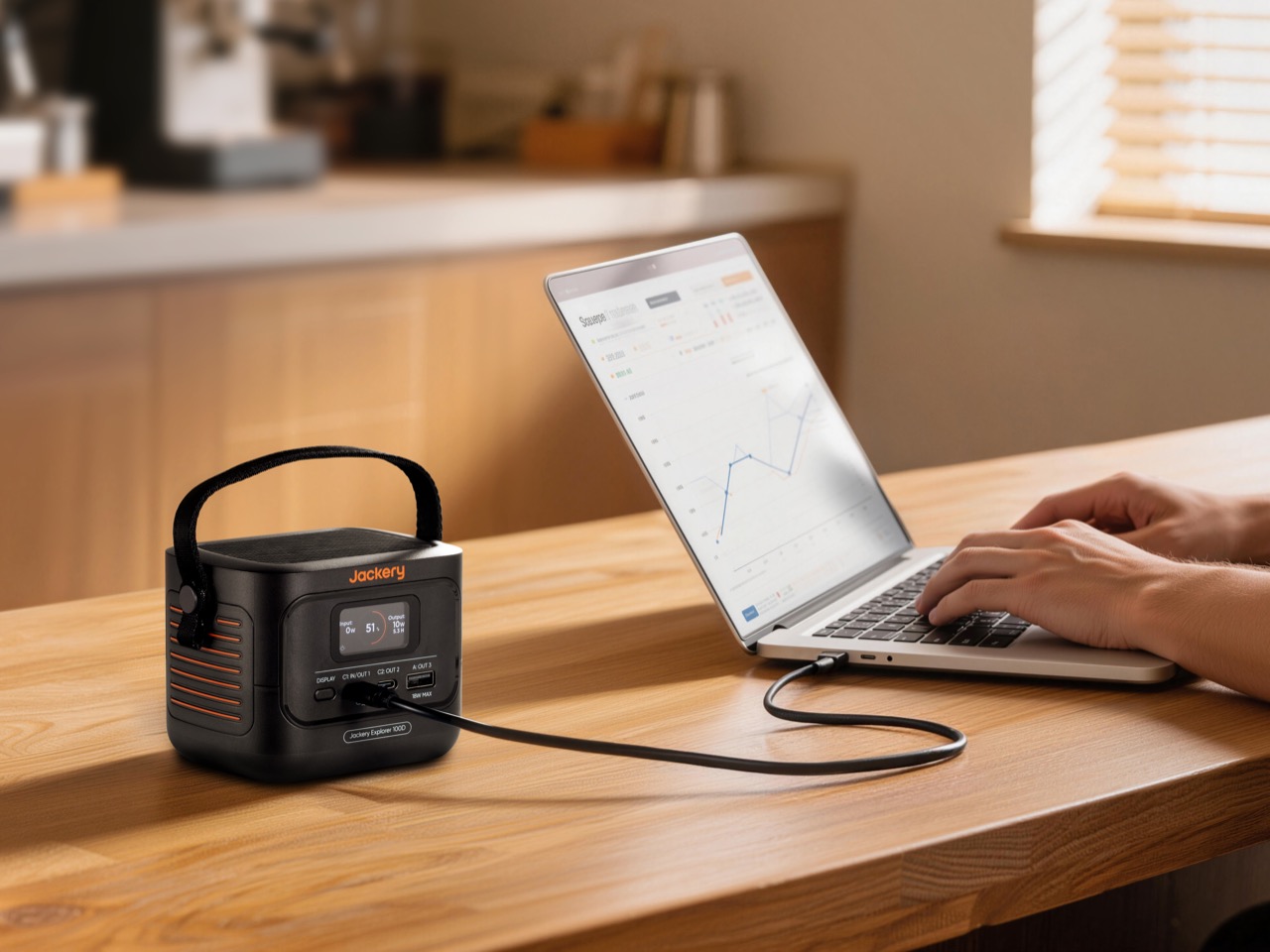
Jackery shrank its power station into a 96Wh cube with 140W USB-C

Jackery’s new Explorer 100D looks like it should play AM radio. The squat little cube has a framed front panel, orange slatted vents down its sides, and a webbing strap you’d expect on a vintage transistor set. Instead of tuning into ballgames, it stores 96Wh of energy and delivers up to 158W across two USB-C ports and one USB-A port. It measures 4.67 by 3.25 by 3.37 inches (11.9 x 8.3 x 8.6cm), making it roughly softball-sized, and weighs 1.87 pounds (850g). It’s the smallest power station Jackery has ever built.

Jackery’s D-series models skip the AC outlet entirely, and that decision explains much of the design. They don’t need an inverter, a bulky component that generates heat and often requires a cooling fan. Leaving it out lets the box shrink to desk-friendly proportions, while the 96Wh battery sits just below the FAA’s 100Wh threshold for batteries carried without airline approval. Jackery estimates more than four charges for an iPhone 17 or Galaxy S26, or roughly one full recharge for a 14-inch MacBook Pro. That’s a useful reserve in something that weighs less than the laptop it’s charging.

Designer: Jackery

One Button Runs the Whole Show

A TFT display on the front tracks input and output wattage, battery level, and estimated runtime, with additional screens for battery health, cycle count, and internal temperature. One DISPLAY button handles it all. Tap once to flip between status screens, double-tap to keep the screen on or switch it off, and hold for three seconds to enter Low-Power Charging Mode. That last trick is for smartwatches and earbuds. Some power banks stop supplying power when a device draws too little current, leaving you with AirPods stuck at 40%. Jackery’s dedicated mode is designed to keep power flowing to those smaller gadgets.

The screen resembles a car’s instrument cluster, with a circular battery gauge in the middle and input and output readouts flanking it. A glossy, framed front panel groups the display and ports into a single face, which is where the transistor-radio vibe comes from. Port labels are printed directly on the panel, and a small bracket under the two USB-C ports marks their 140W maximum. The horizontal vent slats carry Jackery’s signature orange. Four rubber feet help keep it steady on a café table, and the strap fastens to round studs on either side.

140 Watts That Fit in a Tote Bag

The USB-C ports offer up to 140W and support three fast-charging protocols: USB Power Delivery (PD), Programmable Power Supply (PPS), and Adjustable Voltage Supply (AVS). PD serves modern laptops, PPS fine-tunes voltage for compatible devices, including Samsung phones, and AVS is the newer addition Jackery highlights for Apple gear. Jackery claims the 100D can charge an iPhone 17 to 50% in 21 minutes. Total output across all three ports reaches 158W, allowing a laptop, phone, and pair of earbuds to share it. The 18W USB-A port handles whatever legacy cable is still living in your bag.

Recharging options include a 140W USB-C wall charger, a 100W car charger, or a 100W solar panel. Jackery quotes 1.7 hours from zero to 80% on solar. Car charging supports both 12V and 24V sockets, covering semi-truck cabs as well as hatchbacks. Car and solar charging use a USB-C to DC8020 adapter connected to C1, the only port that accepts input. When charging the battery and powering devices simultaneously, input and output are capped at 100W each, worth knowing if you plan to use it as a desk hub. Jackery rates the LFP cells for 3,000 cycles before capacity drops to 80%, equivalent to more than eight years of daily cycles.

The Pocket-Size Panic Buy

The 100D replaces the Explorer 100 Plus, Jackery’s previous smallest station, with several improvements. Weight drops from 2.13 pounds to 1.87, output climbs from 128W to 158W, and rated cycles rise from 2,000 to 3,000, with a 3Wh reduction in capacity. The one step back: only one USB-C port accepts input, whereas the 100 Plus could charge through either. Anker’s Solix C200 DC is an obvious rival, offering 192Wh for $149. That doubles the energy but exceeds the FAA’s 160Wh upper limit for spare lithium-ion batteries in passenger baggage, ruling it out for air travel.

Walmart is scheduled to start selling the 100D for $99 on November 15, Costco already offers a two-pack for $179.99, and Jackery lists it at $119 on its own site, with sign-ups for preorder alerts. It’s a compact entry into 2026’s power-station panic buy. Large home-backup stations are built to keep appliances running during an outage. The 100D is for the laptop deadline at an airport gate where every outlet is taken, or the campsite with no plug for miles. It’s a power station you might actually use on a Tuesday.

The post Jackery shrank its power station into a 96Wh cube with 140W USB-C first appeared on Yanko Design.
  •  

Flying Traffic Cone concept transforms into a Drone to auto-assemble itself on roads

The traffic cone is basically a Rorschach test for the internet generation. Construction workers see a long night shift, college kids see dorm decor, and anyone who’s ever downloaded a movie sees VLC. I mostly see something to swerve around. Xinhao Guo saw a robot. Guo led a student team at the Beijing Institute of Technology that developed SkyCone, a drone concept designed to fly to a highway incident, land in position, and fold itself into a traffic cone.

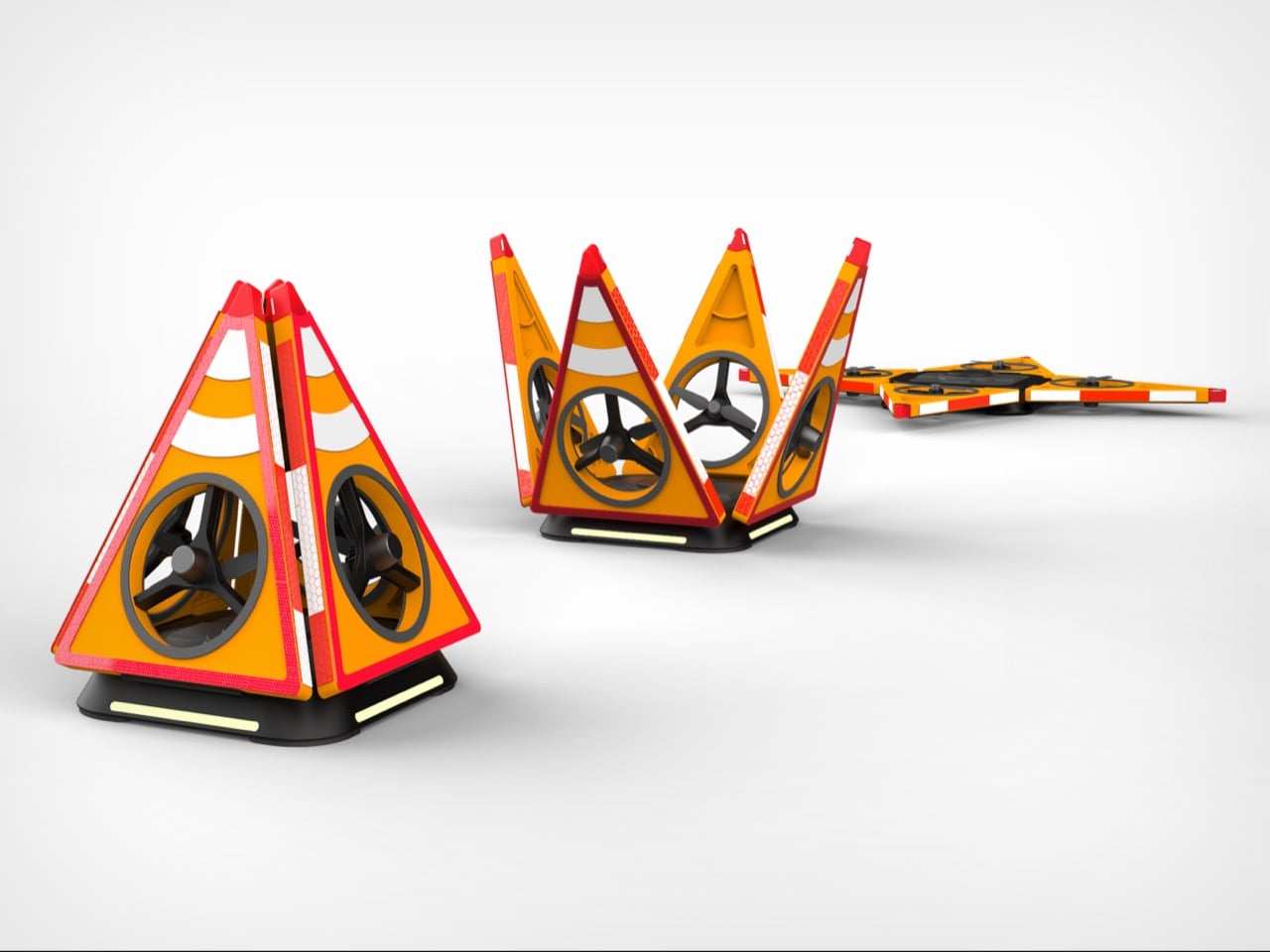
Guo’s teammates were Songyan Pan, Zixu Zhang, and Wanzheng Liu, and their concept won in the Conceptual Industrial Product Design category at the 2026 European Product Design Award. SkyCone is designed to fly as an X-shaped quadcopter, with each of its four triangular arms housing a ducted propeller. After landing, the arms would tilt up and lock together at magnetic tips, forming a four-sided pyramid with the familiar orange and white stripes. The goal is to keep workers out of live lanes. The team cites a figure that 57% of frontline highway personnel consider manual cone placement their most dangerous task.

Designers: Xinhao Guo, Songyan Pan, Zixu Zhang & Wanzheng Liu

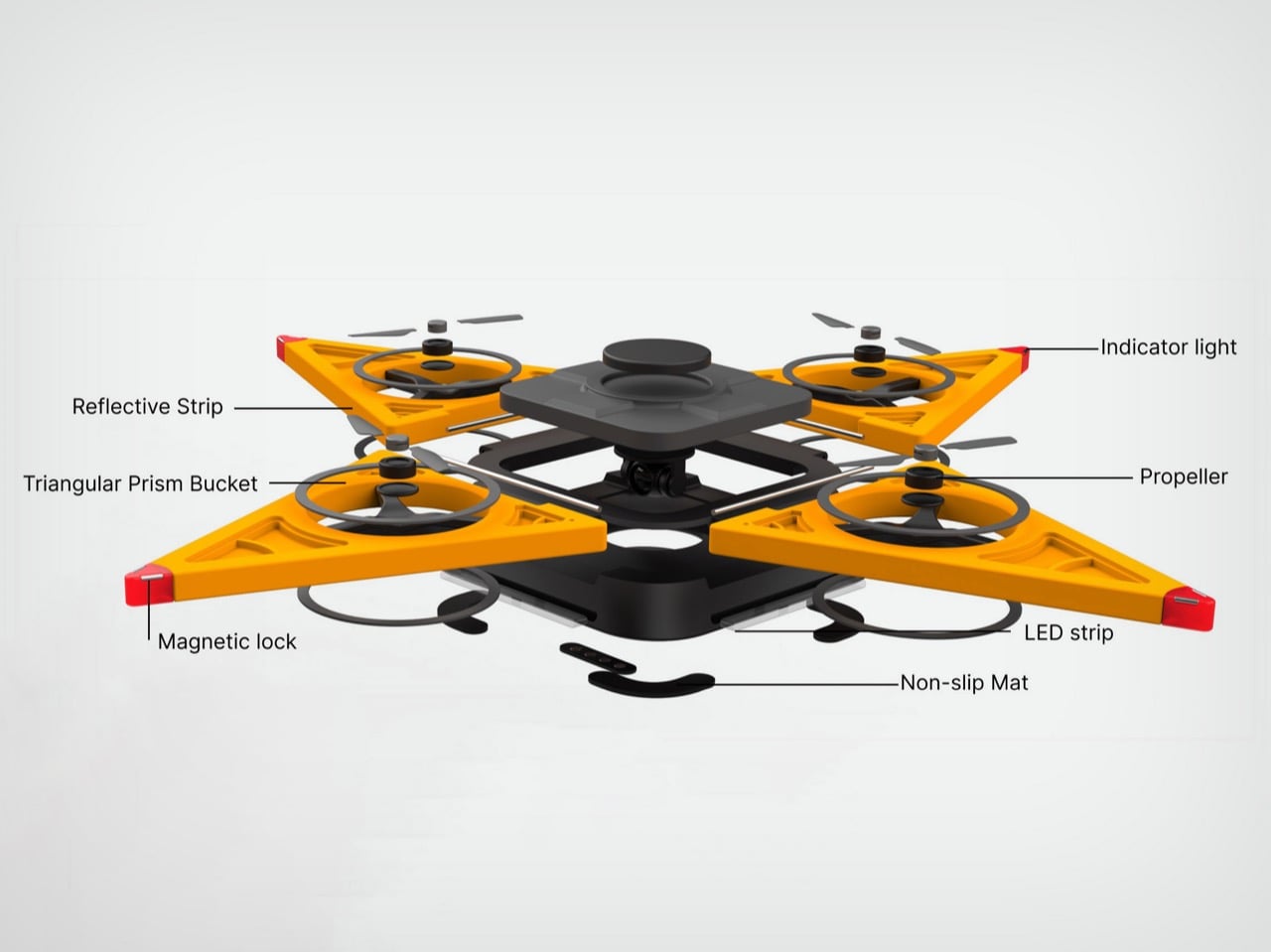
A square central hub anchors SkyCone, carrying a downward-facing camera on a gimbal, with an LED strip and a non-slip mat built into its underside. The four arms are what the team calls Triangular Prism Buckets, hollow orange wedges that each surround a ducted propeller. Red magnetic locks with integrated indicator lights cap the arm tips, which meet at the cone’s apex when everything folds shut. Reflective strips trace the arm edges to improve visibility. My favorite detail is graphic: the white cone bands sit on the faces that point outward after folding, so the drone only looks like a cone once it actually is one.

Charles D. Scanlon, a Los Angeles street painter, designed the modern traffic cone to keep cars away from his wet paint, building it from rubber and fabric salvaged from old tires. His patent was granted in November 1943, and Interstate Rubber Products began manufacturing the design in 1947. The cone eventually made it into the Manual on Uniform Traffic Control Devices, the federal traffic-control manual. Materials and reflective collars have evolved over eight decades, yet the silhouette has barely budged. SkyCone largely keeps that familiar shape while changing how it gets into position, a sensible approach for an object drivers need to recognize quickly.

Placing those cones is still mostly manual work, with crews riding the back of a slow-moving truck or walking beside it and setting cones down a few feet from passing traffic. The US recorded 850 work zone deaths in 2024, an average of more than two a day. In March 2023, a single crash on I-695 outside Baltimore killed six roadway workers. The SkyCone team describes the first few minutes of an emergency or maintenance call as the most critical stretch, when crews are particularly exposed. A fleet of drones that could position cones before anyone steps out of the truck might reduce that initial exposure.

Brisbane-based Arrowes has already built an Automated Cone Truck that drops a cone every five seconds. On Melbourne’s Eastern Freeway, it handled 65,000 cones while cutting worker exposure to live traffic by roughly 500 hours. Caltrans and UC Davis developed a cab-operated cone machine back in the 2000s, and Spain’s Sacyr and GMV set out to prototype a self-driving trailer with an AI-guided robotic arm. Each system relies on a truck or trailer. SkyCone proposes making each cone responsible for its own delivery. Chris Chang’s Apiece showed in 2022 that a cone could be assembled from flat triangles, and SkyCone basically gives those triangles propellers.

The team’s renders place SkyCone at a nighttime highway repair, an incident scene behind an arrow-board truck, a rockfall on a mountain road, a snowed-over highway, and the crumbling edge of an open-pit mine. The mine scenario sold me, since walking a crumbling pit edge to place cones sounds like a genuinely terrible afternoon. SkyCone joins a line of highway concepts that propose sending machines into hazardous places. The Highway Patrol Drone was designed to wait on light towers and fly to crash scenes ahead of responders, while the Median AMB proposed riding the road divider like a monorail to skip traffic. SkyCone’s role would be marking off the scene so responders can work.

The European Product Design Award is a global, open-entry program run by Farmani Group. SkyCone won in its conceptual tier as a student project, so the award recognizes a design proposal rather than proven roadside performance. Guo and his team want the cone to get into position on its own; whether it can do that reliably beside live traffic remains to be demonstrated. My brain will probably keep saying VLC whenever I see a cone, but now it’s going to add “robot” right after.


The post Flying Traffic Cone concept transforms into a Drone to auto-assemble itself on roads first appeared on Yanko Design.
  •  

Nike and LEGO’s new space-themed sneakers let kids take their basketball style beyond Earth

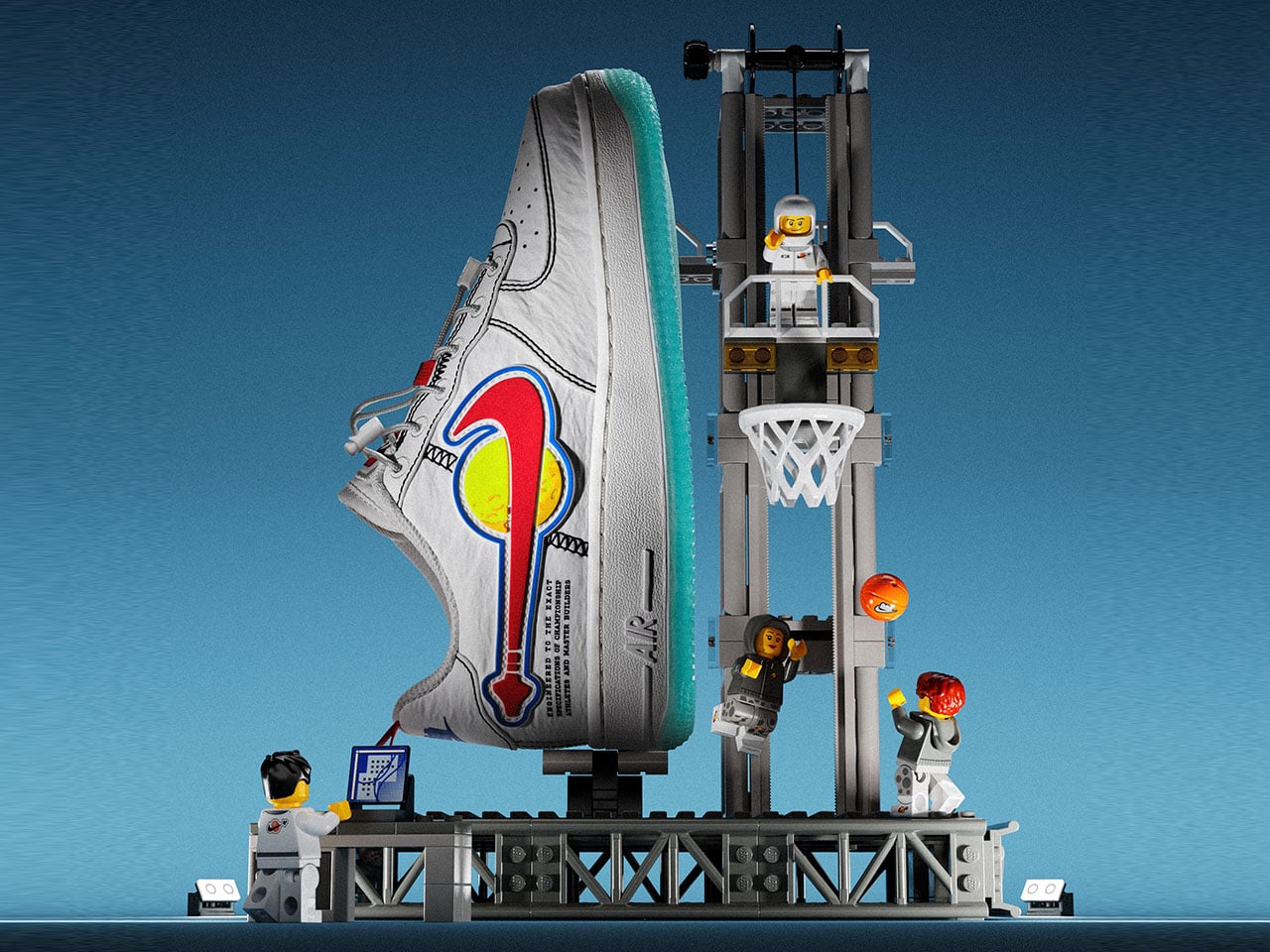
Nike and LEGO kicked off their in-line product collaboration with the LEGO x Nike Air Max Dn bright yellow sneaker in August 2025. Now the duo is targeting kids this holiday season with new additions to their multi-year partnership. Within a month from the the release of the Jordan’s 30th-anniversary Space Jam collection, Nike has teamed up with LEGO to unveil the space-inspired kids’ basketball collection that comprises Air Force 1 Low LV8 and S.T. Dynamite sneakers.

The two new space-inspired basketball sneakers are from the same collection, but are starkly different from each other, right from their DNA to the aesthetics. The Nike x LEGO collaboration, which has been limited to the courts on Earth until, is now inviting kids to imagine basketball beyond the court, in outer space, if you may.

Designer: Nike

As mentioned, the Nike x LEGO basketball collection is radically different, but shares the space theme. It has been, according to Nike, “created for basketball-loving kids.” The company says, “the collection gives young athletes new ways to connect with the sport,” without compromising personal style or their seriousness toward the sport.

If you’re interested, the Air Force 1 Low LV8 borrows its appearance from an actual astronaut spacesuit, while the S.T. Dynamite seems prepared for a game in an icy blizzard. The shoes are available in sizes ranging from 10.5C to 7Y.

The Nike Air Force 1 Low LV8 is reimagined with an upper that looks like an astronaut’s spacesuit. The sketched stitch detailing adds a constructed feel and playfulness, while the LEGO space-themed Swoosh and minifigs give the Air Force 1 a new feel that kids are definitely going to appreciate. It wouldn’t be surprising if basketball fans line up outside Nike stores to get a pair for their kids, not because they can’t get it in their size but for their little one to feel the fanfare.

The Nike x LEGO collaboration gets a deeper meaning with the Nike S.T.Dynamite that takes basketball – the kids’ collection – to an “ice planet.” The sneaker wears a color-shifting finish and a glittering outsole to generate that outer space icy look. Alongside the space-inspired aesthetics, these new collaborative sneakers have multidirectional treads in the sole, bouncy foam cushioning, and a lightweight upper.

The Nike x LEGO kids basketball collection is not limited to footwear alone. The sneaker duo, which will be available in North America from November 24 (but is in stores elsewhere starting November 2), comes with printed ripstop trousers, a graphic T-shirt, and Dri-FIT basketball shorts with a lunar landscape print. Also, part of the collection is a full-zip fleece hoodie equipped with a basketball minifigure patch that changes as you move.

The post Nike and LEGO’s new space-themed sneakers let kids take their basketball style beyond Earth first appeared on Yanko Design.
  •  

Assouline turns classic board games into luxury interior objects with The Game Room Collection

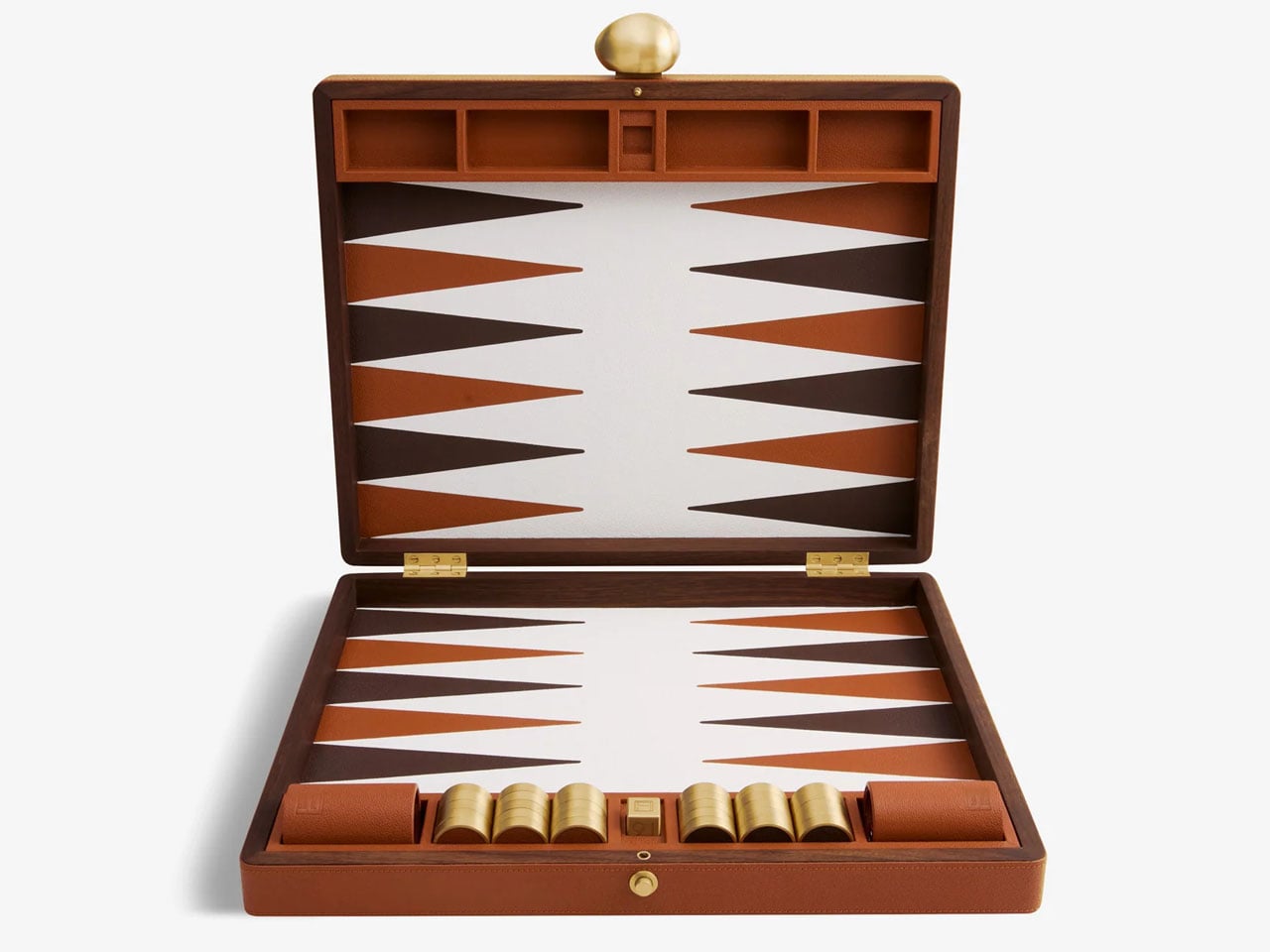
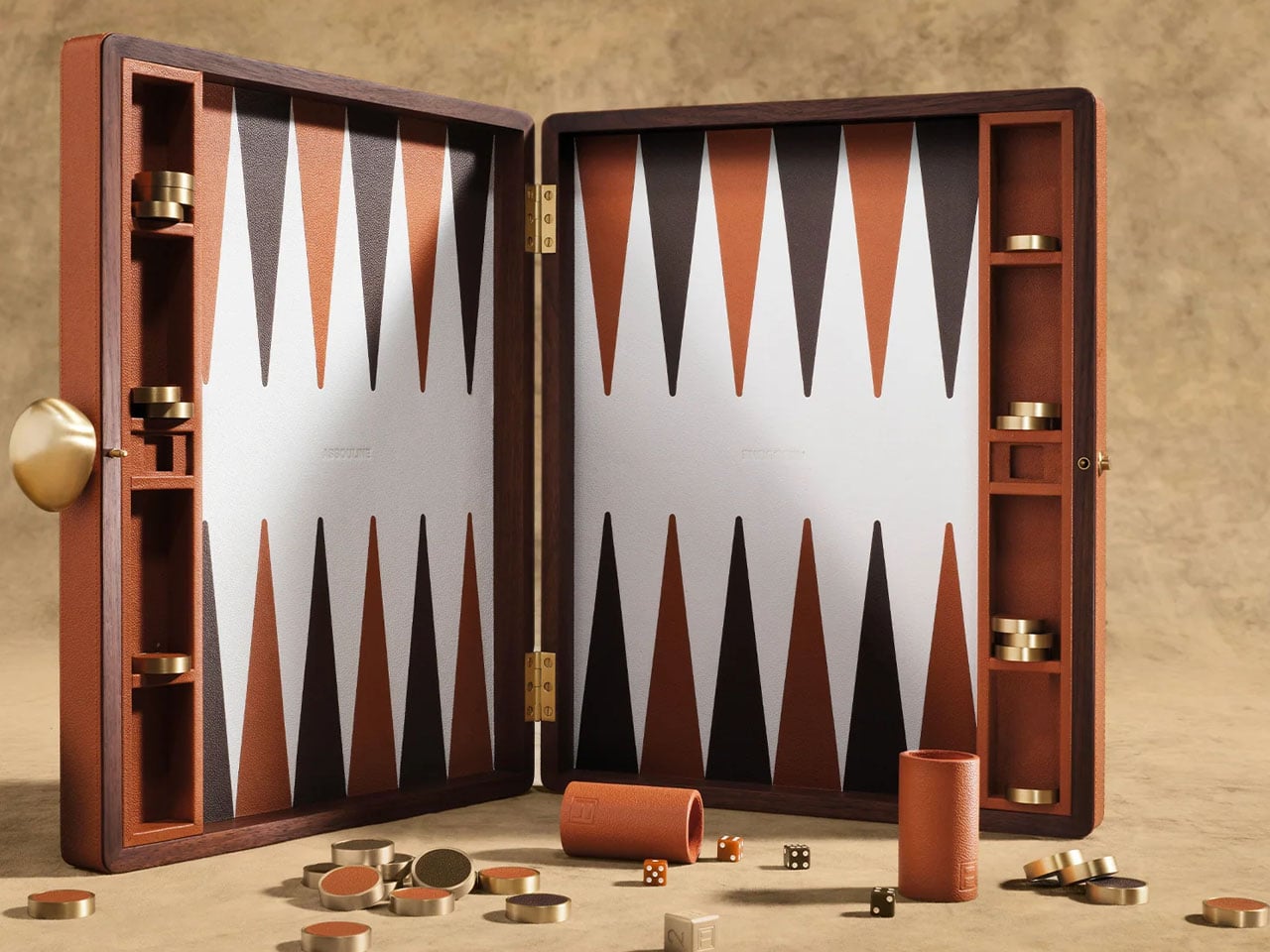
Best known for its luxury coffee table books, Assouline is extending its design-led approach to everyday objects with the launch of The Library Collection: Game Room. This new collection reinterprets five familiar tabletop pastimes as carefully crafted lifestyle accessories, combining traditional games with premium materials and decorative detailing. Chess, backgammon, tic-tac-toe, dominoes, and playing cards receive a refined makeover, portraying them as objects designed for both entertainment and display.

The board game collection brings together rich walnut, pebbled and inlaid leather, brushed brass, heavyweight aluminium, and soft polysuede. A restrained colour palette of red, camel, brown, and stone gives the five pieces a consistent visual identity, allowing them to complement contemporary interiors, libraries, studies, and living spaces. Rather than changing how these games are played, Assouline focuses on their physical presentation, turning familiar objects into collectible pieces that can remain on display between games.

Designer: Assouline

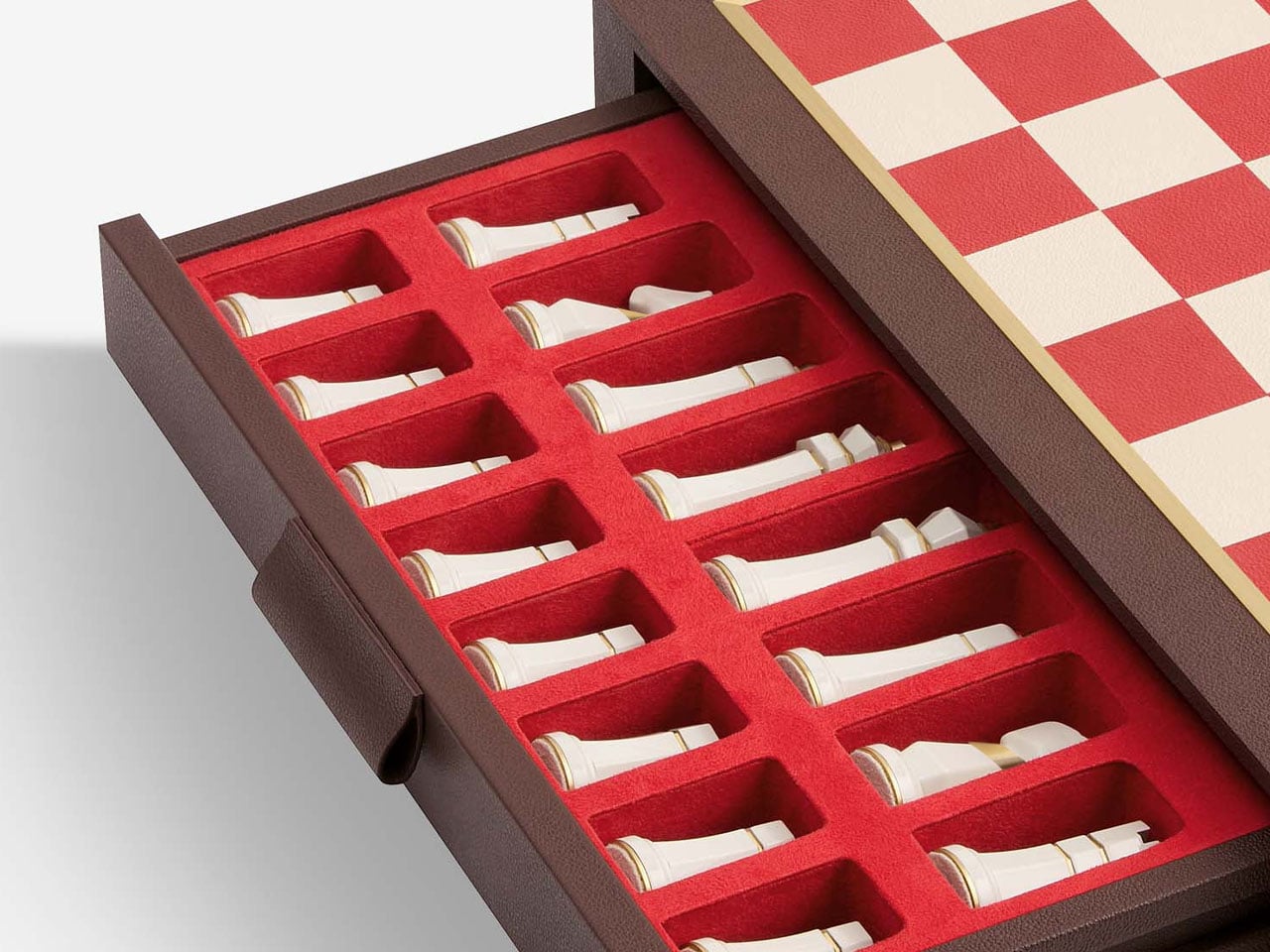
Leading the board game collection is the Empire Chess Set, priced at $2,500. The chessboard combines a walnut structure with a brushed brass border and an inlaid pebbled leather playing surface. Integrated removable drawers provide storage for the pieces, while soft polysuede underlays add another layer of finish. Its heavyweight aluminium chess pieces feature brass accents and sculptural forms. One notable detail is the queen, whose crown draws inspiration from the distinctive visual motifs of artist Jean-Michel Basquiat.

The Pebble Backgammon Set follows at $2,250, housed in a solid walnut case with an inlaid leather playing surface. Its checkers are wrapped in leather and finished with brass detailing, while the dice are hand-painted in Assouline’s signature colour palette. The combination of tactile materials and traditional craftsmanship gives the set a more considered presence than conventional board-game accessories.

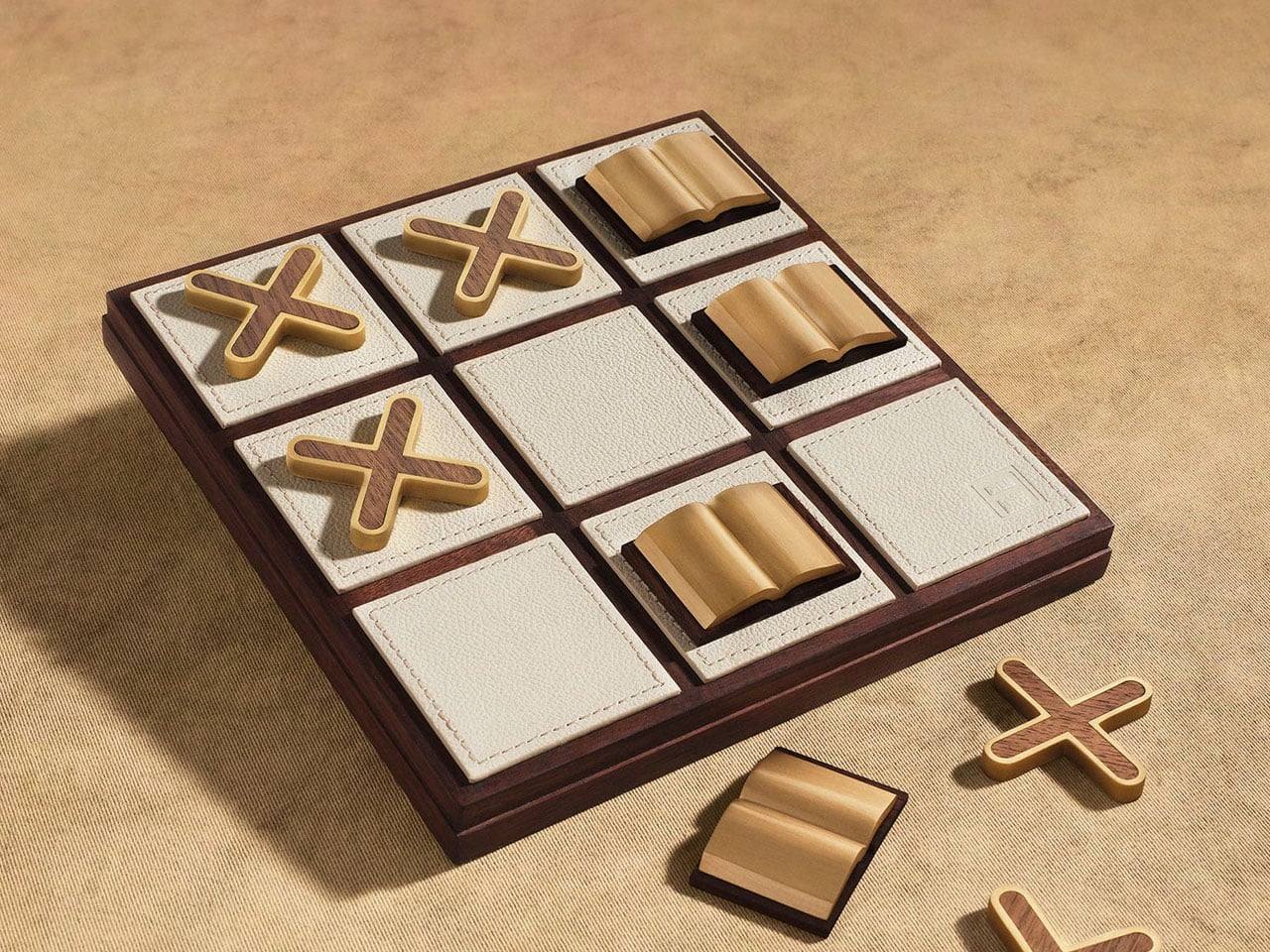
For a more compact alternative, the Library Tic-Tac-Toe Set costs $750 and combines walnut with pebbled leather. Its playing pieces introduce an unusual design detail: alongside wood and brass markers, the O-shaped pieces take the form of miniature books, referencing Assouline’s publishing heritage.

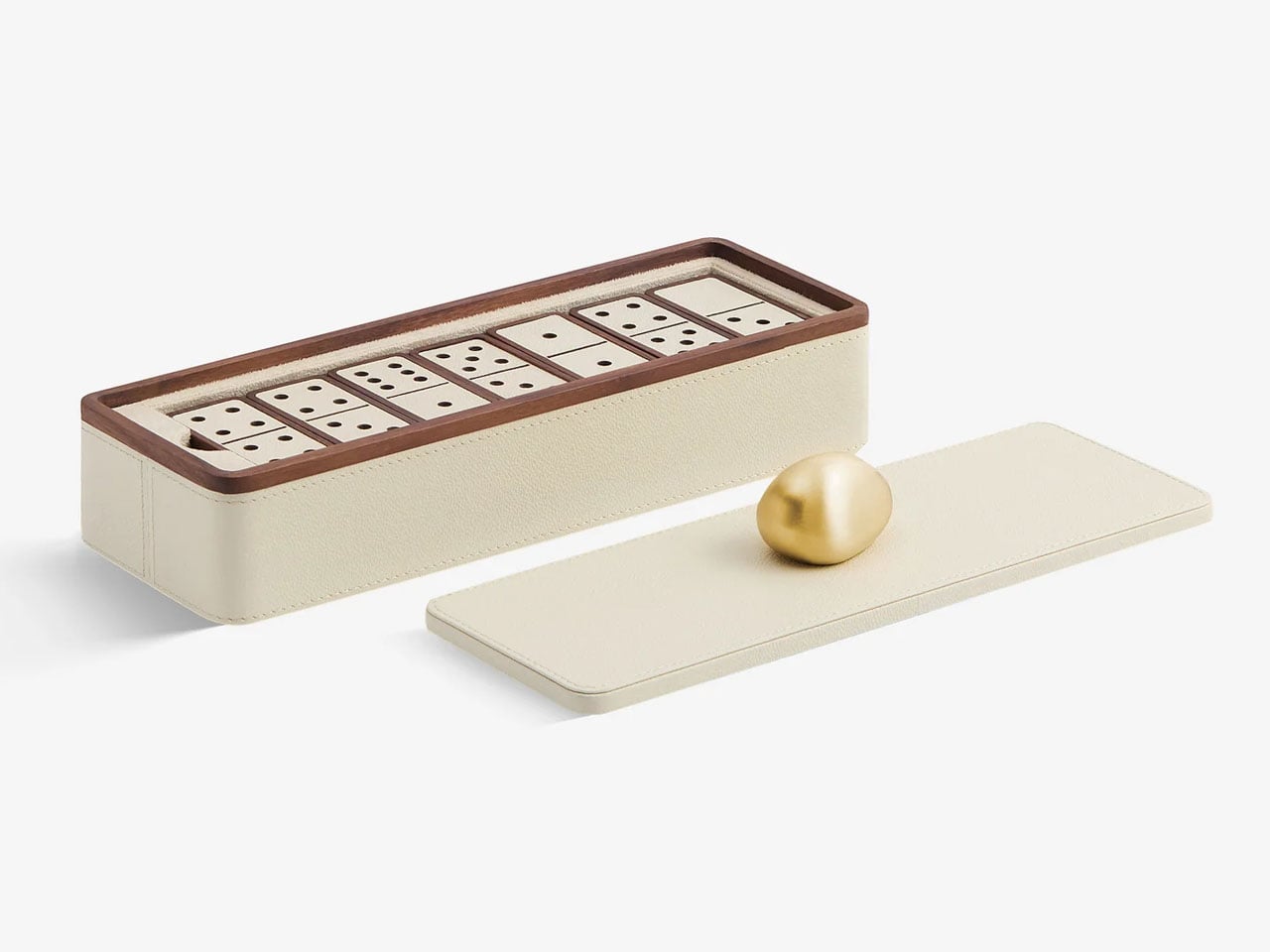
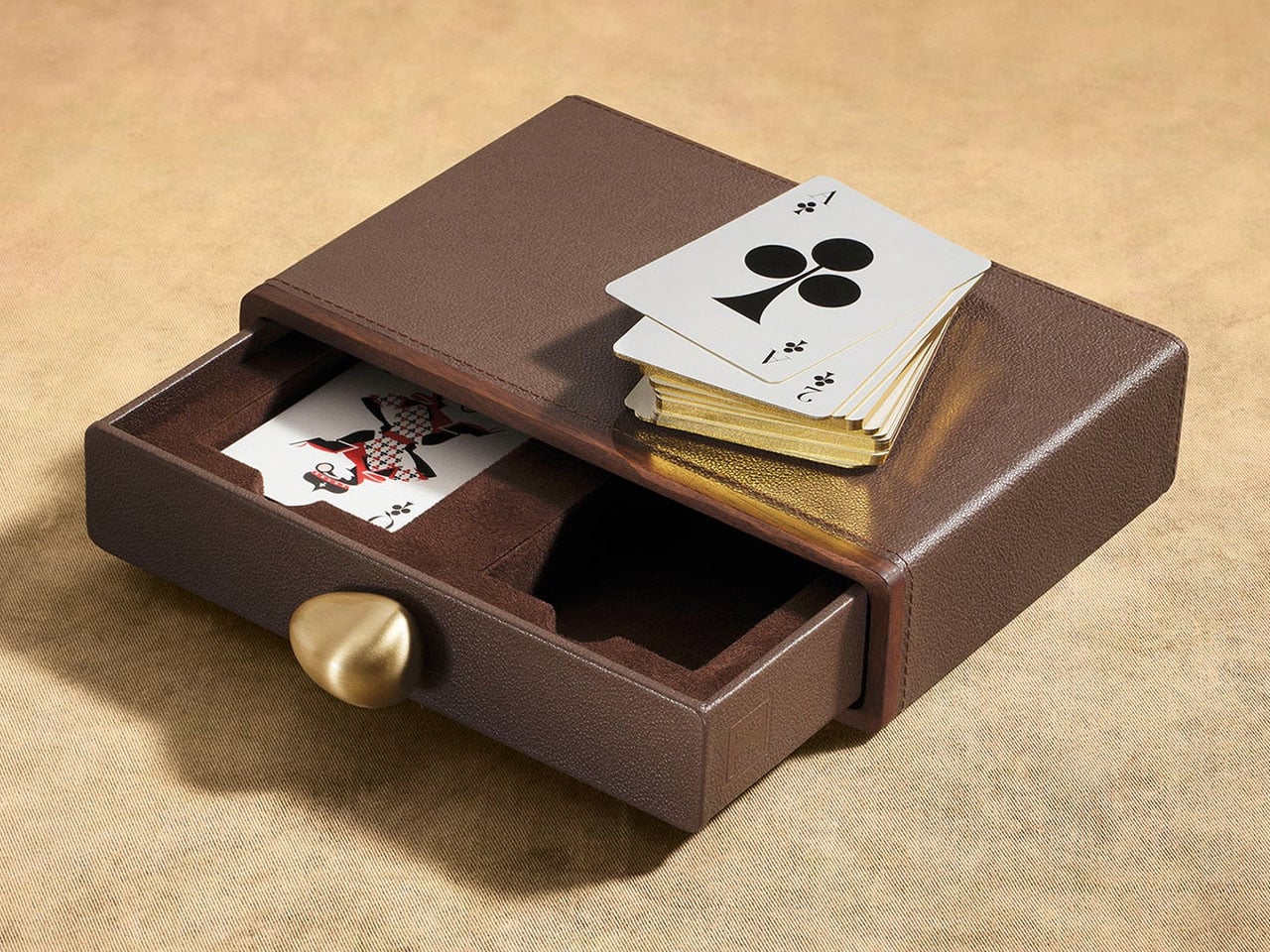
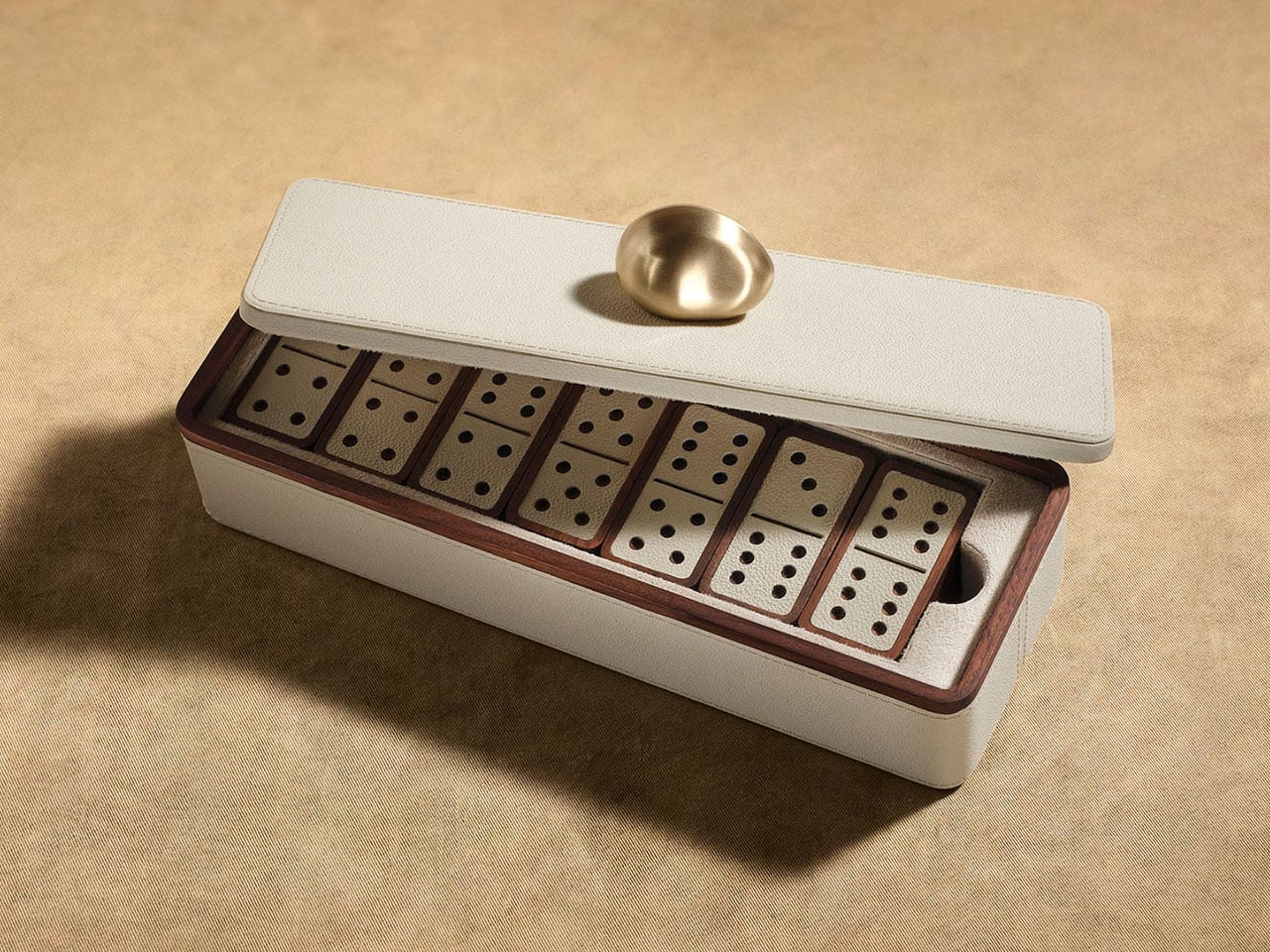
Completing the lineup are the Pebble Domino Set and Pebble Playing Card Set, priced at $650 and $450, respectively. The dominoes feature oversized leather-inlaid tiles framed in walnut, with recessed walnut pips and a distinctive pebble-shaped brass handle on the storage box. Meanwhile, the playing card set includes two gold-gilded decks featuring Didot typography and illustrated jokers depicting characters juggling books. Both decks are housed in a sliding leather case.

With prices ranging from $450 to $2,500, The Library Collection: Game Room extends Assouline’s approach to design beyond printed publications. Each piece brings a familiar social activity into the language of luxury interiors, where material quality, craftsmanship, and thoughtful detailing are as important as everyday functionality. The collection is available through Assouline’s online store.

The post Assouline turns classic board games into luxury interior objects with The Game Room Collection first appeared on Yanko Design.

  •  

This palm-sized robot dog has a Nokia battery and a customizable LEGO-compatible back

Petoi has been shrinking Boston Dynamics down to desk size for almost a decade now. Dr. Rongzhong Li started the company in his dorm lab in 2016, after a video of his open-source robot cat prototype went viral. That cat became Nybble, a laser-cut wooden kitty, and it was followed by Bittle, a palm-sized robot dog that ended up in classrooms, research labs, and a surprising number of home offices. Petoi says it has shipped more than 30,000 robots to over 60 countries, all running its open-source OpenCat framework. Each new model has gotten smaller, smarter, and easier to build, which brings us to the newest pup in the litter.

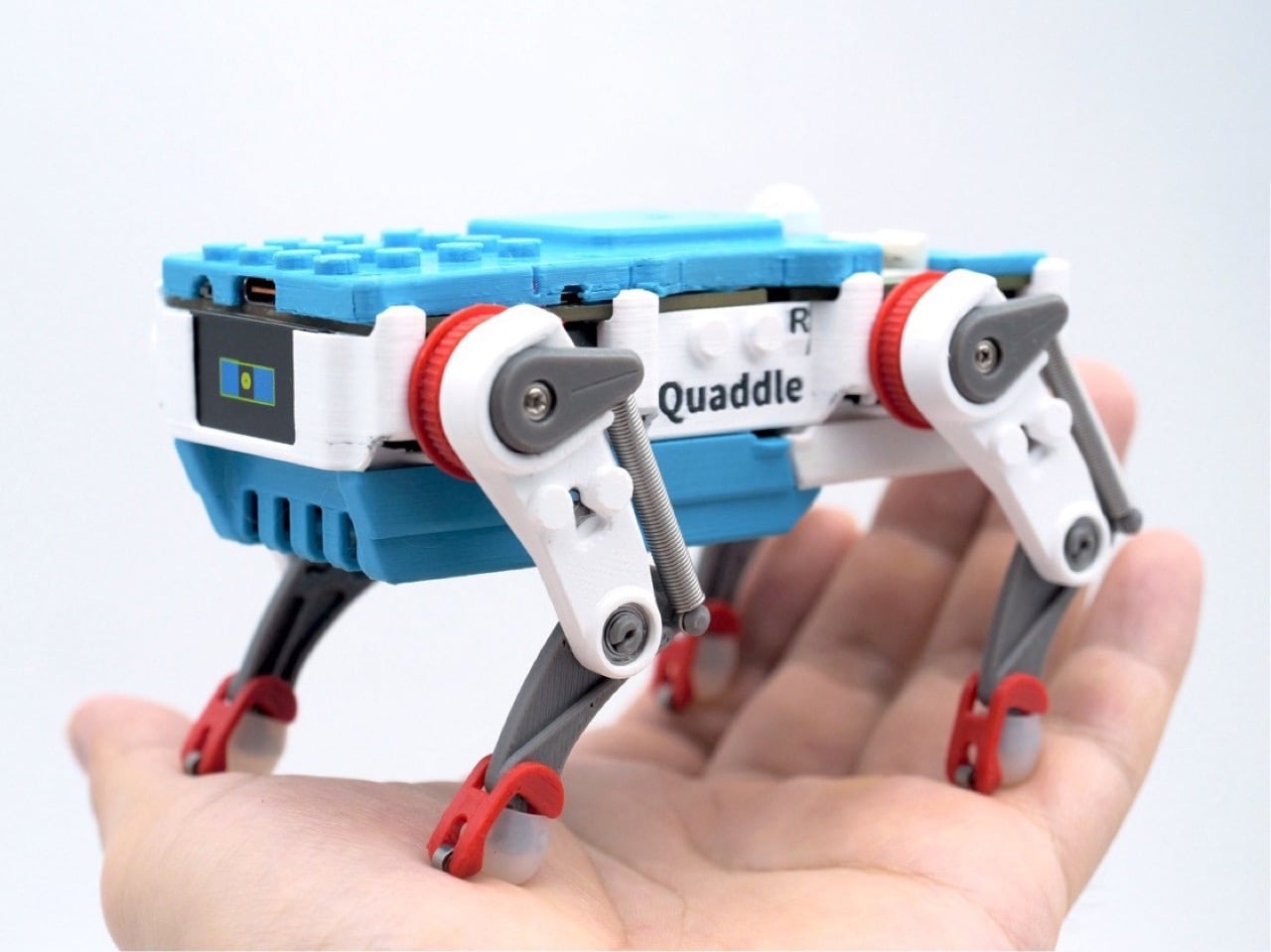
Meet Quaddle, a palm-sized robot dog that walks, glides, spins, and does backflips using just four servos. That’s half what Bittle uses in its legs and roughly a third of what most quadrupeds need, thanks to a spring-loaded linkage Petoi calls the MinDoF leg, which lets one motor drive both the shoulder and the knee. It weighs about 6 ounces, snaps together without screws, and takes LEGO bricks on its back. You can teach it tricks by physically moving its legs, chat with it, or code it in anything from beginner blocks to ROS. Prices start at $179, which is pretty reasonable for a dog that never needs walking.

Designer: Petoi

How one servo runs an entire leg

Each of Quaddle’s legs hangs off a single servo, with a spring and a four-bar linkage doing the job a second motor normally would. As the servo swings the upper leg, the linkage folds the knee up and straightens it again, turning one rotating shaft into a proper step. Petoi calls this the MinDoF leg, short for Minimal Degrees of Freedom, a degree of freedom being one independent way a joint can move. The spring clips onto different anchor points, changing how stiff or bouncy each leg feels. In Petoi’s tabletop tests, Quaddle walks about one body length per second, turns 90° in a single step cycle, and climbs onto a ledge as tall as its own knee.

Walking machines driven by a single crank go back to Pafnuty Chebyshev, the Russian mathematician whose 1870s linkage turned rotation into a surprisingly lifelike stride. Theo Jansen’s wind-powered Strandbeests on Dutch beaches run on the same basic idea, and Quaddle feels like their tiny, battery-powered cousin. Petoi added one more trick by fitting small bearings to the tips of the feet. Angle the legs just right and those bearings become wheels, letting Quaddle glide across a smooth desk at around three body lengths per second without a single extra motor. Fewer motors also means less weight, less cost, and less battery drain, which is how the whole dog comes in at roughly 6 ounces.

Teach it tricks by hand, then teach it in code

On the Buddy and Scout models, every leg servo reports its position back to the robot, so you can teach Quaddle a move by simply grabbing its legs. Tap to start recording, guide the legs through whatever silly dance you have in mind, and tap again to have it play the motion back. There’s no app or code involved, and Petoi says you can teach it a basic walk in about ten seconds. Recorded moves can be pulled into Petoi’s Skill Composer software for fine-tuning and shared with other Quaddle owners. For a kid, this is probably the fastest route from “I wonder if” to a robot actually doing the thing.

Buddy and Scout split their thinking across two ESP32-S3 chips, one for motion and balance and one for voice chat and smart home control. A physical slide switch cuts power to the AI chip entirely, which is great for privacy and for days when your robot dog gets a bit too chatty. Coding starts with drag-and-drop blocks, moves to Python or MicroPython, and eventually reaches the Arduino C++ firmware. Bigger projects can mount a Raspberry Pi Zero on its back or plug into ROS, the software framework most research robots run on. A browser-based simulator runs the same code as the real robot, so you can test ideas on a laptop or even a phone with no robot in sight.

LEGO bricks, a Nokia battery, and three Quaddles to pick from

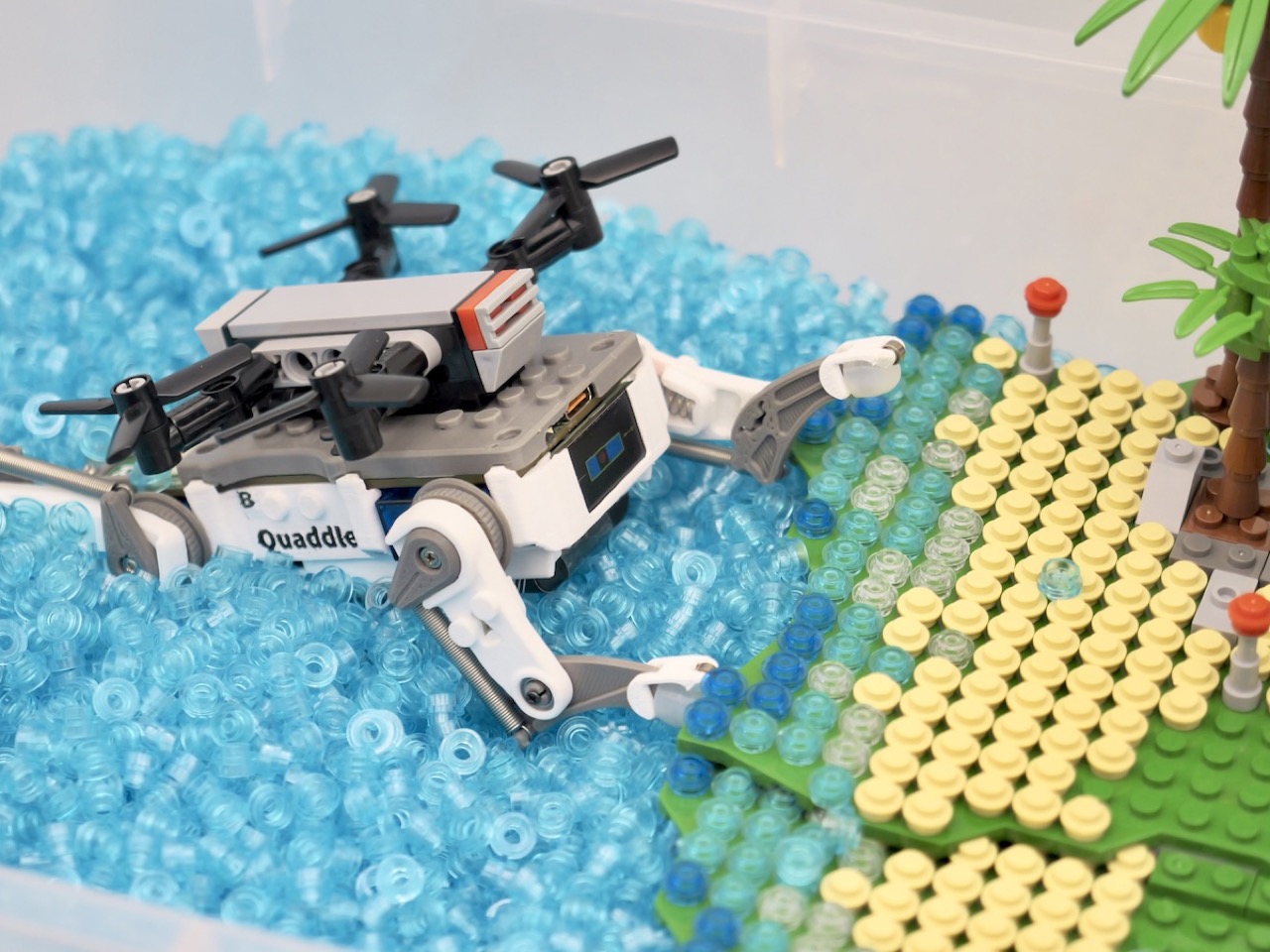
The top of Quaddle’s shell takes LEGO bricks, and Petoi will publish printable shells and mounts for anyone with a 3D printer. Petoi’s own demos have turned it into a walking LEGO AT-AT, a waddling biped called the NanoDuck, and a rover on Mecanum wheels, which use angled rollers to slide sideways. Power comes from a swappable Nokia-format phone battery, the same BL-5C shape that lived inside Nokia’s famously indestructible early-2000s handsets. Quaddle ships with the bigger 1,800 mAh BL-10C cell, good for roughly 1 to 1.5 hours of walking depending on the model. Plug it into USB-C while you code and it charges as it runs, so marathon debugging sessions are fair game.

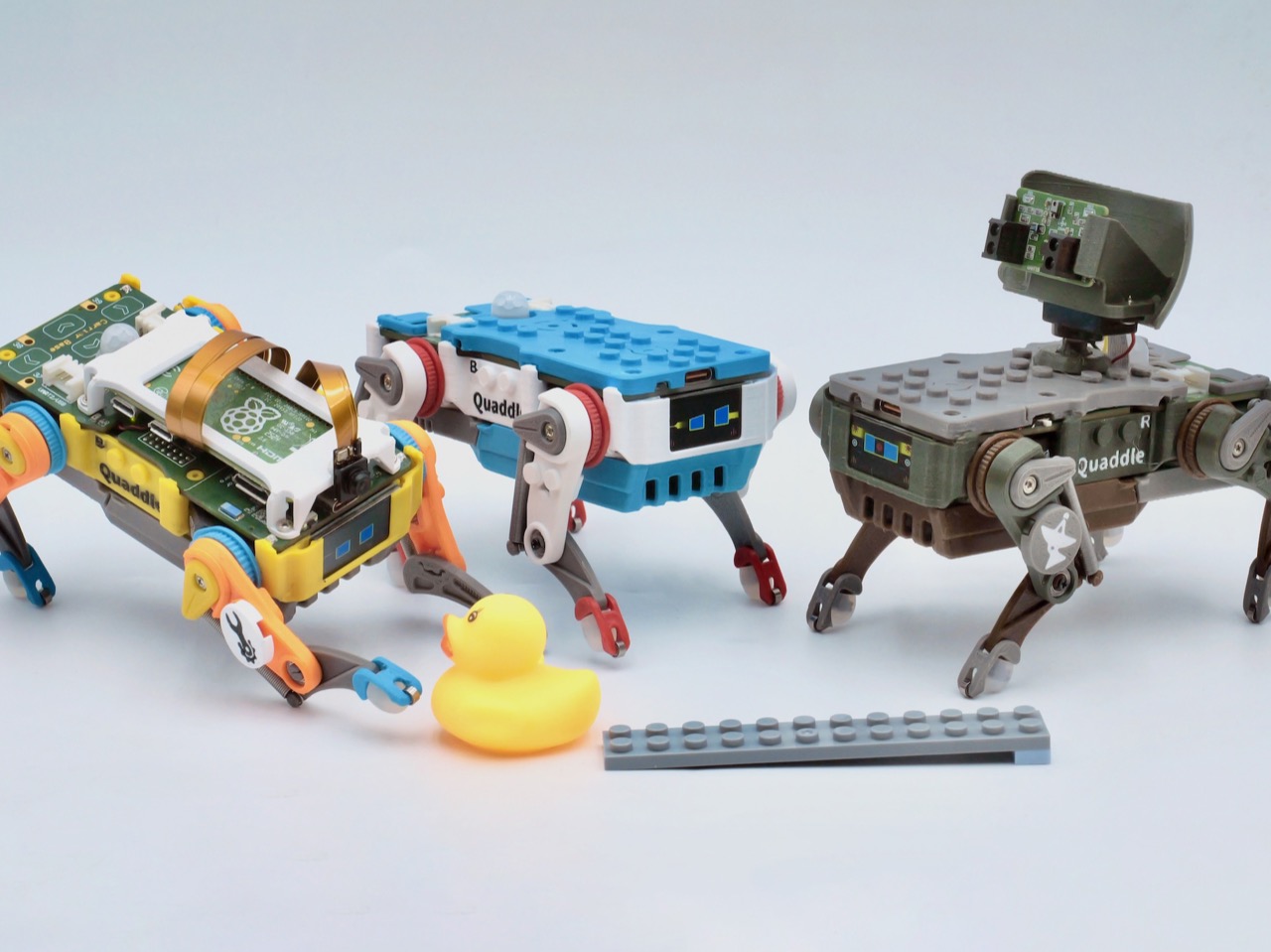
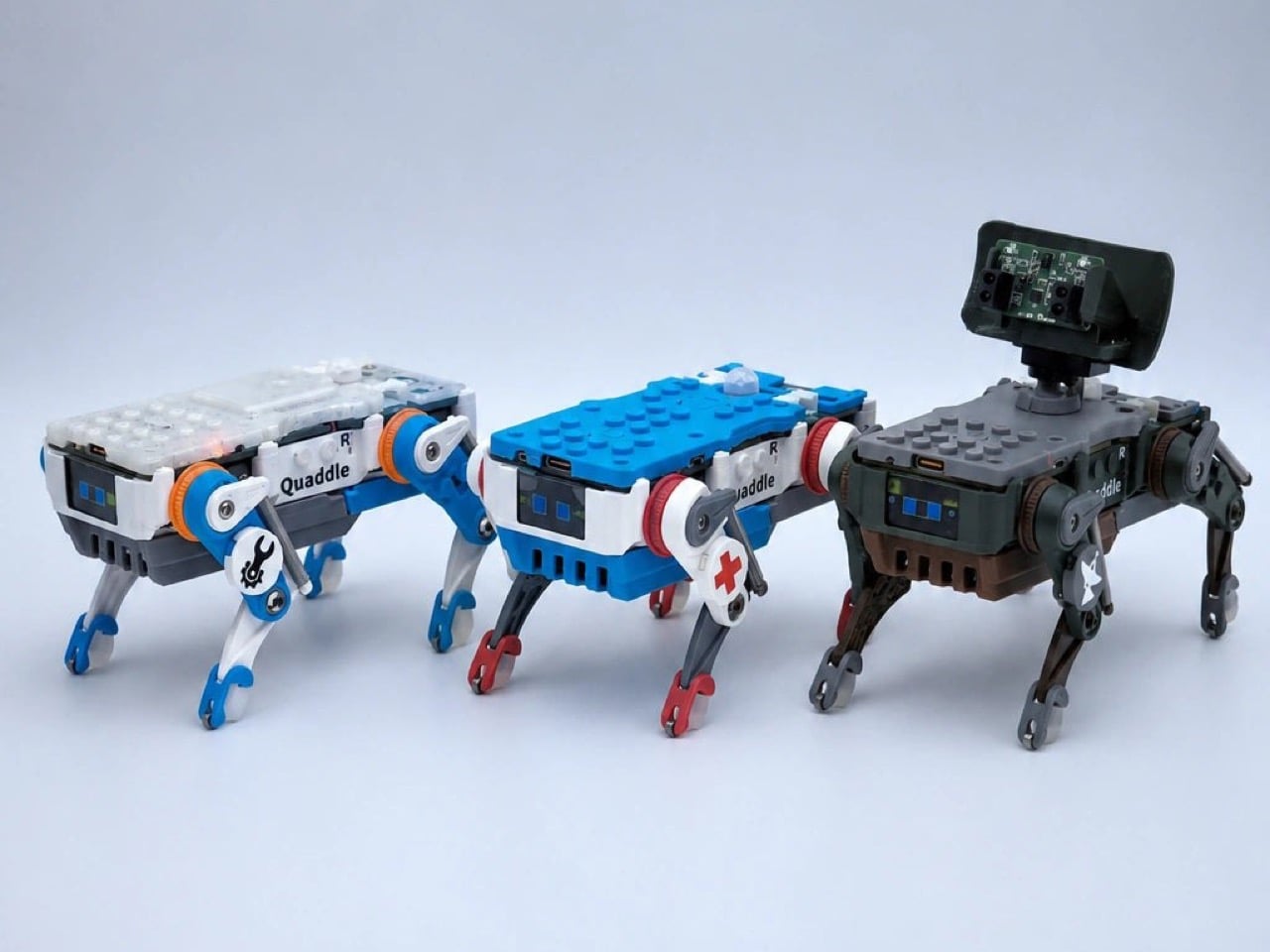
Builder PLUS ($179) handles walking and coding, Buddy ($219) adds AI chat and teach-by-hand, and Scout ($269) adds a sensor head that detects gestures, light, distance, and people. All three are priced at $144, $175, and $215, with deliveries starting in December. For context, Petoi’s own Bittle X lists at $279, Unitree’s Go2 starts around $1,600, and Sony’s Aibo launched in the US at $2,900. Petoi spent a decade shrinking big robots down to desk size, and Quaddle shows the smartest way to shrink one further is to give it fewer parts.

The post This palm-sized robot dog has a Nokia battery and a customizable LEGO-compatible back first appeared on Yanko Design.

  •  

The 8 Best Halloween Designs for a Delightfully Spooky October

Halloween decorating can start small, with something like a skeleton on the porch. A strange little object on the dinner table, a lamp that reveals something unexpected, or a pair of shoes with eyes on the heels can be enough. The most interesting seasonal designs give familiar things a new personality, leaving room for a little mischief without turning the entire house into a haunted attraction overnight.

These eight picks approach the season through miniature storytelling, everyday utility, and atmospheric details. Some are unmistakably Halloween, while others suggest a darker mood without wearing a pumpkin on their sleeve. This is an editorial selection rather than a tested ranking or a collection of new releases. It includes retail products, an older lighting design, and a LEGO fan proposal, with those distinctions kept clear as we explore each one below.

1. Halloween Snow Globe

The Brick Artist’s Halloween Snow Globe puts a graveyard where you would normally expect a snowman. Published as a LEGO Ideas fan proposal, rather than an official retail set, it gathers a twisted tree, a floating ghost, and a pumpkin-headed scarecrow beneath a transparent dome. Its proposed hand crank rotates the scene, bringing a skeleton and spider into view from behind the tombstones. That gives the mechanism a storytelling purpose beyond simply displaying the same arrangement from another angle.

The published renders make the strongest case for its inclusion here. Orange leaves interrupt the black and gray palette, while a vampire on the base greets anyone approaching the miniature scene. It would be an appealing centerpiece for someone who prefers examining tiny details to hanging oversized decorations. The construction is less convincing from behind, where the moon exposes its studs, but that also reveals the theatrical thinking: this is a small stage with a carefully arranged opening view.

What we like

  • Rotation reveals hidden characters.
  • The dome contains an entire miniature Halloween scene.

What we dislike

  • It is a fan proposal, not an official retail set.
  • The rear view exposes some scenic construction.

2. Nike Dunk Low “Shibuya Halloween”

Nike’s Dunk Low Premium Halloween takes a quieter approach to dressing for October. The leather upper has a scaly appearance, with dark green and black keeping the daytime palette restrained. The more theatrical detail sits behind you: eyes on the heel tabs glow in the dark, accompanied by an outsole with the same effect. Nike also includes a Shibuya city tongue label, connecting the shoe’s familiar nickname to a specific detail rather than relying on Halloween colors alone.

For anyone who wants a seasonal accessory without committing to a costume, that restraint is the attraction. The familiar sneaker silhouette remains intact, and the monster character emerges through texture and small graphic interventions. It is a more flexible wardrobe proposition than footwear covered in pumpkins, at least aesthetically. The limitation is that much of the Halloween effect depends on darker surroundings. Nike describes the glowing elements but does not specify their duration, so treat them as decoration, not illumination.

What we like

  • Heel eyes give a familiar sneaker an unexpected character.
  • The dark palette is less overtly seasonal than orange graphics.

What we dislike

  • The Halloween effect is subdued in daylight.
  • Nike does not specify how long the glow lasts.

3. Skeleton Wine Glasses

Pottery Barn’s Skeleton Wine Glasses let a tiny skeletal figure do the lifting. Instead of decorating the bowl with a printed Halloween motif, the design incorporates the skeleton into the stem, with raised arms reaching toward the glass above. The manufacturer specifies a handmade zinc alloy embellishment and a bowl made from mouth-blown soda lime glass. It is a satisfying change of scale: something normally imagined standing in a doorway becomes the character supporting a drink at dinner.

This is a particularly useful direction for a Halloween table because the decoration participates in the meal rather than occupying another patch of tabletop. Set against plain plates and napkins, the figure could carry most of the seasonal theme on its own. The practical compromise comes afterward. Pottery Barn calls for washing by hand with mild soap and warm water, and the glass cannot be removed from its skeleton. These are entertaining pieces that ask for a little extra cleanup.

What we like

  • The skeleton becomes part of the glass’s structure.
  • One piece supplies both drinkware and table decoration.

What we dislike

  • Cleaning requires washing by hand.
  • The glass does not detach from the skeleton.

4. Elizabat Kitchen Scissors

Elizabat turns a pair of kitchen scissors into a bat without hiding what the tool is supposed to do. The wings form the handles, and a small face sits between them, giving the silhouette a character that becomes especially clear when the scissors open. OTOTO combines stainless steel blades with plastic and rubber components. The tool also incorporates a bottle opener and a nutcracker, putting several kitchen jobs inside a shape that would otherwise be easy to dismiss as novelty.

Something is appealing about letting Halloween enter through food preparation instead of adding another ornament to a shelf. Elizabat can remain in the kitchen after the decorations come down, assuming the bat aesthetic suits your everyday tools. OTOTO lists the scissors as dishwasher-safe, which is a useful distinction from the more demanding glassware in this collection. The wing shape is still a stylistic commitment, and the friendly expression should not obscure the fact that these are sharp kitchen scissors.

What we like

  • The handles give the bat silhouette a functional role.
  • Scissors, bottle opener, and nutcracker share one tool.

What we dislike

  • The winged handles are visually busy.
  • The playful appearance can obscure the sharp blades.

5. Angela Deane Incense Smoker

West Elm’s collaboration with Angela Deane brings a pair of small ceramic ghosts to the tabletop. Their uneven heights, dark eyes, and draped forms make them look more like curious visitors than threatening apparitions. The object is an incense smoker, giving the sculpture a role beyond standing on a shelf. Its soft, pale silhouette offers a useful alternative to the black metal, orange plastic, and deliberately distressed finishes that can make a Halloween display feel visually crowded before anything happens.

For a smaller seasonal arrangement, the ghost pair could sit beside a stack of books or become the focus of an otherwise ordinary side table. The ceramic form remains legible without needing a large surrounding display, which is part of its appeal. Incense introduces another layer of atmosphere, though smoke and fragrance will not suit every space or preference. West Elm recommends wiping the piece with a soft, dry cloth, so its upkeep is closer to caring for a sculpture than washing tableware.

What we like

  • Two ghost figures create a charming sculptural composition.
  • It combines seasonal decoration with an incense function.

What we dislike

  • Incense smoke will not suit every space.
  • Care requires wiping with a soft, dry cloth.

6. Agatha Spoon Holder & Steam Releaser

Agatha’s joke becomes clear as soon as a spoon passes through her hands: the utensil becomes a witch’s broomstick. Designed by OTOTO in collaboration with Uli Ben Israel, the purple silicone character works as a spoon holder and steam releaser. Her pointed hat and flowing outline make the Halloween reference immediate, but the cooking connection gives the character a reason to exist. A witch beside a pot is a more convincing piece of visual storytelling than a random seasonal graphic.

The appeal is strongest for someone who enjoys the season while doing ordinary things. Preparing dinner becomes the setting for the design, with the pot standing in for a cauldron and the spoon completing the scene. OTOTO lists the silicone as dishwasher-safe and resistant to boiling water. Fit still deserves attention, since a useful holder needs to work with your particular spoon and cookware. Agatha is a small accent rather than a decoration that changes the mood of an entire room.

What we like

  • The spoon completes the witch’s broomstick silhouette.
  • One silicone character serves two cooking roles.

What we dislike

  • Compatibility needs checking against your utensils and cookware.
  • Its decorative impact stays mostly around the stove.

7. King Edison Ghost Pendant Lamp

A dark pendant shade is not an obvious Halloween decoration until it reveals the chandelier hidden inside. Designed by Young & Battaglia for Mineheart, the King Edison Ghost contains a miniature brass chandelier within a shade of hand-blown black glass. According to the manufacturer, the interior becomes visible when the light is switched on. The result borrows the visual language of an old drawing room, then compresses it into an object whose exterior initially gives very little away.

This is the collection’s most permanent approach to creating an eerie atmosphere. There are no cartoon ghosts or seasonal slogans, just an illuminated object appearing through dark glass. It could appeal to someone who prefers a suggestion of haunted architecture to literal party decor. It also demands a different commitment: this is a ceiling pendant with a ceiling rose, not a lamp to unpack for one evening. Mineheart’s page currently offers availability notifications, so immediate purchase should not be assumed.

What we like

  • Switching it on reveals an unexpected miniature chandelier.
  • The ghostly effect does not depend on seasonal graphics.

What we dislike

  • Ceiling installation makes it a longer-term commitment.
  • The manufacturer currently directs shoppers to availability notifications.

8. Miniature Bonfire Wood Diffuser Set

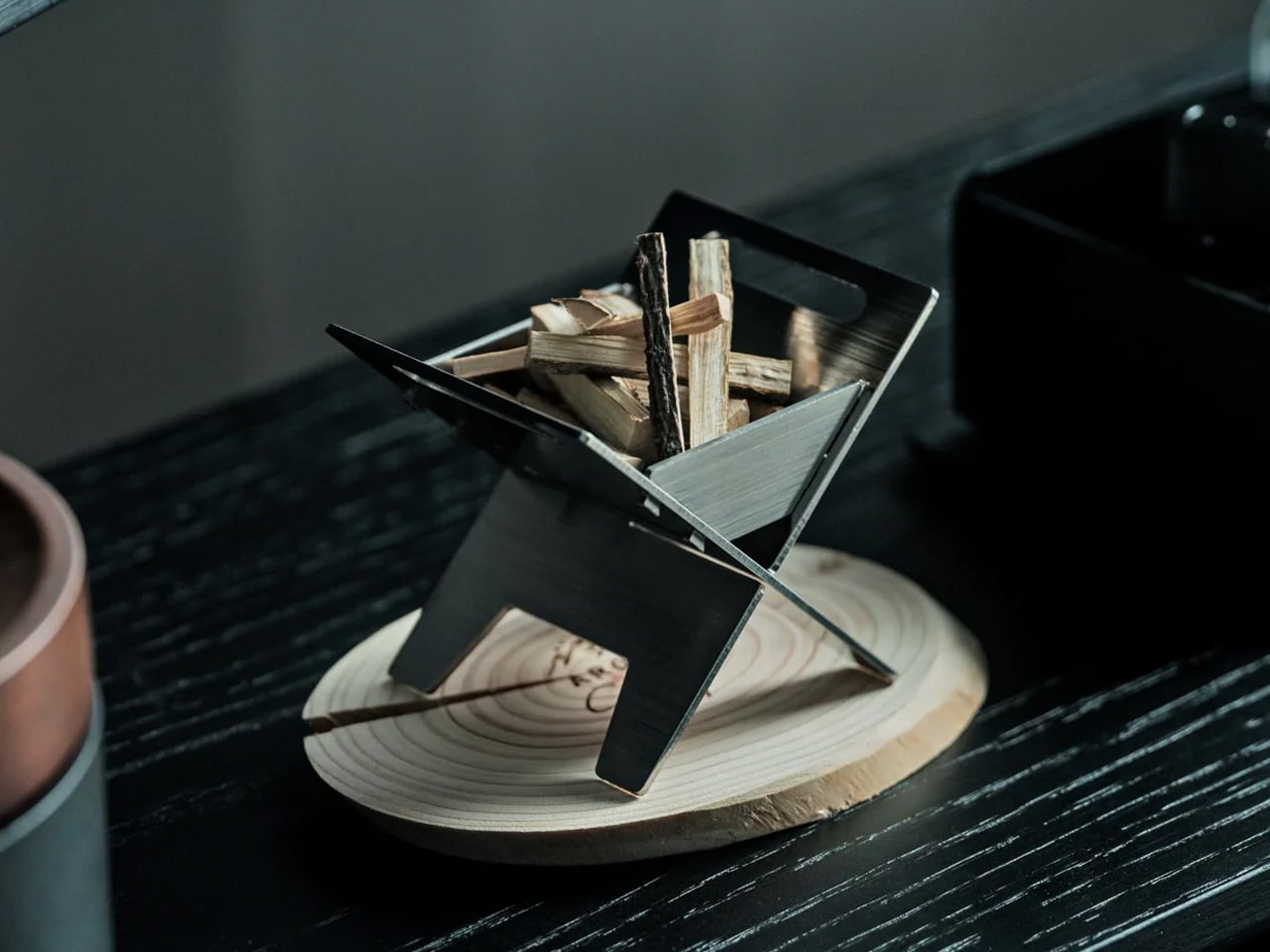
Shinchi Ringyo’s Miniature Bonfire Wood Diffuser Set takes its seasonal cue from campfire stories rather than haunted houses. The Japanese design arranges miniature firewood on a stainless steel stand, using the wood to disperse aromatic oil. The stand measures about 2.1 by 2.7 by 2.3 inches, making this a tiny campsite rather than a conventional centerpiece. Its appeal lies in recognizing a familiar outdoor arrangement at a scale intended for a desk or shelf.

The Halloween connection is atmospheric, so this is the pick for anyone who would rather suggest a woodland evening than display another pumpkin. The shop lists cedar and Hakusan scent options, with the latter combining cedar, cypress, and lindera umbellata. Fragrance preferences are personal, and the set’s $99 price makes this a considered purchase for such a small object. Its role here is as an aroma diffuser; the listing’s separate stove claims are not the basis for recommending it.

Click Here to Buy Now: $99.00

What we like

  • The miniature campsite offers a quieter autumnal mood.
  • Its woodland theme can remain relevant after Halloween.

What we dislike

  • At $99, it is expensive for a small decorative diffuser.
  • The Halloween connection is indirect.

A Little Halloween Goes a Long Way

A good starting point is to choose the moment you want to change rather than the number of decorations you want to own. A dinner table needs something different from an entryway, and a kitchen tool earns attention differently from a display piece. Give one object enough space to be noticed. A distinctive silhouette or unexpected reveal can lose its effect when surrounded by too many competing seasonal props nearby.

It is also worth deciding how much Halloween you want to keep after October. Literal ghosts and skeletons can become an annual ritual, while darker lighting or woodland references may suit the room for longer. Neither approach needs to dominate the house. The pleasure is in finding a design whose particular joke, detail, or small surprise still makes you look twice when you pass it during an otherwise ordinary day.

The post The 8 Best Halloween Designs for a Delightfully Spooky October first appeared on Yanko Design.

  •  

RAY’s 3D Print Scraper Concept Refuses to Be Another Rectangle

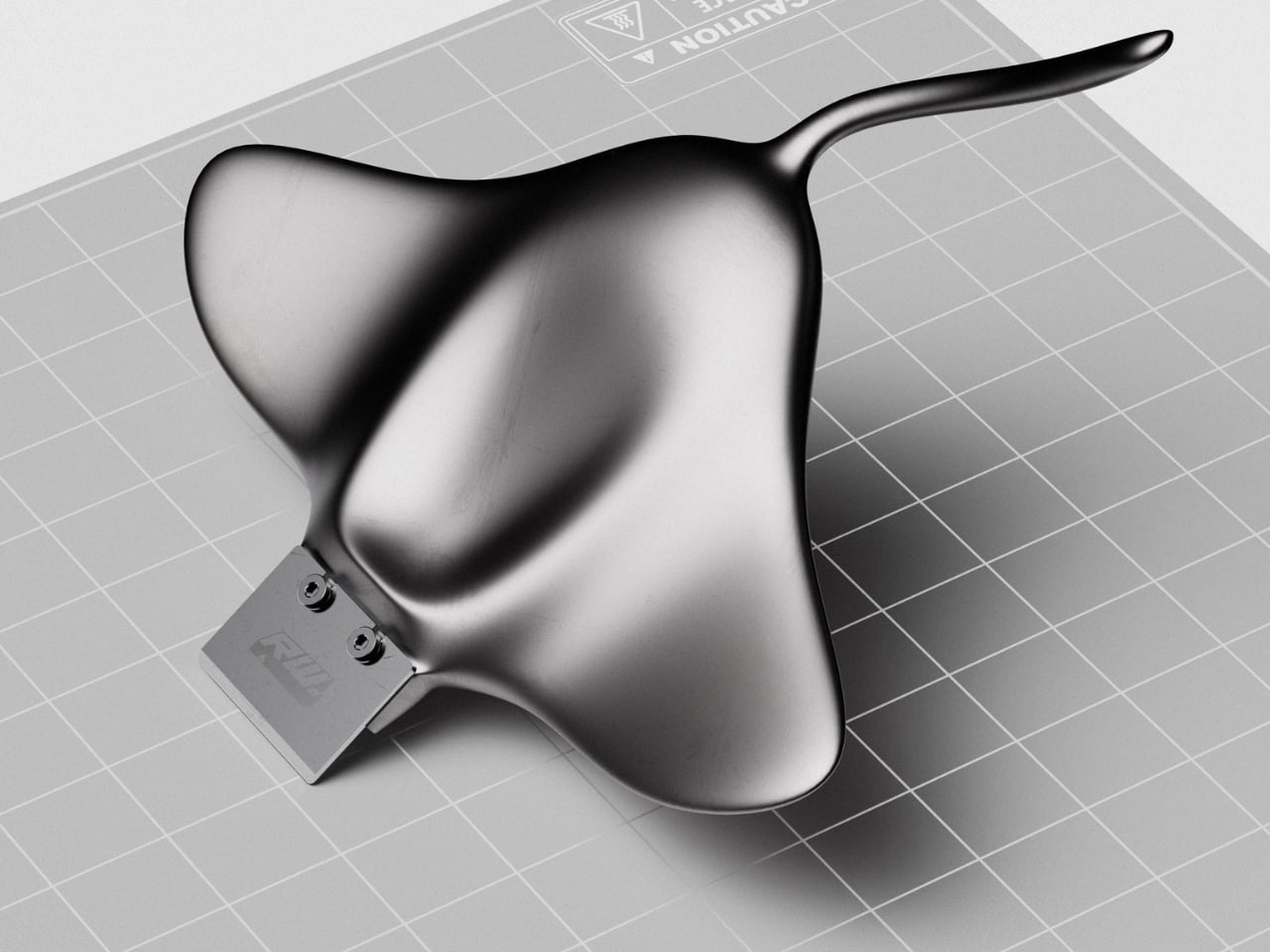
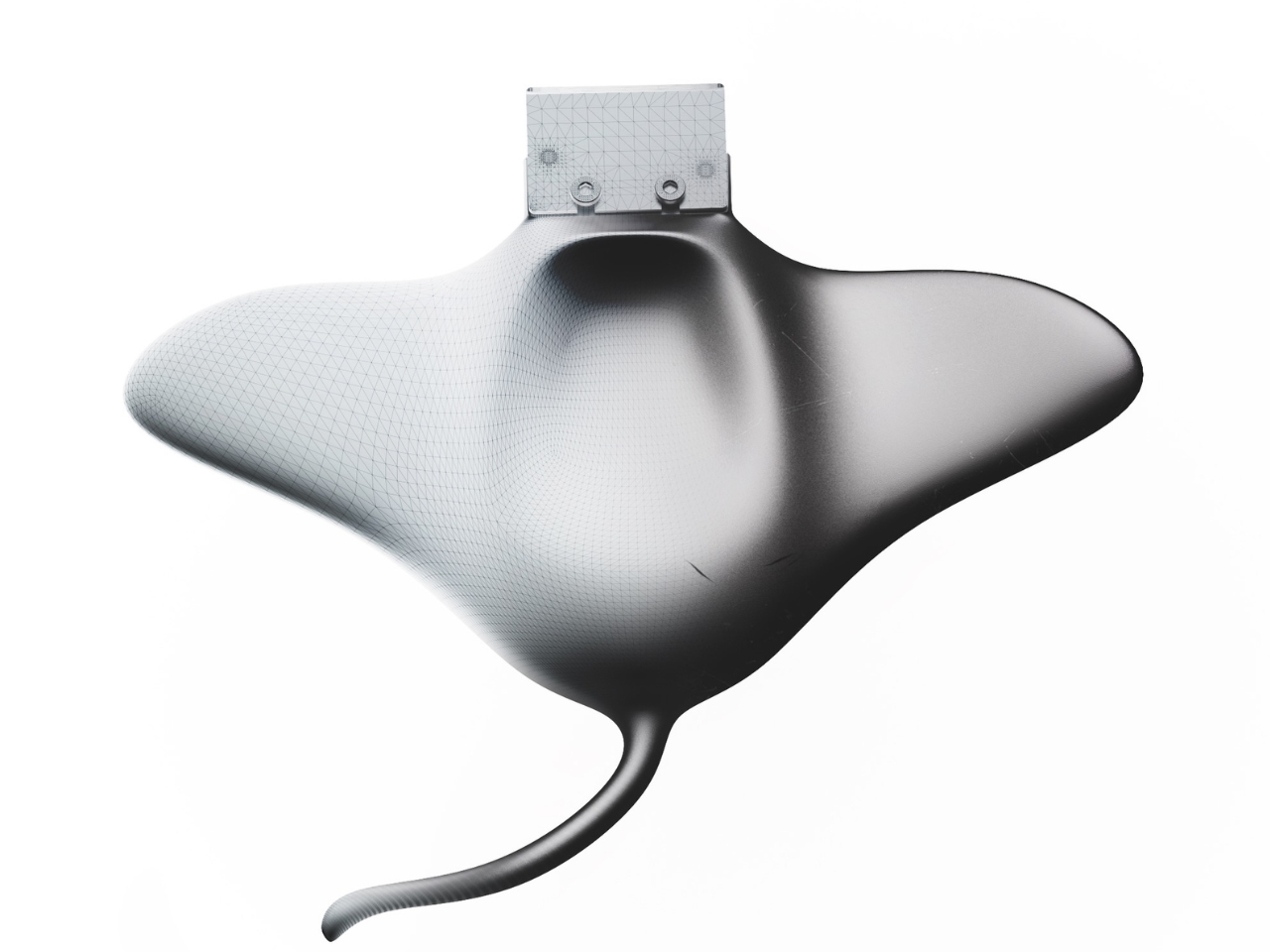
The little rectangular blade gives RAY away. Without it, Marija Kucurski’s stingray-shaped design could pass for a small sculpture, all sweeping fins and a curling tail. It’s actually a concept for a 3D print scraper, a tool meant to help release stubborn plastic from a printer’s build surface. Presented through renderings on Render Weekly, it gives an unglamorous workshop accessory a silhouette I’d happily leave out on the bench.

The practical problem is straightforward: a print needs to stay attached while it’s being made, but removing it afterward can take care. Prusa recommends letting its flexible steel sheets cool before bending them to release a print, sometimes using a spatula for assistance. RAY explores a handle for that scraping job while tackling a second, more personal frustration. Kucurski wanted to get away from the cubes, rounded rectangles, and racetrack shapes that had started to feel repetitive.

Designer: Marija Kucurski

In her project description, Kucurski compares working with SubD to playing with pizza dough or clay. That experimentation led her toward a stingray. I like how modest that explanation is. There’s no elaborate story about the ocean teaching us to scrape plastic more efficiently. She wanted to try a different shape, followed the modeling process, and arrived at an animal whose broad body gives the tool a recognizable identity. Sometimes that’s a perfectly worthwhile starting point.

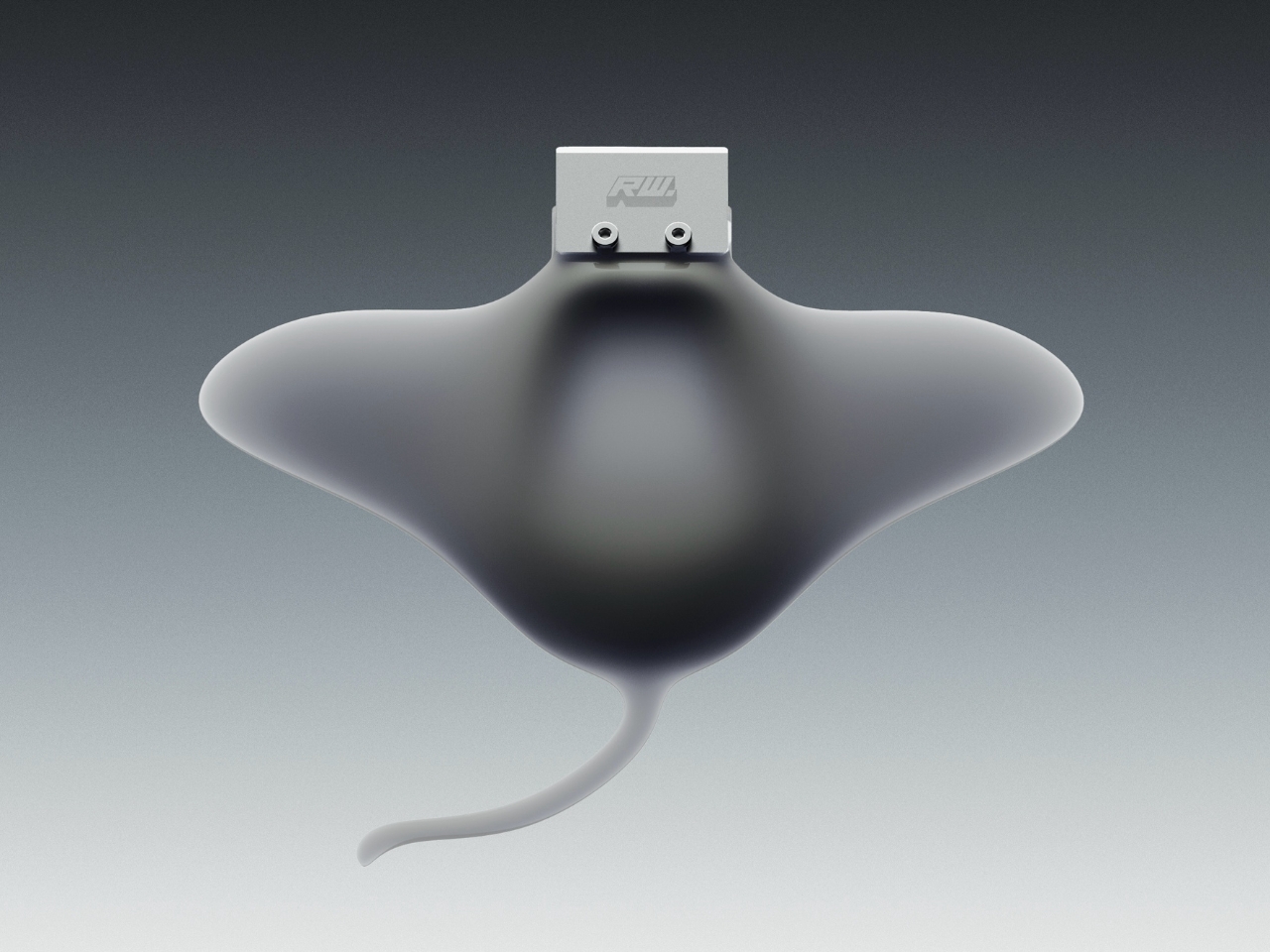
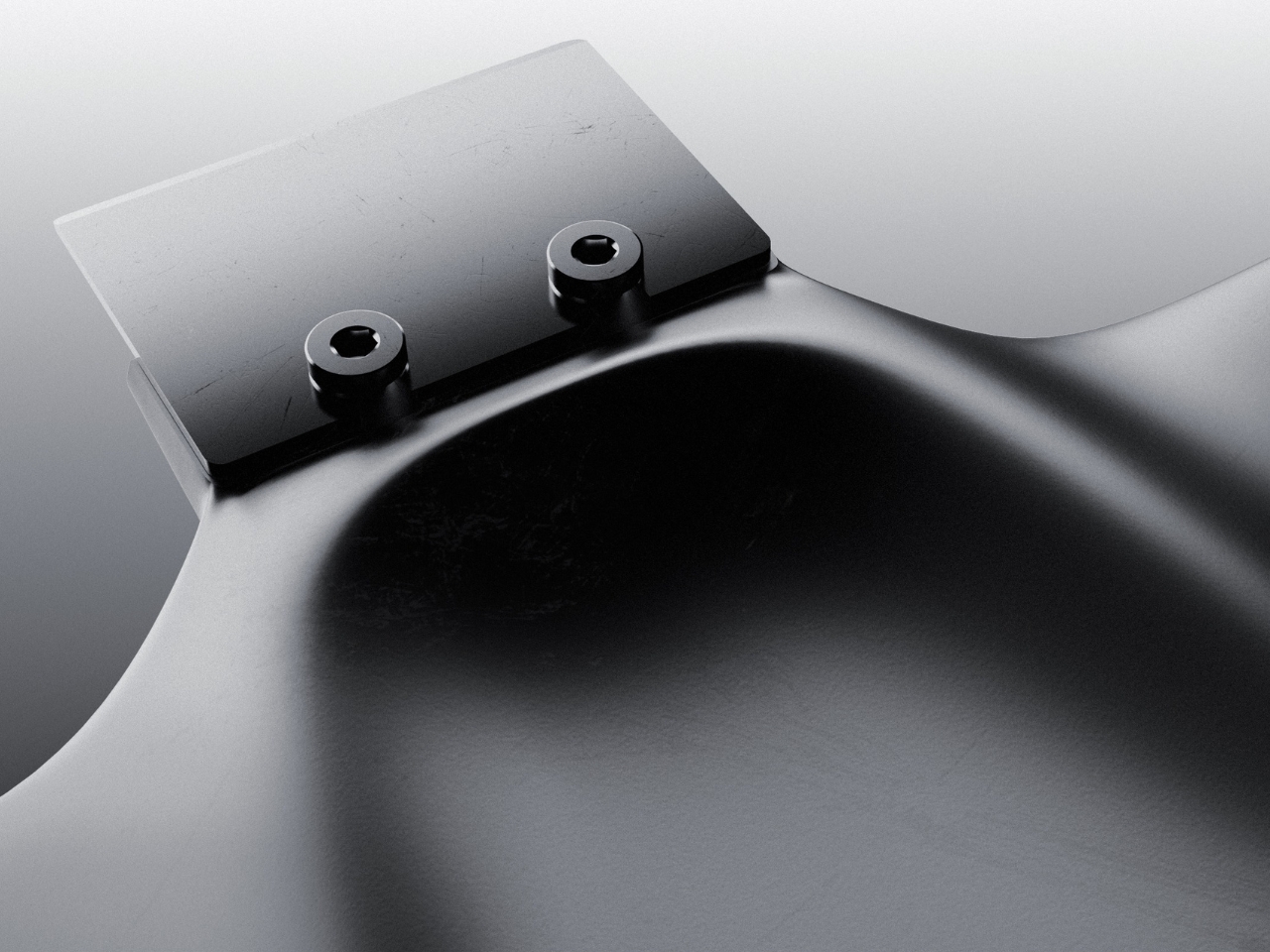
Seen from above, RAY spreads outward into two rounded wings, with a raised central body flowing into a slender, curved tail. The dark, metallic-looking surface catches light across those changes in curvature, making the body feel more sculpted than assembled. That’s a visual effect in the renderings, not confirmation of a particular material. The blade sits at the front, interrupting those soft contours with a plain rectangle and two exposed fasteners.

A separate visualization makes the proposed grip clearer. A hand cradles the broad body, with the thumb resting near the center and fingers supporting the wings from underneath. The tail extends back toward the wrist rather than serving as a conventional narrow handle. That arrangement suggests a different relationship between hand and tool: more of a palm-supported object than something held by a stick. I’d be curious to see how that translates when applying pressure close to the build plate.

The blade attachment is a useful visual anchor. Two visible screw heads keep the business end legible, so the animal reference doesn’t completely swallow the tool’s purpose. I appreciate that decision. A perfectly uninterrupted stingray would make a cleaner sculpture, but the exposed hardware gives RAY a little workshop credibility. It also draws attention to the connection that would need to hold up during use.

My hesitation is mostly about the tail. It completes the stingray immediately, and removing it would make the design less memorable. But I’d want to know whether it contributes anything to handling or simply asks for extra space in a drawer. The wide wings raise a similar question about storage. Neither concern ruins the idea. They’re the ordinary negotiations that make a playful concept interesting once you imagine it sharing a bench with other tools.

The available presentation doesn’t establish grip comfort, scraping performance, or compatibility with particular build surfaces. Those details would matter more than the silhouette if RAY moved toward production. Even a beautiful scraper needs to respect the surface underneath it. Prusa specifically cautions against damaging the sheet when using a spatula and recommends slipping it beneath the model while the sheet is slightly bent, rather than digging into a flat surface.

Still, I’m glad Kucurski followed the less predictable shape. I don’t need every tool to resemble a sea creature, but I do enjoy a design that makes its maker’s curiosity visible. RAY earns attention through the sweep of its body and the almost comically practical blade attached to its front. The next step would be putting that expressive form to work, finding out which curves help the hand and which ones are simply along for the ride.

The post RAY’s 3D Print Scraper Concept Refuses to Be Another Rectangle first appeared on Yanko Design.

  •  

Arrowspace’s $119 screwdriver identifies screws and lights up the matching bit

For five years, Arrowmax has been teaching screwdrivers to read people. The SES Pro in 2021 watched your wrist, so a twist left or right told the motor which way to spin. The SES Max added app control, and the M1 Pro stretched output to 10 kgf·cm with a manual fallback for stubborn screws. Its little screen could report torque and battery level all day. Your screwdriver got smarter and you got lazier, in the best possible way. The obvious next question was why the tool still had no idea what screw it was holding.

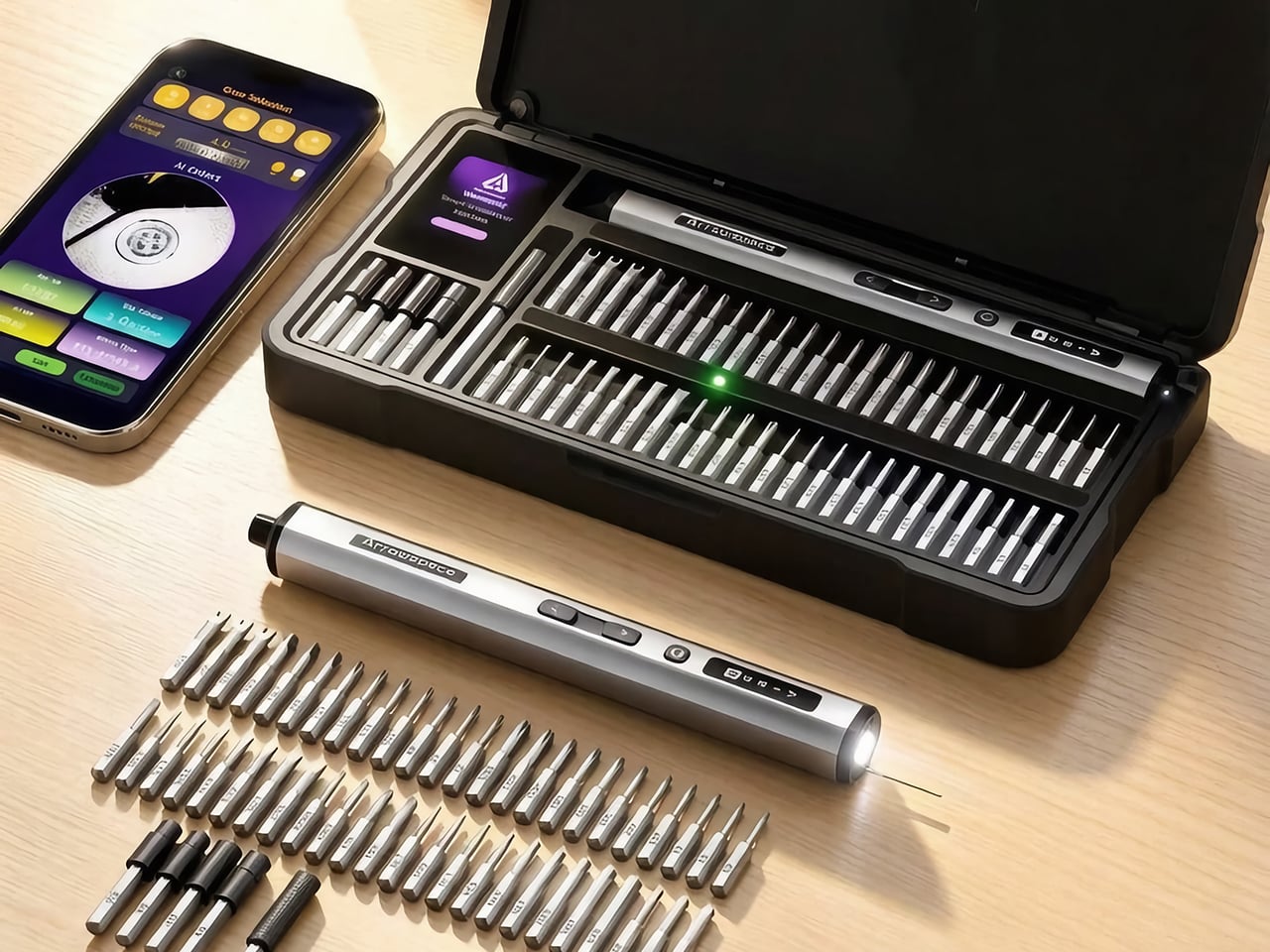
The Arrowspace S1, built by the same team under a new brand name, answers that with a camera on the tail end of the screwdriver. Image recognition names the screw’s drive type and exact size, while a small probe holds the lens at a fixed distance so tiny heads stay sharp. The smart case then lights the slot of the matching bit, and Auto mode picks a safe torque for that fastener. It keeps the 10 kgf·cm ceiling of the M1 Pro, which is plenty for everything from earbuds to e-bike parts. Early pricing starts at $119, and the kit includes the case, 52 S2 steel bits, and a power tip extension.

Designers: LAU YIN / XU YU

Click Here to Buy Now: $129 $215 (40% off). Hurry, only 40/400 left! Raised over $119,000.

The Screwdriver That Squints So You Don’t Have To

The camera sits at the rear of the S1, right behind a small contact probe, and the two work as a team. You rest the probe on the screw head, which locks the lens at one fixed distance, so every shot lands sharp. A screw this small turns to mush if the camera drifts even 1mm. Arrowmax fixed that blur problem with a metal pin instead of more code, which is a very hardware-person way to win an argument. I love it, because it means recognition survives a messy bench and shaky hands instead of working only in a demo video.

Once the shot is sharp, the driver sends it to the companion app on your phone, which works out the drive type and exact size. Everything runs locally with no internet involved, so your screw photos stay on your phone. Arrowmax trained the model, a YOLO object detector, on its own collection of tens of thousands of real screw photos, currently covering 12 common head profiles. The app shows the actual camera image next to the verdict, so you can see what the S1 sees and judge the call yourself. Only the reading step needs the phone, since motor control, torque, and the displays all work on their own.

A Case That Points at the Right Bit

The smart case turns the app’s verdict into something you can see across the bench. A 2-inch TFT screen with Arrowspace’s purple interface shows the recognized screw type and size, while an LED glows under the slot holding the matching bit. Reach, grab, done. Compare that with the usual ritual of squinting at tiny codes on dozens of near-identical shafts, and the old way starts to look like a part-time job. It is the same idea as a warehouse pick-to-light shelf, shrunk down to a tray of S2 steel bits.

The 52 bits are S2 steel hardened to HRC60, which keeps the tips from rounding off after repeated use, and extended bits reach screws buried in deep holes. A magnetic holder keeps bits seated while you work. The case itself is a CNC-machined frame in aerospace-grade aluminum with EVA protection inside, a build the M1 Pro’s CNC aluminum box would recognize. That solid metal feel suits a bench that sees daily use. One box ends up holding the driver, the bits, and the answer to which bit you need.

Gentle With Earbuds, Firm With E-Bikes

Electric torque runs from 1 to 10 kgf·cm, roughly 0.1 to 1 N·m, and Arrowspace’s own chart maps that range to real jobs. The low end suits earbuds, smart bands, and glasses. Around 3 you are into laptops and camera bodies, 6 covers RC cars, drones, and game consoles, and the full 10 handles e-bike parts and large appliances. Auto mode matches a conservative preset to the screw it just identified and remembers your last setting between jobs. Prefer to drive? The app lets you tune the torque for each mode yourself.

When electric mode runs out of muscle, the S1 switches to manual on its own, a trick it inherits from the M1 Pro. The mechanism is rated for 30 kgf·cm of hand-twisted force, which handles the factory screw that laughs at motors. A 600mAh LiPo battery covers 900+ screws or about 90 minutes of continuous use, and USB-C refills it in roughly 70 minutes. An OLED on the body shows torque level, spin direction, and battery, and it even animates while charging. A full session of fiddly repairs fits comfortably inside one charge.

The Price of Never Guessing Again

The S1 suits anyone who repairs often enough to own a drawer of bits but not often enough to have a veteran’s eye, meaning RC builders, scale modelers, drone owners, and the friend who gets every laptop question. Arrowspace says the AI handles identification while your hand keeps the control, and that split feels right to me. My one wish is friendlier recognition for oddballs like JIS cross-head screws, the Phillips look-alikes in plenty of Japanese electronics. Arrowmax says updates will keep widening the 12 profiles covered today, so the wish has a path. A screwdriver that learns new screws over time is a fun idea for a tool that used to be a metal stick.

Pricing for a single S1 kit starts at $119, listed at 45% off, with $129 and $149 tiers also available. Every tier includes the driver, the illuminated smart case, 52 S2 steel bits, and a power tip extension. Shipping is an estimated $16 by air freight to anywhere in the world, so US buyers are covered, with delivery expected in April 2027. Two kits run $238 and three run $339, with shipping at $30 and $45. The optional Angle Screw attachment is sold separately, so check the product page for its price. A stripped screw can cost you a whole device, which makes $119 look like cheap insurance.

Click Here to Buy Now: $129 $215 (40% off). Hurry, only 40/400 left! Raised over $119,000.

The post Arrowspace’s $119 screwdriver identifies screws and lights up the matching bit first appeared on Yanko Design.
  •  

Do yourself a favor and buy a power station now, before the energy crisis gets worse

Every crisis has its panic buy. In 2020 it was toilet paper and N95 masks, in 2021 it was graphics cards, in 2025 it was RAM chips, and in 2026 my money is on lithium iron phosphate. With Iran attacking tankers in the Strait of Hormuz, gas sitting at a record-for-October $4.36 a gallon, and heating oil bills forecast to climb 21% this winter, the case for keeping your own stash of electrons has never been stronger. A portable power station from Anker, EcoFlow, or Jackery keeps your fridge cold and your lights on when the grid gives up. It also runs indoors without trying to poison you, and it never needs a trip to the gas station.

Stockpiling toilet paper made you look a little unhinged. Owning a power station makes you the neighbor everyone suddenly wants to befriend during an outage. Black Friday could knock a few more dollars off, sure, but fall sale prices are already the best we’ve seen this season, and winter storms rarely wait for a coupon code. I’ve narrowed the field to one value pick from each brand, all hovering around the 2kWh mark, enough to keep a fridge humming for well over a day. Anker gets first crack, because its S2000 squeezes 2,010Wh into a 35.7-pound body that costs less than a decent espresso machine.

[Editor’s Pick] Anker S2000 2,010Wh Portable Power Station: $699.99

Anker announced at IFA 2026 that its SOLIX power station brand is folding into the Anker name, so you’ll still spot “SOLIX” on boxes and Amazon listings while the switch plays out over the next couple of years. Same company, same warranty, simpler logo. The S2000 makes a great poster child for the new identity, because it looks like it wandered over from the home appliance aisle. At 8.2 x 11.1 x 12.7 inches (208 x 282 x 323mm) and 35.7 pounds (16.2kg), it takes up roughly the counter space of a coffee maker. That makes it nearly 4 pounds lighter than Jackery’s Explorer 2000 v2 and 9 pounds lighter than EcoFlow’s DELTA 3 Max.

Inside are 314Ah lithium iron phosphate cells rated for 6,000 cycles to 80% capacity and 10,000 to 60%, the same chunky format used in grid-scale storage. Anker estimates a 15-year design life, so this thing could easily outlast your fridge. Output tops out at 1,500W continuous with a 3,000W surge, plenty for a fridge, router, lights, laptops, and a CPAP. The real magic is efficiency, with idle draw of just 6W, which helped it keep a fridge running for 34 hours and 15 minutes in GearJunkie’s testing. At $599.99 for subscribers, that works out to roughly $300 per kilowatt-hour, the cheapest of our three picks by a wide margin.

Click Here to Buy Now

What we like

  • At 35.7 pounds, it’s the lightest 2kWh station you can buy right now, and compact enough to live on a kitchen counter.
  • A UPS switchover of 10ms or less keeps your router and desktop online the moment the grid drops.
  • Long-life cells and roughly $300 per kWh make it the best value of the three.

What we dislike

  • Solar input caps at 400W, which means about five hours of ideal sunshine to refill, and winter rarely delivers ideal.
  • It isn’t expandable, so 2kWh is your ceiling.
  • 1,500W of output rules out running a space heater alongside much of anything else.

Jackery Explorer 2000 v2 2,042Wh Portable Power Station: $899

Jackery’s orange-trimmed Explorers were the default power station for years, long before Anker, EcoFlow, and Bluetti started crowding the category. The Explorer 2000 v2 keeps that familiar look but trims the bulk, measuring 13.2 x 10.4 x 11.5 inches (335 x 264 x 292mm) and weighing 39.5 pounds (17.9kg). Its proportions are squatter and more cube-like than the Anker’s, which makes it easier to tuck under a desk or beside a fridge. Jackery marketed it as the lightest and most compact 2kWh LiFePO4 station around, a crown the S2000 snatched this year by shedding nearly four more pounds. The two brands are basically locked in a very nerdy weight-loss competition.

Output is where the Jackery pulls ahead of the Anker, with 2,200W continuous and a 4,400W peak spread across three AC outlets. That’s enough headroom for a sump pump, a fridge compressor, or a microwave without the station breaking a sweat. Jackery’s ChargeShield 2.0 system layers in 62 protection mechanisms, and Silent Charging Mode keeps noise under 30dB, roughly a whisper, which is handy if it ends up in your bedroom during an outage. The cells are rated for 4,000 cycles and a 10-year lifespan, fewer than Anker promises but still plenty for daily use well into the 2030s. At $899, you’re paying about $440 per kilowatt-hour, dropping to $416 when it dips to $849.

Click Here to Buy Now

What we like

  • 2,200W of continuous output handles bigger appliances than the Anker can.
  • Silent Charging Mode stays under 30dB, so it won’t keep you up at night.
  • A 3-year standard warranty plus a 2-year extension covers you for five years total.

What we dislike

  • Only three AC outlets, so a power strip becomes part of the kit.
  • It isn’t expandable, and solar input maxes out at 400W.
  • It won’t charge below 32°F (0°C), so an unheated garage in January is a bad home for it.

EcoFlow DELTA 3 Max 2,048Wh Portable Power Station: $899

EcoFlow’s DELTA family is the brand’s bread and butter, and the DELTA 3 Max is the 2kWh sweet spot of the current lineup. It’s also the chunkiest of our three picks, measuring 19.45 x 9.41 x 12.01 inches (494 x 239 x 305mm) and weighing 44.8 pounds (20.3kg). That long, low, suitcase-like shape belongs on the floor next to the fridge, and you’ll want two hands whenever you move it. EcoFlow spends that extra bulk on muscle, and the trade feels fair once you see the output numbers. The Halloween sale has it at $899, down from $1,199, which puts it neck and neck with the Jackery on price.

You get 2,400W continuous across four AC outlets, the most of our three picks, plus EcoFlow’s X-Boost mode for resistive appliances up to 3,400W. X-Boost works by dropping the voltage, so a kettle or hair dryer runs a little slower instead of tripping the station. That’s enough headroom to run a 1,500W space heater with the fridge and router still plugged in. EcoFlow also rates it at 25dB or less when charging or discharging at 600W, which is quieter than a library. At $899, it lands at about $439 per kilowatt-hour, essentially tied with the Jackery, so the choice comes down to extra watts versus a lighter box.

Click Here to Buy Now

What we like

  • 2,400W continuous output, with X-Boost up to 3,400W, makes it the most powerful of the trio.
  • Four AC outlets, one more than the Jackery.
  • It stays under 25dB at moderate loads, so it’s easy to live with indoors.

What we dislike

  • At 44.8 pounds, it’s the heaviest of the three, roughly 9 pounds more than the Anker.
  • The long footprint eats more floor space than its boxier rivals.

The post Do yourself a favor and buy a power station now, before the energy crisis gets worse first appeared on Yanko Design.
  •  

The Auk Mini 2 brings your grocery store’s herb aisle to your kitchen counter (with zero human effort)

During World War II, Americans planted millions of victory gardens in backyards, vacant lots, and rooftops, and by most estimates those plots supplied roughly 40% of the country’s fresh vegetables. Today’s enemy is the grocery receipt, which now runs roughly 35% higher than it did in 2019. Prices have cooled lately, but they never came back down, and the herb aisle still charges luxury rates for a handful of leaves. Norwegian brand Auk has a counterattack in the Mini 2, a countertop garden that takes the victory garden indoors and shrinks it to fit beside the coffee maker. Your war effort is now four pots of basil, and honestly, I respect it.

The Mini 2 is the sequel to Auk’s best-selling Auk Mini, and it comes from a team in Oslo, where December daylight is more rumor than fact. Lead designer Johan Schreiner and his team just took home a 2026 European Product Design Award in the Kitchen Appliances category. That’s a jury-judged international competition with more than 800 categories, so call it a solid nod rather than an Oscar. The pitch is simple: herbs, salad greens, even chilies and tomatoes, grown from seed on your counter all year. It’s 12% smaller than the first model, holds 25% more water, and starts at $239.

Designers: Johan Schreiner, Jostein Kvitvang, Magnus Bjørnstad & Didrik Dimmen

A Grow Light That Stops Turning Your Kitchen Into a Nightclub

Anyone who has shared a kitchen with a grow light knows the deal: the plants get their sunshine, and so does everyone trying to eat dinner. The Mini 2 fixes that with an optical lens system that aims light down at the leaves instead of spraying it across the room. Auk’s spec sheet lists output between 300 and 1,000 µmol/m²/s of PPFD depending on mode, which is the number plants actually care about. Average power draw runs from about 5 W in slow mode to 17 W in fruit and vegetable mode. That’s somewhere between a night light and a modest LED bulb, so your electric bill barely flinches.

Scandinavian designers have been fighting glare since Poul Henningsen’s PH lamps for Louis Poulsen in the 1920s, which hid the bulb behind layered shades so light landed where people needed it. The Mini 2 carries that instinct into horticulture, and it makes a neat contrast with Lettuce Grow’s Counterstand and Glow Lamp, which tames its grow light by tuning the color temperature until it looks warm and livable. Auk controls where the light goes, while Lettuce Grow controls what the light looks like when it arrives. Henningsen was Danish, so Norway gets a polite asterisk on the heritage claim. Either way, nobody has to live under a purple haze anymore.

Walnut, Oak, and Ash: A Garden Dressed Like Furniture

Pull the Mini 2 out of the box and it reads as furniture first, appliance second. A wraparound sleeve of FSC-certified, oil-treated European wood (walnut, oak, beech, or ash) rolls around softly radiused corners, and Auk keeps the seams flush so nothing catches the eye or your sleeve. Two slim wooden dowels, 0.63 in thick, hold up a light bar made from 100% recycled Norwegian aluminum, its ribbed top borrowing the look of heat sink fins. The base and pots are recyclable ABS plastic. Even the 5.9 ft braided USB-C cable comes in green, so the wire looks like it belongs to the plant kingdom.

Five colorways run from Espresso Walnut to Sage Ash, so the Mini 2 can slip into a moody dark kitchen or a pale Scandinavian one without making a scene. The footprint shrinks from the original’s 17.5 x 8.5 in to 16.9 x 7.5 in, and Auk’s own math calls the whole unit 12% smaller. Yet the tank holds 0.9 gallons on the first fill, 25% more water than before, which means fewer refill trips and fewer “oops, I forgot” moments. Longer dowels and wider Big Plant Pots, bundled in a chili and tomato kit, let the Mini 2 grow fruiting plants too. Smaller box, bigger ambitions.

Does a $239 Garden Actually Beat the Produce Aisle?

A clamshell of basil runs about $3.50, so if you buy one a week, the Mini 2’s $239 price covers roughly 68 of them, or about 16 months of Sunday-night pesto. Power is cheap, with Auk listing 3.6 to 12.2 kWh a month, which works out to a buck or two at typical US electricity rates. Seeds, coco fiber, and nutrients add a little, so treat 16 months as the friendly estimate. Past that point, every snip is free basil with a side of smugness. Better yet, you cut exactly one sprig and leave the rest alive, so the cilantro funeral in your fridge never happens.

Nobody is quitting the grocery store over this, but cutting a few herb runs a month adds up to a real taste of food independence. Pod-based systems like Click & Grow sell you plant capsules, while the Mini 2 grows from any seeds you like in coco fiber, with no pump and no pods. The optional Bluetooth app handles light cycles and modes, and Slow Mode keeps plants from outgrowing the light while you’re away on vacation. The victory gardeners of the 1940s never had it this easy. You can order the Mini 2 at Auk’s site, and the first basil is about four to five weeks out.

The post The Auk Mini 2 brings your grocery store’s herb aisle to your kitchen counter (with zero human effort) first appeared on Yanko Design.
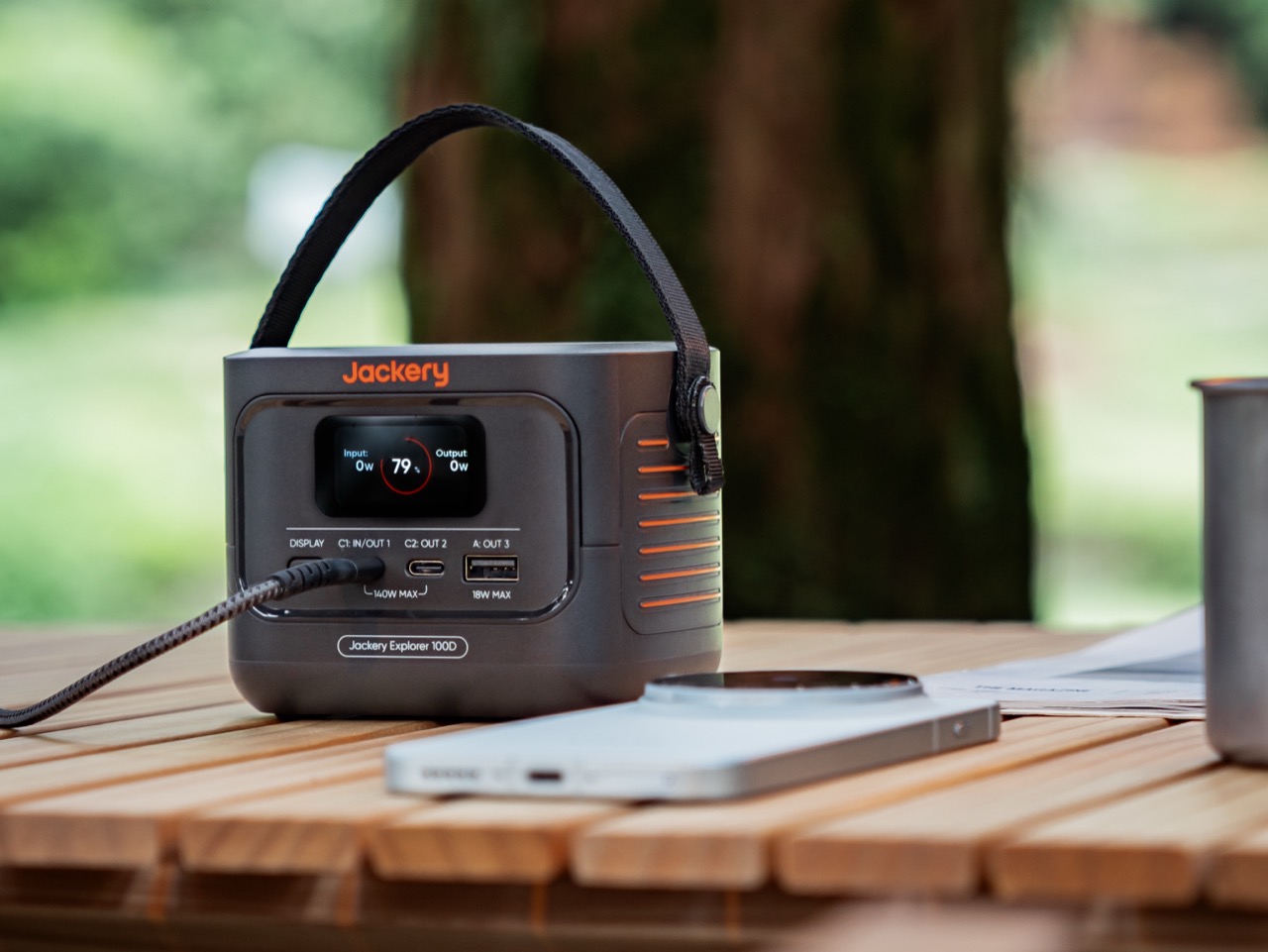
  •  

Apple’s new M6 iMac is faster, not different

Apple’s October has turned into a full-on home makeover. First came HomeView, a $299 smart display for the kitchen with a generous helping of iMac nostalgia baked into its design. Now the iMac itself is back with the M6 chip, which feels a bit like the original star showing up after the spinoff already aired. The two aren’t rivals at all, because a 7-inch hub and a 24-inch desktop live very different lives. They play for the same team, with HomeView running the house while the iMac sits on the desk handling homework, taxes, and the occasional late-night gaming session.

The new iMac skips the M5 generation and goes straight to Apple’s 2nm M6 chip, with two more CPU and GPU cores than before. It starts at $1,499 for the 10-core, two-port model, while $1,699 gets you 12 cores, four Thunderbolt ports, and 2.5 Gigabit Ethernet living inside the power brick. Apple also swapped in its own N1 wireless chip for Wi-Fi 7, Bluetooth 6, and Thread, which fits neatly with all that smart home energy. Those prices match what the M4 iMac cost after June’s price hike, so the extra cores are basically a free upgrade. Pre-orders open October 28, and the first deliveries land November 6.

Designer: Apple

The iMac skipped M5 and went straight to 2nm

The M6 is built on TSMC’s first-generation 2nm process, swapping the M4’s FinFET transistors for gate-all-around nanosheets that leak less power at these tiny sizes. The $1,499 model gets a 10-core CPU split into two super cores, three performance cores, and five efficiency cores. The $1,699 model bumps that to 12 cores, with two super, four performance, and six efficiency cores. Both get a matching GPU with a Neural Accelerator in every core, plus two 16-core Neural Engines totaling 32 cores. Memory bandwidth climbs from 120GB/s to up to 170GB/s, and the SSD now supports PCIe 5.0 for up to twice the read and write speed.

Apple’s own numbers put the M6 iMac up to 1.5 times faster than the M4 in Microsoft Excel and up to twice as fast for photo editing in Affinity. Ray-traced gaming performance doubles too, which is great news for anyone secretly using the family computer as a gaming rig. The biggest jump is on-device AI, with prompt processing in LM Studio up to five times faster than M4. Apple’s press release even name-drops vibe coding as an iMac use case, a very 2026 thing to say about a computer that comes in pink. If you’re coming from an Intel iMac, Apple claims up to 18 times faster performance, which should feel like time travel.

The Ethernet port lives in the power brick now

The $1,699 model comes with a 2.5 Gigabit Ethernet port as standard, and the $1,499 model can add one for $30. Apple builds that jack into the power adapter instead of the computer itself. That keeps the iMac’s 11.5mm-thin body free of a chunky network port, and your cable clutter ends up under the desk where it belongs. The previous model used the same brick trick, but it topped out at 1 Gigabit. At 2.5 Gigabit, pulling a giant photo library off a home server should feel a lot less like waiting for a kettle to boil.

Apple’s own N1 wireless chip replaces Broadcom, bringing Wi-Fi 7, Bluetooth 6, and Thread, the low-power mesh network behind a lot of Matter smart home gear. External display support gets generous on the four-port model, which can drive two 6K screens at 60Hz, two 4K screens at 165Hz, or a single 4K panel at 240Hz. It can even run both external displays off a single Thunderbolt port. Everything you see and hear stays the same, from the 24-inch 4.5K Retina display at 500 nits to the 12MP Center Stage camera and six-speaker system. The seven colors carry over too, along with color-matched keyboards and mice that charge over USB-C.

Same $1,499 price, two more cores

The M4 iMac launched at $1,299 back in 2024, then jumped to $1,499 in June when Apple raised prices across the Mac lineup to cope with soaring memory and storage costs. The M6 model keeps that $1,499 starting price, but the base chip now has 10 CPU and GPU cores instead of eight. Compared to yesterday, that’s two extra cores of each for the same money. Compared to two years ago, the cheapest iMac costs $200 more. The four-port model at $1,699 is the one I’d point most people toward, since it bundles Ethernet, more display options, and the full 12-core chip.

If you bought an M4 iMac, enjoy it, because the display, camera, speakers, and design are identical and your browser tabs won’t notice the difference. Families still running an Intel or M1 iMac are the real audience here, and the jump will feel enormous. Pre-orders open October 28, with deliveries starting November 6. That makes it the third new Apple product in two days, after the iPad mini and alongside the M6 MacBook Pro, with touchscreen Macs still on deck. HomeView may have gotten the nostalgic looks this month, but the iMac is still the one doing the family’s homework.

The post Apple’s new M6 iMac is faster, not different first appeared on Yanko Design.
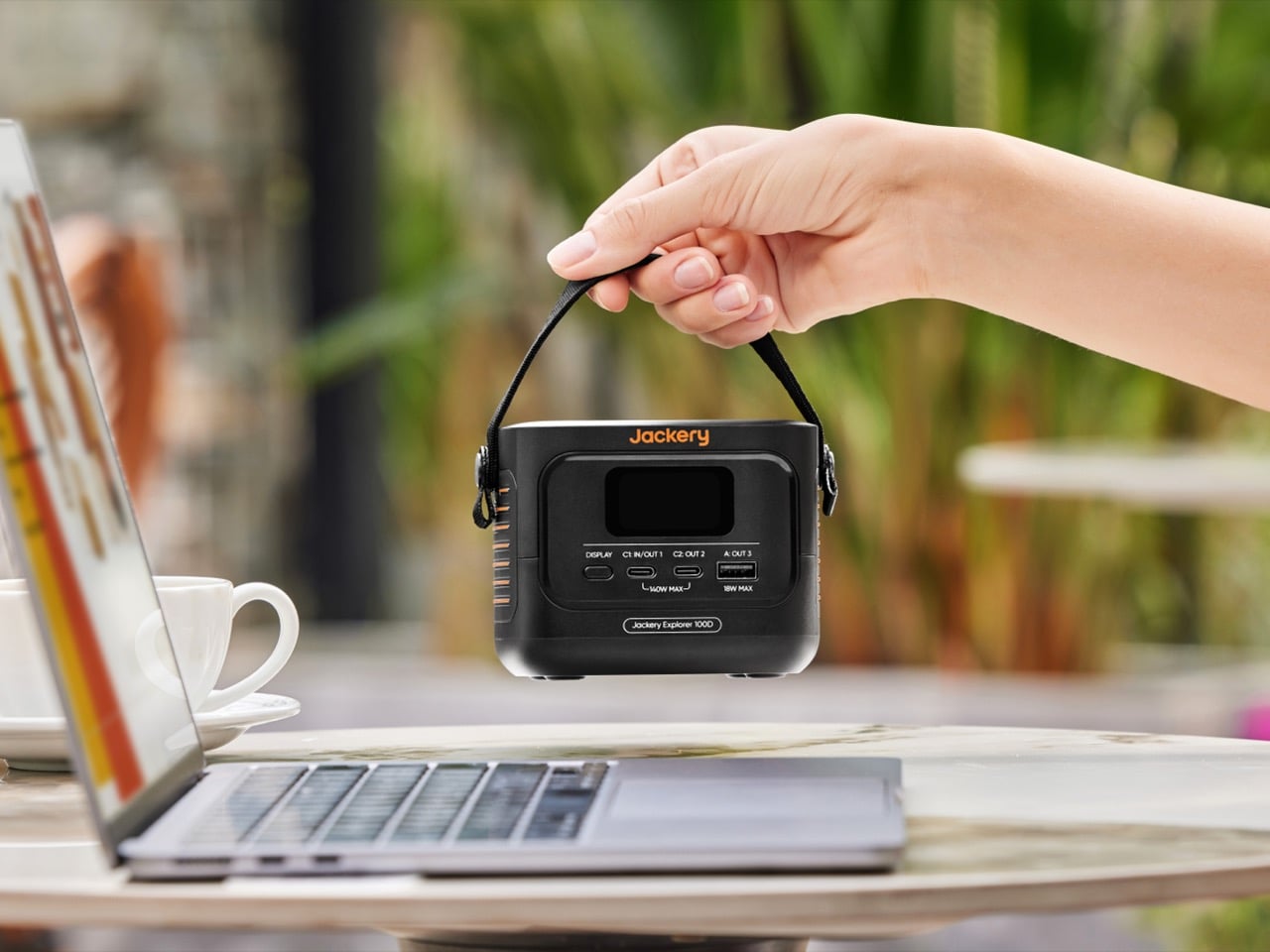
  •  

Apple just launched a MacBook Pro 24-hours before its MacBook Pro event

On Monday, the day the new iPad mini landed, I begged John Ternus to take a break. On Tuesday morning, Apple responded by dropping a brand-new 14-inch MacBook Pro with the M6 chip, roughly 24 hours before its Pro and Tell event in Los Angeles. That’s the event literally named after the MacBook Pro, by the way. It’s like a band releasing a single the night before the album drops, if the single cost $1,999. At this point I’ve stopped asking for rest and started stretching before I open my inbox.

The new MacBook Pro starts at $1,999 with 16GB of unified memory and 1TB of storage, the same price the M5 model has carried since Apple’s June price hike. Inside sits the M6, a 2nm chip with a 12-core CPU and 12-core GPU, two more cores apiece than before. Apple claims up to 30 percent faster graphics than M5, with Wi-Fi 7 and Bluetooth 6 arriving through its own N1 chip. Pre-orders open October 28, with deliveries starting November 6 in silver and space black. Even funnier, Wednesday’s rumored touchscreen MacBook Pros reportedly run M5 Pro and M5 Max chips, so the cheapest Pro in the lineup now has the newest silicon.

Designer: Apple

Two more cores, 2nm silicon, and a reshuffled CPU

The M6 is built on TSMC’s first-generation 2nm process, and it first showed up in the Mac mini back in August. It swaps the old FinFET transistors for gate-all-around nanosheets, which wrap the gate around the channel on every side so less power leaks away at these tiny sizes. The CPU layout changes too, from four super cores and six efficiency cores to two super, four performance, and six efficiency cores. The GPU climbs to 12 cores, each with its own Neural Accelerator, while the Neural Engine doubles up to a dual 16-core setup totaling 32 cores. Apple claims up to 1.3 times faster Blender ray tracing and Xcode builds than the M5 model.

Apple ditched the M5 model’s Broadcom wireless chip for its own N1, which brings Wi-Fi 7, Bluetooth 6, and Thread support. Thread is the low-power mesh network a lot of Matter smart home gear runs on, which fits neatly with the HomeView push Apple kicked off earlier this month. External displays get a bump as well, with two 4K monitors now running at up to 165Hz instead of 144Hz. Memory bandwidth rises to 170GB/s, though only on the 24GB and 32GB configurations. The base 16GB model stays at 153GB/s, so if you plan on running local AI models, spring for the extra memory.

Same $1,999 price tag, same body, same 24 hours

The M5 model launched at $1,599 with 512GB of storage last October, jumped to $1,699 in March when 1TB became standard, then hit $1,999 in June when Apple raised prices across the Mac lineup. Apple blamed AI data centers hoovering up the world’s memory supply, saying it had never seen component costs climb so far so fast. So the M6 costs exactly what the M5 did yesterday, while sitting $400 above where the 14-inch Pro started a year ago. That 1TB base is generous at this tier, though it also means there’s no 512GB option to save a few bucks. Students and educators can knock the price down to $1,899.

Everything outside the chip carries over from the M5 model. The Liquid Retina XDR mini-LED display still peaks at 1,600 nits in HDR, with a nano-texture option for anyone working beside a sunny window. The 12MP Center Stage camera, six-speaker sound system, HDMI port, MagSafe 3, SDXC slot, headphone jack, and three Thunderbolt 4 ports all return untouched. Battery life holds at up to 24 hours, matching the M5, so Apple’s “longest ever in a Mac” line describes a tie. Coming from a 13-inch M1 MacBook Pro, though, that’s up to four extra hours, plus up to 13 times faster AI prompt processing.

The cheapest MacBook Pro now has the newest chip

According to Bloomberg’s Mark Gurman, Wednesday’s 14-inch and 16-inch MacBook Pros will bring OLED touchscreens, a Dynamic Island in place of the notch, and a lighter build. They’ll also reportedly stick with M5 Pro and M5 Max chips, which means the $1,999 model you can’t touch has a newer chip generation than the flagships you can. Gurman says the mini-LED models stay on sale for now before eventually being phased out. Apple announced the M6 model on October 27, exactly ten years after it unveiled the Touch Bar, its last attempt at putting touch on a MacBook Pro. I refuse to believe that timing is an accident.

For an M5 owner, the M6 is an easy skip, since the design, display, and battery are identical. For anyone still hanging onto an Intel MacBook or an early M1 machine, this is the most sensible Pro you can buy, and it costs $500 less than the $2,499 M5 Pro model. Pre-orders for the 14-inch MacBook Pro with M6 open October 28 at 10:10 a.m. Pacific, with deliveries starting November 6. That’s an iPad mini, an iMac, and a MacBook Pro in two days from the guy I asked to take a break, with touchscreen Macs queued up next. At this rate we’ll get that Apple Car announcement by the end of the week.

The post Apple just launched a MacBook Pro 24-hours before its MacBook Pro event first appeared on Yanko Design.
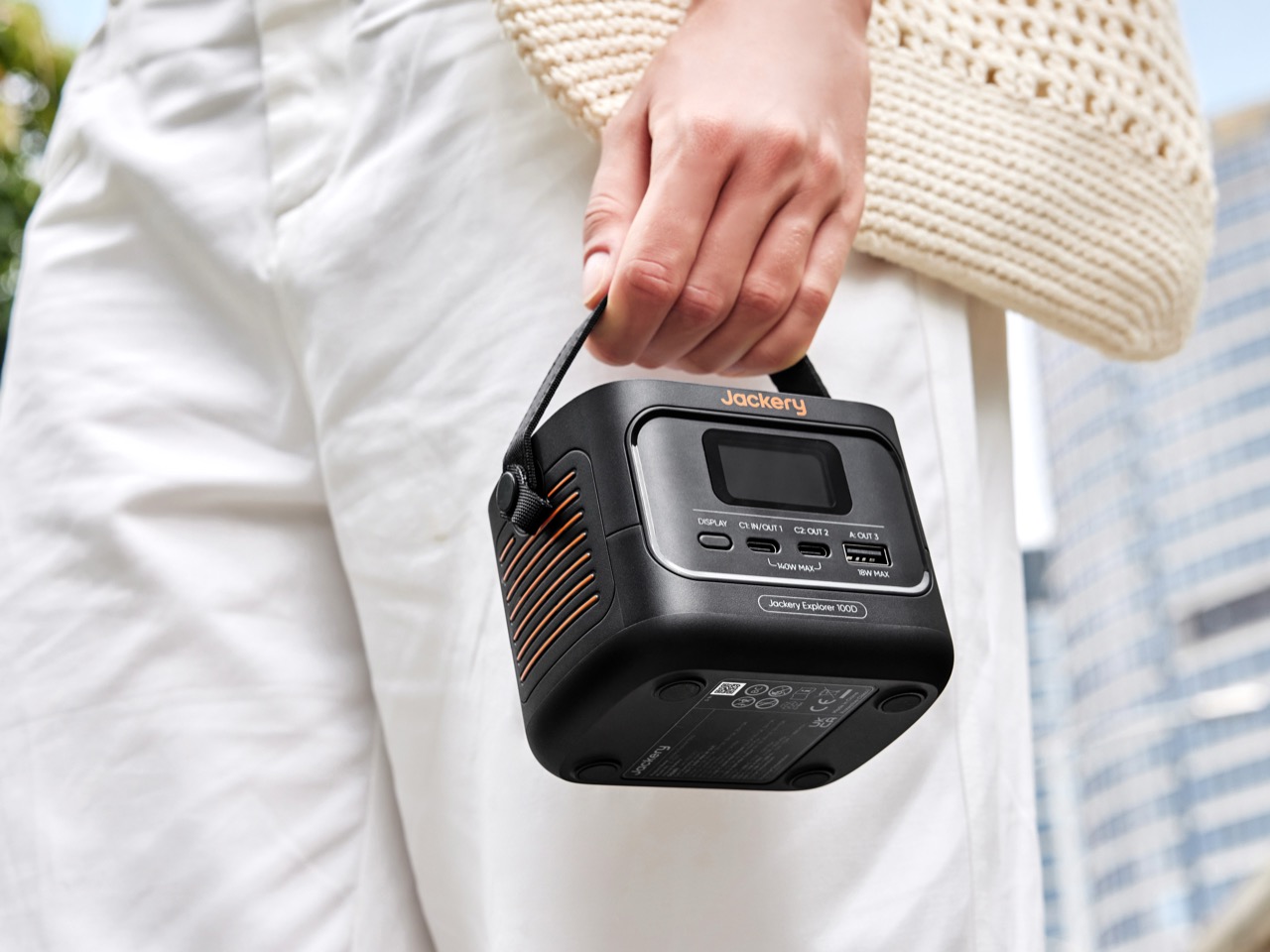
  •  

This $6 Glow-in-the-dark Carabiner might be Camping EDC’s biggest upgrade

We put glow on everything we are afraid of losing in the dark. Watch hands, exit signs, stair edges, light switches, and those plastic stars on a kid’s ceiling all got the memo decades ago. The carabiner, an object whose entire job is hanging onto things in low light, somehow missed it. It sits there, smug in anodized aluminum, daring you to find it. That is the oversight of the century, and I will happily defend that claim at any campsite.

OBORO, from Maruhachi Kasei, a plastics factory in Nagoya, Japan that has been molding resin since 1974, closes the loop. The large D carabiner is glow-infused polycarbonate, measures about 3 by 1.7 inches, weighs 0.42 ounces, and is rated for 66 pounds. Leave it in sunlight or under a lamp for a bit and it shines for hours, with no battery, no charging, and no app (thankfully). A one-handed clip joins it for towels and tarps, rated for 55 pounds, and both come in green or a cooler blue. It is accessory gear rather than climbing gear, so keep your rope work on the real stuff.

Designer: Maruhachi Kasei

Click Here to Buy Now: $73 $91 (20% off) for 12 pieces. Hurry! Only 5 days left.

The Glow Is Baked Into the Plastic Itself

The glow pigment is mixed into the polycarbonate itself, so the entire body is the light source. There is no paint layer to chip or flake, which matters on an object that spends its life banging against rocks, zippers, and other gear. Polycarbonate is the same family of plastic used in bulletproof glazing, and the maker claims five times the impact resistance of ABS and 250 times that of ordinary glass. It also handles weather and heat better than most plastics. The gate is a nickel-plated metal wire, the one part that has to flex thousands of times, so it makes sense that it is not resin.

In the maker’s own test, twenty minutes under a blacklight gave about three hours of visible glow. Brightness peaks in the first 10 to 20 minutes and fades gradually from there, the way every glow-in-the-dark thing you have ever owned behaves. Sunlight and ordinary LED room lighting both recharge it, as many times as you like. Long-afterglow pigments like this trace back to a 1993 breakthrough at Japan’s Nemoto & Co., the lineage behind Super-LumiNova on Swiss watch dials, though the maker does not name its exact pigment. Water is the weak spot: the maker says wet pigment loses its charge and the surface can cloud, so this belongs in the tent, not out in the rain.

A Bigger Gate, Beefier Numbers, and a Clip for Towels

The large D measures about 3 by 1.7 inches and 0.28 inches thick, which the maker says is 30 percent bigger than a standard carabiner. That extra room is the whole point of the redesign. The gate opens wide enough for thick camp rope, so a mug, a kettle, and a lantern can all hang without a game of Tetris. The working load is rated at 66 pounds, while the maker’s pull test ended at 213 kilograms, roughly 470 pounds. That gap is deliberate, since the rating sits near 15 percent of breaking load, and at 0.42 ounces you will forget the thing is on your bag until you need it.

The clip is built for flat, floppy things like towels and tarps. It opens and closes with one hand, using serrated jaws and a sliding block with a toothed lock, and a thin metal loop up top lets it hang from a line or a bag. The wide mouth takes thick fabric where a standard clothespin gives up. Its 55-pound rating sits a bit under the D carabiner, which is plenty for a soaked camp towel. Two clips and a rope between trees give you a glowing clothesline you can actually find after dark.

Two Colors, Endless Things to Hang, and Roughly $6 a Piece

Green is the classic and the brighter of the two, while blue is the rarer, cooler color that I find more fun to look at. By day neither looks like it does at night, since green reads pale yellow-green and blue looks milky white. Blue is dimmer after dark, which seems a fair trade for the novelty. The use cases click once the idea sinks in: a tent guyline, a go-bag handle, a kid’s school backpack, a dog’s leash, a key hook by the front door.

The 12-piece set (six large D carabiners and six clips) is ¥11,616, about $73, against a ¥14,520 (about $91) retail price, which works out to roughly $6 a piece. Singles run about $6 for a D carabiner and about $7 for a clip. Pink versions of both ($40 for six of each), a three-pack of Suncheck glow carabiners ($33), and the older Ouroboros Carabiner Clip ($4) are available as add-ons. OBORO ships worldwide with delivery estimated for January 2027.

Click Here to Buy Now: $73 $91 (20% off) for 12 pieces. Hurry! Only 5 days left.

The post This $6 Glow-in-the-dark Carabiner might be Camping EDC’s biggest upgrade first appeared on Yanko Design.

  •  

5 Pocket-Sized EDC for People Who Hate Carrying Bulky Multitools

A multitool can earn its place in your pocket, right up until its weight makes you leave it at home. Pliers, blades, drivers, and openers all need somewhere to go, and those stacked layers of steel add up. If your daily repairs mostly involve opening a package or tightening a loose screw, carrying the entire assortment can feel like packing a toolbox for a job that takes thirty seconds flat.

The five designs here keep their ambitions small and their functions specific. There’s a DIY toolkit inside a Zippo case, a utility knife with a magnetic ruler, a keychain tool, a flat flashlight, and compact scissors with a few useful extras. Each offers a different way to pare down your everyday carry. Pick the one that matches your usual tasks rather than treating the collection as a pocket packing list.

1. Tiny Tool Shop’s DIY Zippo Toolkit

Closed, Tiny Tool Shop’s DIY toolkit is still a Zippo case. Open it, and a custom 3D-printed insert holds a Crom micro ratchet, two Steinwhale micro bits, and a Klein utility knife extension. The lighter insert has been removed, so this no longer doubles as a lighter. That constraint is part of the appeal: the maker uses an existing enclosure, with its hinged lid already solved, then designs the internal storage around a very specific selection of small tools.

The cleverest detail is retrieval. A spring salvaged from a Bic lighter helps push the ratchet through an opening in the case’s back, addressing the obvious problem of extracting something packed this tightly. Dedicated recesses organize the components instead of leaving them loose inside the shell. This is a maker project, not a ready-made Zippo product, and reproducing it means sourcing parts and making the insert. For someone drawn to mechanical projects, that assembly process is part of its attraction.

What we like

  • Reuses a familiar hinged enclosure with dedicated tool storage.
  • Spring-assisted retrieval addresses the difficulty of removing tightly packed components.

What we dislike

  • Requires DIY assembly and a custom printed insert.
  • Storage is tailored to the specified ratchet, extension, and bits.

2. CraftMaster EDC Utility Knife

CraftMaster makes more sense when opening boxes and trimming materials account for most of your tool use. The utility knife pairs a metal body with a replaceable OLFA blade deployed using a rotating knob. At 4.72 inches long, the package stays compact, while a companion metal ruler docks magnetically against the back. Rather than hiding a blade among unrelated attachments, the design gives cutting and measuring the full object, with the ruler stored alongside the knife.

The ruler carries both metric and imperial markings, with a raised edge to help lift it from a flat surface. It also incorporates a blade breaker for removing dull segments, keeping a maintenance accessory within the same compact arrangement. That’s the interesting decision here: the extra features support the main task instead of chasing a larger function count. At $80, this is a deliberate upgrade to a basic cutter, and its appeal depends on how often you cut and measure.

Click Here to Buy Now: $80.00

What we like

  • Magnetic storage keeps the ruler attached.
  • Replaceable blade with a dedicated blade breaker.

What we dislike

  • An $80 price for a utility knife.
  • No driver or plier functions.

3. Gerber Shard

Gerber’s Shard takes the opposite approach to the Zippo build: there’s nothing to unpack. This stainless steel keychain tool integrates a pry bar, two flathead drivers, a cross driver, a wire stripper, and a bottle opener into its fixed shape. A hole attaches it to your keys, so it doesn’t demand a separate pouch. The appeal is straightforward. For occasional small adjustments or light prying, you can reach for a tool without unfolding an entire set of handles and attachments.

The design asks you to accept a small gripping surface in exchange for less hardware. That’s a reasonable bargain for a backup, but not a reason to retire proper screwdrivers. There’s no blade or pair of pliers here, and the integrated tips aren’t interchangeable. Gerber specifies a titanium nitride coating for corrosion resistance, although that’s a protective treatment rather than a claim that the tool is titanium. Its distinction is how little mechanism it needs to do its limited jobs.

What we like

  • Integrated tools need no unfolding or assembly.
  • Keyring attachment avoids a separate carrying case.

What we dislike

  • Fixed driver tips cannot accommodate interchangeable bits.
  • Small gripping area limits its role in demanding jobs.

4. Streamlight Wedge SL

A flashlight earns its place here because seeing the screw can matter as much as having the right bit. Streamlight’s Wedge SL uses a flat aluminum body rather than a cylindrical tube, measuring 0.28 inches thick, or 0.41 inches with its pocket clip. It weighs 1.14 ounces and measures 5.65 inches long. Those proportions explain the design: this is a slim inspection light for a pocket edge or tool pouch, with dimensions that prioritize a thin profile over outright miniaturization.

Streamlight rates continuous output at 100 lumens on high and 50 on low, with a temporary mode reaching 500 lumens. Keeping those figures distinct matters more than leading with the biggest number. A tail switch handles operation, while USB-C charging and a user-replaceable battery support continued use. The manufacturer quotes 1.75 hours on high, so this is worth choosing around short inspections rather than assuming an entire evening at full output. That runtime deserves as much attention as the brightness.

What we like

  • Flat body measures 0.41 inches thick, including the clip.
  • USB-C charging and a user-replaceable battery.

What we dislike

  • The 500-lumen output is temporary, not continuous.
  • Rated runtime on high is only 1.75 hours.

5. Eiger 8-in-1 Scissors

EigerTool starts with the scissors, which is a sensible choice if most of your everyday cutting involves packaging, string, or labels. Made in Sanjo, Japan, the Eiger 8-in-1 Scissors use SUS420J2 stainless steel and measure 5.12 inches long, weighing 1.87 ounces without the carrying case. The handles and blades incorporate bottle, can, and screw-cap openers alongside other functions. Instead of burying small scissors inside a conventional folding tool, Eiger makes the familiar cutting action the center of the whole design.

A leather case covers the tool for carrying, and the included Nite Ize carabiner offers a bag attachment option. That matters because a tool this long still needs room, even if the scissors themselves weigh little. The case belongs in the size calculation, too: the listed 53 grams refers to the scissors, not everything you’ll carry when they’re protected and clipped on.

Click Here to Buy Now: $65.00

What we like

  • Scissors remain the primary tool.
  • Leather case and carabiner are included.

What we dislike

  • The 5.12-inch length needs pocket space.
  • Case weight isn’t included in the 53g specification.

Choose the Task Before the Tool

Before adding another tool, think about the last few times you actually needed one away from home. Frequent deliveries suggest carrying a dedicated package cutter. Loose fasteners suggest a driver. Dark cupboards suggest a light. That sounds obvious, but it’s an effective way to avoid choosing by function count alone. Your pocket has limited space; the useful question is which recurring inconvenience deserves a permanent place in it each day.

There’s also permission here to leave capabilities behind. If pliers rarely solve a problem for you, their absence isn’t automatically a flaw. If you need them regularly, none of these smaller alternatives make that requirement disappear. Compact carry works best as an honest edit, including the case, clip, or loose components that come along. The goal is a tool you’ll willingly bring, without slowly rebuilding the toolbox inside your pants.

The post 5 Pocket-Sized EDC for People Who Hate Carrying Bulky Multitools first appeared on Yanko Design.
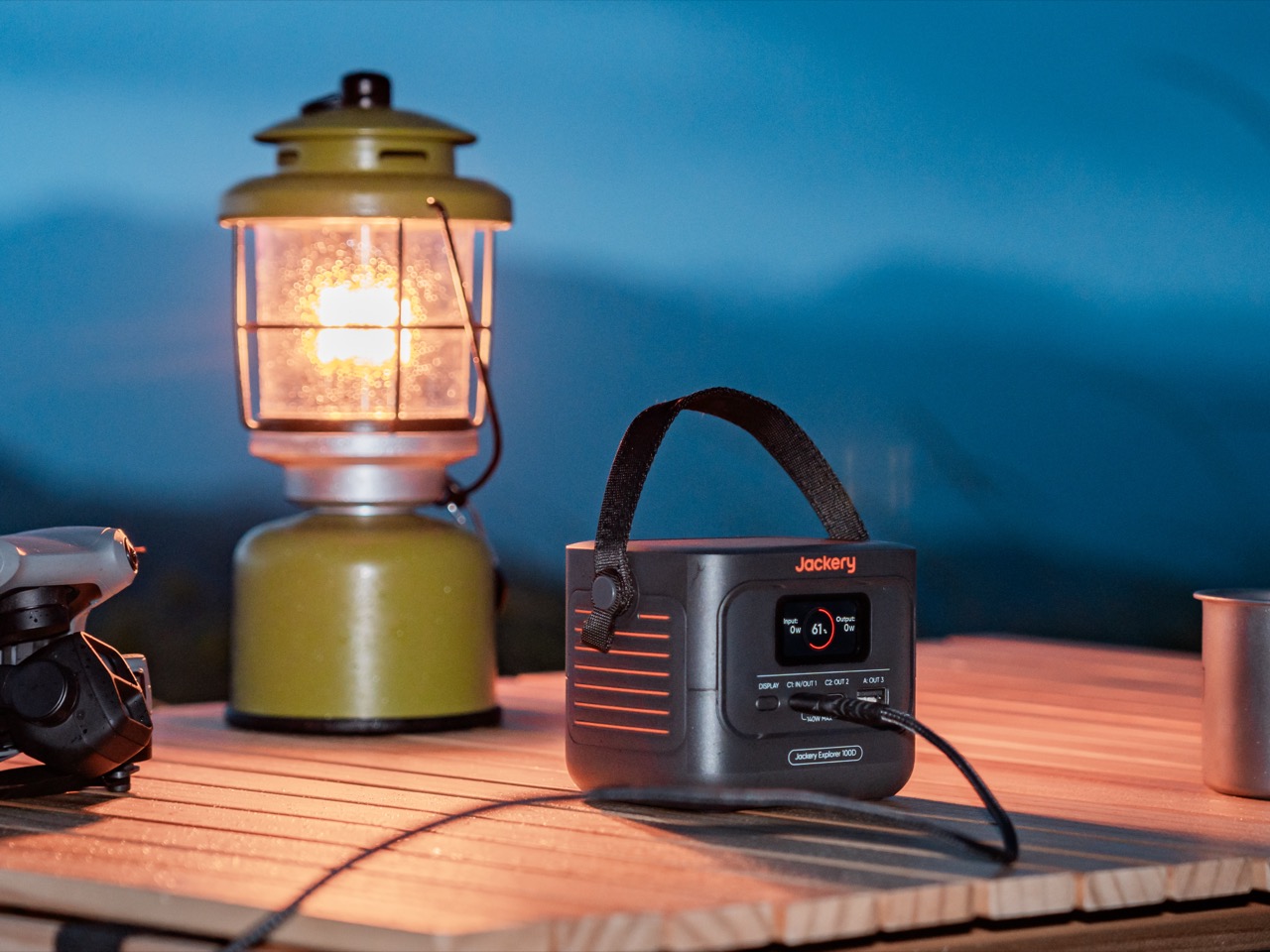
  •  

This titanium watch turns Yuri Gagarin’s first orbit into a dial

Ask any American watch nerd about space watches and you’ll hear one word within three seconds: Speedmaster. Moon landing, NASA certification, the whole legend. Meanwhile, eight years before Apollo 11, a Soviet pilot strapped on a standard-issue navigator’s watch and went around the planet first, and that story gets a fraction of the airtime. I love a Speedy as much as anyone. Still, the first human in orbit deserves a little more wrist love, and a Moscow designer just delivered some.

Alexey Yakushik’s Yuri Gagarin: First in Space is that delivery. His brand launched in 2025, and this is a big step up from its earlier releases on Vostok and Luch movements. The case is Grade 5 titanium, 45mm across (about 1.8 inches), with a domed sapphire crystal, a Miyota 8215 automatic sits under a custom module, and a rocket hand circles a blue Earth every hour. It collected two European Product Design Award wins this year. The run is 130 pieces, split between natural titanium and black PVD, at about $4,150 each, sold only through the brand’s Russian site.

Designer: Alexey Yakushik

A polished blue Earth sits dead center of the dial, and a rocket-shaped minute hand laps it once an hour. Minute numerals ring the globe like a launch-control readout. Hours sit lower down as bold Arabic numerals, with a red marker picking out the current one. Four plates on the diagonals spell СССР in Cyrillic, which is about as subtle as a Soviet space poster should be. For the record, Vostok 1 took roughly 89 minutes to orbit the planet and the rocket does it in 60, but I won’t be filing a complaint about the pacing.

The case and the integrated bracelet are both Grade 5 titanium, the alloy aerospace engineers love because it is strong, light, and unbothered by most of what life throws at it. At 45mm the case is large on paper, though titanium weighs far less than steel, and the brand hasn’t published the weight or thickness. The domed sapphire crystal is 35mm across and bulges up over the globe like a capsule window, which is the whole porthole idea in one piece of glass. Water resistance is 100 meters, the lume is BGW9, and the links look faceted and angular in the renders. Nobody is mistaking it for a dress watch.

Underneath sits the Miyota 8215, a 21-jewel Japanese automatic workhorse that keeps time reliably and stays out of the dial’s way, with the brand’s AYW001.1 module built on top. The renders show a custom rotor stamped with 1961, СССР, and 2026, the sort of detail only the owner will ever see. Yuri Alekseyevich Gagarin’s full name wraps the sapphire caseback window, and every watch carries its own number, such as 01/65. Hiding a love letter on the back of a watch is a wearer-only flex, and I’m here for it. Nobody across the table will ever read it, which is exactly the point.

Yakushik says the project has the blessing of Gagarin’s daughters, Galina and Elena, along with Roscosmos support. It launched April 16, 2026, timed to the flight’s 65th anniversary, and the first piece went to the Moscow Museum of Cosmonautics. The European Product Design Award is a paid-entry Farmani Group competition that covers concepts and finished products, so read the two wins as a nod to the design and leave the horological verdict to others. At about $4,150, the money goes to the titanium, the bracelet, the dome, and the custom display more than the base caliber. Gagarin carried a 33mm brass tool into orbit, and sixty-five years later his flight has a 45mm titanium watch of its own.

The post This titanium watch turns Yuri Gagarin’s first orbit into a dial first appeared on Yanko Design.
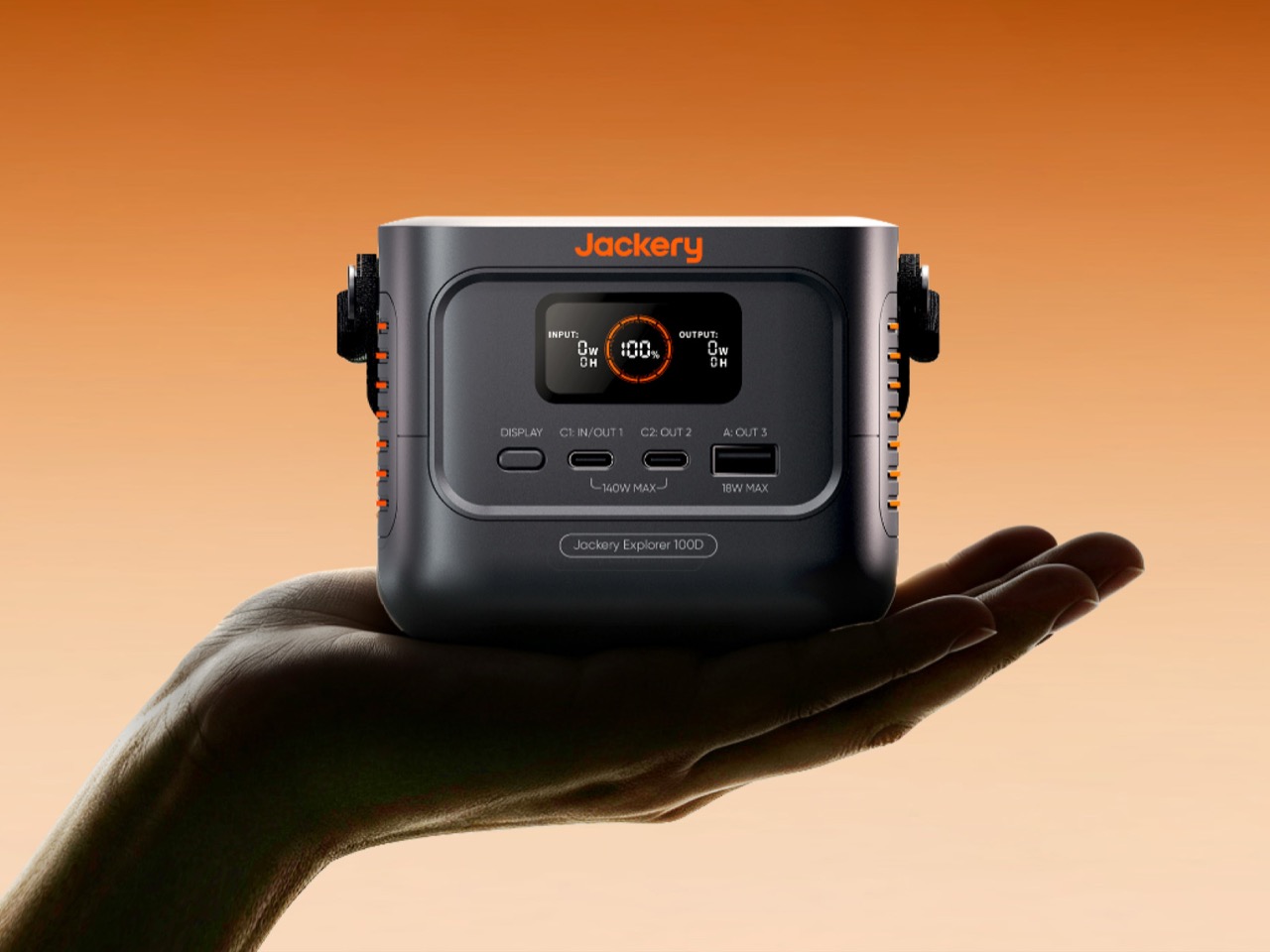
  •  

This Jenga tower is also a lamp, and it lights up as you stack it

Give an architect a box of blocks and they’ll tell you it’s research. Toronto architecture studio PARTISANS took that excuse all the way and came out the other side with a lamp. The Jenga Light rebuilds the game’s famous rectangles in a translucent material that glows from inside. Set the blocks on a powered base and electricity travels upward through every point where one block rests on another. The path the weight takes is the same path the power takes. That one idea turns a party game about collapse into a lamp you build by hand, one glowing brick at a time.

Lead designer Alex Josephson and teammate Teddy Shropshire solved the fiddliest part of the problem with a component most people have never heard of. The blocks hide bridge rectifiers, tiny circuits that make polarity a non-issue. Flip a block, rotate it, or push it into a cantilever that looks like it’s daring gravity, and it still lights. The lamp won its category, Home Lighting: Lamps and Luminaires, at the 2026 European Product Design Award, an international competition that welcomes prototypes as well as finished designs. Pricing and availability haven’t been announced yet. Meanwhile, I’m trying to figure out how many blocks it takes to reach the ceiling.

Designers: Alex Josephson & Teddy Shropshire

How bridge rectifiers make every block reversible

Every electrical connection has a positive side and a negative side, and most stacking lamps deal with that by forcing pieces to go one way. A bridge rectifier is four diodes arranged in a loop, and it sends current out the same way no matter which way it comes in. Tuck them inside the blocks and “upside down” stops meaning anything. A brick can sit flat, sit flipped, or spin around, and its LEDs get the right polarity every time. That one cheap part deletes every rule you’d otherwise have to learn before playing. It’s the electrical version of a USB-C plug, which also stopped caring which way you hold it.

Compare that with the Tetris lamp ThinkGeek sold around 2012, where a powered bottom piece fed light to the tetrominoes stacked above it and the interlocking shapes did the steering. Later patents for modular light kits went mechanical, adding magnets and contacts shaped to avoid short circuits when blocks meet at odd angles. LumiBlocks took the magnetic route too, pairing snap-together blocks with app control and RGBCW LEDs. PARTISANS skips magnets entirely, letting electronics handle orientation and gravity handle everything else. The result asks nothing of you except a steady hand. That also happens to be the only thing Jenga ever asked.

Translucent printed bricks and a grid of contacts

From the photos, the bricks appear 3D-printed in a translucent plastic, with visible layer lines and a wavy internal infill. Most designers would sand or hide that texture, but here it does the job of a lampshade. Light passes through the infill and paints a woven, scaly pattern across every face, so each block glows with a grain that frosted acrylic could never give you. The shots mostly show warm white light, with one hero image running cooler. PARTISANS hasn’t published brightness or color temperature figures yet. Stack enough bricks and the whole thing reads like a lantern built by someone who really loved masonry.

Small metal contacts dot the top of each block, three in a row on the long pieces, while the base carries more, plus a power cord and a small port on one side. Those dots likely form a grid that decides how far one block can overhang the next and still stay lit. They also mean you can’t play an actual round of Jenga on it, since shimmying a brick out of the middle of a tower will just disconnect the entire top half of the lamp. Think of it as Jenga-inspired, with the building half of the game kept and the pulling half retired. A bumped table can still flatten a ten-minute spiral, which is the most Jenga thing left about it.

From a Toronto toy fair to a Toronto studio

Jenga began as a family game Leslie Scott played with wooden blocks growing up in Ghana, and it launched at the London Toy Fair in 1983. Its real break came in 1986 at the Toronto Toy Fair, where Hasbro’s chairman reportedly decided he had to have it. Forty years later, a Toronto studio has turned the same stack into a table lamp. PARTISANS is mostly an architecture practice, best known for the cedar-lined Grotto Sauna on Georgian Bay, yet Josephson keeps drifting into lighting. His Gweilo lamps, made from hand-molded acrylic sheets, won the 2016 AZ Award for Best Lighting Installation.

Playful lighting has had a good run lately, from Analog lamps, which grew out of LEGO play and now sell at MoMA, to app-controlled magnetic blocks for desk setups. The Jenga Light skips apps and color modes and bets everything on the hands-on part. The European Product Design Award judges entries anonymously and accepts prototypes, so this win recognizes the idea and its engineering ahead of any retail launch. PARTISANS hasn’t announced pricing or a release date. Until it does, I’m staring at my old Jenga set and wondering how hard bridge rectifiers really are to solder.

The post This Jenga tower is also a lamp, and it lights up as you stack it first appeared on Yanko Design.

  •  
❌