Le média Distilled a recoupé trois permis de construire déposés auprès des autorités texanes avec des images satellite montrant un défrichement démarré le 24 juillet. Amazon a confirmé derrière : le projet GW Ranch, dans le comté de Pecos, est bien le sien.
La centrale est développée par Pacifico Energy sur un terrain de plus de 8 000 acres, soit environ 3 240 hectares. Elle alignera jusqu'à 35 turbines à gaz pour 7,65 gigawatts, complétées par 1,8 GW de stockage sur batteries et 750 mégawatts de solaire installés sur place.
La particularité du projet, c'est son raccordement : il n'y en a pas.
GW Ranch fonctionne en réseau privé, isolé d'ERCOT, le réseau électrique texan. Amazon a acheté le site et achètera l'électricité produite, sans passer par la file d'attente d'interconnexion qui immobilise les autres projets pendant des années. C'est le premier campus de data centers IA hors réseau de l'entreprise.
L'argument commercial est prêt depuis longtemps. Amazon explique que son campus est alimenté par une production nouvelle sur site qui n'augmentera pas la facture d'électricité des familles texanes, et techniquement, c'est exact.
Le permis délivré en janvier par la TCEQ, l'agence environnementale du Texas, autorise jusqu'à 33 millions de tonnes de CO2 par an. La centrale au charbon la plus émettrice du pays, James H. Miller Jr. en Alabama, tourne autour de 16 millions de tonnes. Le plafond texan est donc au double.
Ce chiffre reste un plafond d'autorisation et pas une prévision, puisqu'une centrale ne tourne jamais à pleine charge toute l'année. Mais un permis calibré à ce niveau signifie que l'exploitant s'est ménagé la place pour le faire.
Le calendrier est serré. Premier électron visé au premier trimestre 2027, un gigawatt en service en 2028, cinq gigawatts et plus d'ici 2031. Pacifico avait annoncé le projet à 5 GW, il est monté à 7,65 en cours de route.
Trente-cinq turbines à gaz allumées en 2026 pour faire tourner des modèles d'IA, ça pique un peu quand même.
Environ 59 projets du même genre sont annoncés aux États-Unis, pour près de 90 GW cumulés. Amazon reste signataire du Climate Pledge, qu'elle a cofondé. Interrogée sur cette situation, l'entreprise répond que le monde est différent de ce qu'il était à l'époque. Ah ben d'accord.
Le Fire TV Stick 4K Select d'Amazon ne tourne pas sous Android. Il tourne sous Vega OS, un système maison basé sur Linux, et ça va foutre en l'air vos projets de player pour votre média center puisque les applications Android n'y ont plus cours, et que l'installation manuelle est verrouillée.
Il n'y a donc plus de bascule "sources inconnues" planquée dans les réglages, comme sur les Fire TV sous Android. Rien que pour faire apparaître les options développeur, il faut d'abord enregistrer l'appareil auprès d'Amazon avec un compte développeur et même comme ça, aucun APK Android ne se lancera.
Résultat, Kodi ne tourne pas ! L'application avait déjà été retirée du store d'app Amazon en 2015, mais on la réinstallait tous à la main sur les anciens sticks. Eh bien ce contournement n'est plus possible et côté Jellyfin, malheureusement, le projet n'a toujours pas sorti de client pour Vega OS.
Bref, Amazon a verrouillé la machine au nom de la sécurité et de la chasse au piratage, comme prévu puisque
je vous en parlais déjà en novembre dernier
. Sauf que le même verrou bloque aussi la lecture des fichiers qui dorment par exemple sur votre NAS, même si vous les avez rippés vous-même, peu importe que ce soit le dernier Avatar ou une vidéo de vacances.
Et ce n'est pas un accident de parcours sur un modèle d'entrée de gamme puisque sur sa
page développeur
, Amazon écrit qu'à partir du 4K Select, tous les futurs Fire TV Stick tourneront sous Vega, donc il n'y aura plus de retour arrière, désolé...
Par contre, les modèles sous Fire OS restent en vente pour l'instant, et eux acceptent toujours l'installation manuelle. Donc si vous comptiez remplacer le vôtre un jour, vérifiez le nom exact de la référence avant de commander, c'est maintenant que ça se joue !
Sur un stick qui serait déjà passé à Vega, il reste toutefois Astra, un client tiers compatible Jellyfin et Emby, dispo sur le magasin Amazon mais limité à une lecture basique. Plex passe aussi, mais en H.264 seulement, sauf à transcoder côté serveur. Et de son côté l'équipe Jellyfin
dit travailler
sur un vrai client Vega sans annoncer de date... Voilà, donc pour le moment c'est compliqué avec Vega mais j'ai bon espoir que des bidouilles et nouveaux outils sortent dans les mois qui viennent.
The e-reader has been one of the most static product categories of the past two decades. Since the first Kindle appeared in 2007, the form factor has barely evolved: a single screen, a flat back, and dimensions roughly matching a paperback. These devices have gotten lighter, sharper, and more waterproof, but the fundamental design assumption has stayed the same. They’re books without the book part.
A growing number of designers have been working on a different premise: what if an e-reader actually opened like a book? One with two E Ink panels and a real hinge, held the way you’d hold a paperback, where left and right pages exist as physical space. That shared ambition has driven a small but serious cluster of projects building quietly over the past five years.
The proof that e-paper could bend
The idea of folding an E Ink display isn’t new. Back in 2020, E Ink Corporation demonstrated a hinged prototype showing that a bending e-paper panel could survive the mechanical stress of being folded. It never reached retail shelves, but it answered the one question that mattered most at the time: whether the material itself could handle the geometry of a real book.
Designer: E Ink
That prototype didn’t solve everything. It was a controlled demonstration with no commercial roadmap, no software, no battery life to speak of, and no clear form factor beyond the fold itself. What it gave the industry was proof that flexible e-paper was a viable building block rather than a permanent research curiosity. Every foldable E Ink project that came after built on that understanding.
The book illusion finally made real
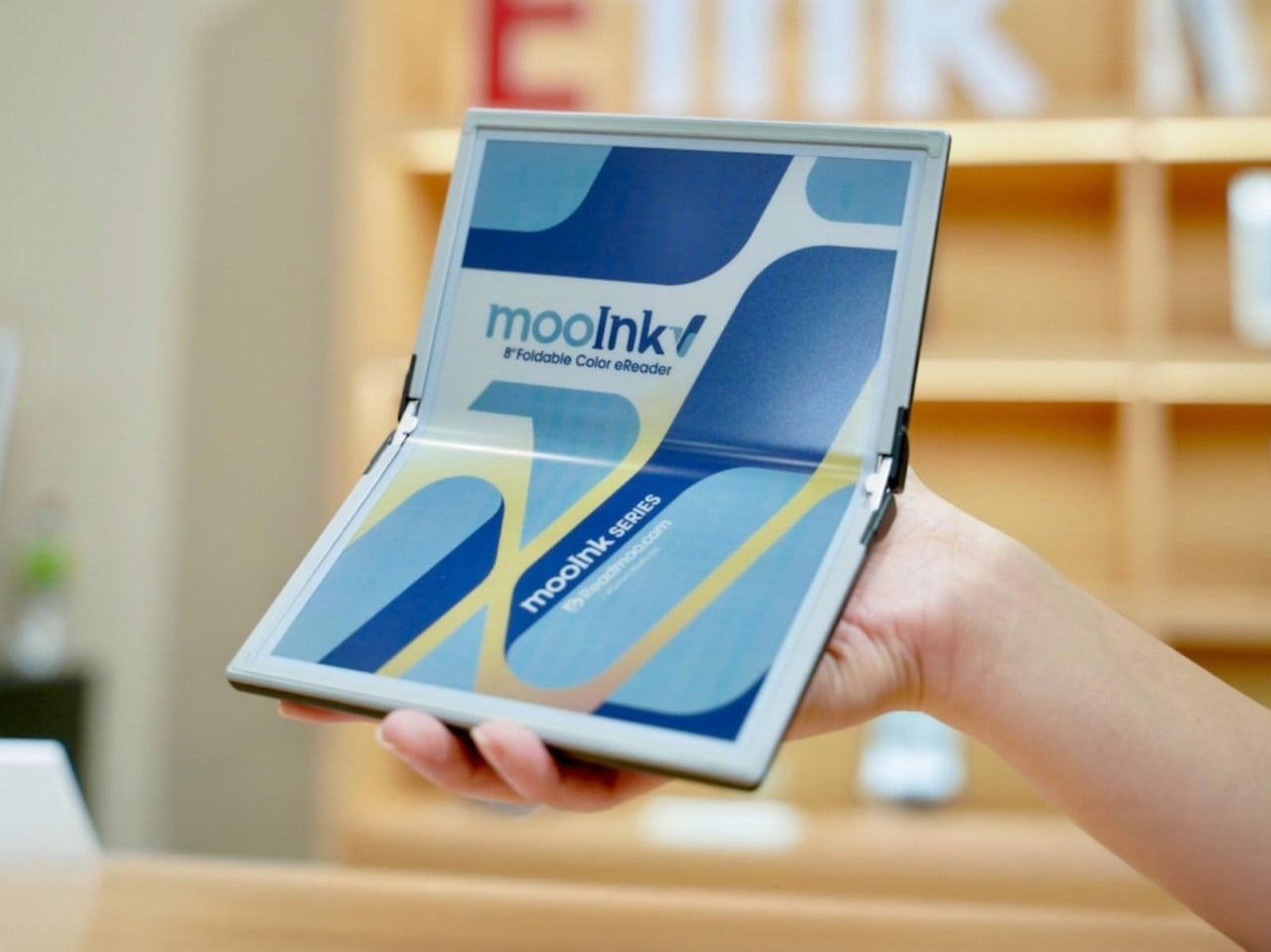
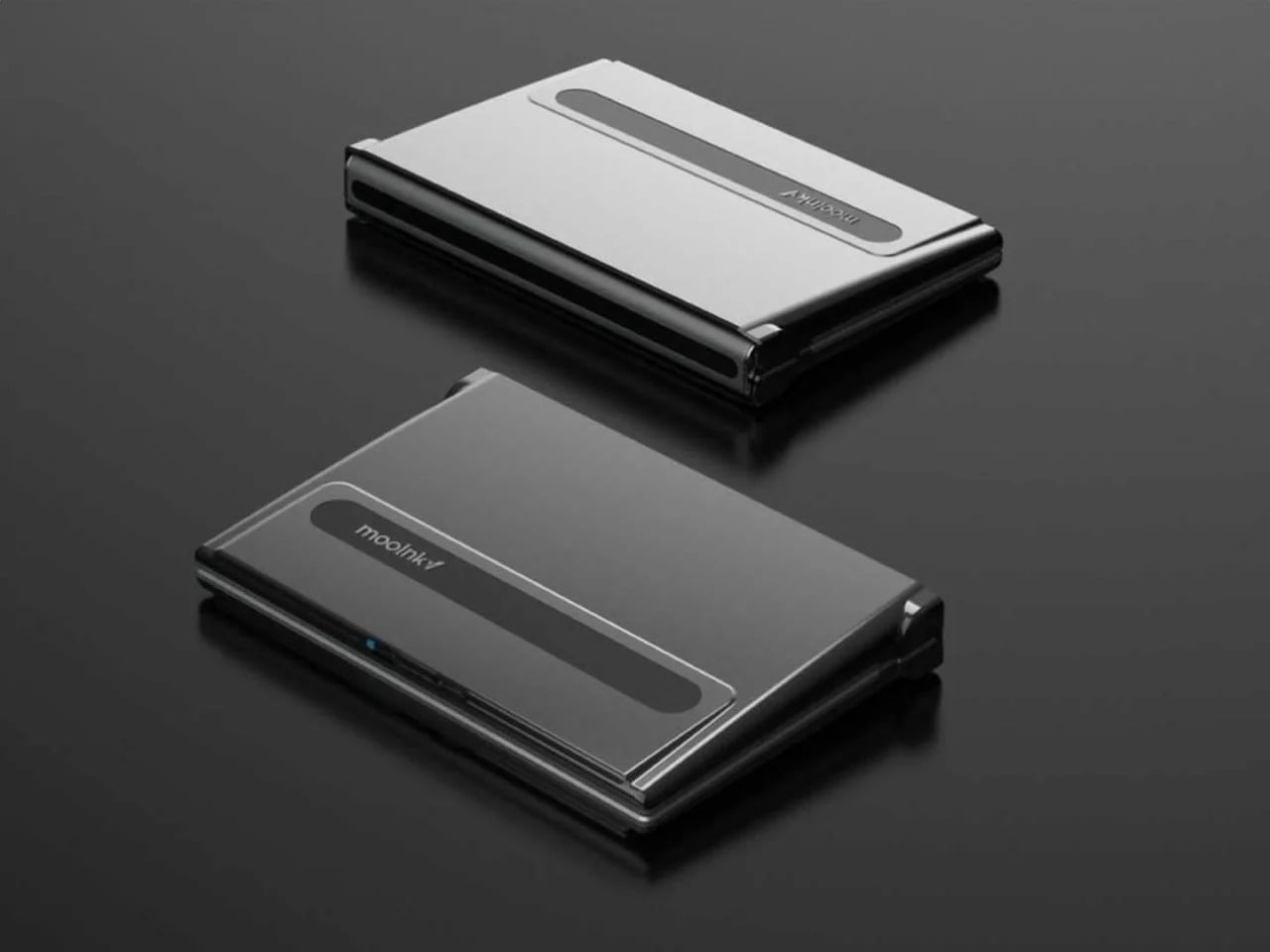
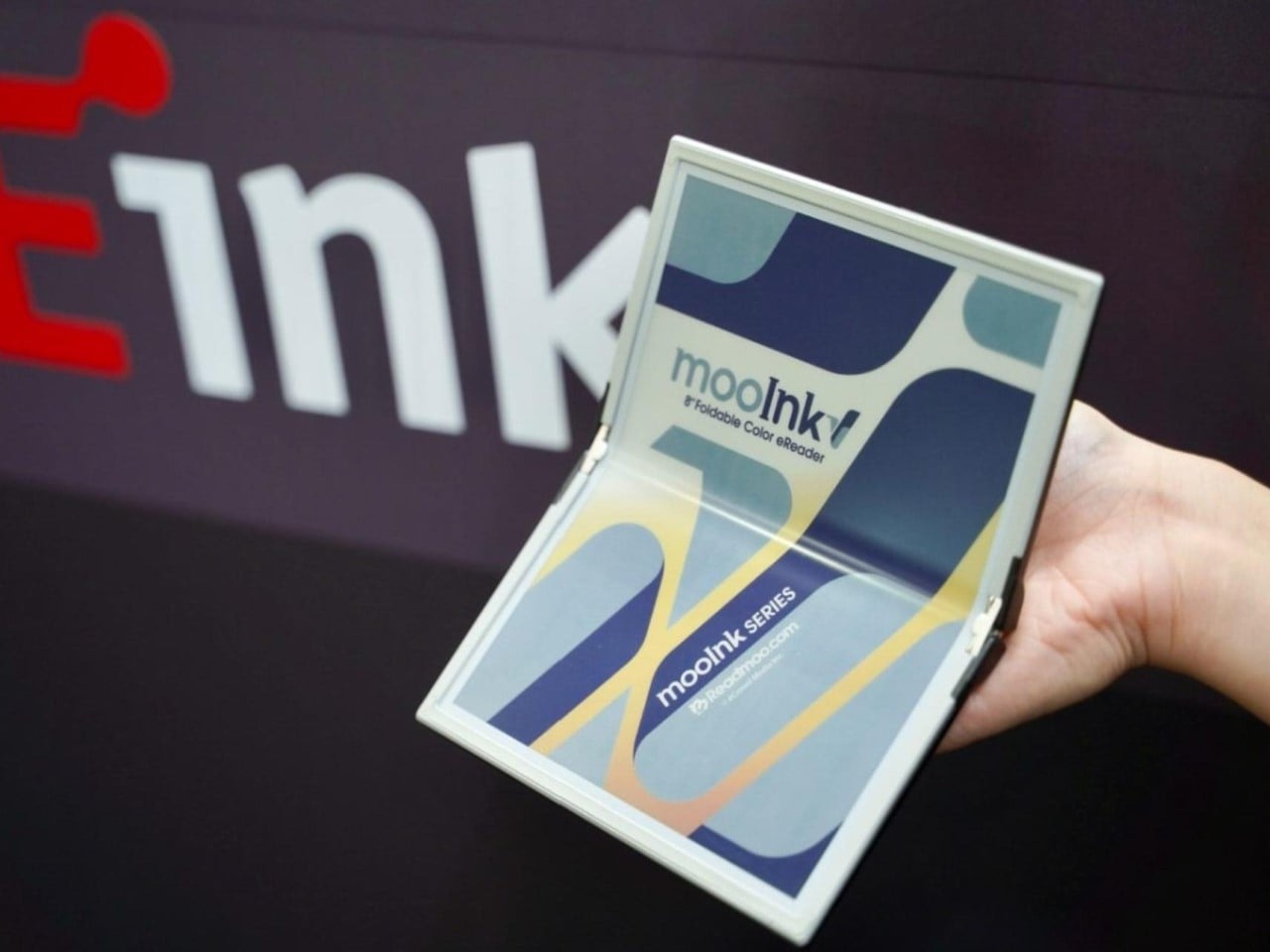
Readmoo’s Mooink V was the first design to make the flexible E Ink concept feel emotionally legible to a general audience. It’s built around an 8-inch Gallery 3 color e-paper display developed in collaboration with E Ink, one that folds down the middle to make the device small enough to pocket when closed and wide enough to feel like a slim paperback when open.
The color display matters more than it might seem. Gallery 3 renders close to 50,000 colors at 300 PPI, expanding the format beyond plain text to illustrated books, comics, and magazines. The fold reportedly passed 200,000 bending tests during development, and when fully open, the crease isn’t dramatic enough to register as a flaw so much as an honest design trade-off.
Mooink V hasn’t had the smoothest road to market, though. Despite genuine buzz at trade shows including Touch Taiwan and SID Display Week, no confirmed retail availability or street price had materialized as of mid-2026. The design made the foldable E Ink book look and feel tangible in a way earlier prototypes hadn’t. Whether it gets there commercially is a different and still open question.
Two screens, no crease
Not everyone building a book-shaped e-reader was willing to bet on a single flexible panel. A parallel design school took a more pragmatic approach: pair two conventional E Ink screens with a well-engineered hinge and let the gutter do the work. The result avoids crease anxiety entirely since neither panel has to bend, though it trades the seamless page illusion for a visible seam you’d have to accept.
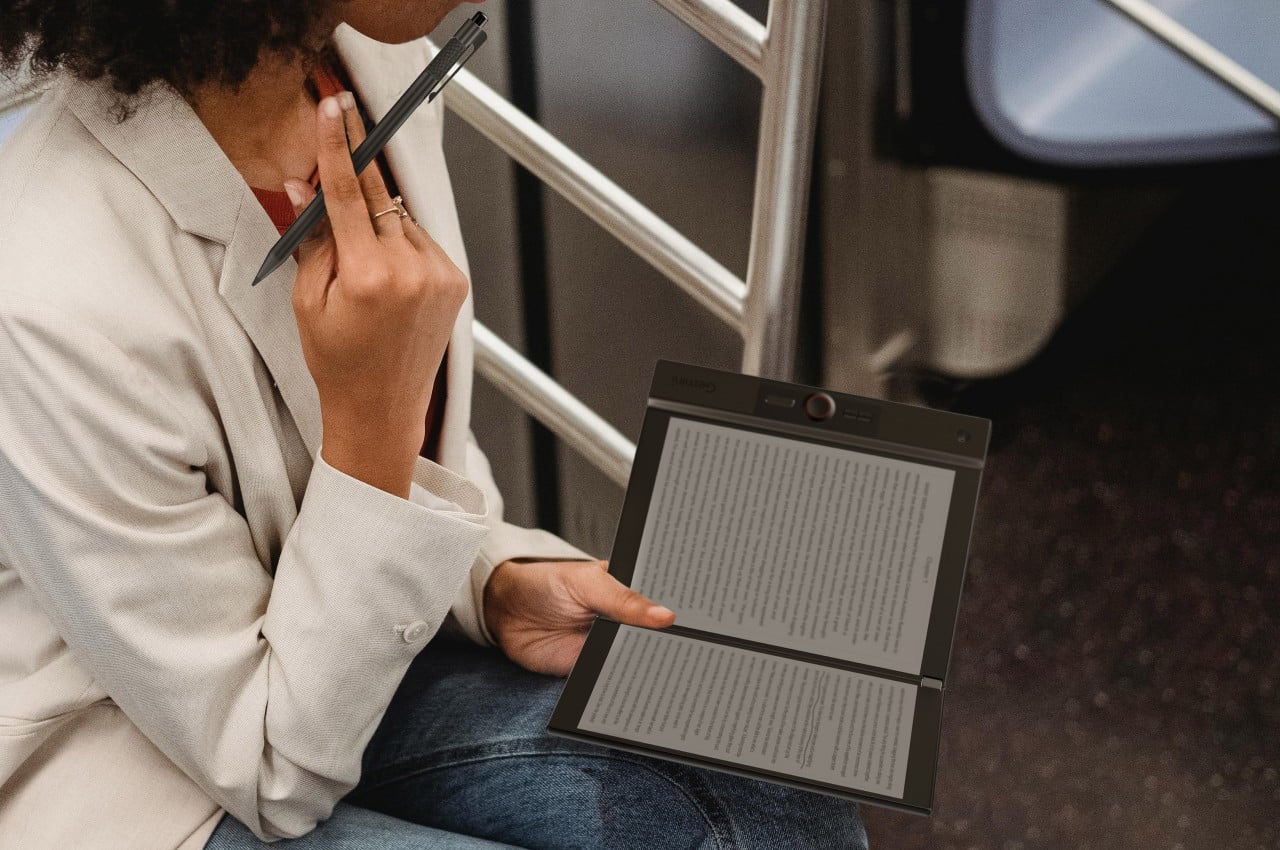
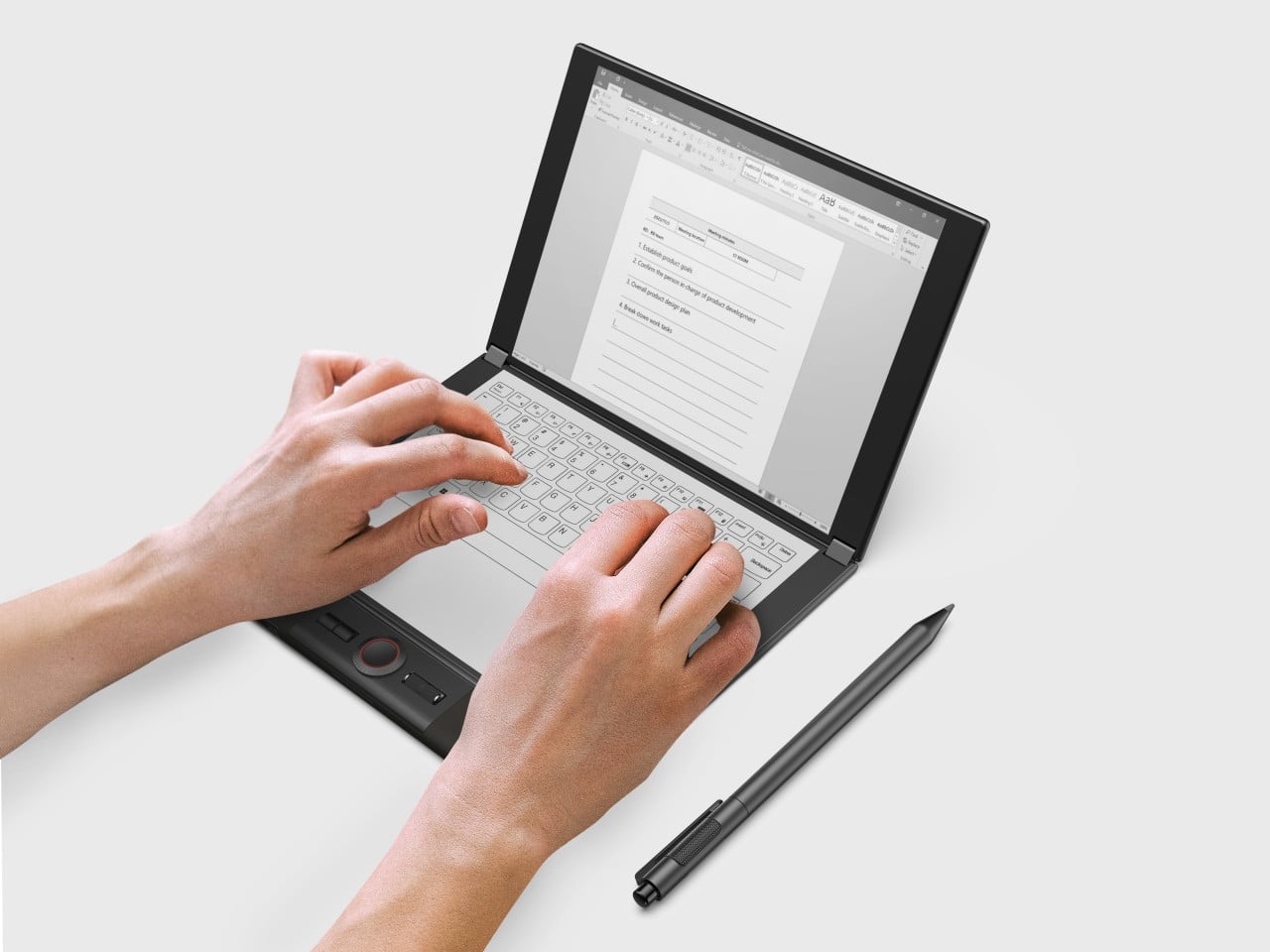
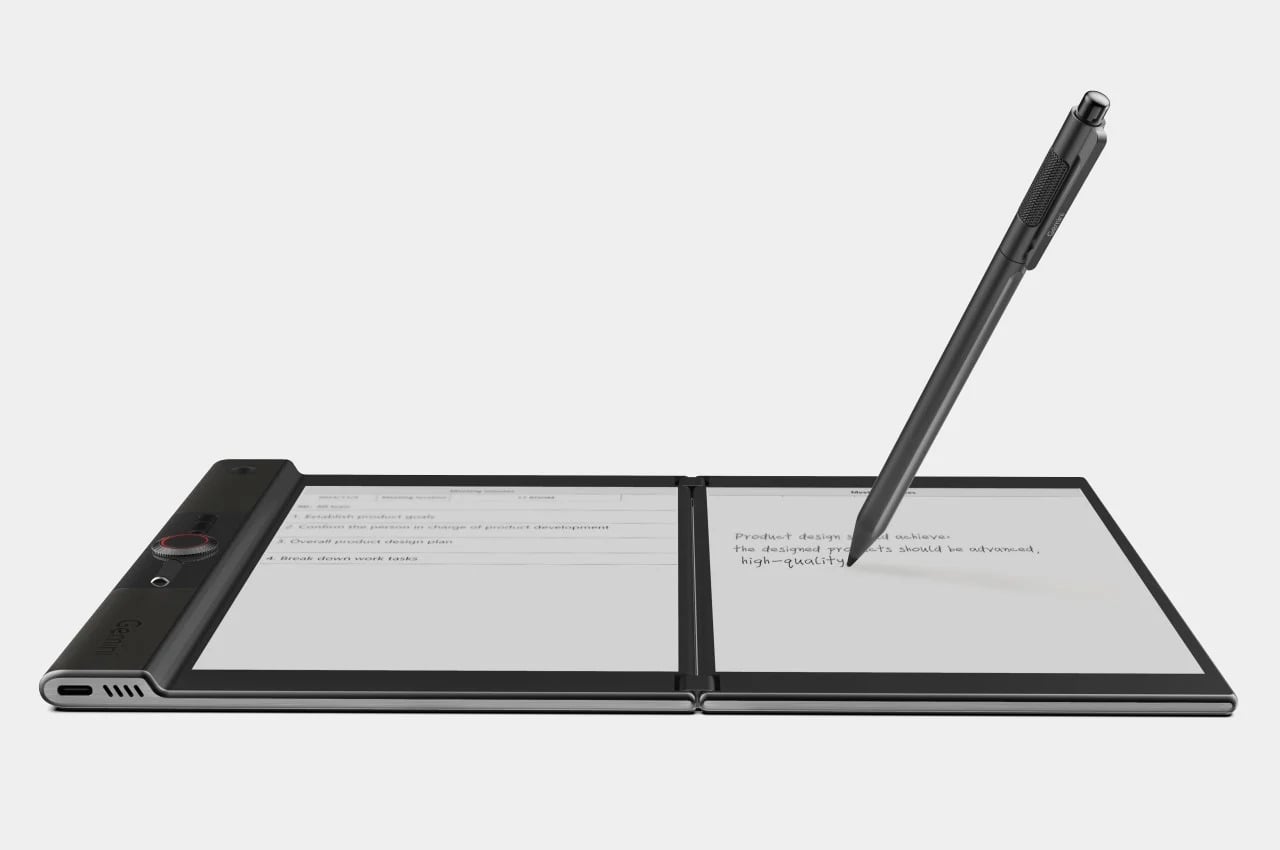
LCFC’s Gemini took the productivity angle furthest, giving both E Ink panels enough real estate to function almost like a laptop, with reading material open on one side and an active workspace on the other. The InkReader Duo concept took a more compact approach, fitting two E Ink screens into a phone-sized form, which made it feel less like a desk tool and more like a pocket notebook.
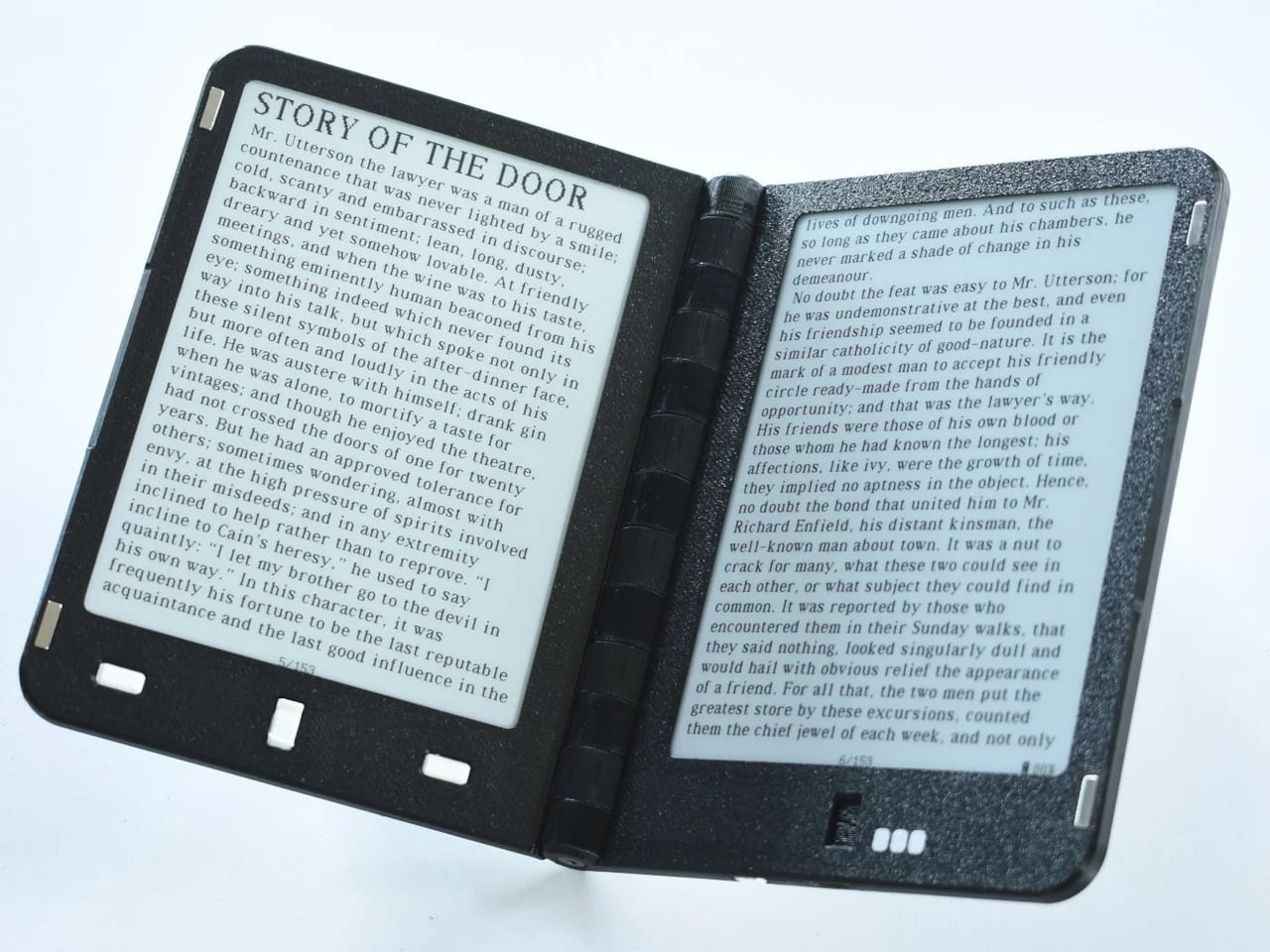
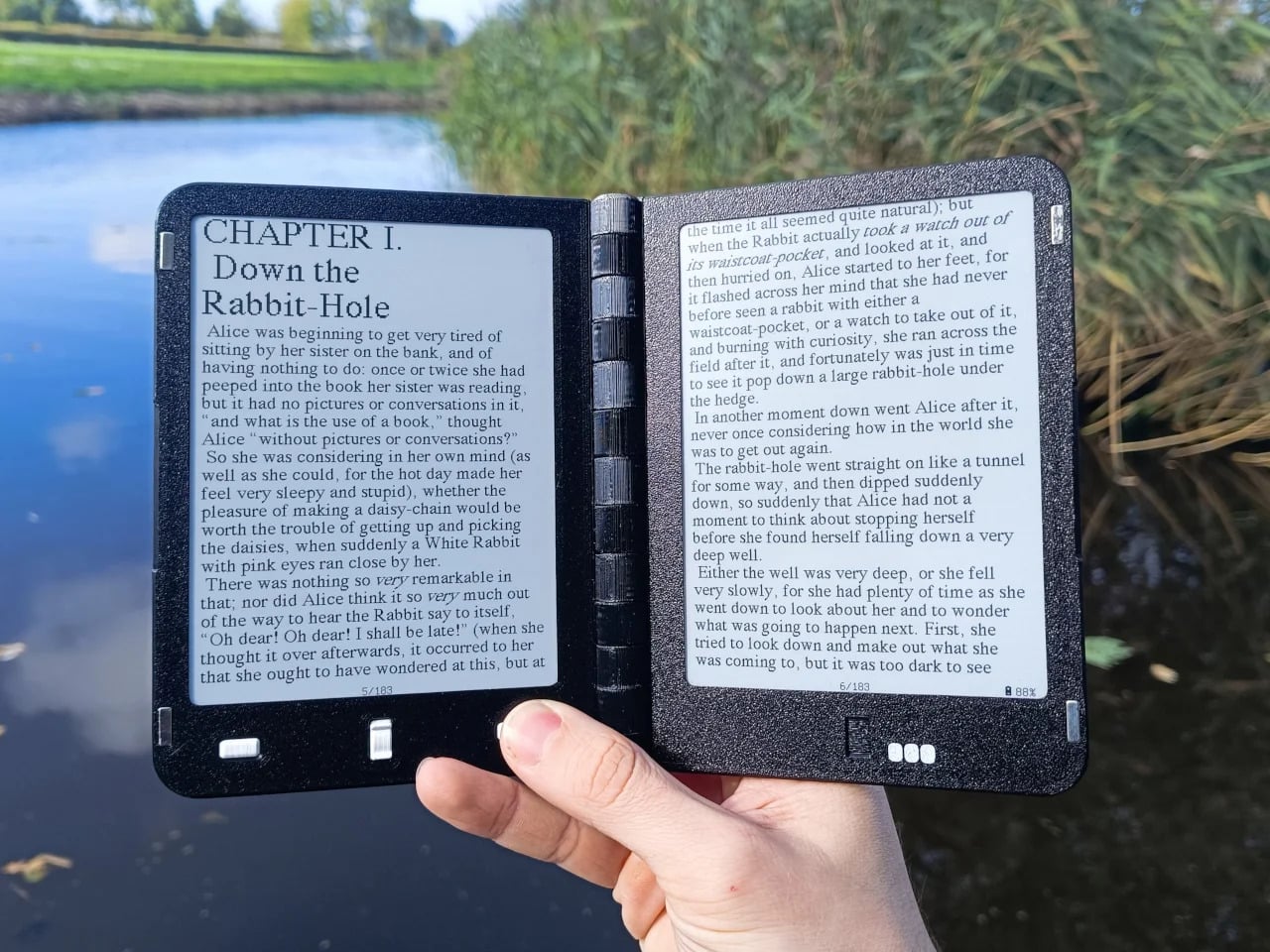
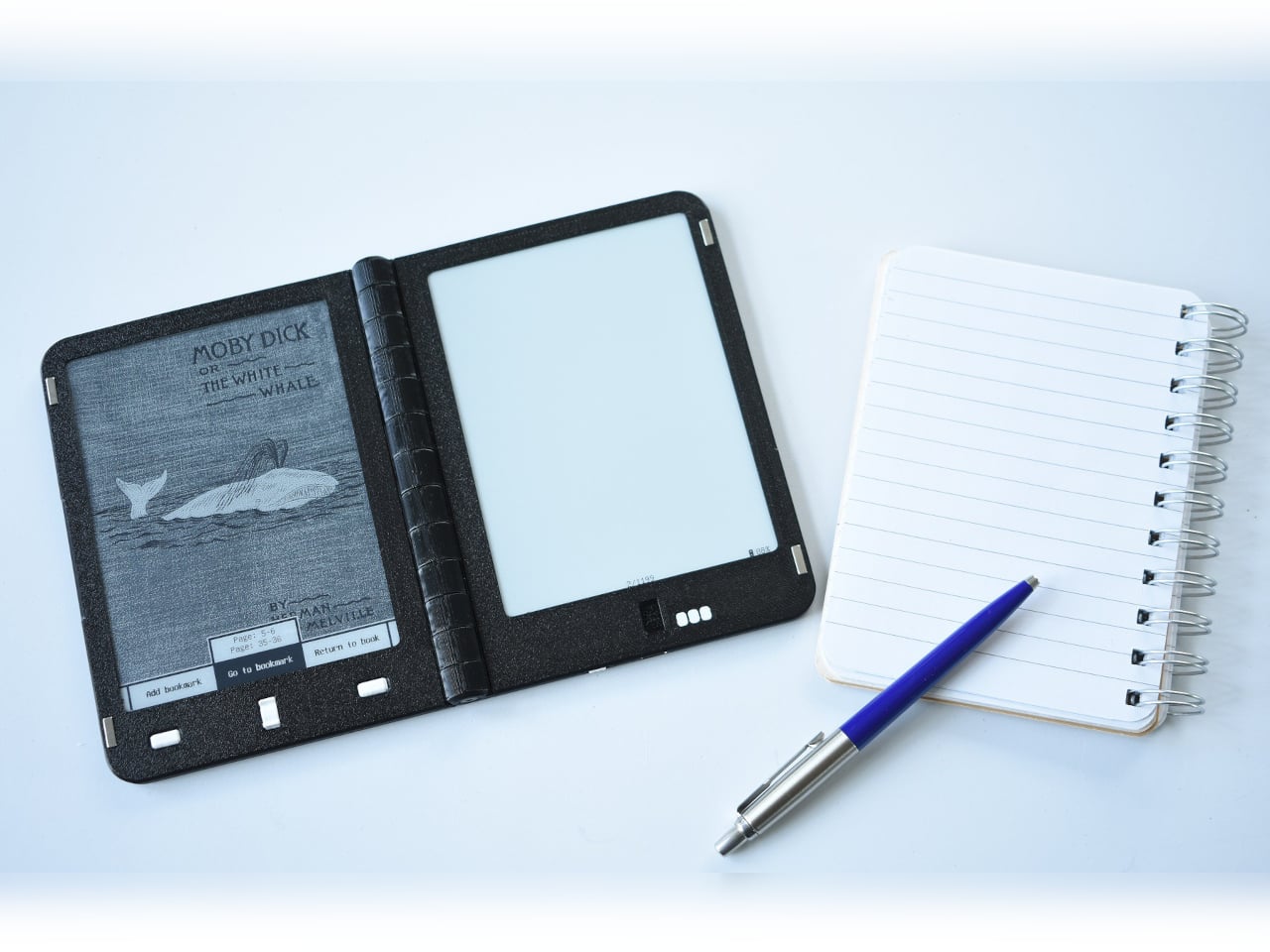
Diptyx went in a different direction altogether. Rather than chasing consumer polish, the project leaned into open-source principles, building a two-panel hinged e-reader without the lock-in that defines most commercial platforms. It isn’t the most refined interpretation of the book-shaped reader, but it made a clear point: the hardware problem was increasingly solvable, and the real challenge was getting the software and ecosystem right.
Not every dual-screen device fits cleanly into this story. The Bluegen OKPad pairs an E Ink panel with a regular LCD screen, which makes for a versatile tablet but undermines the unified reading experience that makes an E Ink book feel coherent. Switching between two fundamentally different display types introduces a visual disconnect that software bridging alone can’t fully smooth over.
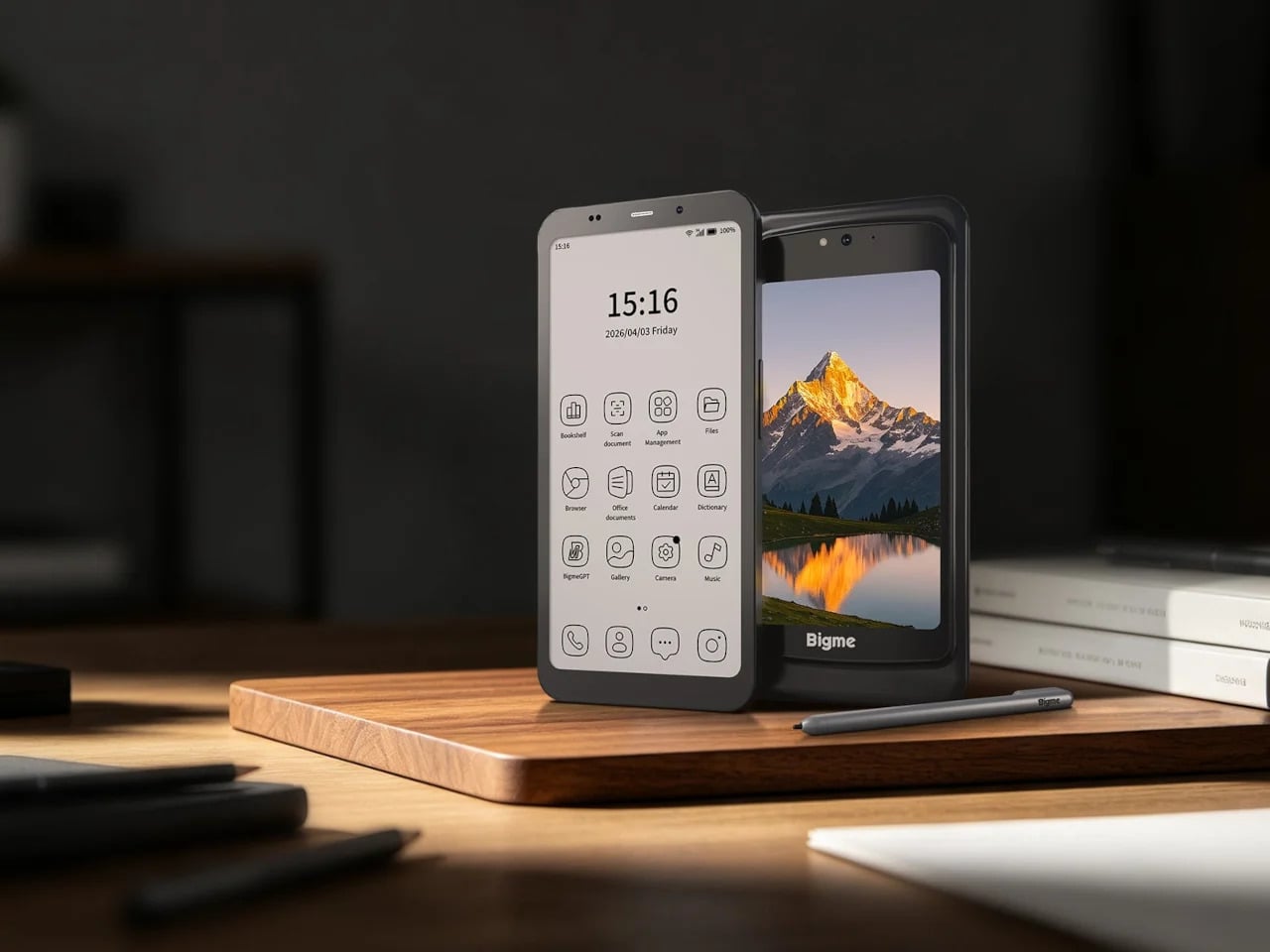
Bigme’s HiBreak Dual 2 runs into a different kind of problem. It’s a smartphone with a secondary E Ink display on the back, which is a genuinely clever idea for managing notifications and extending battery endurance, but it’s shaped and used like a phone rather than a book. A second screen doesn’t automatically recreate the spatial logic of reading a bound object.
Inkleaf is the most pragmatic entry in the foldable E Ink space so far. Instead of chasing a seamless fold, it pairs two 10.3-inch Carta E Ink panels in a notebook-style hinge, with one side for reading and the other for writing. The seam between them works as a gutter rather than a flaw, and the design doesn’t try to hide it.
That workflow proposition is what makes Inkleaf interesting beyond its form factor. Having reference material on one panel while taking notes on the other removes a friction point that every single-screen reader quietly ignores. You don’t need to switch apps, scroll back, or memorize what you just read before writing something down. It’s aimed at a different kind of reader than a Kindle typically serves.
Inkleaf is currently collecting early-access signups ahead of an August 2026 launch, with a broader public release targeted for 2027. That’s a staggered timeline worth noting: the hardware still has to prove itself beyond initial demos, and the software will matter as much as the panels themselves. Carta E Ink is a sensible fit for a writing-focused device, but actual daily use remains the real test.
What Kindle still has to answer for
None of this means the Kindle is suddenly irrelevant. Amazon’s device still wins on price, ecosystem depth, and a friction-free reading experience built up through years of software refinement. If all you want to do is buy a book and read it on a train, nothing in this group of foldable experiments beats a Paperwhite for simplicity. The incumbents aren’t losing sleep yet.
What these devices do expose is a design gap Amazon hasn’t seriously tried to close. A Kindle displays text efficiently, but it doesn’t recreate the spatial logic of reading a bound book: two visible pages, a sense of position, a natural place for margin thoughts. Those aren’t features that get patched in through a software update, which is why the form-factor conversation is overdue.
That’s what this group of foldable and dual-screen E Ink devices has been quietly building toward for the past five years. Not a product category defined by any single winner, but a shared argument about what a digital reading device could look like if it started from the book rather than the screen. Whether any of them fully delivers on that is a question 2027 will help answer.
Depuis la dernière mise à jour des Fire TV et Fire TV Stick, des publicités se lancent en plein écran dès l'allumage. Un comportement très agaçant qu'il est heureusement possible d'éviter. Voici comment. Parmi les systèmes de TV connectées existants,...
On attendait la réponse d’Amazon à ChatGPT, la voici enfin. Celle-ci se prénomme Bedrock et se présente plutôt comme un ensemble d’outils d’intelligence artificielle. Pour le moment, la plateforme s’adresse uniquement aux clients d’Amazon Web Services. ChatGPT a lancé la...
Dans une interview accordée à CNN, Jeff Bezos, fondateur d'Amazon et l'un des hommes les plus riches de la planète, a déclaré qu'il comptait donner l'intégralité de sa fortune à des oeuvres caritatives avant sa mort. Jeff Bezos, fondateur d'Amazon,...
Amazon vient d'annoncer un investissement d'un milliard d'euros sur cinq ans pour développer sa flotte de véhicules électriques dédiés à la livraison en Europe. Le géant du e-commerce espère ainsi doubler le nombre de camions et camionnettes électriques en circulation....
Amazon vient d'annoncer ce lundi 3 octobre 2022 le lancement d'Amazon Access, un nouveau hub qui centralise les programmes, les réductions et les fonctionnalités offertes par la plateforme pour faire ses achats à moindre coût. Ce 28 septembre, Amazon a...
Les prix en euros de tous les iPhone 14 ont fuité. Et l’inflation est considérable. Microsoft met en avant les modes d’économie d’énergie de la Xbox Series X. Et les gains ne sont pas négligeables. Elon Musk s’en prend à...

 Connexion