Vue lecture

Il y a de nouveaux articles disponibles, cliquez pour rafraîchir la page.

Microsoft’s emissions just jumped 25% because AI datacenters are exploding in size, and dropping renewable credits finally exposed how much power the company is burning to fuel its AI ambitions

Microsoft’s latest sustainability report sparked claims that the company produced 34 million metric tons of carbon emissions in a single year. That figure was never reported by the company. What the report actually shows is a 25 percent year‑over‑year increase driven by AI datacenter expansion and Microsoft’s decision to stop buying unbundled renewable energy certificates.

The Microsoft Environmental Sustainability Report shows a complicated progression of rising emissions caused by AI datacenters, controversial "greenwashing" tactics, and enough wiggle room to leave space for debate.

Real emissions vs estimated emissions

When I first read the coverage surrounding the Microsoft Environmental Sustainability Report, it seemed like a clear case of AI hurting the planet and a tech giant callously damaging the environment. I was ready to write a piece calling out Microsoft for setting carbon neutral goals and then increasing carbon emissions by 25% in a single year.

But as I do with any story I cover, I went to the source material and did some digging. What surprised me is that the Microsoft Environmental Sustainability Report does not indicate unbridled burning of fuel to power AI datacenters. Instead, it shows efforts to reduce emissions and make meaningful changes.

I want to be clear, AI datacenters do create high carbon emissions. Microsoft is not faultless when it comes to energy use or pollution. I think there is a lot more the company could do to help the environment. I also think there's some misunderstood data seeping onto social media and throughout the web.
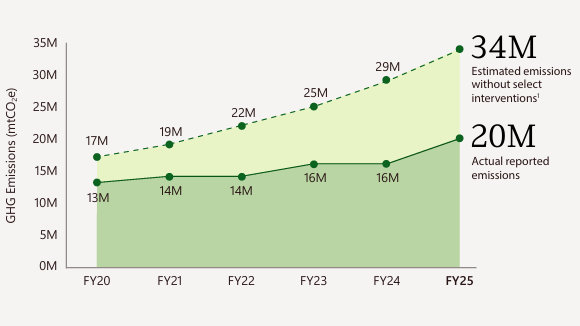
A chart from the Microsoft Environmental Sustainability Report illustrating emmissions and hypothetical emission rates.

The most recent Microsoft Environmental Sustainability Report shows the actual emissions of the company (solid line) compared to the estimated emissions if Microsoft had not taken steps to reduce its emissions. (Image credit: Microsoft)

The above chart from the Microsoft Environmental Sustainability Report shows Microsoft's actual reported emissions over the years and the estimated emissions without select interventions. The footnote on the chart directs to a clarifying statement on the estimate. I'll include the full footnote here but highlight the most relevant text:

"The solid line represents Microsoft’s reported greenhouse gas emissions (Scopes 1, 2, and 3) for FY20–FY25, prepared in accordance with GHG Protocol and management’s criteria, and uses a market-based emissions approach. The dotted line represents an illustrative counterfactual scenario of estimated emissions had select, discrete carbon reduction initiatives not been undertaken. These initiatives include energy efficiency improvements for XBOX consoles, renewable energy purchases, sustainable aviation fuel (SAF) and sustainable marine fuel (SMF) certificates, and supply chain decarbonization of Surface devices. The difference between the two lines is an estimate of emissions avoided through these specific initiatives relative to a scenario without those initiatives occurring. This estimate is directional in nature, does not represent the full scope of Microsoft’s decarbonization efforts, and is not part of our reported greenhouse gas inventory. It should not be interpreted as a comprehensive measure of total emissions reductions or as additive to other carbon reduction or removal claims."

Basically, the chart shows Microsoft's actual emissions and then a rough estimate of how much the company would have emitted had it not taken steps to reduce its carbon footprint. But Microsoft did take those steps. Microsoft did not have 34 million metric tons of carbon emissions in the last year. The actual emissions figure is 20 million metric tons.

That's still a massive amount of emissions, and 20 million metric tons is a 25% increase year-over-year, but there's some needed context.

What are unbundled renewable energy certificates?
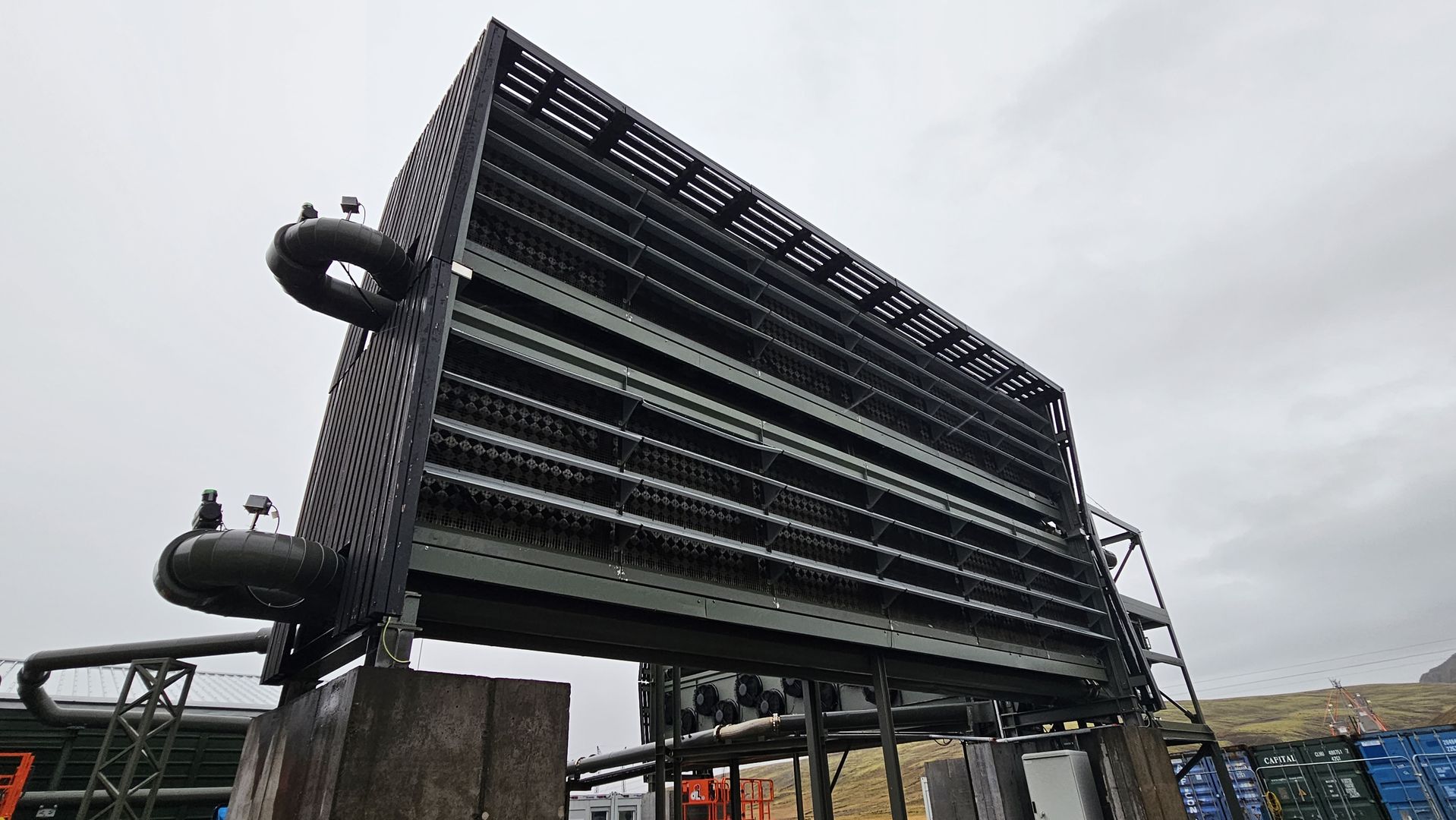
Climeworks facility in Iceland

Microsoft has several plans to reduce carbon emissions, including a 10-year partnership with Climeworks for direct air capture. (Image credit: Windows Central | Jez Corden)

Microsoft's carbon emissions increased by 25% in a single year. The increase was driven primarily by Microsoft's expansion of datacenter infrastructure and the fact that the company paused the purchase of unbundled renewable energy certificates.

In February 2025, Microsoft announced that it "ceased purchasing non-additional, unbundled renewable energy certificates." That decision led to the massive jump in emissions seen in the recently published sustainability report (in conjunction with AI datacenter infrastructure expansion).

Renewable energy certificates (RECs) represent the legal ownership of the "renewable-ness" of generated electricity. Unbundled RECs are sold separately from the electricity itself.

The United States Environmental Protection Agency notes that "Unbundled Renewable Energy Certificates (RECs) refer to RECs that are sold, delivered, or purchased separately from electricity. RECs provide no physical delivery of electricity to customers and as such the customer is purchasing power from a separate entity than the one selling them the REC."

The separation of generated electricity from the legal ownership of the "renewable-ness" is controversial (that phrase comes straight from the EPA).

Many, including myself, view unbundled RECs as a form of greenwashing. Microsoft or any other company can legally say they are powered by renewable electricity without actually using the electricity that was generated.

The defense is that buying unbundled RECs financially contributes to the development of renewable energies.

Microsoft did not refer to unbundled RECs as a form of greenwashing, but its statement is telling:

"While we continue to apply the carbon fee to investments in emissions reductions, we have ceased purchasing non-additional, unbundled renewable energy certificates. We are refocusing the use of these funds on more long-term, higher-impact investments across carbon reduction, carbon removal, and clean electricity procurement. These interventions are expected to more effectively help us achieve our goal of becoming carbon negative by 2030 and may take us out of carbon-neutral position."

Microsoft implied that unbundled RECs are not the most effective way to have a long-term positive impact on the environment.

The rest of the report

The Microsoft Environmental Sustainability Report is 65 pages of dense information. It links to several external resources as well. If it were a paper report, there'd be a good joke here about an environmental report killing so many trees.

A large portion of the report is dedicated to discussion about Microsoft's use of water, which is a critical component of its environmental strategy. Notably, Microsoft replenished more water than it withdrew in the year.

Because of the size of the report, I've focused on the carbon emissions of Microsoft, but I suggest people read the entire report to get perspective on what's being done and where Microsoft still falls short.

Click to join us on r/WindowsCentral

Join us on Reddit at r/WindowsCentral to share your insights and discuss our latest news, reviews, and more.

Microsoft Fairwater Datacentre

Microsoft's Fairwater Datacenter is one of the most powerful datacenters in the world. It is one of many datacenters contributing to Microsoft's spike in carbon emissions.
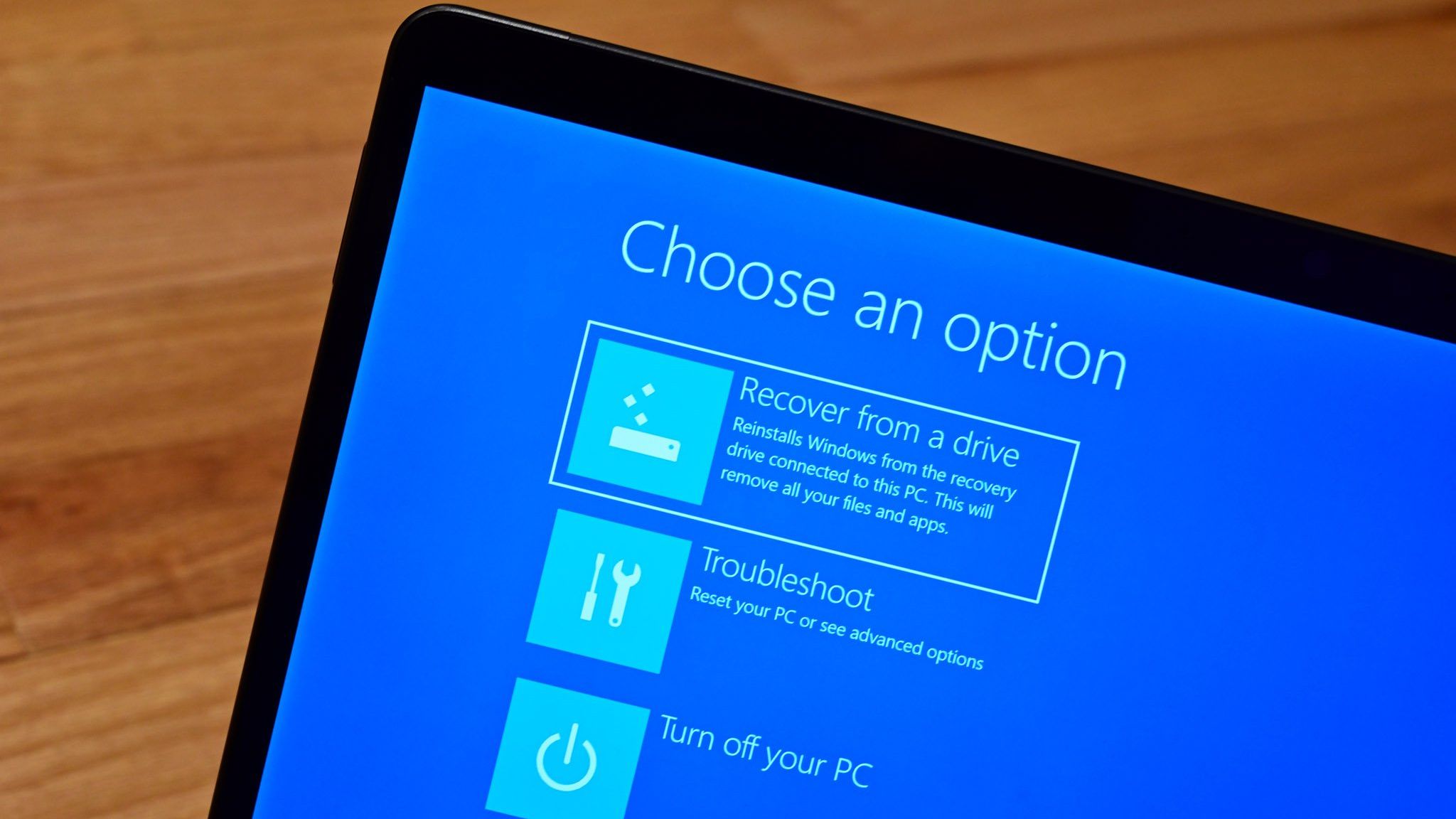
As physical media fades, Windows 11’s Cloud rebuild shows how tech giants should handle user choice

With Sony planning to stop making discs for games and revoke access to movies and TV shows people paid for, physical media is more important than ever. Xbox is considering a disc-to-digital program for Project Helix, proving Microsoft weighs the importance of physical media when making decisions.

But the physical media debate isn't really about discs; it's about control. People want to control the content and devices they've purchased. Microsoft's newly expanded options for resetting PCs showcase how choice and control can be given to consumers.

Like many, I've spoken out against Sony's plans and advocated for physical media to be preserved. So, it might come as a surprise to hear that I'm happy about the new option to reset a Windows 11 PC that relies entirely on the cloud and does not use a USB drive.

While I advocate for physical media to preserve ownership of games and movies, when it comes to the pure utility of fixing a broken PC, convenience wins.

A new feature called Cloud rebuild is in testing on Windows 11. It lets you restore a PC to a clean state without needing an external drive.

What is Cloud rebuild on Windows 11?

Windows 11 Recovery Drive

Microsoft has added a new option to reset your PC by using the cloud, but the previous options remain in place. (Image credit: Daniel Rubino / Windows Central)

Cloud rebuild is a feature that lets you reinstall Windows and your PC's drivers by using the internet. Rather than requiring a USB drive that's been set up, you can reset your PC entirely through the cloud.

Microsoft explained Cloud rebuild recently when the feature shipped to Insiders:

"Unlike Reset this PC, Cloud rebuild downloads both the target Windows image and the device's drivers from Windows Update, so the device comes back fully functional without USB media, without a custom image, and without depending on the health of the currently installed OS."

While Reset this PC and Cloud rebuild both let you recover your PC, they differ in important ways apart from the fact that one uses a USB drive and the other uses the cloud.

Reset this PC gives you the option to retain your personal files, which could save vital content from being lost. But even if you have an external USB install drive ready to go, you can only use Reset this PC if Windows is bootable.

The feature also requires you to have manually created a USB installer ahead of time on a working computer.

In contrast, Cloud rebuild works even if your PC refuses to boot. The downside is that it does not provide an option to maintain apps and files.

Blank Pixel

Cloud rebuild brings your PC to a clean slate with Windows working and device drivers in place.

The biggest advantage of Cloud rebuild is reliability. Cloud rebuild doesn't rely on a tool you've set up in advance or ensured was formatted correctly. It just pulls a fresh image and drivers through Windows Update.

All my files are stored on OneDrive and backed up elsewhere, so I don't need the option to retain my files. It would save a bit of time after a reset, but it's not essential.

Cloud rebuild does depend on having an internet connection, so a USB installer is still the safer option for people in low‑connectivity environments.

Let the people decide

Of course, having the option to use a USB drive or the cloud is best. While I personally prefer Cloud rebuild for restoring my PC, I want both options to be available. Many people prefer to have physical tools they know are reliable and that can run locally.

That's what the current debate about physical media comes down to: choice and control. The vast majority of game sales are digital, but people want the option to own physical media.

Windows 11 management is the same way. Some will rely on the cloud while others will have USB drives to reset their PC and SSDs stored away to back up files.

Cloud rebuild is the better option for my workflow, but the point isn’t to replace USB recovery. It’s to give people the choice and control. Just like physical media, recovery tools shouldn’t be taken away; they should coexist.

Click to join us on r/WindowsCentral

Join us on Reddit at r/WindowsCentral to share your insights and discuss our latest news, reviews, and more.

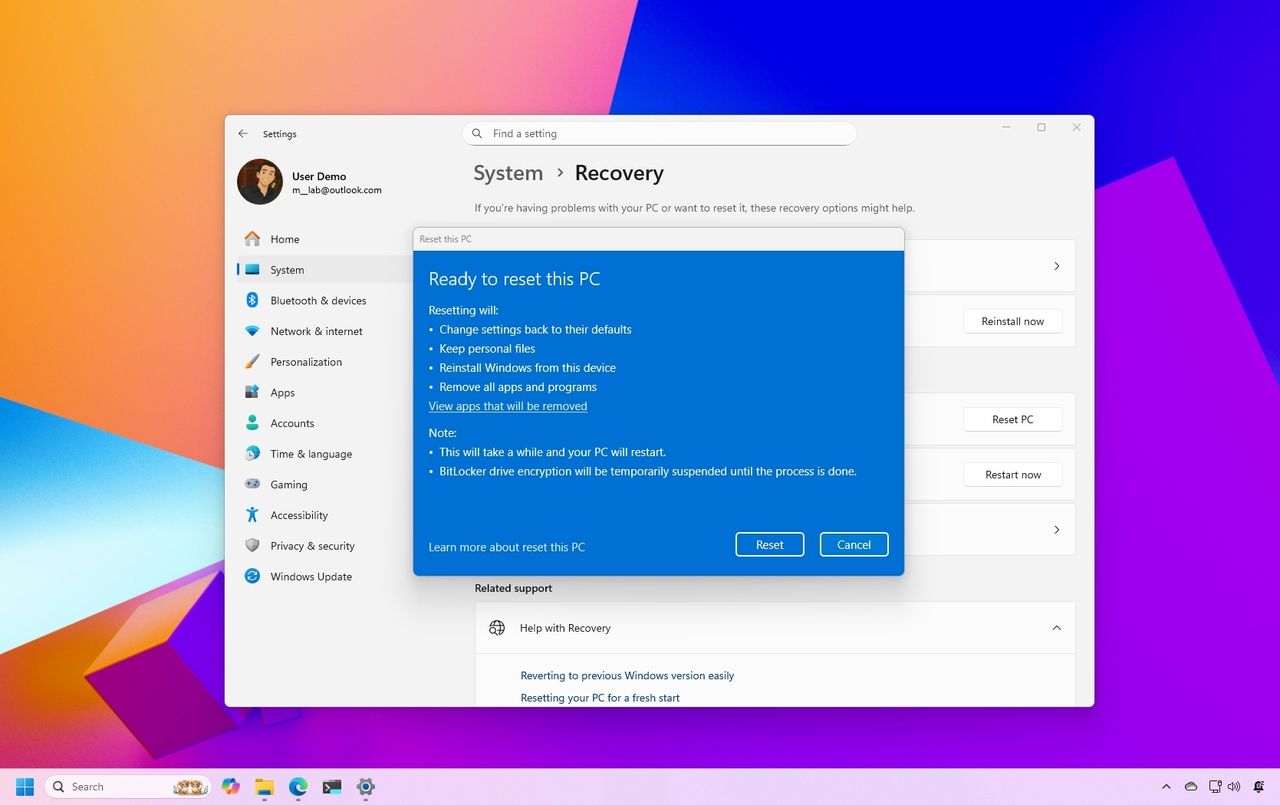
Windows 11 reset to factory settings

Windows 11 is testing a new Cloud rebuild feature to reset your PC without a USB drive.

The Windows Central Podcast breaks down the Copilot OS leaks, the latest Microsoft layoffs, and what all of this means for the future of Windows and the company’s AI strategy

The tech world is sweating, and it’s not just the summer heatwave. This week on the Windows Central Podcast, Daniel Rubino, Zac Bowden, and Jez Cordon sit down to unpack a massive wave of Microsoft layoffs. We break down Asha Sharma’s internal memo revealing a staggering 14 layers of middle management at Xbox, why the gaming division has struggled to capitalize on massive acquisitions like Fallout and Minecraft, and whether turning Xbox into an independent subsidiary is the brand's last chance for survival.

Zac walks us through the shocking Discord leak of "Project Ion," an experimental, web-native Copilot Operating System built entirely inside Microsoft Edge. Finally, we break down the quiet arrival of Snapdragon X2-powered Surface devices, the new 24 GB RAM "sweet spot," and why sources tell us the Surface Go lineup is officially dead.

  • Microsoft and Xbox Layoffs: An in-depth look at the 4,800 job cuts, why the brunt is hitting Xbox, and a critique of management's failure to capitalize on massive IPs like Fallout and Minecraft.
  • Leaked "Project Aion" (Copilot OS): Zac reveals an internal 2024 incubation project that leaked on Discord—an experimental, platform-agnostic, web-native operating system built entirely inside Microsoft Edge where Copilot replaces the traditional Start menu.
  • The Tech Industry's AI Bubble: A philosophical debate on consumer pushback against AI, the staggering cloud costs of large language models, and the lack of quantifiable productivity gains for regular users.
  • Snapdragon X2 Surface Refresh: Details on the consumer launch of the Surface Laptop 8 and Surface Pro 12, the introduction of a 24 GB RAM middle-tier "sweet spot," and lower-cost 8 GB configurations engineered to beat the RAM crisis.
  • The Death of the Surface Go Lineup: Breaking down exclusive source info confirming that the 10-inch Surface Go and the Surface Laptop Go lines have been canceled, leaving a major gap for enterprise and ultra-portable tablet fans.

Have a question you want us to answer on the podcast? Send it to us at [email protected]

Hosts:

Subscribe to the Windows Central Podcast

If you like the show, please let us know by give us a rating on your podcast platform of choice. It really helps us!

LIVE Video Podcast

You can watch the live, uncut version of the Windows Central Podcast on our YouTube channel!

Click to join us on r/WindowsCentral

Join us on Reddit at r/WindowsCentral to share your insights and discuss our latest news, reviews, and more.

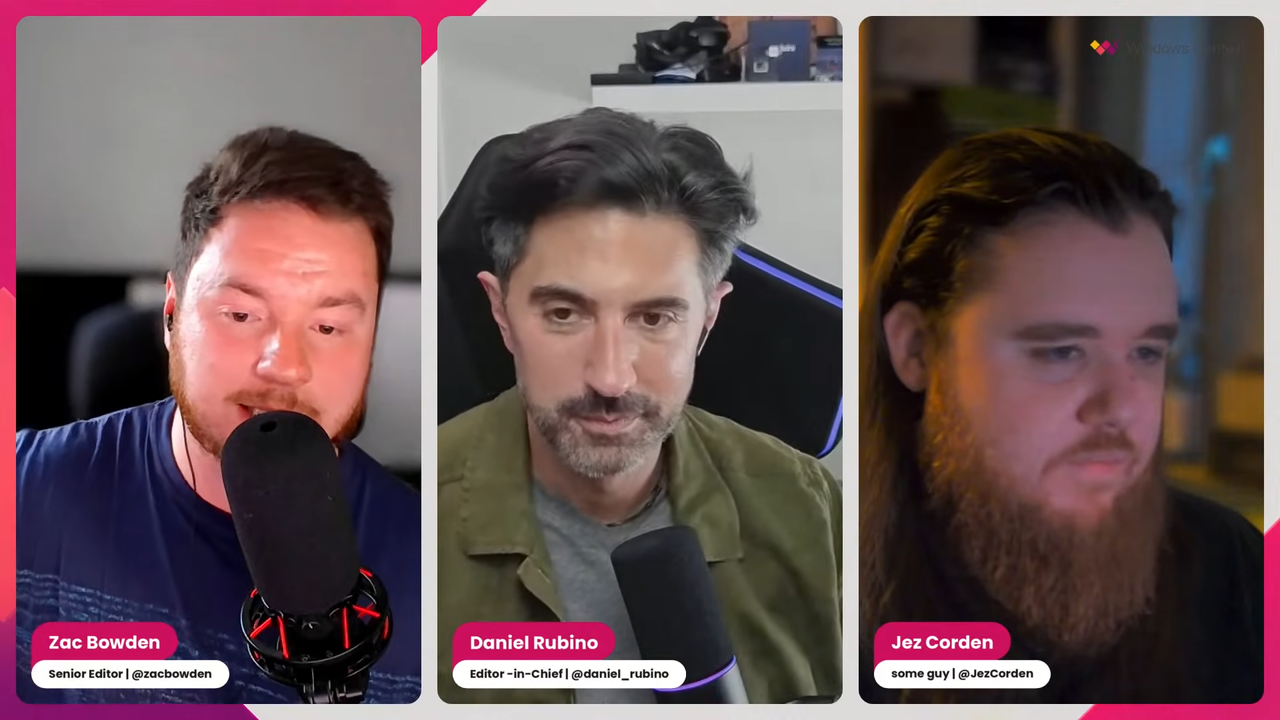
Three podcasters, Zac Bowden, Daniel Rubino, and Jez Corden, talking on a live stream.

From left to right: Zac Bowden, Daniel Rubino, and Jez Corden discuss the latest on Microsoft and Xbox woes.

A mad gaming genius managed to recreate Minecraft on the Game Boy Color and even the original Game Boy — because why not?

This week has mostly been a depressing affair for the gaming industry, what with Sony killing off physical PlayStation Discs and Microsoft laying off over 3,200 roles at Xbox.

We could all use some levity after this string of bad news, so we're going to do that by marveling at the creative ingenuity of YouTuber 'Game of Tobi'.

For you see, this clever tinkerer has managed to get a version of the legendary Minecraft running on two iconic portable consoles that helped pave the way for gaming handhelds as we know them today: the Game Boy Color from 1998 and the original Game Boy from 1989.

This fan-made game "3D Minecraft" isn't a lower-resolution port of Minecraft. It's a unique creation where the player can play on a flat map or a full 3D-generated world. Like in regular Minecraft, you can place blocks, explore the world, and even build.

Granted, the graphics, frame rate, and gameplay are limited compared to the real thing, especially when running on the original Game Boy, as it has no colors other than black and white. Yet the fact that this creator managed to get Minecraft working on a 1998 gaming handheld and an even older one from 1989 is nothing short of technical wizardry.

This isn't the first time 'Game of Tobi' got a modern game to work on retro hardware, as they made working versions of Minecraft on the Game Boy Advance and Nintendo DS in the past that more closely resemble and play like regular Minecraft (complete with Survival Mode!).

In addition, they also made a Nintendo DS version of The Legend of Zelda: Twilight Princess, a Nintendo 3DS version of Super Mario Odyssey, and more.

Personally, I like seeing people using their technical know-how to make games we love playable on platforms we wouldn't expect (look no further than DOOM being playable on Notepad.exe or even a pregnancy test), and these Game Boy ports of Minecraft are no exception.

It just makes you wonder what the gaming world would've looked like if Minecraft had been made in the 1990s instead of 2011, and whether it would've been as successful back then, when gaming was still niche.

Plus, having a physical, offline version of Minecraft that isn't beholden to online servers to keep it running sounds like a pretty good idea, especially in this day and age, when online games can be delisted at any time, at the whim of a corporation, for whatever reason.

Blank Pixel

Either way, Game of Tobi has my YouTube subscription for this invention, and I'm looking forward to seeing what they make next (here's hoping they make Minecraft playable on the Nintendo Virtual Boy just for the sheer, eye-bleeding hilarity of seeing the Nether rendered entirely in the system's Red and Black color scheme).

What do you think of 'Game of Tobi's' Game Boy Color and Game Boy versions of Minecraft? Would you like to play an offline version of Minecraft on older hardware for the nostalgic novelty?

If you have any thoughts, please let us know through the poll, the comments section, or our Reddit page.


Embark on a journey of wonder and creativity with your friends in the world-famous crafting survival game, Minecraft.View Deal

Click to join us on r/WindowsCentral

Join us on Reddit at r/WindowsCentral to share your insights and discuss our latest news, reviews, and more.

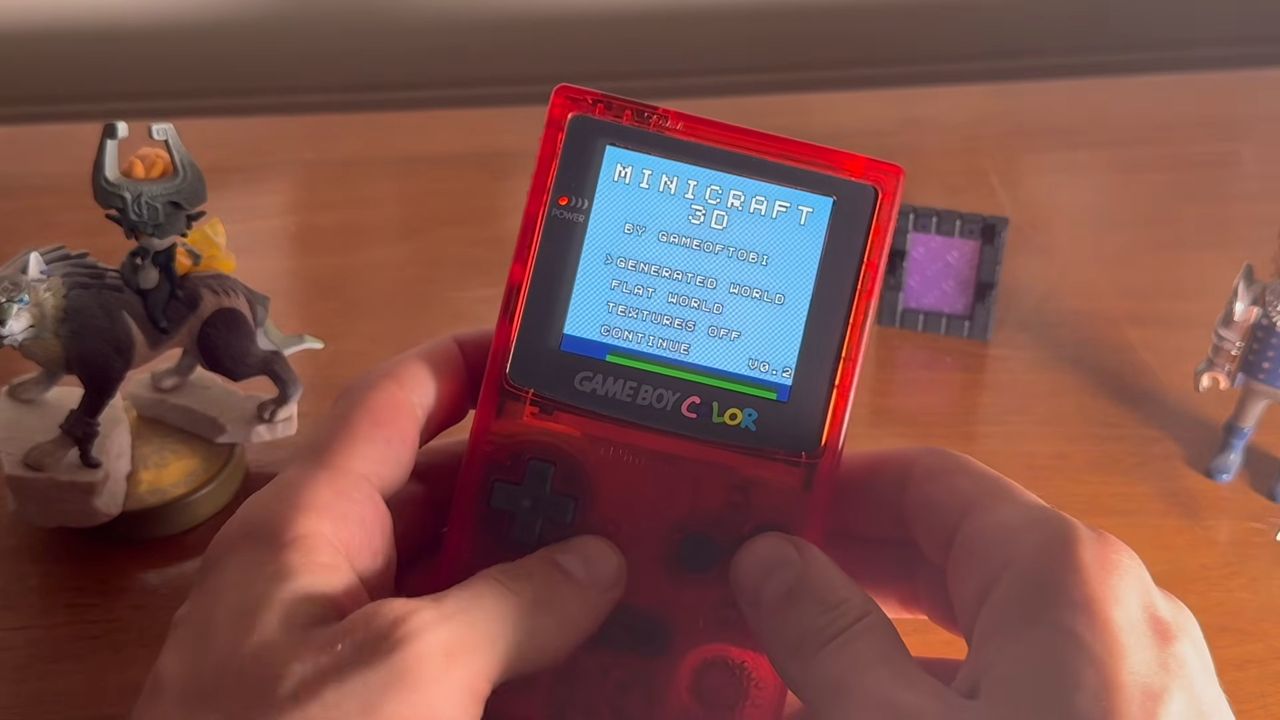
Hands hold a transparent red Game Boy Color displaying "Minicraft 3D." Nearby are figurines on a wooden surface, creating a nostalgic gaming vibe.

Watch out DOOM, Minecraft is looking to overtake your platform compatibility count.

Windows now uses AI to find and help fix vulnerabilities, but it's not replacing humans

Microsoft is using AI to protect Windows against attackers. The development represents an arms race because AI is also being used increasingly to find vulnerabilities modern tech, as highlighted by The Hacker News.

Hackers can use AI to find and take advantage of vulnerabilities that could then be weaponized. It's not just discovery that's been sped up, reverse engineering security flaws is now a quicker process because of AI. That means attackers can find flaws and quickly take advantage of them before traditional methods of protection could take effect.

To combat those malicious actors and evolving tactics, Microsoft is deploying MDASH (Multi-Model Agentic Scanning Harness) at scale across Windows.

Pavan Davuluri, EVP of Windows and Devices at Microsoft, shared a blog post about the new methods the company is using to protect Windows.

"The fastest way to reduce customer exposure is to find issues before attackers can use them," said Davuluri. "Windows is expanding its ability across the platform to find issues earlier, accelerate the engineering work to fix them, strengthen validation, and deliver timely, high-quality updates that keep customers protected."

Using AI to identify potential flaws, prioritize fixes, and scale discovery across the codebase of Windows lets Microsoft quickly roll out protection to customers.

To scale MDASH to Windows, a dedicated cloud infrastructure was set up for scanning for potential flaws. A separate prove pipeline then is used to eliminate false positives. The Windows engineering team can then act on the most likely candidates that need addressing.

Microsoft will expand its use of AI for scanning and proving to other parts of the company.

Using AI to improve work

When Microsoft announced 4,800 layoffs across the company, its leaders emphasized that the eliminated roles are not being replaced by AI. People across a wide range of sectors are concerned about automation taking human jobs.

The approach Microsoft is using to scan for issues and streamline the selection process of candidates to address represents AI helping people rather than replacing workers.

When speaking of improving internal systems and practices, Davuluri said, "That means using AI to help identify potential issues earlier in the development process, while relying on human expertise to evaluate findings, make risk-based decisions and ensure fixes meet the quality bar customers expect."

The end result is that more security updates will be included in each security release, which should protect PCs from the growing number of attacks.

Click to join us on r/WindowsCentral

Join us on Reddit at r/WindowsCentral to share your insights and discuss our latest news, reviews, and more.

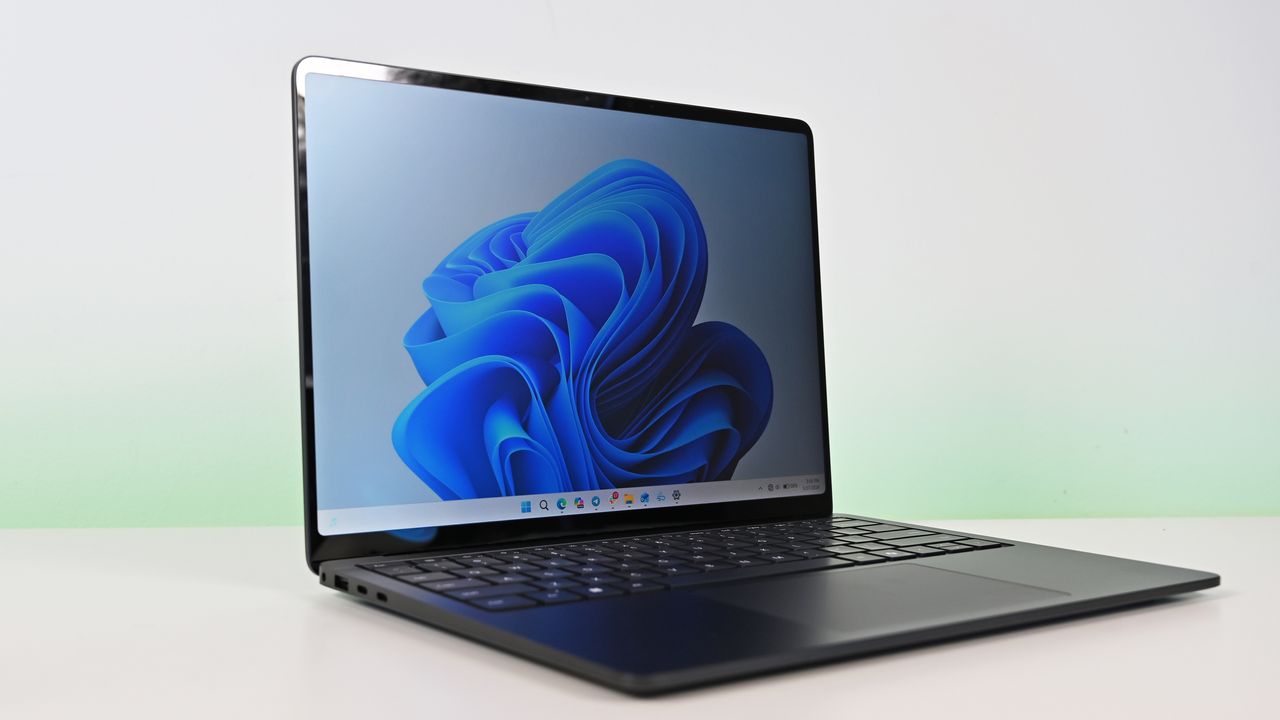
Suface Laptop for Business 8th Edition with a black keyboard and a modern design, displaying a blue abstract swirl on its screen, set against a light gradient background.

Suface Laptop for Business 8th Edition with a black keyboard and a modern design, displaying a blue abstract swirl on its screen, set against a light gradient background.

"It's the kayfabe of a tech industry that really has run out of ideas.": Zitron says Microsoft’s trillion‑dollar AI push is a bubble built on hype, hidden losses, and demand that doesn’t exist

Microsoft's share price has slid 22% in the past year, as investors increasingly cast doubt on the firm's long-term AI strategy.

Artificial intelligence has been billed as the next coming by Big Tech, with everyone from Amazon to Google trying to figure out how to leverage the expensive technology to generate profits. The problem is, nobody is even close to having an answer.

Generative AI is incredibly costly to run, and the return on investment is unclear at best. Many companies are starting to discover that, in fact, it's cheaper and more effective to simply use human labor. Companies that previously laid off engineers in favor of AI models later found themselves crawling back to those fired, and others have put large restrictions on token expenditure as returns remain elusive.

I saw a clip on CNBC from Ed Zitron, creator of the Where's Your Ed At newsletter and host of the Better Offline podcast recently. It summarized Microsoft's AI conundrum in pro wrestling terminology — which appealed to my simple brain. His full analysis is anything but simplistic, though. It speaks to the hard reality companies like Microsoft are facing: Is any of this actually worth it?

Zitron describes the challenges of companies like OpenAI and Anthropic joining SpaceX in going public, describing how the company's financial realities betray the almost demented hype around them.

"They'd be the first to be this bad, other than WeWork, and this is so much worse than that. OpenAI burned $20.9 billion dollars in 2025. The problem with these companies is ... their margins are getting worse. Their costs increase linearly with their revenues. There's no proof they can improve their margins. No amount of specialist silicon will bring these costs down.

"We're at a point where OpenAI is pushing their IPO to 2027 because they couldn't get a trillion-dollar valuation. People are wising up to the problem of generative AI: there's not really a business there."

Zitron posits that none of the hyperscalers and companies like OpenAI and Anthropic "encourage waste," while potentially stealing ideas generated by companies using their models, citing Claude Design and Figma. Indeed, the only public company that seems to be flying on its AI hype right now is Google. I would argue that's less to do with innovating, and more because they've found a way to steal revenue from human creators via Gemini's Google Search summary box — instantaneously creating infinite, dynamic (albeit hallucinating) ad-scaling opportunities.

This wholesale content theft is not as readily available to OpenAI, Anthropic, or Microsoft. Google Search remains the dominant tool for browsing the web, and thanks to Chrome and Android, Google owns the entire stack here.

Microsoft Fairwater Datacentre

Microsoft's data centers have come under increasing scrutiny for pollution, noise, electricity bill inflation, and water depletion. (Image credit: Microsoft)

Microsoft very much does not own the entire stack. It barely owns a stack at all here.

Microsoft's partnership with OpenAI is on the verge of collapse, pending contractual obligations that will expire over the next few years. It's already ditching OpenAI's pricey models in favor of supposedly more-efficient MAI home-grown models in some products. Microsoft Copilot is already barely used, despite being baked into Windows. It languishes at lower than 10% of the market, according to estimates, far behind the likes of Claude, Gemini, and ChatGPT.

CEO Satya Nadella's decision to give up on Windows Phone and internal Android projects has precluded Microsoft from any form of mobile play here. Mobile is where all new consumer tech will thrive, whether or not it's AI or something else. The historical open nature of Windows prevents it from reaching consumers with any of its products. Nobody uses Bing, Edge, or Copilot, and it's a result of Microsoft's wholesale lack of foresight.

Microsoft bet that it could provide the underlying infrastructure instead, and has spent monstrous amounts of CapEx on data centers in the past few years. But Zitron posited in a large report from May that it might be exaggerating, or perhaps even outright lying, about its data center expansion plans. Indeed, there's little evidence that Microsoft has actually expanded its capacity since 2024. Zitron tracked a variety of Microsoft-announced data center projects and found them in various states of incompletion.

Is this a signal that there's no real demand? Is Microsoft intentionally stalling and dragging out construction because it knows there's no actual ROI incoming from these projects?

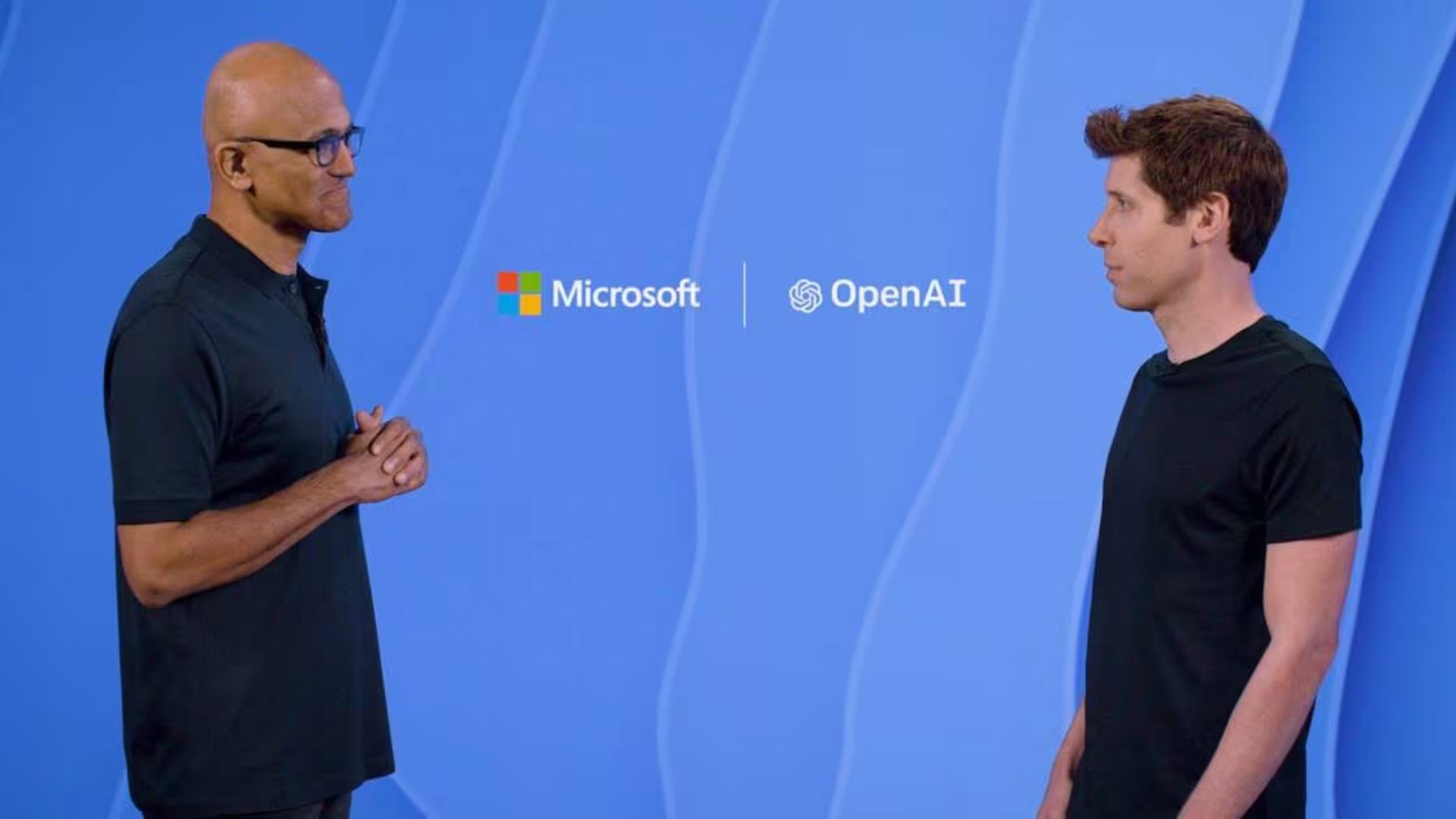
Satya Nadella with Sam Altman at a conference

Microsoft's OpenAI bet was called the smartest investment it had ever made a few years ago. On paper it still is. Imaginary, fantastical paper, at least.

AI-adjacent stocks, including SpaceX, Oracle, and Microsoft, have all been in near free-fall decline recently, as investors seem to bet that there's gross over-extension going on. Meta is also reportedly spinning up a cloud company to try and offload excess compute it had previously invested in AI specifically, despite not having any actual demand.

"The only reason Big Tech is investing in this is that they've run out of hypergrowth ideas," Zitron said, on the general AI industry. "They don't have a next iPhone, they don't have a new Google Search. They've put over a trillion, with trillions more to come, into a kind of dead-end industry. When that ends, they'll have to admit that they don't have anything else."

"In the future, I see [AI] as a boring hardware-based business, kind of the Oracle licensing hardware model. I think this is a $10 to $30 billion TAM [total addressable market] industry, pretending to be a $1 trillion industry."

"Everyone is just kind of pretending. It's the kayfabe of a tech industry that really has run out of ideas."

Click to join us on r/WindowsCentral

Join us on Reddit at r/WindowsCentral to share your insights and discuss our latest news, reviews, and more.

Microsoft Copilot on a red background

Maybe AI actually isn't the future?

Microsoft Forms just gave me another reason to prefer it over Google Forms

Microsoft Forms just got a major upgrade thanks to Copilot. Microsoft 365 Copilot chat now lives within Microsoft Forms, adding a familiar tool to those who use AI in Word, Excel, and PowerPoint.

Copilot in Microsoft Forms can suggest improvements to your polls and forms and present insights from responses.

The Copilot integration is available now to users with Microsoft 365 commercial Copilot licenses.

Microsoft listed all the changes to Forms in a blog post:

  • Smarter suggestions & refinements: Get targeted recommendations to improve your form’s structure, clarity, and effectiveness. Copilot can also apply refinements directly to the form, so you can save time making edits – just describe what you want, and watch Copilot make it happen.
  • Deeper analysis: Copilot can now analyze your results in-depth to provide clear insights and actionable takeaways for you and your team. You can even ask follow-up questions to help parse and summarize your data and unlock your next step.
  • More settings: Review and update form settings with ease, such as applying custom thank-you messages and close dates, so your form is ready to send. You can also adjust question settings in bulk, such as making questions required.
  • Open-ended chat: Copilot chat gives you access to a broad world of capabilities, whether you’re seeking inspiration on survey topics or consulting on how to configure your form – the possibilities are broad with Copilot at your fingertips.
  • Basic branching: Apply basic branching logic directly through the agent. (Note that some complex scenarios are not yet supported, and you should continue to review your branching logic prior to sending your forms.)

I use Microsoft Forms to gather feedback from my American football team. I admit that I first tried it because my job centers around knowing Microsoft products. But after using Microsoft Forms for a while, I grew to prefer it over Google Forms.

Microsoft Forms can sync with Excel documents, making it much easier to stay on top of responses. I'm deeply entrenched in the Microsoft ecosystem, so anything that works seamlessly with the rest of my workflow gets bonus points in my book.

I also prefer some of the features of Microsoft Forms, such as question-level branching. That feature makes filling out forms feel smoother when a poll includes branching questions because it keeps you on the same page.

The layout of Microsoft Forms also presents results quicker because if you want to look at a chart, you don't need to open a separate spreadsheet.

The new Copilot experience in Forms could also be a boon to the platform, though I'll have to see it in action to judge. In my experience, Copilot as a general tool is good at suggesting improvements, performing bulk edits, and creating summaries, so it should thrive within Microsoft Forms.

Click to join us on r/WindowsCentral

Join us on Reddit at r/WindowsCentral to share your insights and discuss our latest news, reviews, and more.

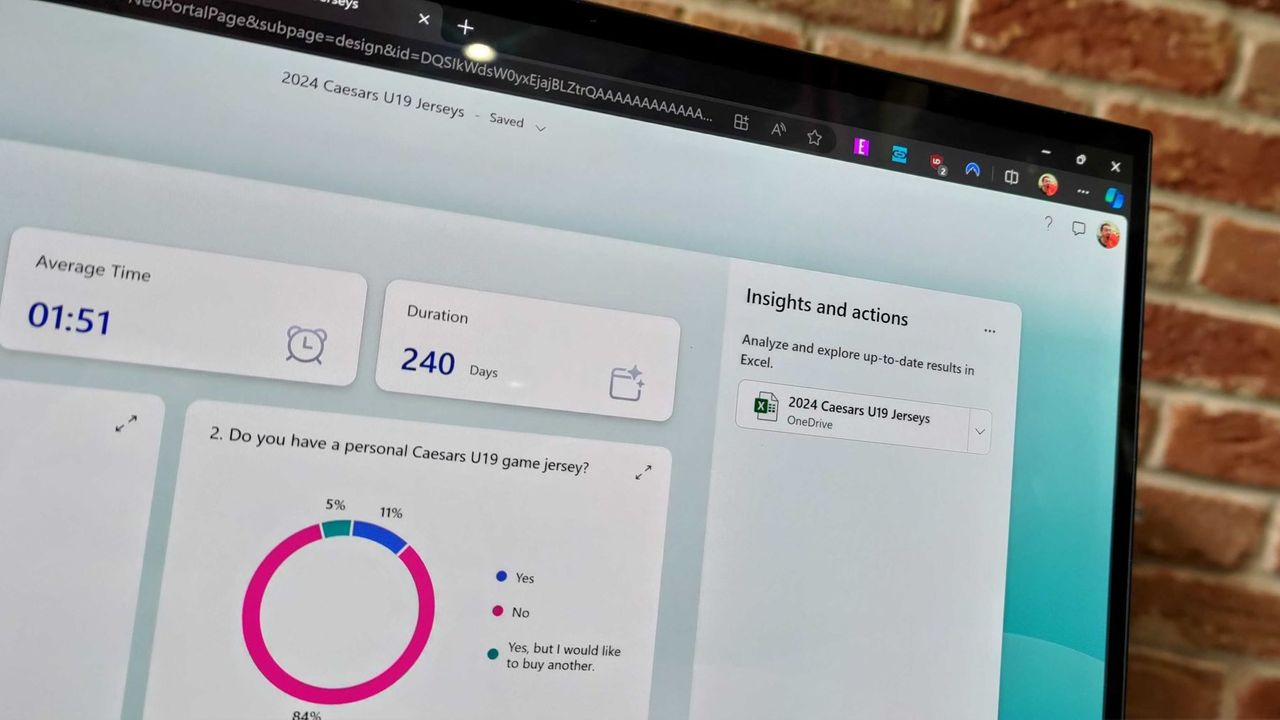
Microsoft Forms results page

Microsoft Forms results page

Microsoft is making Windows 11's search box 4 whole pixels taller for some reason

It looks like Microsoft is planning to make a small but interesting (ok, maybe not that interesting) change to Windows 11 in the coming weeks, one that has us scratching our heads a bit. The company has revealed (albeit accidentally) that it's making the search box that appears on the Taskbar and in the Start menu a little taller, by 4 whole pixels.

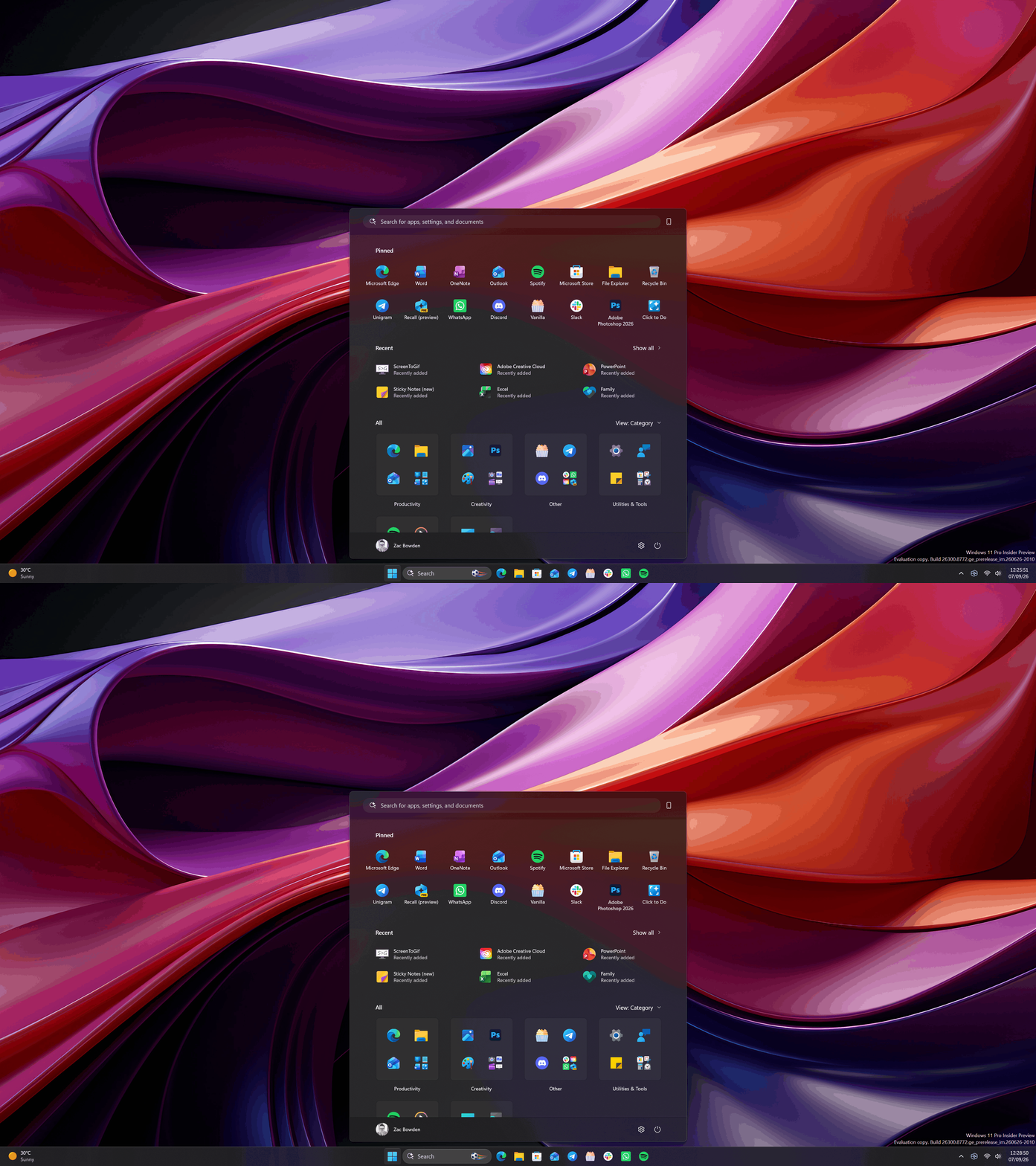
4 pixels doesn't sound like much of a change, but it is a noticeable difference, if you can believe it. The change makes the search box appear chunkier, taking up more visible space above and below it, and bringing it closer to the top edge of the Taskbar itself and slightly pushing content down in Start.

Here's a before and after of the Start menu and Taskbar, in gif format so that it loops making the difference very easy to identify:

Comparing the new search box to the old search box.

Notice how things shift slightly when the thicker search box is enabled. (Image credit: Zac Bowden / Windows Central)

Microsoft hasn't explained why it's making this change, but if I had to guess, I'd say the change is being made to align it with the Ask Copilot search box appearance, which differs from the existing Windows Search search box.

Ask Copilot is an alternative search experience coming soon to the Taskbar on Windows 11 that incorporates Copilot chat directly into the user interface. It's currently aimed at commercial customers, and includes a thicker but narrower search box that appears on the Taskbar when enabled.

Ask Copilot is a separate UI to the standard Windows Search experience, and needs to be manually enabled before you can use it. That's why I think Microsoft is making the default search box 4 pixels taller, as the company likes the look of Ask Copilot and would like that appearance to apply to the default search box too.

Here's a closer look at the search box on the Taskbar comparing the new height to the old height. See, it is a noticeable difference! Investigative journalism at its finest on display here.

Comparing the new search box to the old search box.

Top: The new taller search box. Bottom: The current search box. (Image credit: Zac Bowden / Windows Central)

Either way, you can likely expect to see the search box in the Start menu and on the Taskbar get slightly bigger in the coming months, as Microsoft begins rolling out the change to Insiders before making it generally available to all. The change was unveiled in a changelog for a recent Windows 11 preview build, but a Microsoft engineer has since confirmed to me that the change isn't yet being previewed.

Thanks phantomofearth!

Click to join us on r/WindowsCentral

Join us on Reddit at r/WindowsCentral to share your insights and discuss our latest news, reviews, and more.

Semantic Search coming to Windows 11.

Semantic Search coming to Windows 11.

Microsoft Teams removal shows why we shouldn't get too excited about preview features

A great feature won't make it to Microsoft Teams, at least anytime soon. Microsoft began testing two minimized views in Teams earlier this year, but development of the features has been paused.

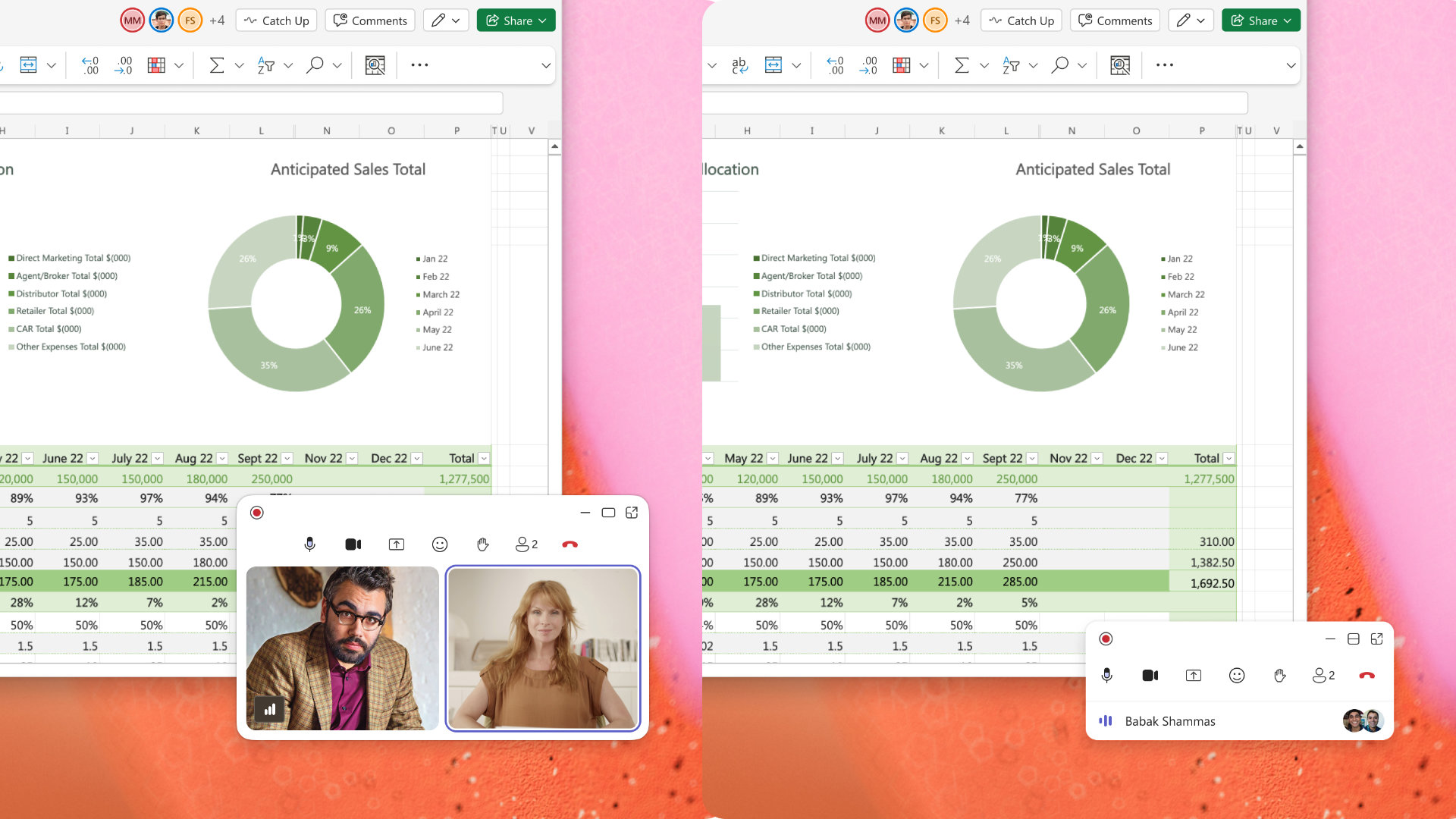
The idea was that when an active meeting window was minimized, Teams would show a minimized window with shortcuts to perform actions like raising your hand or sharing a reaction. One option called Expanded view showed up to four participant videos, while the Compact view focused on quick actions and settings.

"Updated July 7, 2026: We have paused release to GA at this time. We will communicate via Message center when we are ready to proceed. Thank you for your patience," reads the Microsoft 365 Message Center (archived here).

The views were meant to start rolling out in May 2026, but they now sit stuck in the development pipeline. Neowin spotted that the feature was paused.

Two side-by-side screenshots show Excel spreadsheets with sales data and charts, one featuring a video call, and the other displaying a chat message pop-up over the spreadsheets.

Expanded view (left) and Compact view (right) would have shown shortcuts and key meeting content when the main meeting window was minimized. (Image credit: Microsoft)

There's always a chance that preview features will be changed significantly before release or cancelled. Microsoft also needs to work out any issues before shipping a change to Teams.

Microsoft did not share why it paused the development of these minimized views. They both seem like worthwhile additions to Teams that make multitasking easier. I hope Microsoft ships them to Teams eventually.

Teams gets new features regularly. The communication platform gets so many updates that Microsoft has to list changes in a monthly blog post.

But the most talked about Teams feature this year was omitted from the last roundup. Teams now has a controversial feature that lets your boss see where you are if you're connected to Wi-Fi networks at work.

Microsoft was accused of making Teams a "lapdog for your boss," but the company has made changes to the feature since first unveiling it. Microsoft delayed the rollout of that feature, changed the name of the option, and added better privacy controls.

The minimized views within Teams may go through a similar journey. We could see them in the future with altered controls, a new name, or in the same form but at a later date.

Click to join us on r/WindowsCentral

Join us on Reddit at r/WindowsCentral to share your insights and discuss our latest news, reviews, and more.

Microsoft Teams app seen displayed on a smartphone screen and a Microsoft Teams logo on a laptop in the background.

Microsoft Teams app seen displayed on a smartphone screen and a Microsoft Teams logo on a laptop in the background.

Windows 11 cleanup is finally simple with this powerful open‑source tool that strips bloat, boosts speed, and gives you real control

Windows 11 includes several built-in tools to help keep storage usage under control on your computer. Features like Storage Sense, the Temporary Files settings page, and Storage Recommendation can help you reclaim storage with ease, making third-party cleanup utilities less essential than they once were.

However, those features don't clean everything. If you want more control over temporary files, browser data, app caches, and privacy-related files, BleachBit is one tool you have to try. It's free, open source, and, unlike many PC "optimizer" apps, it focuses on cleaning unnecessary files rather than promising unrealistic performance improvements.

In this how-to guide, I'll explain what BleachBit does, how to use it on Windows 11, which settings I recommend, and which features you should avoid unless you understand exactly what they do.

What is BleachBit?

BleachBit is a free and open-source cleanup utility for Windows 11 that removes temporary files, caches, logs, browsing data, and other unnecessary files created by the operating system and many third-party apps.

Unlike many commercial cleanup tools, BleachBit doesn't include advertisements, bundled tools, or premium features. Instead, it gives you complete control over what gets removed and explains every cleaning option before you run it.

Rather than replacing the built-in cleanup tools available on Windows 11, I see BleachBit as an additional utility for users who want more control over what gets cleaned.

Why use BleachBit?

Although Windows 11 already provides several storage management tools, BleachBit adds several more capabilities.

For example, cleaning the system's temporary files as well as those junk files created by third-party apps. You can also use the tool to clean temporary browser data, such as cache, history, and downloads.

In addition, BleachBit provides secure file shredding to make recovery more difficult and wipes free storage space on supported drives.

Finally, the tool offers command-line support for scripting and automation, and there's a portable version that you can use without installation.

The biggest advantage is flexibility. Instead of cleaning everything automatically, BleachBit lets you decide exactly what should (and shouldn't) be removed.

Install BleachBit on Windows 11

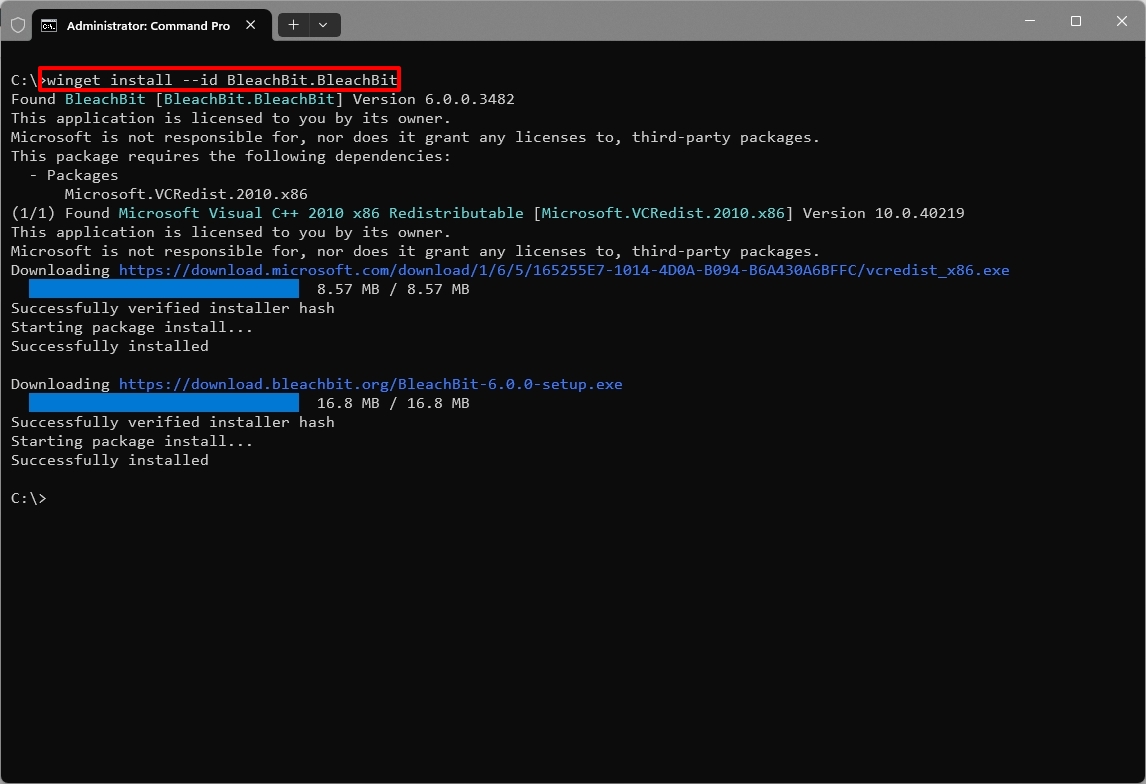
Installing BleachBit is straightforward. You can download either the standard installer or the portable version, then launch the application. However, the quickest way to install the app is by running the winget install --id BleachBit.BleachBit command in Command Prompt (admin).

Command Prompt showing the winget command installing the BleachBit tool on Windows 11.

(Image credit: Mauro Huculak)

For most cleanup tasks, running it in normal mode is enough. Some system cleaning options may require administrator privileges.

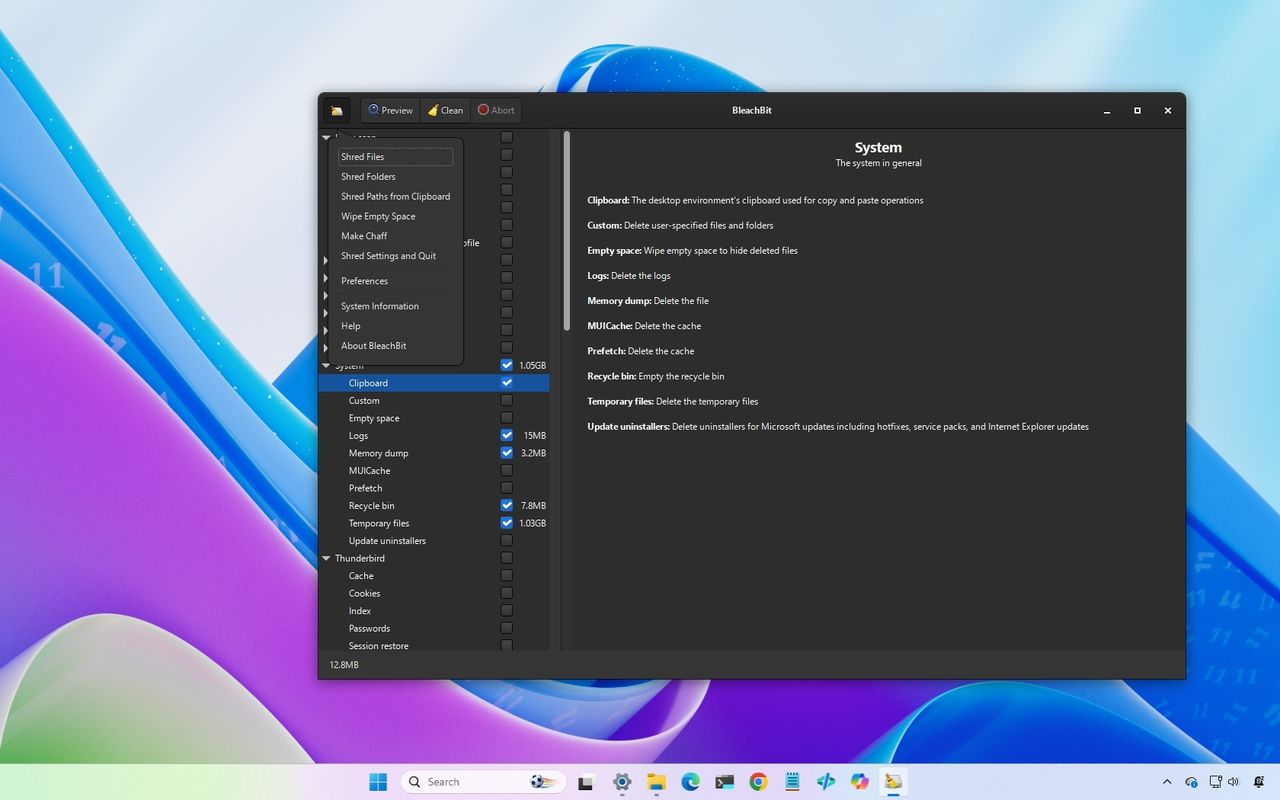
Once opened, you'll notice a list of apps and cleaning categories on the left, along with a brief description of each option as you select it.

Always run Preview first

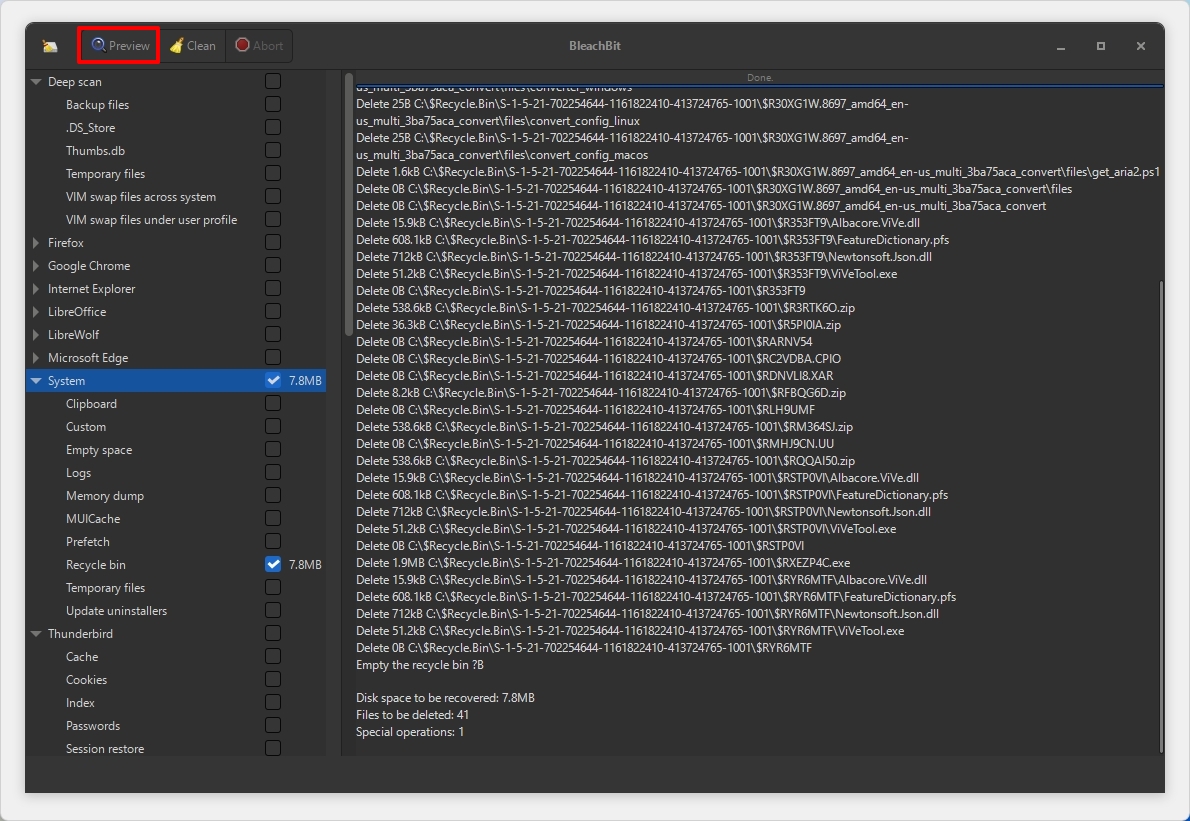
One feature I recommend using every time is Preview. Instead of immediately deleting files, the "Preview" option scans your system, estimates how much storage space can be reclaimed, and shows exactly what BleachBit intends to remove.

BleachBit for Windows 11 show preview results.

(Image credit: Mauro Huculak)

Even if you've used BleachBit before, I still recommend running the Preview option first.

Recommended cleanup options

For routine maintenance, I recommend starting with categories that are generally safe to remove.

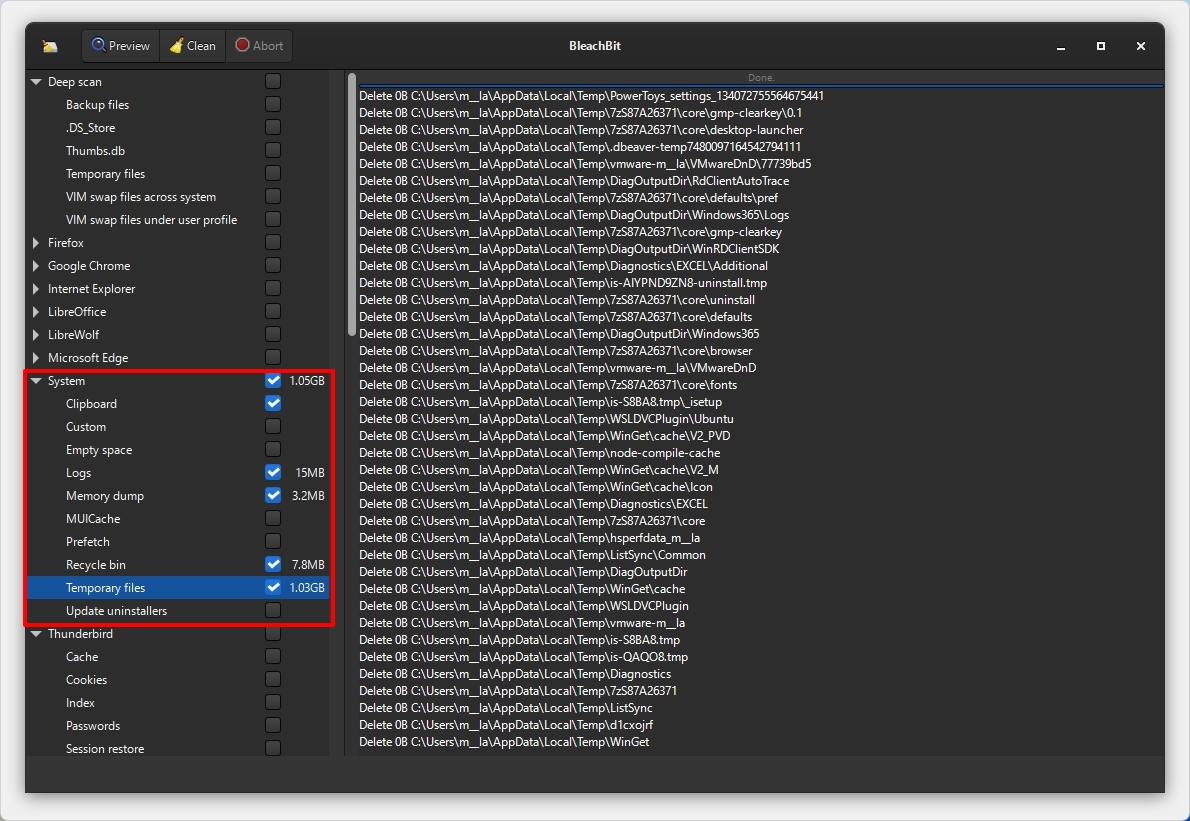
For example, from the "System" section, some good choices include:

  • Temporary files.
  • Logs.
  • Clipboard.
  • Recycle Bin.
  • Update uninstallers.

BleachBit with recommended settings selected.

(Image credit: Mauro Huculak)

Usually, these items consume storage over time without affecting your daily workflow.

For browser cleaning, I suggest being more selective. Clearing cached files occasionally is perfectly reasonable, but deleting cookies will sign you out of websites, and removing session data will close saved browsing sessions.
Unless you're troubleshooting a browser issue or intentionally clearing your browsing activity, I usually leave those options unchecked.

The same advice applies to app caches. While they're generally safe to clear, some apps may take longer to launch the next time because they'll need to recreate those files.

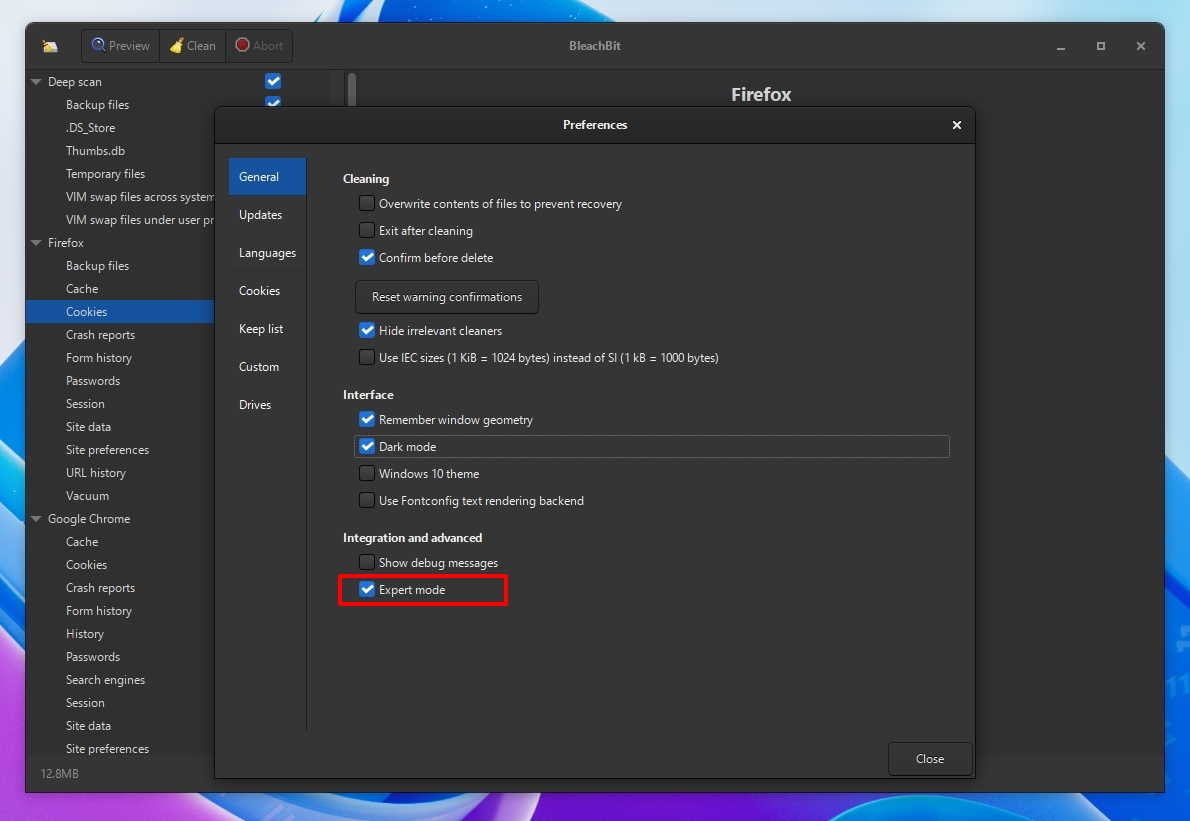
BleachBit showing the General tab and highlighting the

(Image credit: Mauro Huculak)

As mentioned above, cleaning actions may require using the tool in Expert mode. If you receive the prompt, open the BleachBit main menu, select "Preferences," and choose the "Expert mode" option located in the "General" tab.

Securely delete sensitive files

BleachBit includes a built-in file shredder for permanently deleting sensitive files (and folders).

Unlike sending a file to the Recycle Bin (or even deleting it permanently with the "Shift + Delete" shortcut), secure shredding overwrites the file's contents before removing it, making recovery using standard data recovery tools much more difficult.

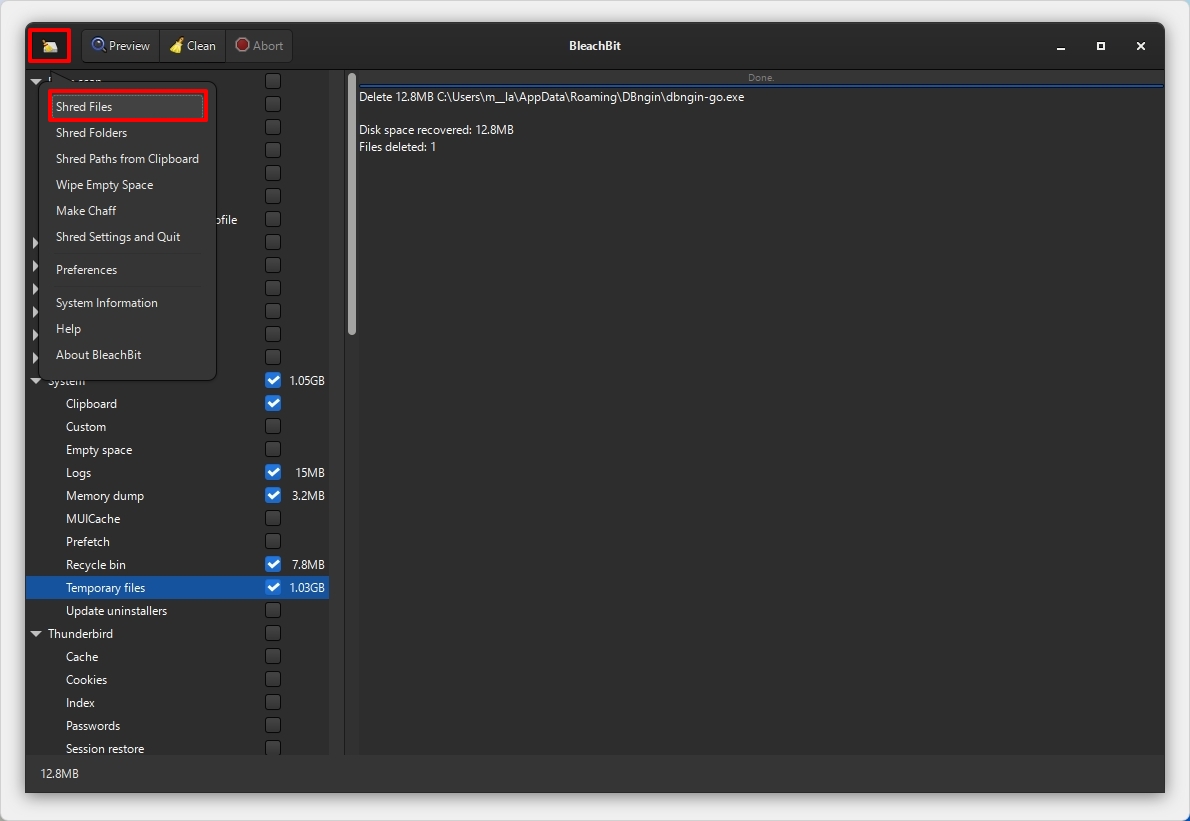
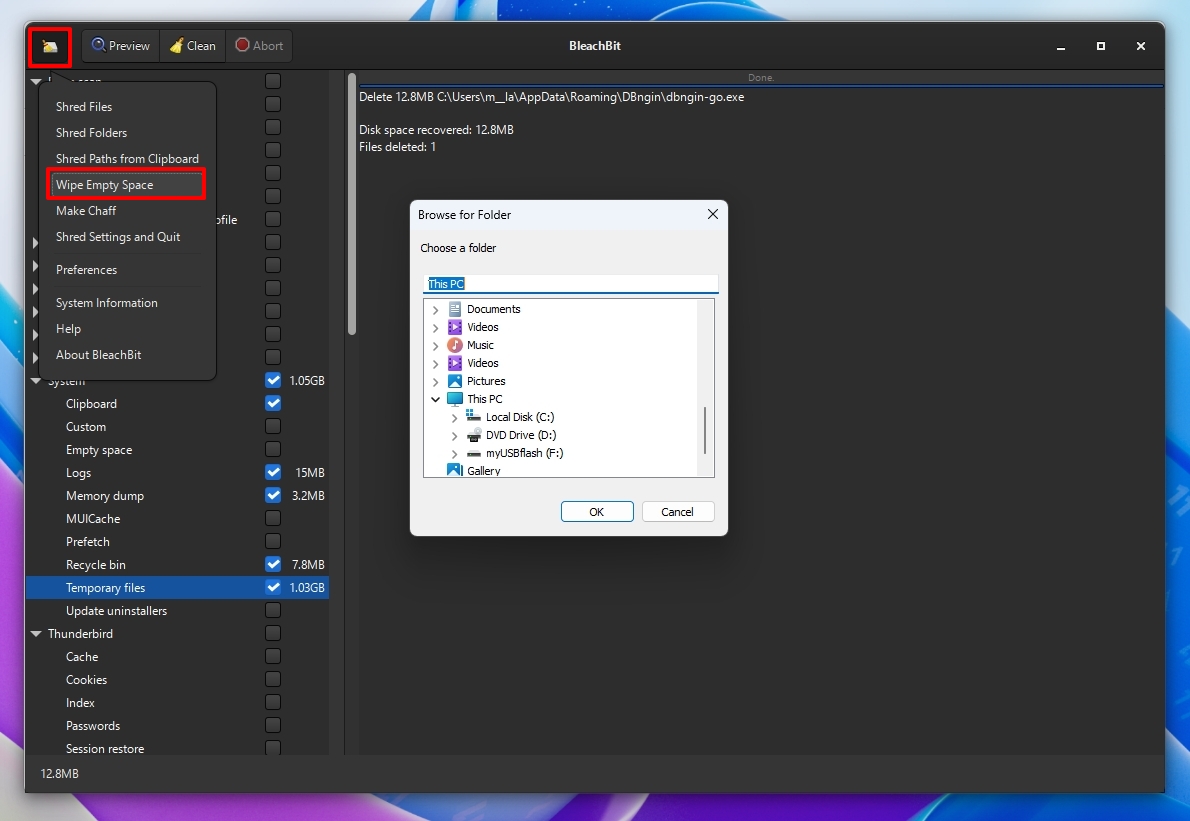
If you want to use this feature, open the BleachBit menu (the first icon at the top-left), choose the "Shred Files" option, then select the file to delete.

BleachBit tool with the main menu opened and the Shred Files option selected.

(Image credit: Mauro Huculak)

This feature is useful when you're deleting confidential content, financial records, or other sensitive files you don't want recovered later.

Wipe free disk space

The open-source tool can also overwrite unused space on a drive to remove traces of files that were previously deleted through the Recycle Bin.

This feature is intended primarily for drives before selling, donating, or retiring a computer, or for secondary drives.

The feature is available from the BleachBit main menu by selecting the "Wipe Empty Space" option and choosing the drive you want to clean.

BleachBit with the Wipe Empty Space option select in the main menu.

(Image credit: Mauro Huculak)

I don't recommend running free-space wiping as part of regular maintenance because it takes time and provides little benefit for everyday use.

If you're preparing a device for resale, the Reset this PC feature is generally the better approach.

One feature you won't find

One thing that BleachBit doesn't offer is a Registry cleaner.

I actually consider that an advantage. For years, Registry cleaners have been marketed as a way to improve performance in the operating system, but in practice, they rarely provide measurable benefits. Worse, removing the wrong Registry entries can cause apps or the system itself to behave unexpectedly.

Microsoft doesn't include a Registry cleaner on Windows 11, and I don't think most users should use one.

By focusing on cleaning unnecessary files instead of modifying the Registry, BleachBit avoids one of the biggest sources of risk associated with older computer optimization suites.

Does BleachBit make Windows 11 faster?

Not directly. When you delete temporary files, you can free up storage space and occasionally resolve issues caused by bad caches, but it won't make your computer faster.

If Windows 11 feels sluggish because your drive is nearly full, cleanup may help. However, performance issues are usually caused by factors such as not enough memory, older hardware, too many startup apps, malware, or software conflicts, not because your temporary files folder is too large (at least not the majority of the time).

Should you use BleachBit?

If you're comfortable with the built-in cleanup tools available on Windows 11, you may never need another maintenance utility.

However, if you want additional control over browser data, temporary files, app caches, privacy-related cleanup, secure file shredding, and other advanced maintenance tasks, you may benefit from BleachBit.

The open-source nature, easy-to-use interface, and decision to avoid questionable features like Registry cleaning make it one of the few utilities for cleaning up Windows 11 and one of the few alternatives to CCleaner.

Windows Central's Take

In the many years I've used the desktop version of Windows, I've tested and relied on countless cleanup utilities. Some of them were genuinely useful at the time, but many were eventually discontinued, acquired by other companies, or changed so much that they no longer offered the same experience.

Over time, I've become much more selective about the tools I recommend, especially when it comes to software that makes changes to the operating system.

Blank Pixel

More often than not, I recommend learning and using the built-in tools. However, BleachBit takes a different approach, and that's why I think it stands out. It focuses on cleaning files, not "fixing" the operating system, and I appreciate that it skips gimmicks like Registry cleaning that can do more harm than good.

If you decide to use it, my advice is not to treat it like a one-click optimization tool. Take advantage of the Preview feature, understand what each option does, and only clean what you actually need. If you use it that way, I think BleachBit is one of the few maintenance utilities that still deserve a spot in your toolkit.

What are your thoughts about BleachBit? Do you prefer Windows 11's built-in cleanup tools, or do you use a third-party utility? Let me know in the comments.

More resources

Explore more in-depth how-to guides, troubleshooting advice, and essential tips to get the most out of Windows 11 and 10. Start browsing here:

Click to join us on r/WindowsCentral

Join us on Reddit at r/WindowsCentral to share your insights and discuss our latest news, reviews, and more.

Windows 11 desktop and the BleachBit tool opened.

Windows 11 desktop and the BleachBit tool opened.

People want more value from Microsoft Rewards, and the new feedback portal makes that impossible to ignore

You can now provide feedback about the Microsoft Rewards Program through a new feedback portal. Similar to the new Xbox Player Voice forum, the Microsoft Rewards Feedback portal lets you suggest features, vote on feedback, and track the progress of changes.

The Microsoft Rewards Program has been around in some form for years, though it used to be under the Bing brand. You can earn points by using Microsoft services that you can then exchange for various rewards.

If you're deeply entrenched in the Microsoft ecosystem, you can earn a lot of points quickly. Over the years, I've used points to build up a library of movies. I value gift cards over other rewards, but you can also use your Microsoft Rewards points to enter sweepstakes and make donations.
I don't spend as much time earning points anymore because of the changes Microsoft rolled out this year.

Microsoft rolled out major changes to its rewards program in May, and some were received poorly. Those changes paired with the increase of the Xbox gift card cost have left plenty of room for feedback.

Generally speaking, points are less valuable than they used to be and there are fewer options for redemption. It's also harder to earn points in several ways.

I think there's a limit to how much we should complain about getting free things, but I think for many the effort to earn points is no longer worth it.

Most requested improvements to Microsoft Rewards

The Microsoft Rewards Feedback portal only launched yesterday, but a theme is already emerging. Several of the top pieces of feedback center around delivering more value to users.

"Redeem points for Game Pass subscriptions," reads the most upvoted piece of feedback. "Bring back Value for money gift cards for redemption," says another suggestion.

Other entries focus on community features, like creating a reward for people who complete 100% of a game or showing a badge on Xbox Live profiles that's related to Microsoft Rewards.

I predict requests to improve value will dominate the top of the Microsoft Rewards Feedback portal once it's given time to mature.

What changes would you like to see to the Microsoft Rewards Program? Share your thoughts in the official Microsoft Rewards Feedback portal and in our comments below!

Click to join us on r/WindowsCentral

Join us on Reddit at r/WindowsCentral to share your insights and discuss our latest news, reviews, and more.

Bold Microsoft logo with vibrant colors and a gold medal icon on the left, reflecting on a glossy floor. The scene conveys achievement and innovation.

Bold Microsoft logo with vibrant colors and a gold medal icon on the left, reflecting on a glossy floor. The scene conveys achievement and innovation.

Amazon has a slop problem and this extension cleans it up

I've heard the term slop bandied around more times than I'd like recently, but today was the first time I'd heard it in the context of Amazon shopping. Meet Knockoff Shopping, the Chrome extension that de-slops your Amazon search results.

What does this mean? Well, if you've used the site at all recently to look for basic items, whether it be clothes, phone cases, or such, you'll notice that many reputable brands are now buried in a sea of items with capitalized letters. Items that appear to be coming from Temu or AliExpress.

Often, you'll be looking for something like a hairdryer, perhaps, and find an identical model listed under 3 different brand names, all trying their damnest to look like Dyson. Should I buy DRYSON, BLOWY, or the SKIBIDI RIZZ hairdryer? It's hard to decide.

Well, someone has had the gumption to create a Chrome Extension to solve this problem; it promises to filter "trademark-squat pseudo-brands (the SZHLUXes and HORUSDYs) out of your search results, so what's left are brands with a reputation to lose."

You can simply head to knockoff.shopping to get the extension and try it for yourself, but here are some more tips on getting it to work for you.

Using Knockoff

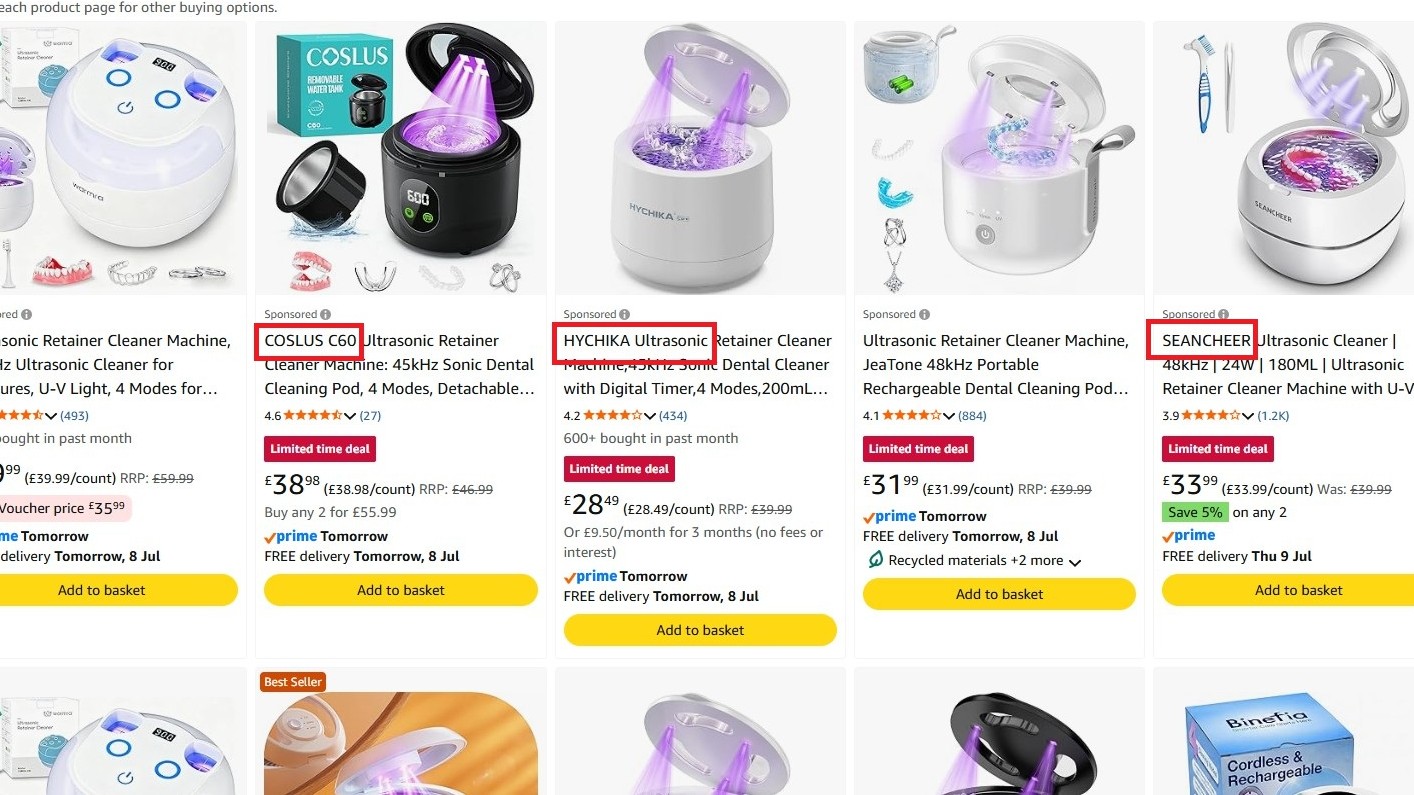
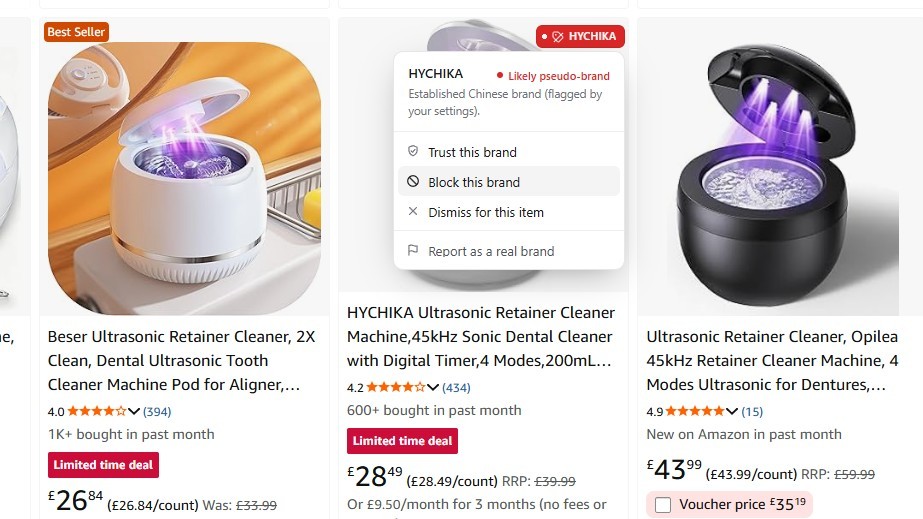
Screenshots from Amazon listings and Knockoff extension

COSLUS, HYCHIKA or SEANCHEER? How can I resist? (Image credit: Jennifer Young - Windows Central)

I've had issues with these "knockoff" brands myself recently while shopping for an ultrasonic cleaner for my son's retainer. We've now ordered two seemingly identical models under different brand names, and both have given up the ghost after a week.

Third time lucky, right? Well, I'm going to use the tool to help me narrow down my search this time. As you can see in the screenshot above, when I search for the item, my results are flooded with similar-looking items from different pseudo-brands that feel the need to shout their names at me. COSLUS! HYCHIKA! SEANCHEER! BUY US!

Following my installation of the tool, I can fiddle with the options before I go on my search to add brands that I don't want to be filtered, so ANKER and UGREEN, for example, are reputable electronic brands I trust; I don't want those filtered.

Screenshots from Amazon listings and Knockoff extension

(Image credit: Jennifer Young - Windows Central)

Now, upon running the search again, you can either have the tool 'dim' the dodgy results so you can still see them and make changes, or have it hide them completely. For now, I've set mine to dim results so I can start to teach it what I do and don't want to see.

Screenshots from Amazon listings and Knockoff extension

(Image credit: Jennifer Young - Windows Central)

Here I have selected to block this brand permanently. On the other hand, if I see brands I trust, I can tell the tool to add them to the Allow list for me.

Creator Josh Pigford has already mentioned on his X account some brands that may be inadvertently filtered out. I don't recognize many of these, but BIODANCE and LANIEGE are at least reputable Korean skincare brands, and I would add them to my filter.

Knockoff is now live!Filter out the knockoff crap brands on Amazon.Sorry to brands like WNPETHOME, EHEYCIGA, YXYL, LU&MN, JOYIN, TOMY, GODONLIF, YOOJEE, LINGTENG, LANEIGE, VISCOO, BIODANCE, COOFANDY, BALENNZ, TOSY and LUENX.https://t.co/9mLk0EAsfG https://t.co/K07lMkepOWJuly 7, 2026

The tool has now helped me select a third, and hopefully more reliable, cleaner for my son's retainer. It also helped me see more clearly that many of the 'dimmed' brands were around the same price, so I paid a little more for something potentially longer lasting.

holy crap, it’s beautifulhe deslopped amazon https://t.co/ThiM8tywlj pic.twitter.com/AfGEinUiyDJuly 7, 2026

I've only just started using the tool myself, afterall it's only been a day! But others are already reporting great success with it and I hope to have even better results as I tweak what I do and don't want to see. The extension is currently only available on Google Chrome, but it's coming to Safari and Firefox soon. No word on Microsoft Edge (yet).

Click to join us on r/WindowsCentral

Join us on Reddit at r/WindowsCentral to share your insights and discuss our latest news, reviews, and more.

Amazon logo and listings

Amazon logo and listings

"Not every app needs to bundle the universe": This tiny notepad app shows why Windows has become so bloated

Have you ever wondered why minimum specs continue to creep upward? Part of the problem is that developers don't need to be as efficient as they did decades ago.

A recent video by Dave Plummer highlights the bloat of modern applications by following the journey of Plummer making a notepad that's just 2,686 bytes.

App development is complex, and there are genuinely good reasons that games and programs require such high specs in 2026. But generally speaking, programming doesn't have the constraints of yesteryear, so developers don't need to trim code.

A single app not being optimized is not that much of an issue, but when every program on your PC is bloated, problems pop up. The same productivity workflow today requires more RAM than it did in 2015.

For context, Windows 10 launched with a minimum requirement of just 1GB (for 32-bit) and 2GB of RAM (for 64-bit). Windows 11 requires at least 4GB just to boot the operating system, but most users want much more memory. It was controversial when Microsoft and other companies started offering new PCs with 8GB of RAM this year.

Plummer is best known for creating the Windows Task Manager. He also discusses programming and Windows history on his YouTube channel.

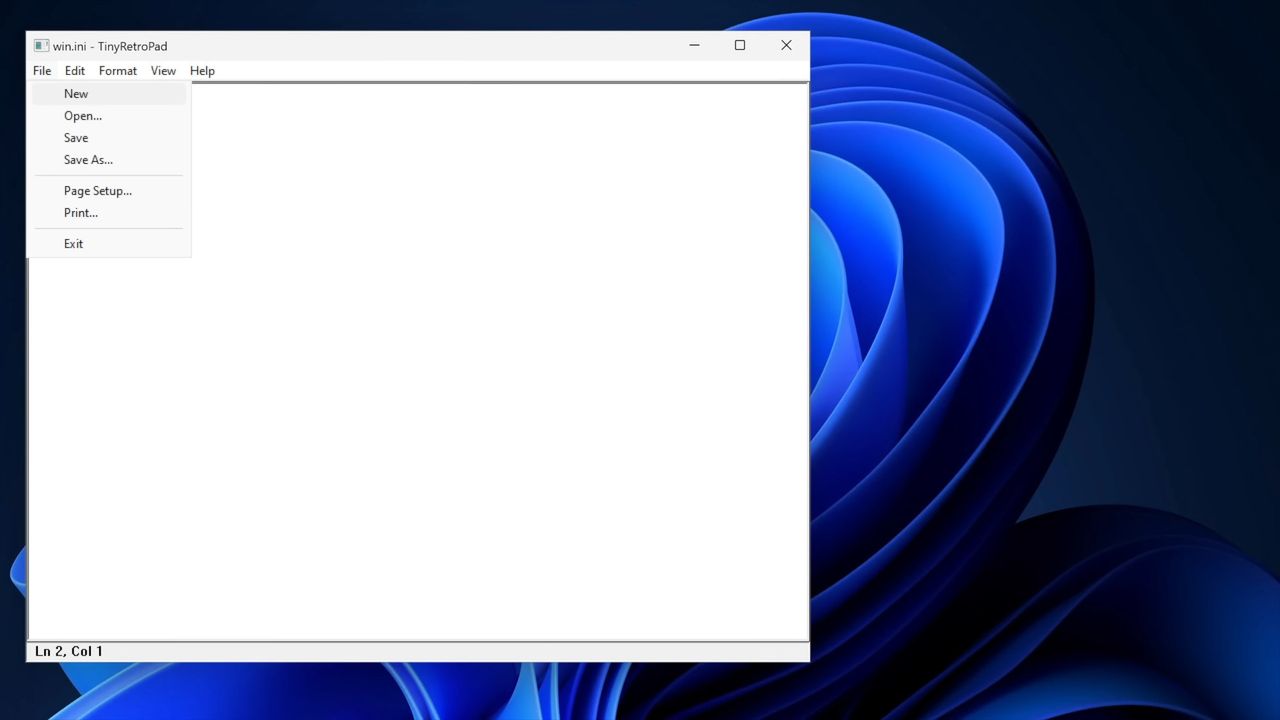
In a recent video, Plummer shared how he made a small notepad application that's smaller in size than a YouTube thumbnail.

Tiny Retro Pad has the core functionality of the original Notepad app built by Microsoft. Notably, it lacks the modern features seen in Notepad, such as Copilot. Considering Notepad's addition of Copilot was mocked by many, Tiny Retro Pad is an improvement in some ways.

Making a notepad app that's under 4,096 bytes is more about working within constraints than the specific size of the final app. In the early days of Windows, there were several limits placed on developers, such as hardware caps. Having to work within those constraints forced developers to be more efficient.

Plummer was able to keep Tiny Retro Pad small by utilizing what's already in Windows.

"A tiny native Windows program does not bring along its own entire civilization. It arrives with a lunchbox and a map of the city," said Plummer.

Later in the video, he added, "The program is small because it is not carrying what the platform already has. And that is a lesson that modern software could stand to remember. Not every app needs to bundle the universe. Not every utility needs to ship with a browser engine."

Nowadays, PCs, tablets, and phones have absurd specs. Even modest devices have several gigabytes of memory and tons of storage. Those specs make modern workflows possible, but they also leave room for lazy development.

"Somehow it seems modern software manages to go the other way. You just want a text box and somehow you've imported a runtime, a layout engine, a renderer, a dependency tree, a telemetry client, an auto updater, and a small portion of Chromium," said Plummer.

No one needs a notepad application that's less than 4,000 bytes, but if more app developers focused on efficient code, Windows 11 would feel smoother across the board.

Blank Pixel

Click to join us on r/WindowsCentral

Join us on Reddit at r/WindowsCentral to share your insights and discuss our latest news, reviews, and more.

Windows interface showing an open notepad application. A dropdown menu is open and "new" is selected.

Windows interface showing an open notepad application. A dropdown menu is open and "new" is selected.

Microsoft hit with class-action lawsuit over "unreasonable and excessive noise" from datacenter

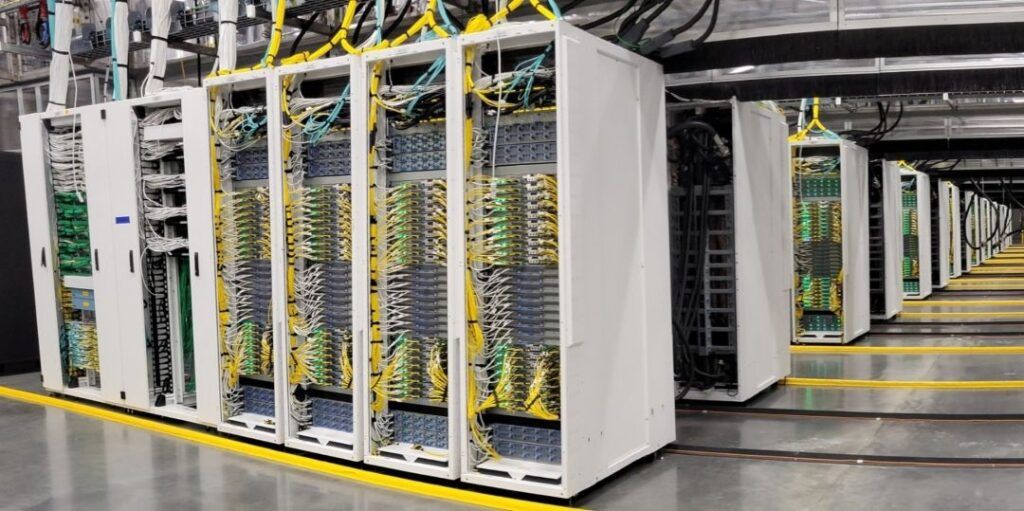
Microsoft finds itself on the receiving end of a lawsuit about "unreasonable and excessive noise" allegedly emitting from the tech giant's Fairwater datacenter in Mount Pleasant, Wisconsin. The suit seeks compensation for damages, though the amount asked for is unspecified.

The Fairwater datacenter was unveiled in September 2025. At the time, it was the largest and most advanced datacenter. The site launched with NVIDIA’s GB200 GPUs. Each rack can process 865,000 tokens per second.

Running those GPUs makes a lot of noise. Microsoft states that the noise levels meet levels required by local ordinances, but the company has taken additional steps to reduce noise.

Microsoft shared the following update on June 18, 2026:

"Our engineering team and consultants on-site investigated the source of the sound, conducted tests, and put noise mitigations in place. Several neighbors confirmed what our independent monitoring showed: that these mitigations fully resolved the issue. We continue to work on short-term mitigation, and over the next several months, we will also install additional sound reduction components and continue to monitor sound at the site."

Despite the measures taken by Microsoft, the lawsuit about the noise from the datacenter was filed on July 1, 2026.

The lawsuit claims that Microsoft has not taken the proper steps to reduce noise in the surrounding area:

"Defendant has failed to follow proper industrial practices to prevent the offsite emission of noise, and has failed to absorb, capture, mitigate, and/or prevent noise from escaping its Data Center, thereby invading the homes and properties of Plaintiffs and the Class."

The plaintiffs of the suit claim that a "low hum" of infrasound emits from the datacenter and that the sound cannot be measured easily on the decibel scale. Our colleagues at PC Gamer highlighted that one plaintiff claimed "the constant noise [affected] his sleep." The filing states that the noise is "not only excessive, but consistent and pervasive."

Since the lawsuit was just filed within the last week, it will likely be a while before we see it reach a conclusion.

Blank Pixel

Click to join us on r/WindowsCentral

Join us on Reddit at r/WindowsCentral to share your insights and discuss our latest news, reviews, and more.

Microsoft Fairwater Datacentre

Microsoft Fairwater Datacentre

Critics on Microsoft extending Windows 10 support for free through 2027: "Are they admitting Windows 11 isn't good enough 5 years later?"

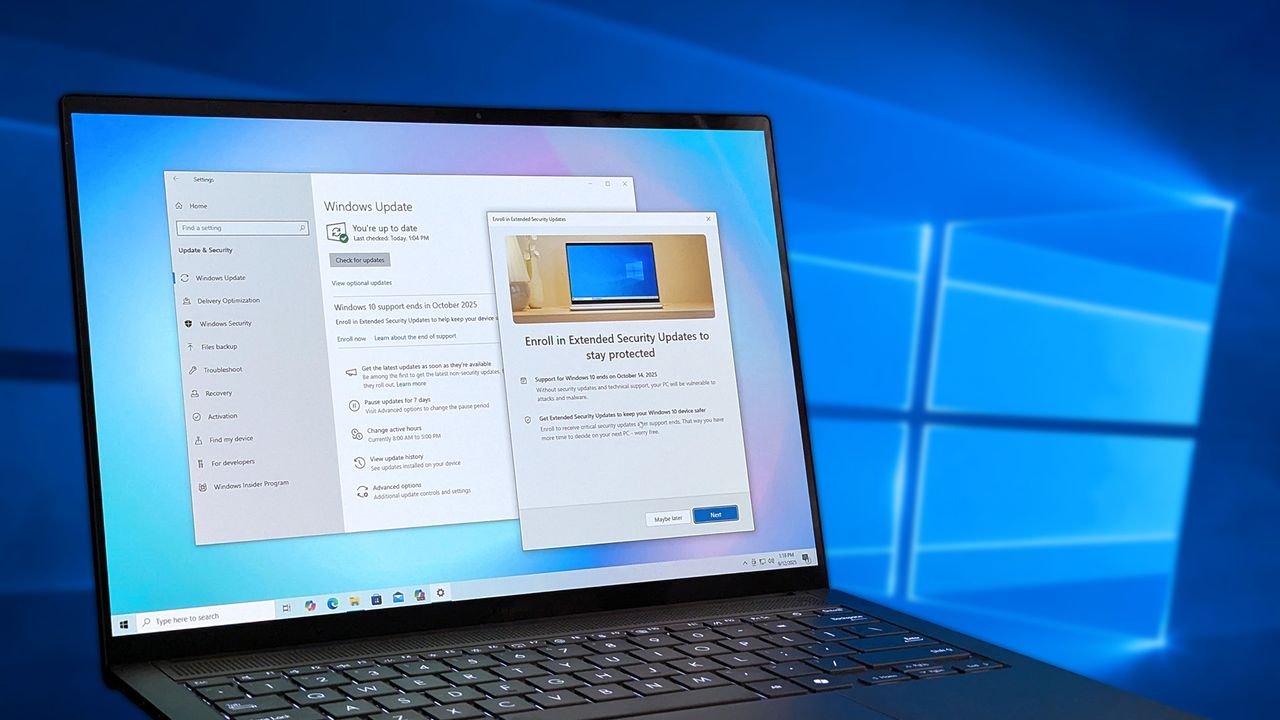
On October 14, 2025, Microsoft officially ended support for Windows 10, despite widespread pleas from millions of users still relying on the operating system. The move risked leaving nearly 400 million PCs without updates, effectively rendering them obsolete. However, Microsoft ultimately extended Windows 10’s lifespan through its Extended Security Updates (ESU) program, giving users continued access to critical patches beyond the end-of-support date.

The Restart Project group, which helped co-develop the "End of 10" toolkit to support Windows 10 users who can't upgrade to Windows 11, claimed that Microsoft's move to continue pushing security updates to Windows 10 beyond its end-of-support feels like a last-minute snooze button, which only acts as a band-aid on a bleeding system.

It's no secret that Microsoft has been pushing users to upgrade to Windows 11, but soaring RAM prices have driven hardware costs sky-high, making the transition even more difficult. This is on top of the operating system's strict hardware requirements and arguments of flawed design elements.

In France, critics even staged a symbolic “funeral” for Windows 10, protesting Microsoft’s push toward Windows 11 and what they see as planned obsolescence. Yet, as recent developments suggest, the company may finally be listening.

Microsoft quietly extended Windows 10's ESU program by another year. As a result, users enrolled in the program will continue receiving support until October 14, 2027. The extension is free for those who sign in to Windows 10 with a Microsoft account, ensuring critical updates remain available beyond the original cutoff.

What does the community think about Windows 10's extended lifeline?

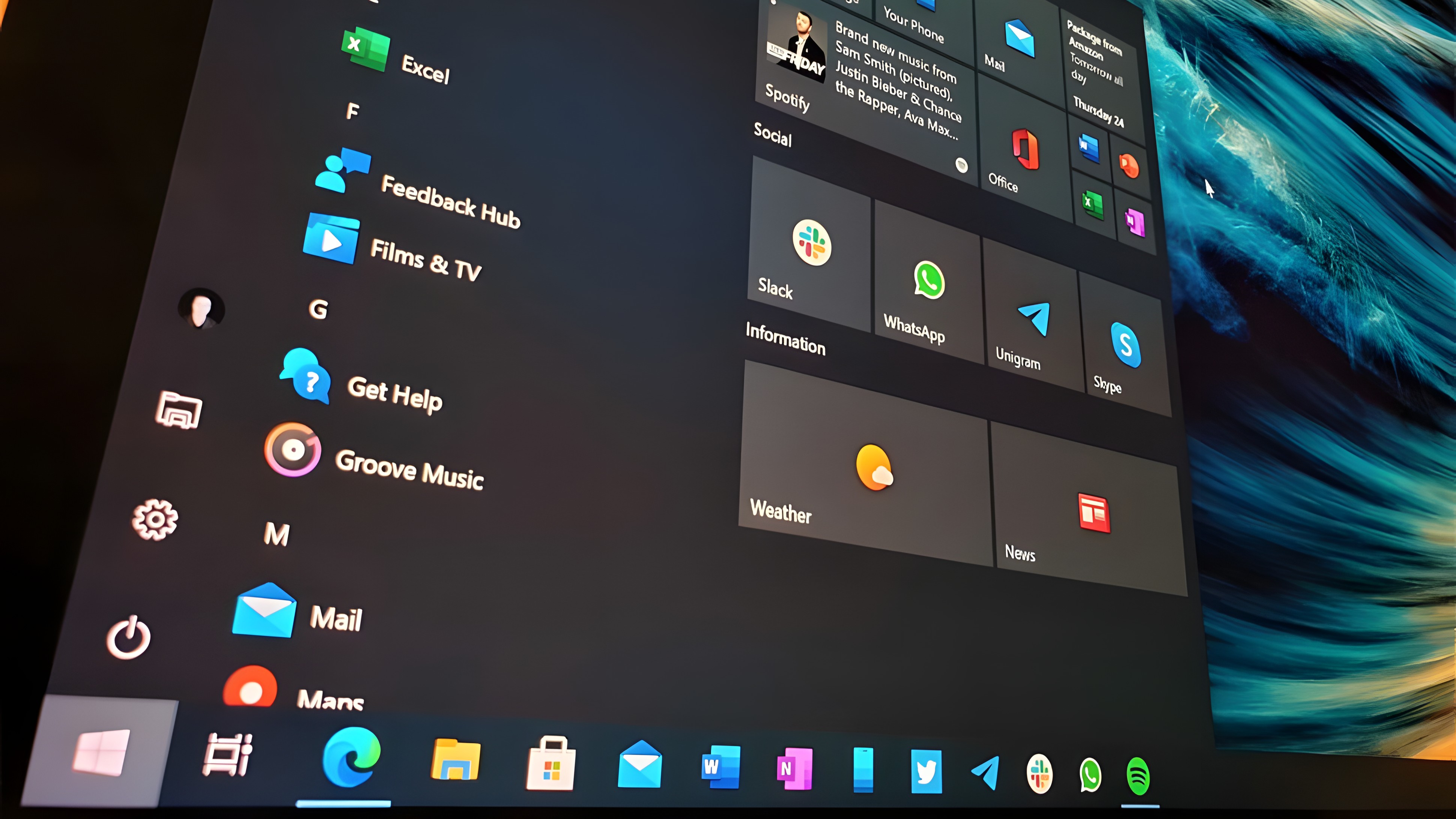
The Windows 10 Start Menu

(Image credit: Windows Central)

"People might start switching to Linux and using open source software for replacements if this RAM/storage issue doesn't get resolved in the next year," a Windows Central reader indicated.

Groups like End of 10 have been pushing users to transition to Linux following Windows 10's end-of-life. The campaign encourages steadfast Windows 10 users to ditch the Windows ecosystem entirely and switch to a version of Linux on any outdated devices, using a lack of ads and telemetry tracking as the key selling points to get users to switch camps.

"I said a year ago that this was going to happen, and I'll say it again, it's going to happen next year too," another reader added. "Windows 10 will be supported till October 2028. This has nothing to do with prices. This was planned since the beginning. But like last year, Microsoft did not say until late this was happening for free, so that people did not plan accordingly and as many as possible move to 11. Same this time. Same next year."

"Windows 10 to Windows 11 is like when you need new running shoes, but Nike discontinued the kind you’ve been buying new versions of for years, and the other kinds are fine but don’t measure up," another user commented in the r/technology subreddit on Reddit. "So you’re like “f*** it, I’ll just wear these until they fall apart.”

For context, a recent HP survey found that 3 out of 10 HP PCs are still running Windows 10. This was a slight decrease from September 2025, when HP and Dell indicated that up to 50% of PCs were still running on the operating system, prompting the PC makers to suggest that users won't upgrade to Windows 11 overnight, and the process could even roll over into 2026.

Some even claimed that Microsoft's decision to extend Windows 10's support beyond 2026 is an outright admission that it's better than Windows 11. "So are they finally admitting that Windows 11 isn't good enough almost 5 years later?"

To that end, it remains unclear how Microsoft extending support for Windows 10 via its ESU program to 2027 will impact Windows 11's market share. The operating system had just started gaining some momentum and even surpassed Windows 10 as the most dominant desktop operating system in the world in July, 2025.

In the interim, you can take advantage of Microsoft's extended support for Windows 11 by enrolling in the ESU program for free by signing in with a Microsoft account, or pay for access via 1,000 Microsoft reward points or $30.

Click to join us on r/WindowsCentral

Join us on Reddit at r/WindowsCentral to share your insights and discuss our latest news, reviews, and more.

Former Microsoft Executive Vice President Terry Myerson stands in front of a presentation about Windows 10

Former Microsoft Executive Vice President Terry Myerson stands in front of a presentation about Windows 10

Windows 11’s huge July 14 update is loaded with new features — these are the 13 that matter most

Microsoft plans to begin the Windows 11 July 2026 Security Update on Tuesday, July 14, 2026. In this seventh month of the year, the company is rolling out several new features and improvements for existing features. In addition, this update is expected to deliver a number of bug fixes.

In this new quality update, Microsoft will be introducing brand new features, including the Point-in-time Restore recovery feature and the Screen tint accessibility feature.

This release also introduces the new Windows Update changes that allow users to pause updates indefinitely. The Widgets feature receives a few changes to make the experience quieter and less distracting.

Furthermore, in this release, users will also find changes to the Windows Magnifier, a new default for installing printers using Windows Ready Print support, as well as improvements to the Settings app, File Explorer, Bluetooth, network virtualization, touchpad, and much more.

In this guide, I'll highlight the most significant changes in the July 2026 Security Update for Windows 11 versions 25H2 and 24H2, since both are identical.

Windows 11's new features arriving in July

As per usual, the company uses the Controlled Feature Rollout (CFR) technology to roll out new improvements gradually, so it may take some time before you see them.

Point-in-time Restore recovery feature

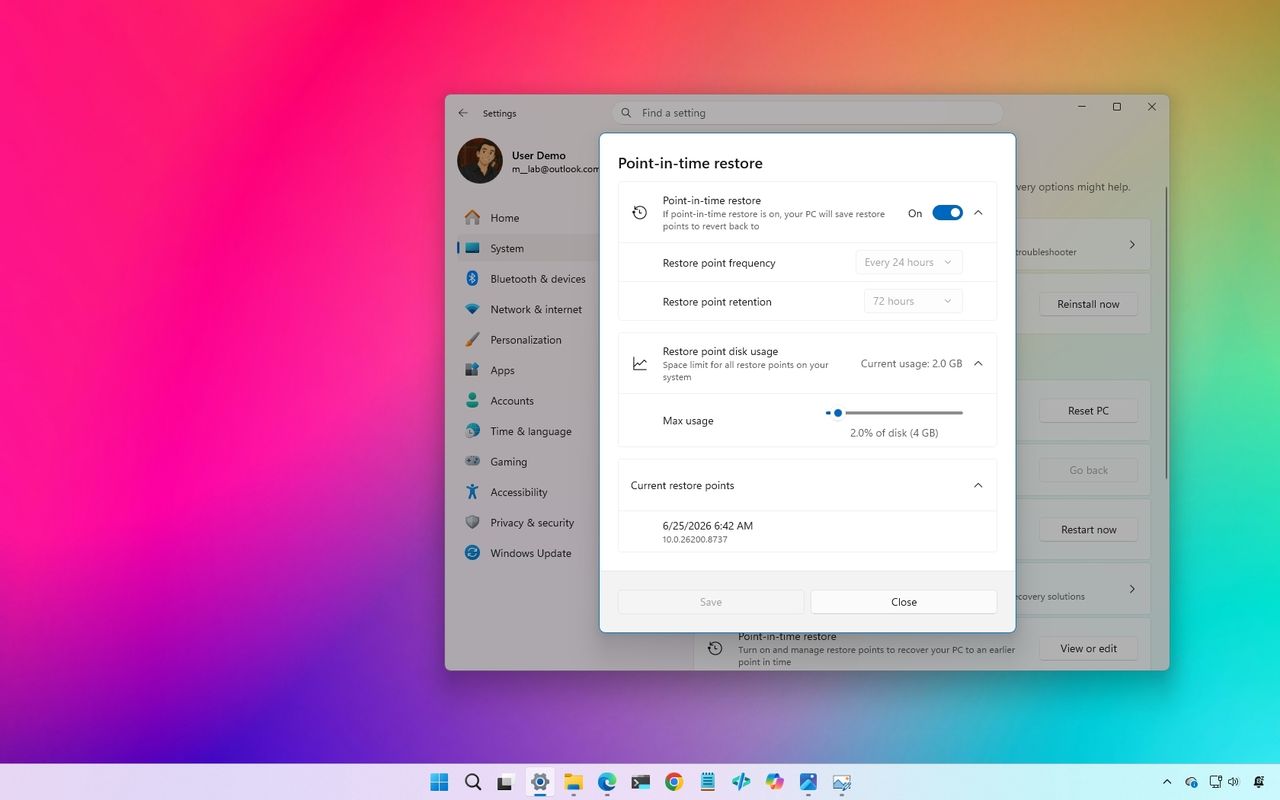
Starting with the July 2026 Security Update, Microsoft is introducing Point-in-time Restore, a new recovery feature designed to quickly roll back a system to a previous good working state.

The feature works automatically and creates restore points that include settings, files, and apps using the Volume Shadow Copy Service (VSS), allowing you to recover your computer when an issue arises.

Point-in-time Restore comes enabled by default in the Home and Pro editions of the operating system. However, the system must have at least 200GB of storage.

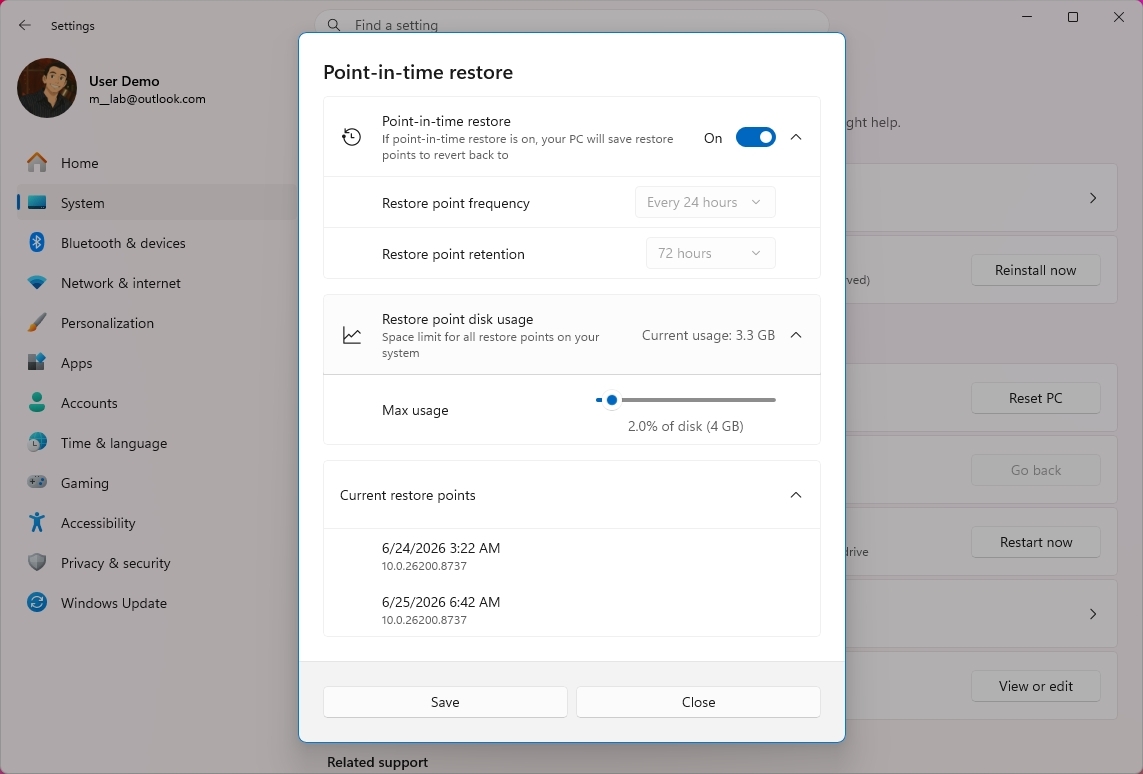
You can always control the feature in Settings > System > Recovery by using the "View or edit" button. On the page, you can turn the recovery feature on or off, configure the restore point frequency and retention, and decide how much storage the feature uses.

Windows 11 Settings with Point-in-time Restore configuration.

(Image credit: Mauro Huculak)

At the bottom, the feature will also notice the most recent restore points.

If something is working correctly, you can always access the feature from the Windows Recovery Environment (WinRE), and from the "Point-in-time Restore" page, select the restore point to recover your device.

Screen tint accessibility feature

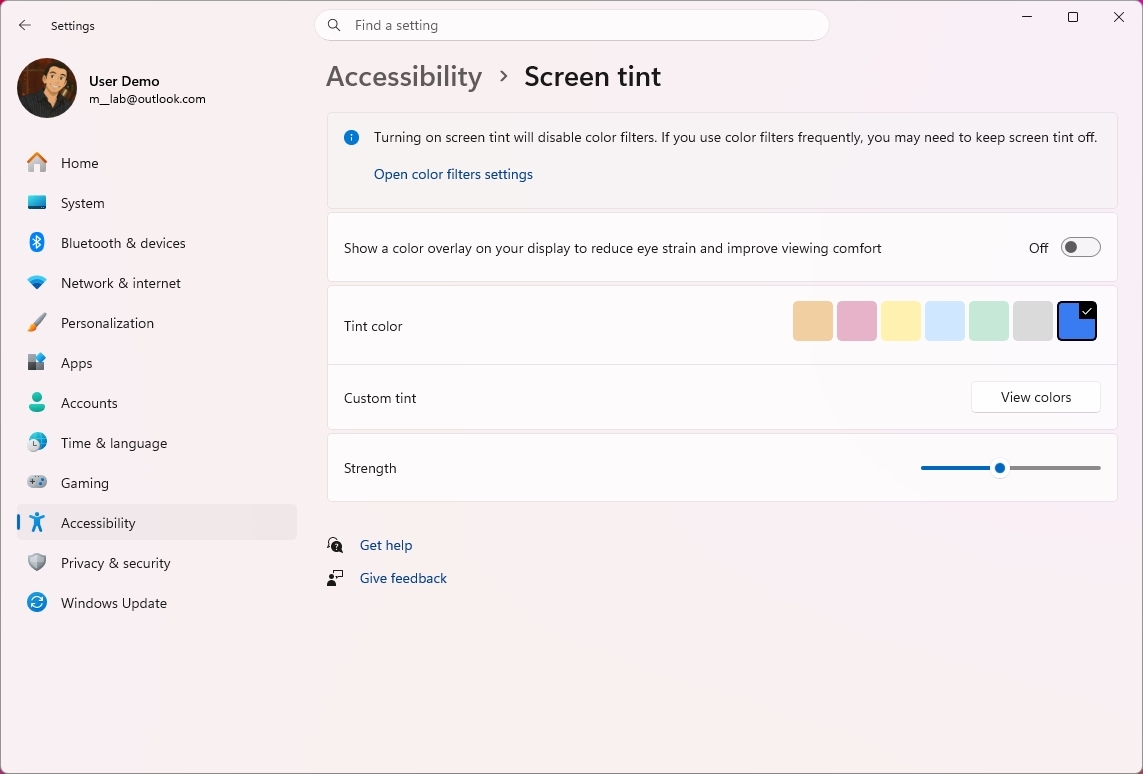
In this update, the company is also rolling out Screen tint. This accessibility feature applies an overlay color on the screen designed to reduce eye strain and improve viewing comfort.

The feature is available in Settings > Accessibility > Screen tint. Once enabled, you can choose from one of the six preset color overlays or create a custom color.

Windows 11 Settings app showing the Screen tint configuration options.
(Image credit: Mauro Huculak)

In addition, there is a slider to control the overlay strength.

While the Screen tint feature seems similar to the Night Light feature, they are different, and they can work alongside each other. However, this feature automatically turns off Color filters and vice versa.

Windows Update new controls

Windows Update is getting a major upgrade. In this release, Microsoft is adding the ability to pause updates indefinitely, which seems to be the closest we'll get to completely turning off automatic updates.

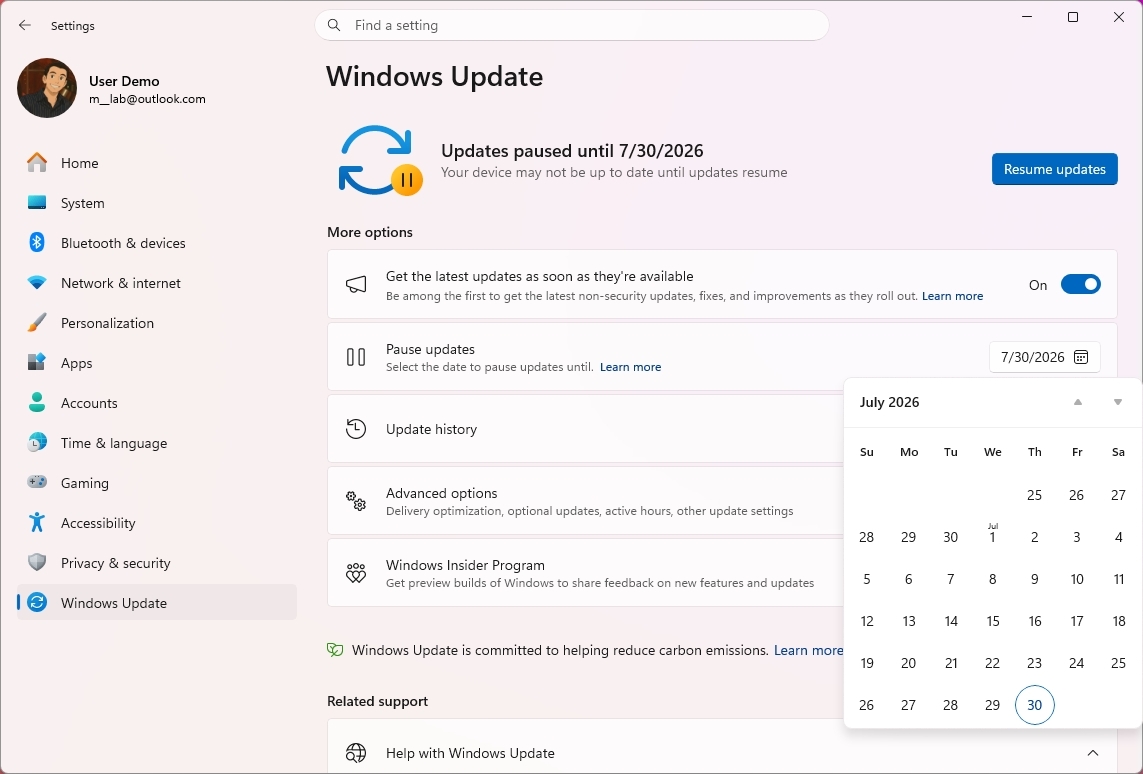
As part of the changes, the "Pause updates" option now includes a calendar view that lets you pause automatic updates for up to 35 days. However, you can re-pause updates as many times as you want.

Windows 11 Settings showing the Windows Update settings page with the new calendar-based pause feature.

(Image credit: Mauro Huculak)

The only caveat is that if you want to postpone updates for more than 35 days, you'll need to manually pause them again. Otherwise, the system will download and install updates automatically as soon as the scheduled expiration expires.

Widgets with less distracting defaults

The company is trying to make the experience quieter and less distracting.

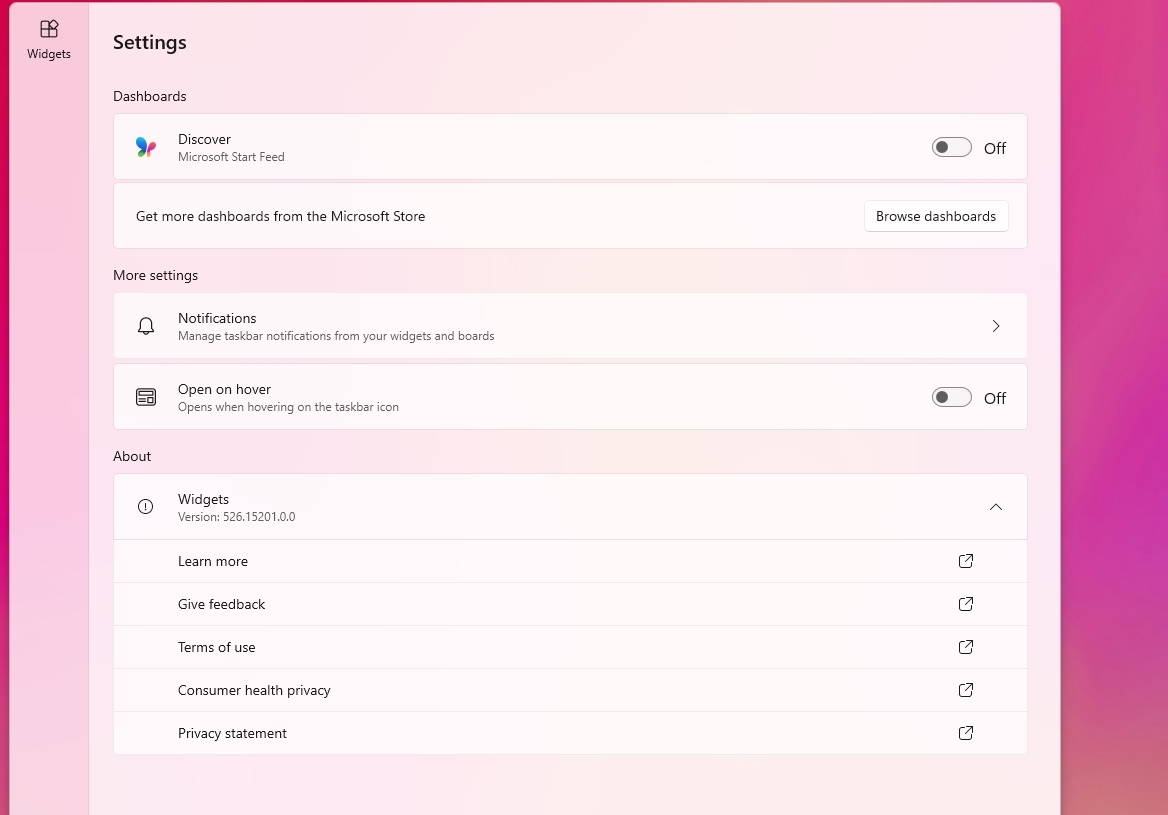
Windows 11 desktop with the Widgets board open in the settings section.

(Image credit: Mauro Huculak)

Widgets now open directly to the dashboard on first use, with hover activation disabled and notifications and Taskbar badges minimized by default.

The experience also offers more control over notifications and personalization settings, allowing users to customize Widgets from the Settings menu.

The dashboard icons can display the number of alerts, while badges clear automatically after leaving the dashboard. Microsoft notes that some settings will continue to adapt based on usage patterns to help limit interruptions.
This update also includes improvements to reliability, responsiveness, and overall visual quality across the Widgets experience.

Windows Magnifier improvements

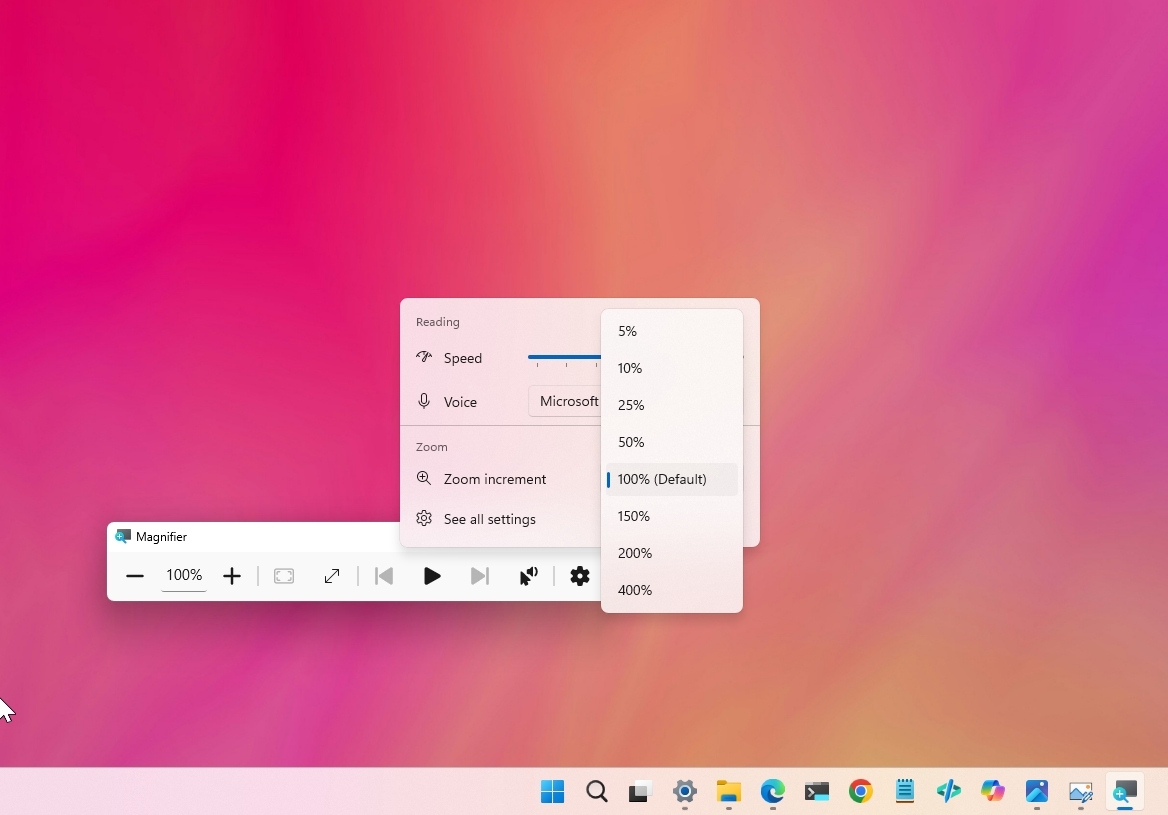
In a continued effort to improve accessibility features, the software giant is also updating the Magnifier with more granular controls, allowing you to enter exact percentage values rather than having to use the zoom buttons to increase or decrease the zoom level.

Windows 11 desktop with the Magnifier UI with new changes.
(Image credit: Mauro Huculak)

Also, in the settings flyout, the zoom adjustment now allows users to set increments up to 400 percent.
Printer default changes

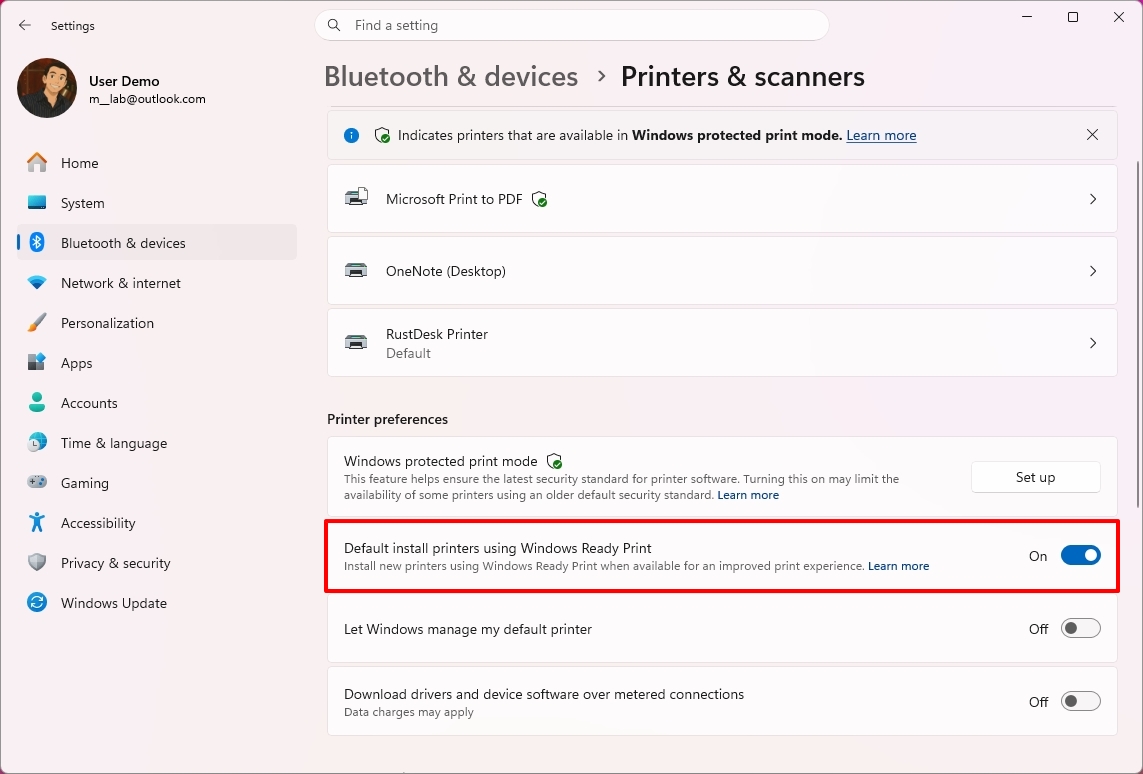
Starting with the quality update for July 2026, the operating system will install printers by default using the Internet Printing Protocol (IPP), provided the device is supported.

Windows 11 Settings showing printer settings and highlighting the

(Image credit: Mauro Huculak)

If you prefer to revert this configuration, open Settings > Bluetooth & devices > Printers & scanners, and turn off the "Default install printer using Windows Ready Print" option.

Location settings improvements

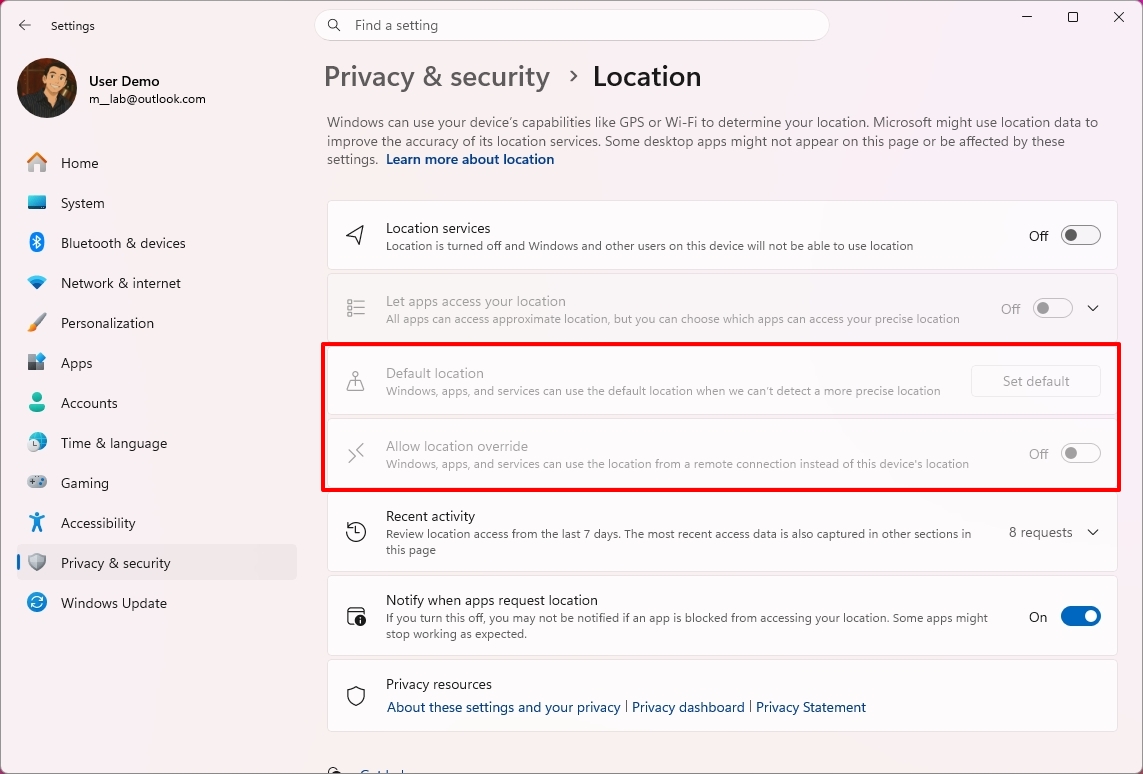
Microsoft is making location settings easier to understand in Settings > Privacy & Security > Location.

Windows 11 Settings in the Location section highlighting new default behavior when the feature is disabled.

(Image credit: Mauro Huculak)

When location services are turned off, options such as "Default location" and "Allow location override" no longer appear active, since apps and services cannot access location data.

As a result, these settings will now be greyed out until location services are enabled, helping clarify when the options are available and reducing confusion.

File Explorer improvements

After installing this quality update, you'll notice that File Explorer will launch faster thanks to new speed improvements.

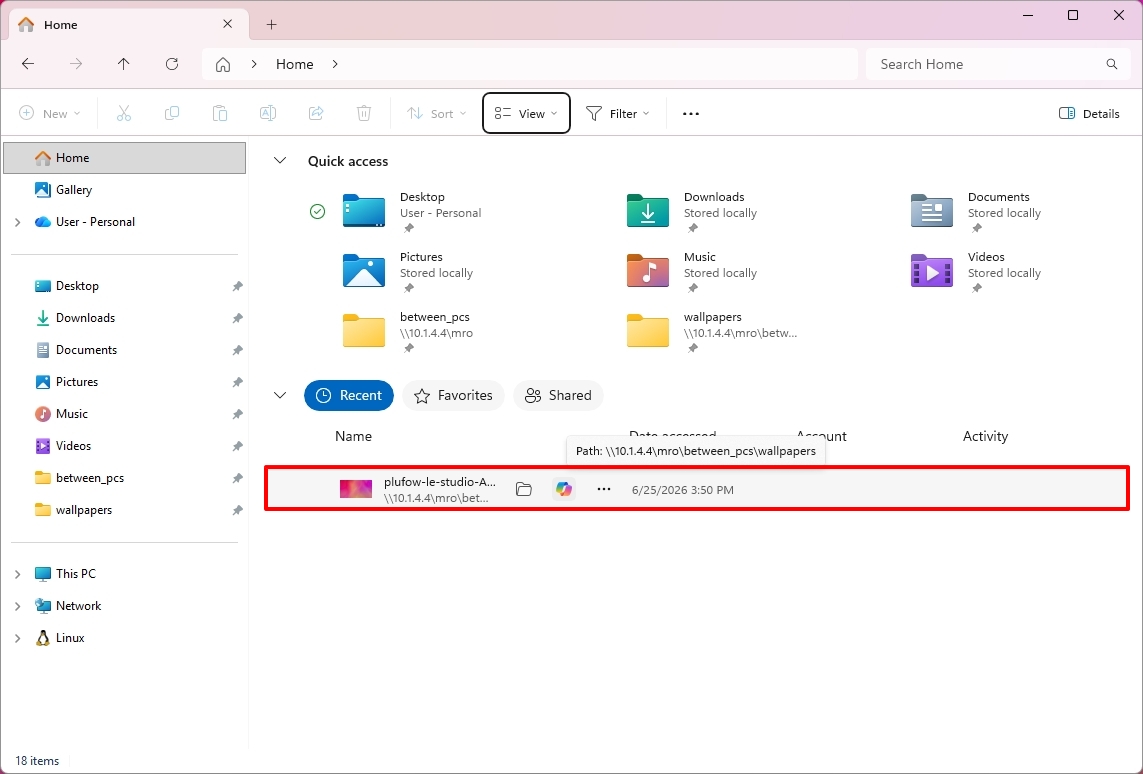
Also, on the Home page, when hovering over files, users who are logged in with a work or school account should now see options like "Open file location" and "Ask Copilot."

File Explorer in Home showing hover buttons for file location and Copilot.

(Image credit: Mauro Huculak)

In addition, the address bar now supports paths with double backslashes and quotation marks, making it easier to paste or type folder paths from different sources.

Continuing with the improvements to the address bar, the experience now closes more reliably after selecting an option. Finally, File Explorer improves its ability to rename files.

Bluetooth changes

Microsoft is rolling out a series of Bluetooth improvements focused on reliability, compatibility, and audio performance.

For example, Windows 11 now keeps the microphone mute status synchronized between the system audio controls and Bluetooth headphones that include dedicated mute buttons or indicators, providing a more consistent experience during calls.

The update also improves compatibility with certain audio accessories. For instance, AirPods should enter pairing mode faster, and Beats Studio Pro headphones should offer more reliable microphone performance.

Voice calls on devices that support the Hands-Free Profile (HFP) should be more reliable. LE Audio accessories can begin playing audio faster while the microphone is active, and Windows 11 stability has been improved for some systems affected by Bluetooth-related driver issues.

The operating system will no longer incorrectly display a "Remove failed" message when a Bluetooth device cannot be removed because the Bluetooth radio is unavailable or has changed since the device was paired.

In addition, the "Bluetooth & devices" settings page has been updated to provide a more stable and consistent experience.

Connection reliability has also been enhanced. Classic Bluetooth audio devices can reconnect more quickly after a computer resumes from hibernation. At the same time, LE Audio accessories should maintain more reliable connections when switching between devices and recover more smoothly from temporary disconnections.

Phone Link improvements

Microsoft is improving how phone calls are handled between Windows 11 and a connected smartphone through Phone Link.

When you place a call from your paired phone, the audio will stay on the phone while it rings, then switch to the computer only after you answer the call on Windows 11.

This change helps prevent audio from switching between devices unexpectedly before the call connects.

The update also improves the "Do Not Disturb" experience. When Do Not Disturb is enabled, incoming calls from a connected phone will no longer ring through the computer, reducing interruptions while you're working.

Voice Typing and Voice Access

As you speak, Voice Typing and Voice Access can now refine the text in real time. In addition, the feature improves its capability to adapt to background noise. However, this is only available for Copilot+ PCs.

Furthermore, Voice Access and Voice Typing are now available in German, Spanish, and French.

Networking changes

The software giant is introducing several networking improvements focused on reliability, performance, and virtualization.

For virtualized environments, Confidential Virtual Machines (CVMs) now use SR-IOV hardware acceleration by default to improve network performance. At the same time, a networking configuration issue affecting nested Hyper-V setups has been fixed to ensure virtual machines are provisioned correctly.

The update also enhances the reliability of the networking stack. It reduces some Wi-Fi-related blue screen errors, improves cellular (WWAN) connectivity, and adds better support for IPv6-based VPN connections.

In addition, Microsoft has improved compatibility with certain third-party VPN solutions and server configurations that use SR-IOV networking. Network adapter settings and bindings are now also preserved during operating system upgrades, helping prevent networking configurations from being reset after an operating system update.

Touchpad changes

If you use a compatible touchpad, there's a touchpad customization option that lets you adjust the size of the bottom-right right-click area.

In Settings > Bluetooth & devices > Touchpad, you can choose between "Default," "Small," "Medium," or "Large" to control how much of the touchpad responds to a one-finger right-click.

This feature is available only on devices with a pressable touchpad surface. If your computer manufacturer provides touchpad customization through its own software, the system will display a "Custom" option to reflect those settings.

Windows Central's Take

I find it interesting that one of the biggest additions in this update is a feature designed to help when Windows 11 breaks rather than when everything is working perfectly.

Microsoft has spent the last few years talking a lot about AI, Copilot, and new experiences, but Point-in-time Restore addresses a much more fundamental problem. Every user eventually runs into a bad update, problematic driver, or software conflict. When that happens, recovery tools suddenly become far more important than whatever new feature was added to the Start menu.

The Windows Update changes also stand out to me because they give users a little more breathing room. The software giant clearly isn't interested in letting people permanently turn off updates, but repeatedly extending the pause period feels like a practical compromise between security and user control.

As for the rest of the update, I see it as evidence that Microsoft is continuing to chip away at long-standing annoyances. Faster File Explorer performance, Bluetooth reliability improvements, and less intrusive Widgets aren't headline-grabbing changes. However, they're often the updates that have the biggest impact on how the system feels after months of daily use.

Which feature in the July 2026 update are you most looking forward to trying on Windows 11? Let me know in the comments.

More resources

Explore more in-depth how-to guides, troubleshooting advice, and essential tips to get the most out of Windows 11 and 10. Start browsing here:

Click to join us on r/WindowsCentral

Join us on Reddit at r/WindowsCentral to share your insights and discuss our latest news, reviews, and more.

Windows 11 desktop showing the Point-in-time Restore feature settings.

Windows 11 desktop showing the Point-in-time Restore feature settings.

Forget PowerToys, Windows 11 needs this feature immediately

Microsoft needs to copy a new feature that makes it easier to multitask on Windows 11. But rather than Sherlocking a third-party app, Microsoft just needs to copy a concept proposed for its own app, PowerToys.

Every once in a while a feature gets added to PowerToys that makes me wonder "why isn't this part of Windows?" FancyZones immediately comes to mind, and Microsoft seems to agree since improved snapping in Windows 11 takes inspiration from that feature.

PowerToys may have another winner on its hands in AltWindowCycle, though I think a new name may be needed.

The utility allows you to switch between windows with a keyboard shortcut. It's similar to Alt + Tab, but it works within a single app. Clint Rutkas explained the tool in a GitHub pull request:

"Introduces a new utility: AltWindowCycle to quickly switch between windows from the same process using Alt + `. It works like Alt + Tab, but scoped to the app you’re already in. Perfect for juggling multiple browser windows, terminals, or editor instances."

AltWindowCycle is still in its early stages. If it is finished and made a part of PowerToys, I hope it also makes its way to Windows 11.

If it does become part of Windows 11, AltWindowCycle would help Microsoft's operating system catch up to macOS and some Linux distros, which use either Alt + \` or Cmd + ` to cycle through windows of the same app, albeit a bit differently.

Many PowerToys features are niche and would be considered bloat by non-power users if included with Windows 11. But a small shortcut that makes multitasking easier would be a natural addition to Windows 11, especially since AltWindowCycle works similarly to the well-known Alt + Tab shortcut.

This collection of utilities includes a large library of features to enhance the Windows experience. PowerToys is designed with power users in mind, but it has handy features for people who just use their PC for everyday computing too.

Free at GitHub | Free at Microsoft Store

Click to join us on r/WindowsCentral

Join us on Reddit at r/WindowsCentral to share your insights and discuss our latest news, reviews, and more.

Windows 11 Start Logo

Windows 11 Start Logo

Bill Gates says AI may replace a lot of jobs, but it will never replace athletes because no one wants to watch computers play

Over the past few years, we've seen generative AI cement its footprint in the workplace and even take over redundant, repetitive tasks entirely. Last year, Anthropic CEO Dario Amodei claimed that AI was on the verge of slashing up to 50% of entry-level white-collar jobs, making it harder for Gen Z to enter the job market.

Even Microsoft's AI CEO, Mustafa Suleyman, recently cleared up the intent of his statement that AI would eliminate white‑collar jobs in less than 18 months. The executive indicated that the statement was blown out of proportion, further clarifying that he meant AI would augment repetitive, mundane tasks — not replace humans.

In 2025, Microsoft co-founder Bill Gates indicated that AI would replace humans for most things. However, the philanthropic billionaire claimed that it'd be mostly up to humans to decide how they interact with the next-gen technology.

The executive previously indicated that biologists, energy workers, and coders would survive the AI revolution, citing that their complex nature constantly requires human intervention.

Incidentally, Gates may have just identified a fourth profession that could be safe from AI replacementathletes. During an appearance on The Tonight Show with Jimmy Fallon, he suggested that while AI might take over many human tasks, no one would want to watch computers playing baseball (via LADbible Group).

With that in mind, it’s safe to say we’ll continue to savor the moments when our favorite players like Arsenal’s right winger Bukayo Saka grace the pitch with their talent and keep us entertained, even now during the World Cup season.

As AI gains broad adoption and becomes more prevalent, it will undoubtedly reshape how we work or even redefine what the term means. Last year, a study by Microsoft Research highlighted 40 job roles that are at risk of extinction in the age of AI, including customer service representatives, interpreters, technical writers, editors, web developers, and more.

Click to join us on r/WindowsCentral

Join us on Reddit at r/WindowsCentral to share your insights and discuss our latest news, reviews, and more.

Microsoft co-founder Bill Gates speaks to the press.

Microsoft co-founder Bill Gates speaks to the press.

Microsoft quietly extends Windows 10's extra security updates program for free: Users can now stay on Windows 10 until October 2027 securely

Microsoft has quietly announced that Windows 10's extended support updates program will continue for an extra year, now until October 2027 for free if you sign-in to Windows 10 with a Microsoft account.

Originally, Windows 10's extended support program was only supposed to last one year, until October 2026 for consumers. However, a new support page published by Microsoft today has confirmed that the Windows 10 ESU program will now last until October 2027 instead.

"Windows 10 support has ended. You can enroll in ESU any time until the programme ends on 12 October, 2027. If you’re already enrolled, your coverage will automatically continue through that date—no action needed," says the support page.

All Windows 10 users that are already enrolled in the ESU program will get this extended year of updates automatically. You can enroll in the program for free by signing in with a Microsoft account, or pay for access via 1,000 Microsoft reward points or $30 USD.

Microsoft has likely extended support for Windows 10 by an extra year due to the ongoing RAM crisis, which has pushed new PC prices through the roof making them difficult to justify financially, especially if you already have a working Windows 10 PC.

There are still hundreds of millions of PCs running Windows 10, and with extended support originally ending this October, many people would have been without the latest security patches keeping their devices secure.

The Windows 10 ESU program is vital to ensuring a PC that is connected to the internet is secure. Microsoft is still updating Windows 10 with security patches through the ESU program, and not being enrolled leaves your device open to attackers that might be trying to exploit vulnerabilities in the Windows 10 OS.

The good news is if you're already enrolled in the program, there's nothing you need to do to remain supported until October 2027. Your PC will keep getting security updates automatically until that date.

Click to join us on r/WindowsCentral

Join us on Reddit at r/WindowsCentral to share your insights and discuss our latest news, reviews, and more.

Windows 10 ESU program displayed on an ASUS Zenbook laptop screen

Windows 10 ESU program displayed on an ASUS Zenbook laptop screen

❌