Samsung is reportedly developing a 17-inch foldable tablet that could shrink to 8 inches. Here's what the leak suggests about its design and challenges.
The post Samsung’s Rumored 17-Inch Foldable Tablet: What We Know So Far appeared first on TechRepublic.
Samsung is reportedly developing a 17-inch foldable tablet that could shrink to 8 inches. Here's what the leak suggests about its design and challenges.
TrendForce expects Apple to ship up to 1.5 million OLED touchscreen MacBook Pros in 2027 as premium pricing and Samsung Display's supply role shape adoption.
The post Apple’s $2,899 OLED MacBook Pro Could Ship 1.5 Million Units in 2027 appeared first on TechRepublic.
TrendForce expects Apple to ship up to 1.5 million OLED touchscreen MacBook Pros in 2027 as premium pricing and Samsung Display's supply role shape adoption.
Motorola's Signature 27 packs a 200MP camera and a claimed 12,000-nit OLED display. Here's what the latest reveal confirms ahead of its launch.
The post Motorola Signature 27 Cheat Sheet: 200MP Camera and 12,000-Nit Display Revealed appeared first on TechRepublic.
Google confirms a Pixel Watch battery drain issue after owners report severe power loss. Here's which models users mention and what to do while waiting for a fix.
The post Google Confirms Pixel Watch Battery Drain Issue, Promises Fix appeared first on TechRepublic.
Google confirms a Pixel Watch battery drain issue after owners report severe power loss. Here's which models users mention and what to do while waiting for a fix.
Apple's rumored $1,000 tabletop robot could launch in 2027 with a swiveling display and Siri AI, but software delays may push its release into 2028.
The post Apple’s $1,000 Tabletop Robot Could Arrive in 2027 appeared first on TechRepublic.
November is finally here, which means it's time for an onslaught of early Black Friday discounts to give your favorite or most desirable laptops a much-needed price cut from all the rising costs caused by AI lately.One of these lucky devices is the Microsoft Surface Laptop 8, which is currently on sale for $1,249.99 at Amazon (was $1,699.99). This beauty is Microsoft's latest flagship laptop, equipped with a state-of-the-art Snapdragon X2 Elite CPU for improved p
November is finally here, which means it's time for an onslaught of early Black Friday discounts to give your favorite or most desirable laptops a much-needed price cut from all the rising costs caused by AI lately.
One of these lucky devices is the Microsoft Surface Laptop 8, which is currently on sale for $1,249.99 at Amazon (was $1,699.99).
This beauty is Microsoft's latest flagship laptop, equipped with a state-of-the-art Snapdragon X2 Elite CPU for improved performance, all-day battery life, and an exclusive new advanced haptics feature to give you improved feedback, just to name a few features.
The Surface Laptop 8 will blaze through productivity workloads with its Snapdragon X2 Elite CPU, 16GB RAM, and advanced haptics feedback.View Deal
Why buy this laptop?
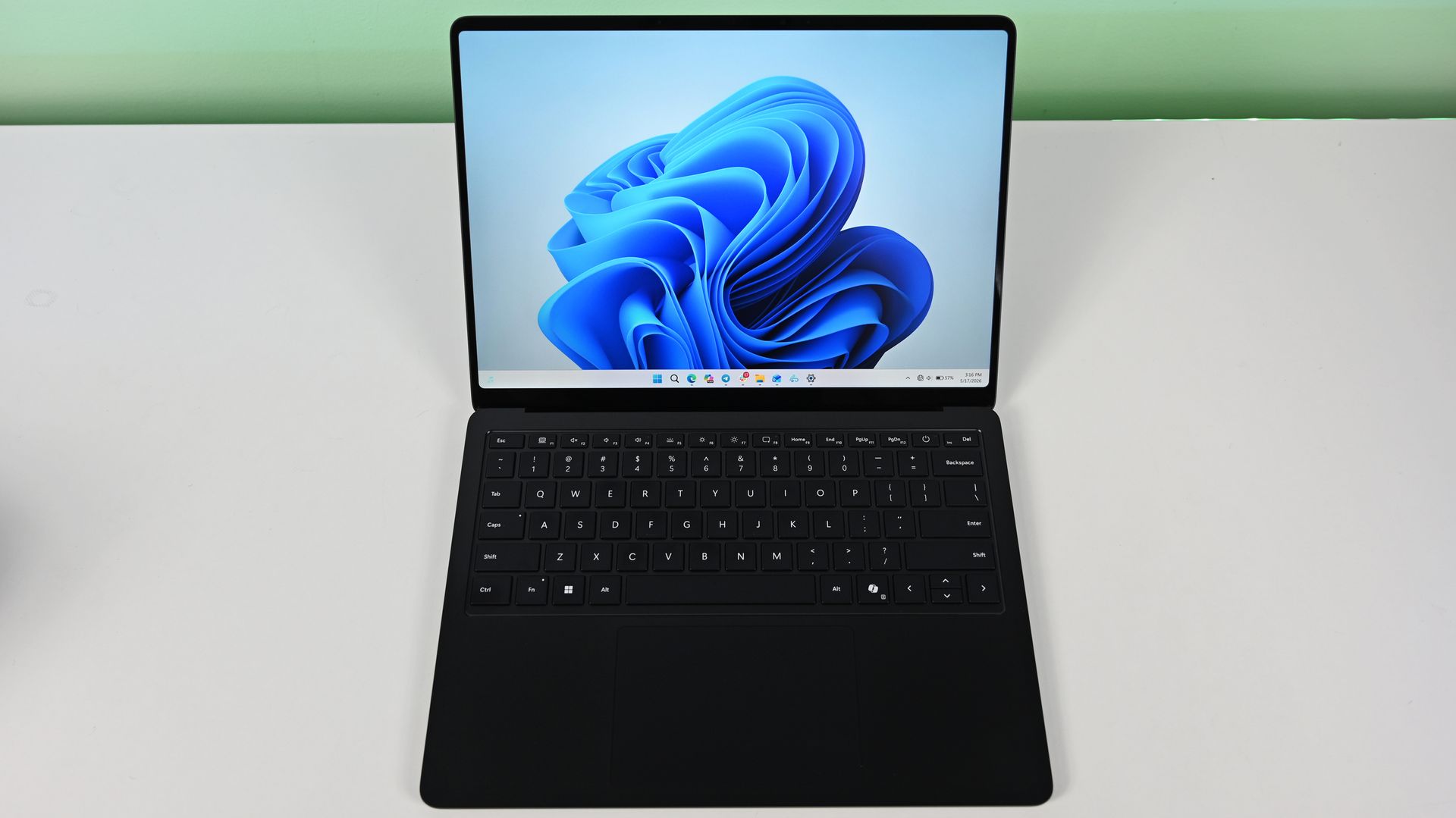
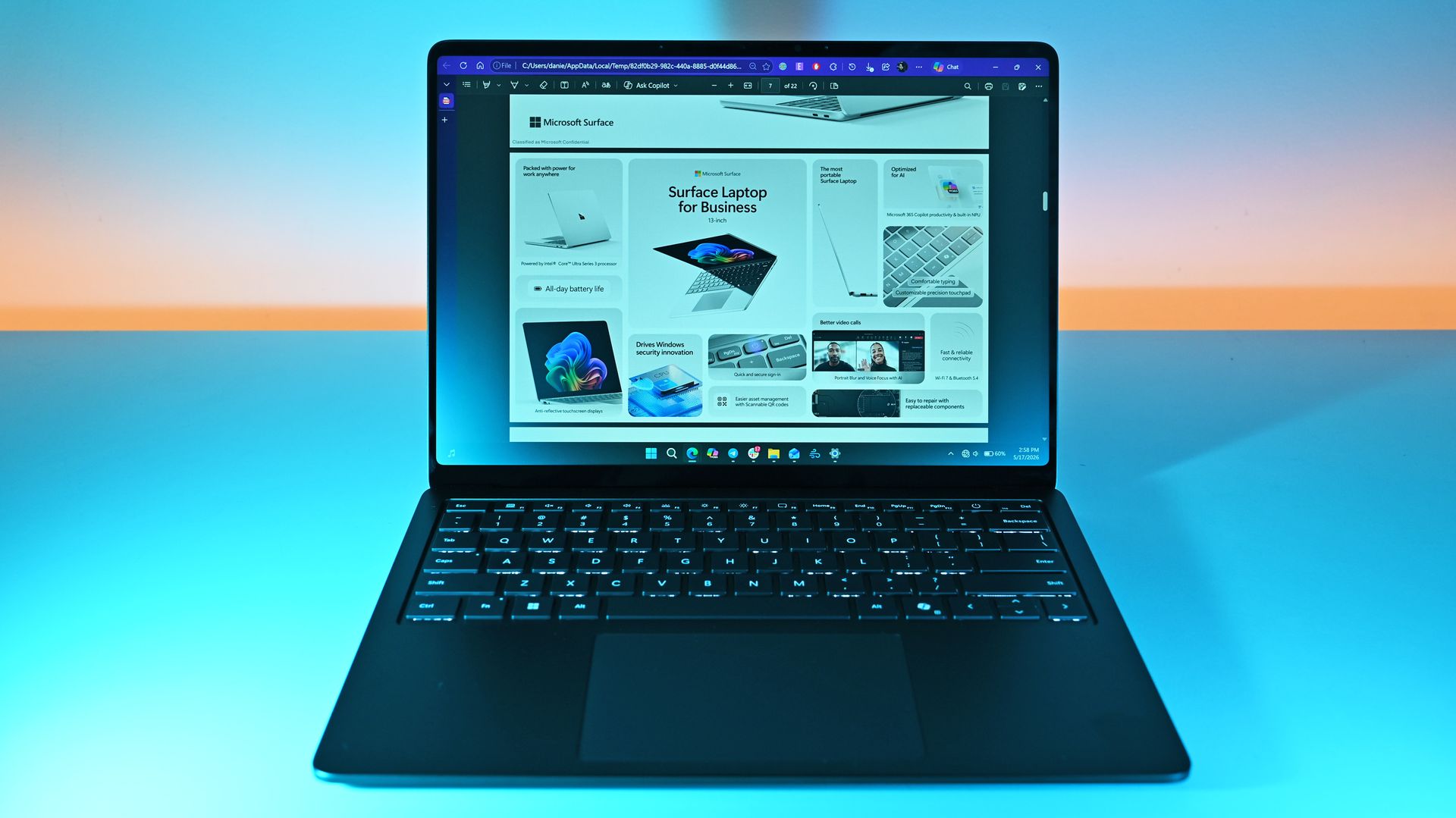
The Microsoft Surface 8 in action. (Image credit: Daniel Rubino)
The Microsoft Surface Laptop 8 is a highly dependable, fast, and durable laptop for IT users and students. This is because it comes equipped with a Snapdragon X2 Elite CPU paired with a turbocharged NPU with 80 TOPS, boosting the laptop's performance significantly when tackling mountains of productivity workloads while multitasking.
It also comes with a 13.8-inch LCD touchscreen display with 600 nits of brightness to fend off annoying daylight glare, Wi-Fi 7 compatibility for strong and stable wireless internet connections, and a massive battery life of 20 hours on a single charge.
On top of that, the Microsoft Surface Laptop 8 features an advanced haptic feedback system, which sends subtle vibrations when using its keyboard, stylus pen, or mouse when performing specific tasks like dragging files in File Explorer or rearranging app windows.
It's a small but enjoyable addition that makes this laptop more polished and responsive to use. Even our Editor-in-Chief Daniel Rubino praised this feature during his Surface Laptop 8 (Business Model) review when he said, "The new advanced haptic touchpad is a joy to use. It provides subtle tactile cues that confirm your actions."
Can I upgrade its RAM and SSD?
No, you can't upgrade the Microsoft Surface 8 laptop's RAM because it's permanently soldered to the motherboard. However, you can swap the SSD for a 1TB or 2TB unit if the default 512GB isn't enough.
Can I use it for gaming?
No, the Microsoft Surface 8 laptop isn't a good laptop for gaming because its integrated graphics and ARM architecture aren't enough to run graphically demanding games or games built with heavy anti-cheat systems without chugging its performance.
Should I wait for Black Friday for a better deal?
It depends on whether you're desperate for a new casual/workhorse laptop and can't wait for a better deal, or if you're willing to wait until Black Friday for a greater discount. Either way, just know that it's a good price for its specs, especially since this is the lowest price drop the Microsoft Surface 8 laptop has had yet (according to CamelCamelCamel).
Join us on Reddit at r/WindowsCentral to share your insights and discuss our latest news, reviews, and more.
Xiaomi's POCO X8 vs. X8s puts battery life against portability and cameras, but prices and availability differ between Vietnam and the Philippines.
The post Xiaomi’s POCO X8 vs X8s: More Battery or Better Cameras for Your Money? appeared first on TechRepublic.
The Steam Deck is quite the success story, at least for Valve, and having used one (and bought one for my sister last Christmas), I can totally see why. It genuinely is a great bit of kit; granted, the price hike is a shame, but that's just how the industry is right now. Despite its success, I have always preferred Xbox, and despite my issues with the Xbox Ally, I still prefer it over the Steam Deck.One thing the Steam Deck definitely does better, though, is the
The Steam Deck is quite the success story, at least for Valve, and having used one (and bought one for my sister last Christmas), I can totally see why. It genuinely is a great bit of kit; granted, the price hike is a shame, but that's just how the industry is right now. Despite its success, I have always preferred Xbox, and despite my issues with the Xbox Ally, I still prefer it over the Steam Deck.
One thing the Steam Deck definitely does better, though, is the user experience. Jez Corden recently spoke about how the Xbox Ally and Ally X were in his re-review, and pointed out how Windows 11 still needed work for handhelds.
I personally opt for other launchers over the Xbox App, like Winhanced, but what I have always truly wanted was the Xbox Series dashboard, or heck, even the old Metro dashboard, just on a handheld. Well, we got one of those things on the Steam Deck thanks to an all-new plugin by kromossomom.
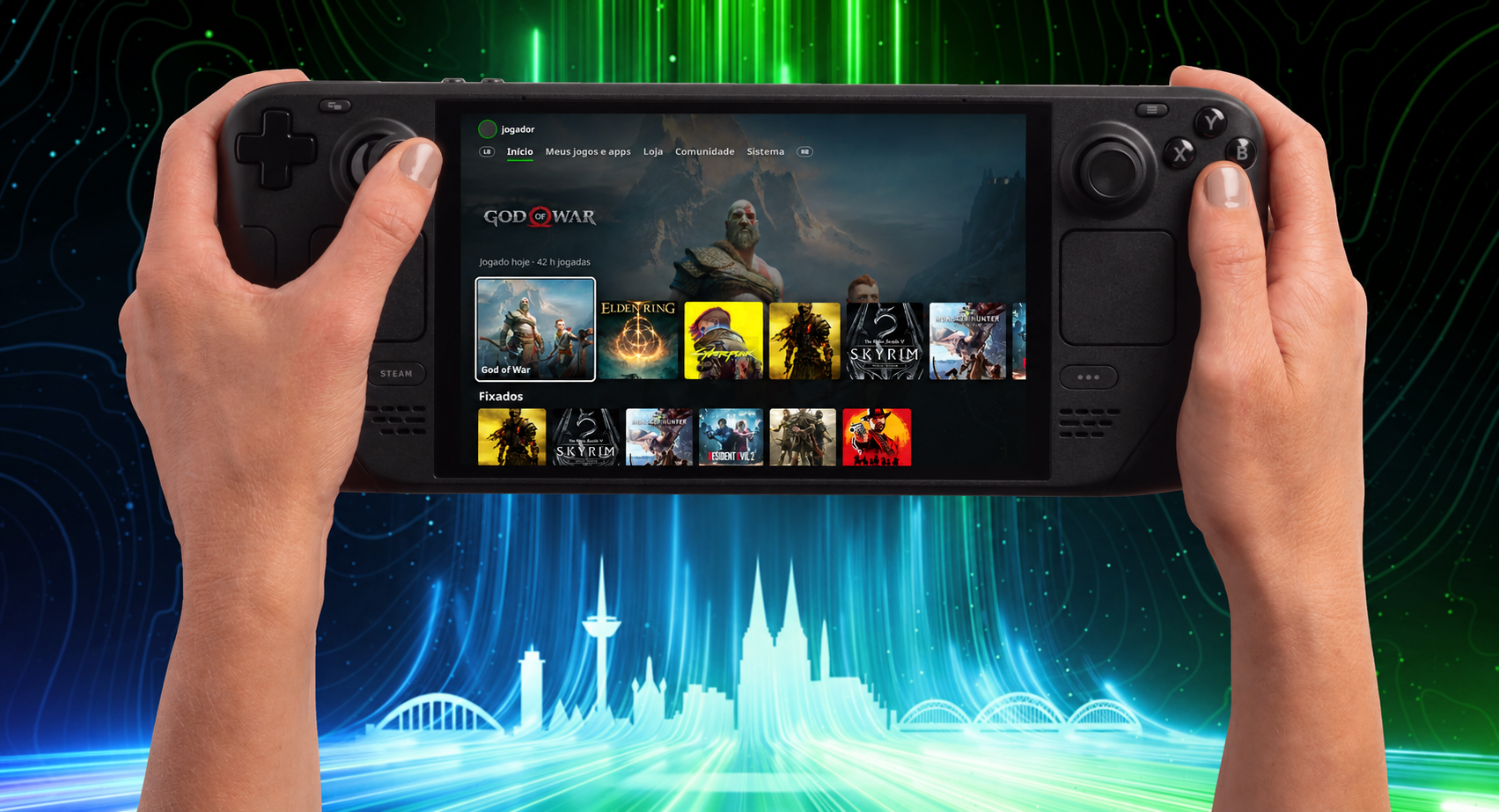
The plugin, which can be found on GitHub, turns your Steam Deck into a complete Xbox Series-style dashboard, and it is really impressive and pretty feature-rich. Quick disclaimer, though: Claude AI was used to help with development, but pretty much everything is now, so let’s move on to the features.
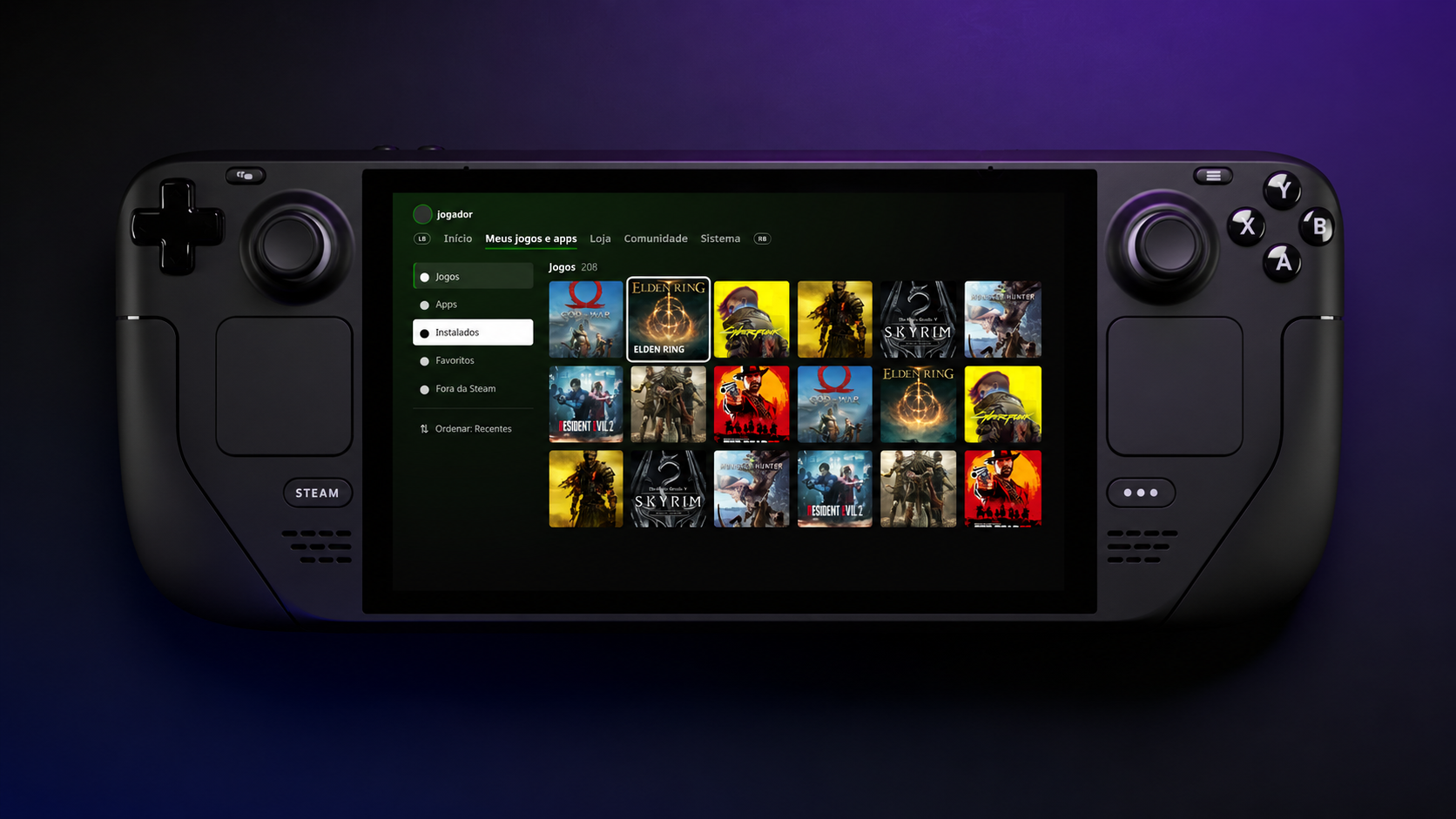
The Xbox Series dashboard looks right at home on Steam Deck
The Xbox Series-style dashboard looks right at home on Valve's Steam Deck. (Image credit: kromossomom | Valve | Xbox)
Decky Xbox Dashboard replaces Steam’s Home interface with the Xbox Series dashboard. You can use LB/RB to move between tabs, which include My games & apps, Store, Community, and System. You can also visit a game’s page when hovering over it and pressing Y to view the game’s compatibility, achievements, and more.
To install Decky Xbox Dashboard, you can follow these steps:
On your Steam Deck, open Quick Access -> go to Decky ->then go to Settings and select General. Make sure Developer Mode is turned on.
Within Developer settings, select Install plugin from ZIP, and pick your downloaded Decky Xbox Dashboard ZIP file.
I wish I could just install this on my Xbox Ally X. As much as I like Winhanced, which I currently use, I want the simplicity of a console in the palm of my hands. That is something the Xbox App and third-party launchers have never truly offered in my experience.
Let me know your thoughts. Is this cool? Would you install it? Do you wish it was available on a Windows handheld, or is it more of a novelty?
Make sure to leave a comment down below, and be sure to take part in our poll too!
Join us on Reddit at r/WindowsCentral to share your insights and discuss our latest news, reviews, and more.
Apple has finally made a touchscreen MacBook Pro, and you know what? Good.I’ve been using touchscreen Windows laptops for well over a decade. Microsoft made touch central to Windows with Windows 8 in 2012, and PC makers have spent the years since experimenting with convertibles, detachable keyboards, pens, dual-screen PCs, foldable displays, and nearly every combination of those ideas imaginable.Now Apple has decided touch belongs on a Mac, too.There’s an obvious
Apple has finally made a touchscreen MacBook Pro, and you know what? Good.
I’ve been using touchscreen Windows laptops for well over a decade. Microsoft made touch central to Windows with Windows 8 in 2012, and PC makers have spent the years since experimenting with convertibles, detachable keyboards, pens, dual-screen PCs, foldable displays, and nearly every combination of those ideas imaginable.
Now Apple has decided touch belongs on a Mac, too.
There’s an obvious temptation here to point and laugh, particularly given how long Apple spent telling everyone that touchscreen laptops were a bad idea. But I don’t think Apple adopting touch in 2026 is really the problem. Technology improves. Consumer behavior changes. Companies reconsider old assumptions. Ideas that didn't make sense 15 years ago can make considerably more sense today.
Companies should be allowed to change their minds. In fact, I wish more of them would.
What bothers me is the corporate absolutism that so often comes before the reversal, and how readily consumers absorb those talking points and repeat them as though they were established technological truths.
Your favorite company is not your friend
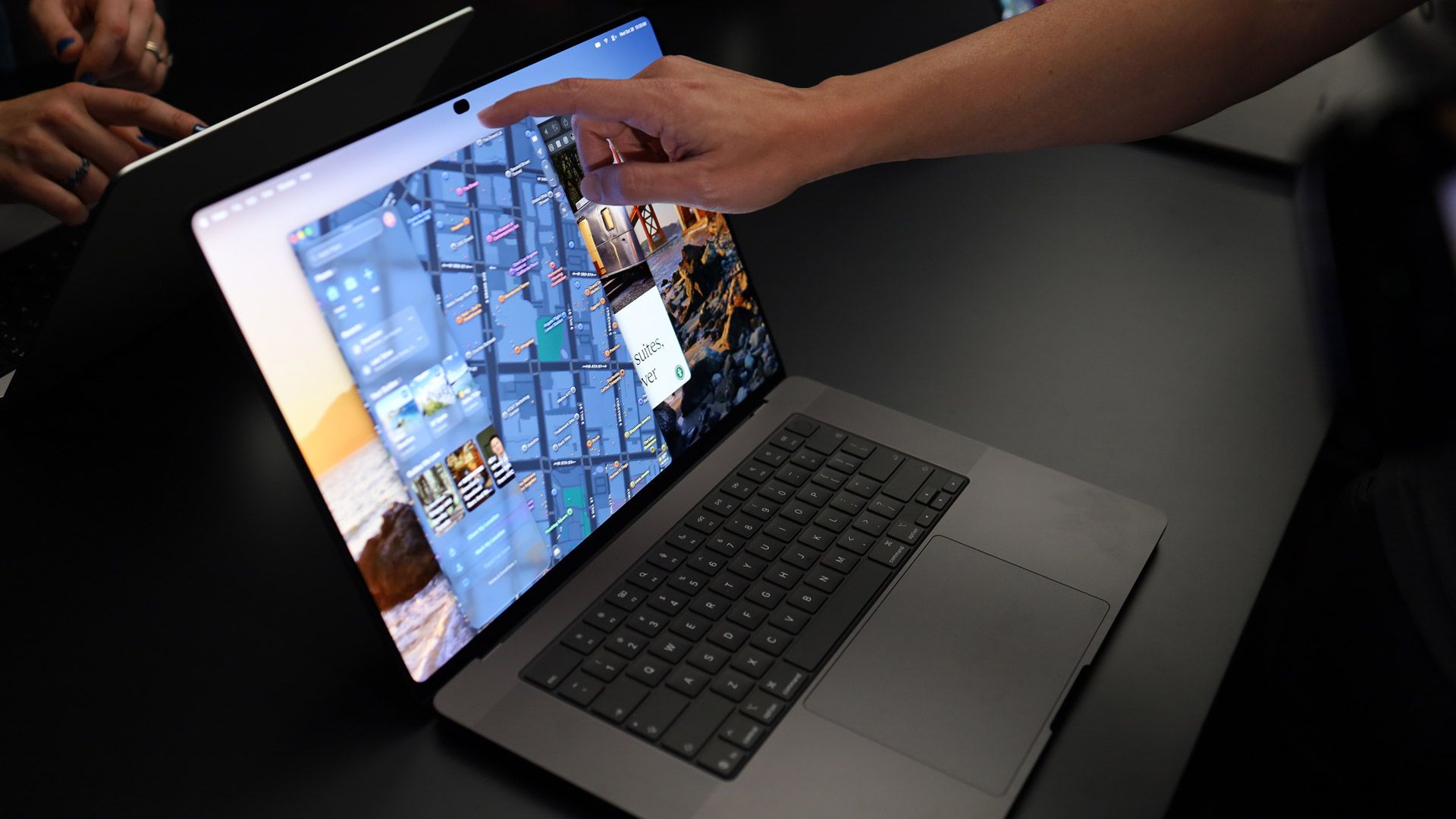
(Image credit: Lance Ulanoff / Future)
Steve Jobs didn't merely say that Apple wasn't interested in making a touchscreen Mac. In 2010, he argued that vertical touch surfaces were “ergonomically terrible” and that after using one for an extended period, “your arm wants to fall off.”
Apple continued defending that philosophy long after Jobs. Craig Federighi argued that reaching up to touch a screen was fatiguing, while John Ternus explained Apple's position in 2021 by saying the iPad was optimized for touch and the Mac for indirect input.
And now we have a touchscreen MacBook Pro.
Apparently, our arms have recovered.
I mean, Windows 10 came out 11 years ago and abandoned the Windows 8 approach you're criticizing.More importantly, what exactly is Apple doing here that Windows 10/11 haven't already done conceptually?The article praises Apple for keeping the familiar desktop UI while making elements more touch-friendly, adding touch gestures, increasing spacing between controls, and supporting things like pinch-to-zoom.That's essentially the post-Windows 8 approach Microsoft has been using for years: keep the desktop, accommodate touch where useful, and dynamically adjust parts of the UI for touch input.Windows 8 deserves plenty of criticism, but using it as the comparison in 2026 sidesteps 11 years of Windows development.If there's something fundamentally new about Apple's approach here, I'm genuinely curious what it is.October 28, 2026
But there was never anything inherently ridiculous about occasionally touching your laptop screen! You don't use a touchscreen PC by spending eight hours with your arm suspended in front of you like you're directing traffic. You type. You use the touchpad. You use a mouse. And sometimes a button is sitting right there on the screen, so you reach up and tap it.
That's it. Nobody needed a grand philosophical argument for why that was useful.
Microsoft certainly got plenty wrong with Windows 8, especially its attempt to aggressively redesign a desktop operating system around touch. But the underlying idea that a computer could accommodate a keyboard, mouse, pen and your fingers was perfectly reasonable. Windows laptop makers proved that years ago.
Yet because Apple didn't want to make that computer, the company's decision somehow became evidence among some of its most devoted followers that these computers shouldn't exist at all.
That's the part I think is worth remembering.
We've watched this happen before
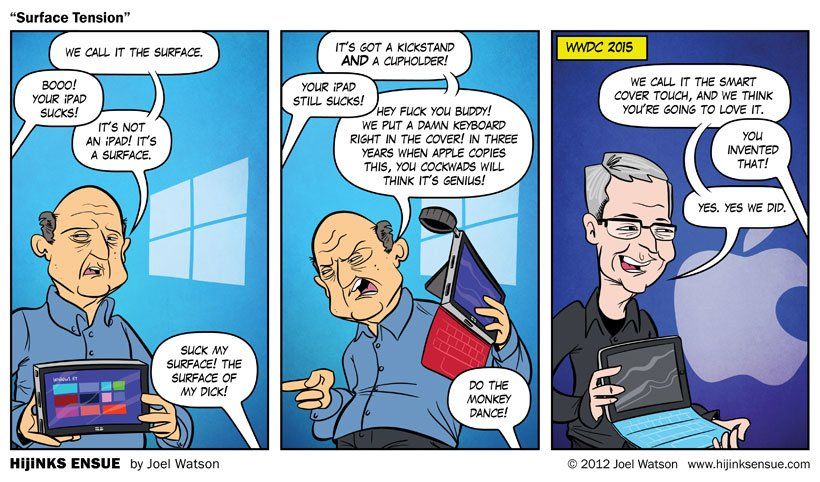
This 2012 comic by Joel Watson proves the point. (Image credit: Hijinks Ensue/Joel Watson (2012))
And touch isn't an isolated example.
When Microsoft was trying to blur the line between tablets and PCs with Surface, Tim Cook famously compared converging products to combining a toaster and a refrigerator. Years later, Apple built the iPad Pro and paired it with increasingly sophisticated keyboard and trackpad accessories. The implementation is Apple's own, but the supposedly absurd idea of a tablet increasingly behaving like a laptop doesn't seem quite so absurd anymore.
I've seen the same attitude around foldables and devices like Surface Duo. Years ago, I found myself explaining to Apple fans, practically like children, why someone might find value in a large display that folds into something much smaller and more pocketable. The response inevitably centered on all the reasons folding phones were unnecessary, compromised, gimmicky, or "solving a problem that didn't exist" (the line always used by people with no imagination).
Now Apple is making foldable devices too.
And again, good. I want Apple to make these products. Competition drives improvement, and Apple entering a category can push everyone else forward. I recently discussed on Schwab Network (above) how strategically important the iPhone Duo is, and its growing pains—or whether it’s the perfect $2,000 phone—are less of a concern in the long term.
This isn't an admonishment of Apple for adopting ideas that competitors got to first. It's an admonishment of the corporate theater that often precedes those reversals, and especially of consumers who willingly participate in it.
Stop turning corporate PR into your personality
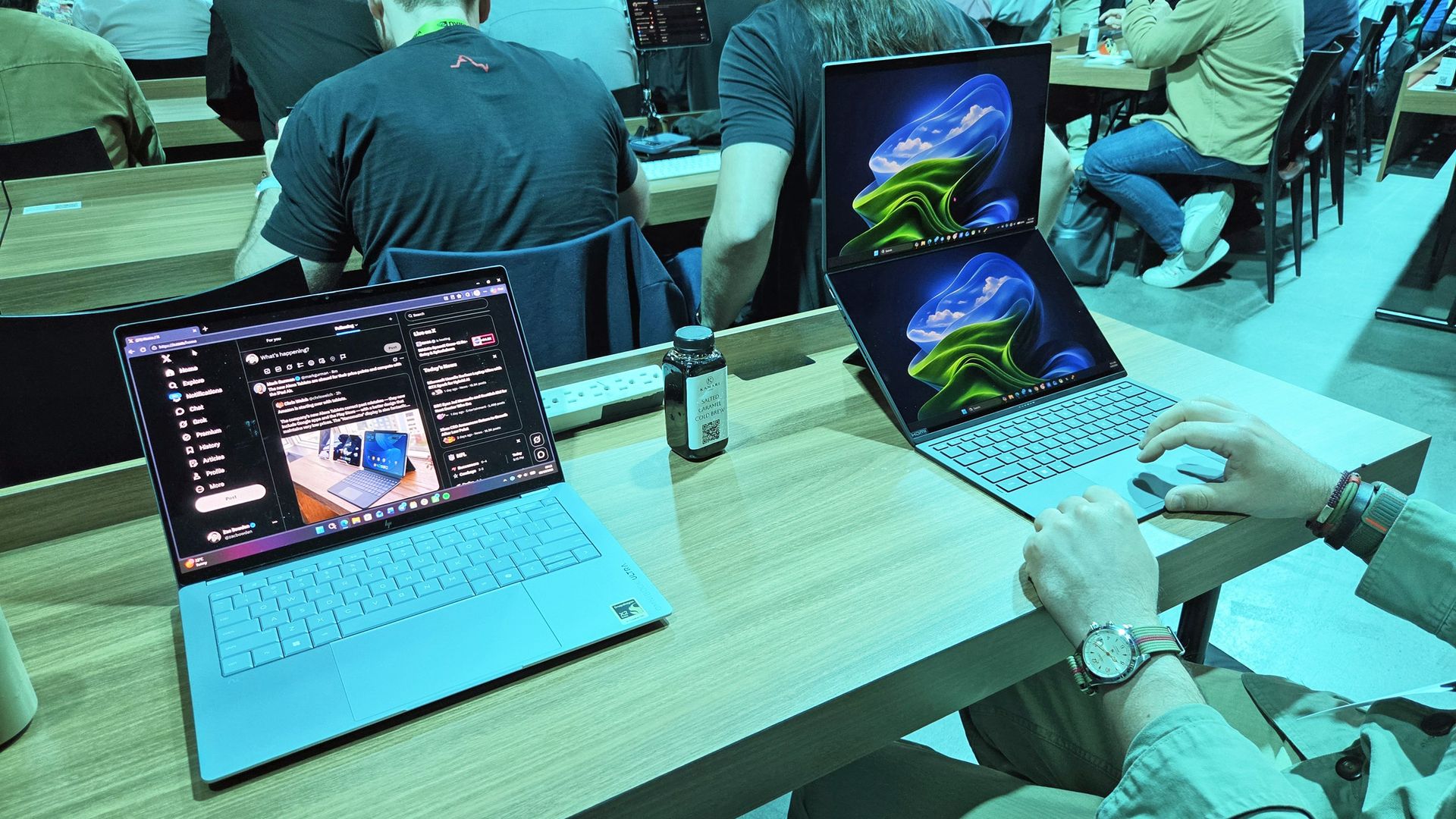
Me using the ASUS ZenBook Duo dual-screen laptop at an NVIDIA event on October 8th, 2026. (Image credit: Zac Bowden)
Every technology company does some version of this. Microsoft does it. Google does it. Samsung does it. Apple does it.
I've interviewed enough executives over the years to know the standard response when you ask why a product doesn't have some particular piece of technology. You usually get something along the lines of: We're watching the technology, we're talking to our customers, and when we think the experience is right, we'll consider it.
That's corporate PR, but it's also a perfectly respectable answer.
What companies shouldn't do, and what consumers absolutely shouldn't help them do, is transform today's product limitation into some grand design philosophy explaining why the missing technology is actually stupid.
(Anyone else remember Apple not making large iPhones because your thumb couldn't reach across the screen? yeaaahh...)
Companies have roadmaps. They have price targets, manufacturing constraints, engineering limitations, internal politics, and products they aren't ready to announce. Sometimes they haven't figured something out yet. Sometimes a competitor simply got there first.
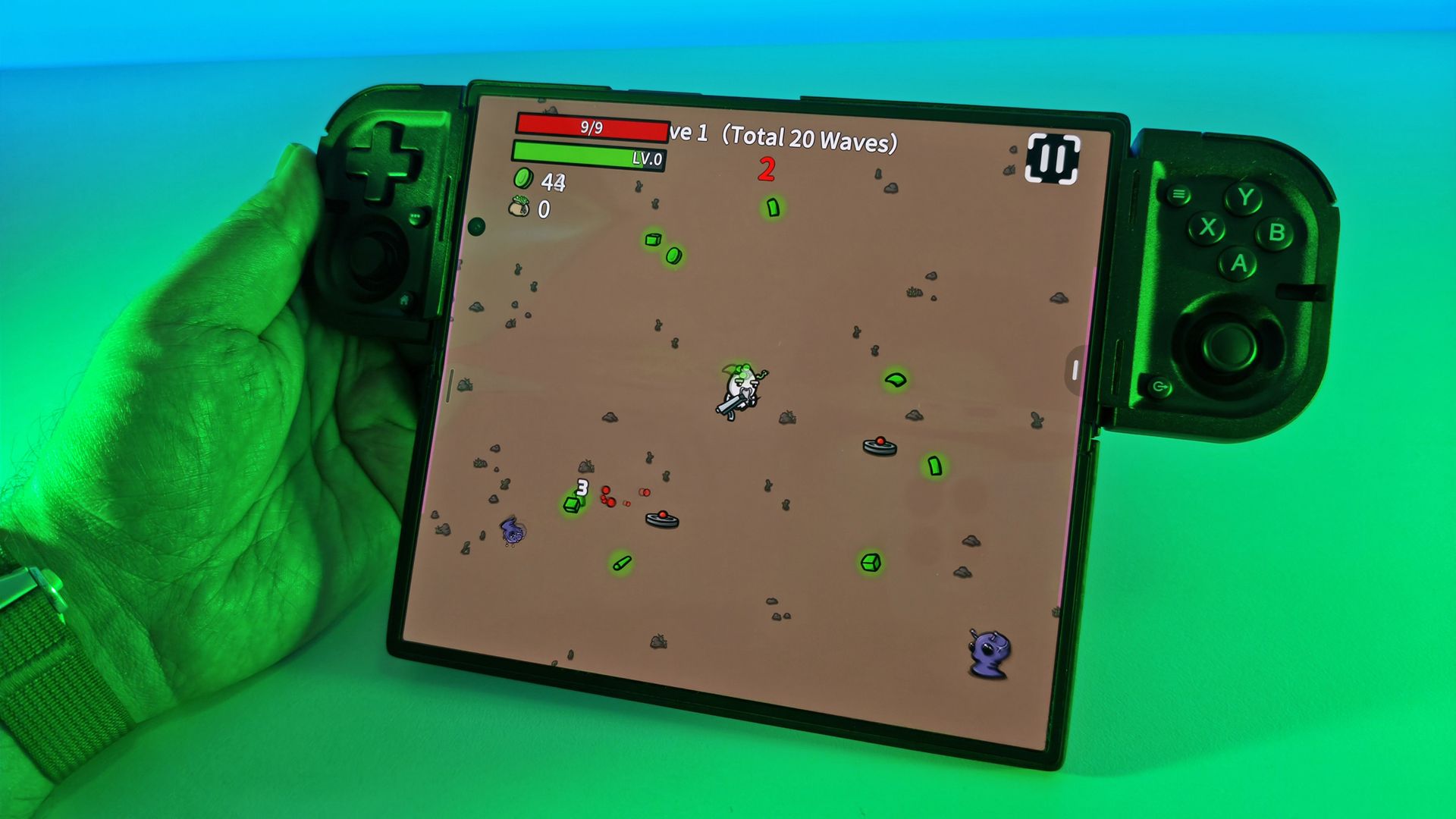
Turns out, foldable devices are fun. Seen here: Samsung Galaxy Z Fold7 and Razer Prio controller. (Image credit: Daniel Rubino)
And sometimes they're just wrong. Steve Jobs, Tim Cook, and Craig Federighi were wrong. And it wasn't the tech that changed; it was the opinion.
Consumers and the technology press shouldn't turn those temporary business realities into articles of faith.
Apple is particularly good at controlling the language around its products, which makes resisting this tendency even more important. When Apple doesn't offer something, there's often an impulse among its most ardent supporters to rationalize the omission and explain why nobody really needs it anyway.
Then Apple ships it, and suddenly it's useful.
That's why the lesson of the touchscreen MacBook Pro isn't that Apple lost, and Windows won. Frankly, that kind of platform-war thinking is just another version of the same problem.
@OABlanchard @TheRichWoods "He wouldn't be saying it today."Speaking for the dead now are we?October 28, 2026
The lesson is much simpler: stop putting corporations on pedestals.
You don't work for these companies. You don't owe them ideological consistency. Buy the products you like. Praise them when they're good. Criticize them when they're bad. And when an executive explains why a technology their competitors already offer is unnecessary, ridiculous, inelegant, or something customers don't want, maybe don't adopt that argument as part of your identity.
Because a few years from now, they may be standing onstage trying to sell it to you.
And when that happens, changing their mind is perfectly fine. Pretending they never told you otherwise is something else entirely.
But tell me, am I wrong or missing something? What do you think about Apple suddenly being interested in foldables and touchscreen laptops in 2026? Let me know in the comments.
Join us on Reddit at r/WindowsCentral to share your insights and discuss our latest news, reviews, and more.
It has been a year since the Xbox Ally X launched, so I figured it was about time we did a re-review. We have FSR 4.1 on the Xbox Ally X now, a big Xbox app revamp is around the corner, and I'm probably one of the few content creators who actually uses this device on an almost daily basis. So, I really want to answer that burning question for Xbox ecosystem users: is it actually still worth a thousand big ones, even now, one year later? How has the battery life s
It has been a year since the Xbox Ally X launched, so I figured it was about time we did a re-review.
We have FSR 4.1 on the Xbox Ally X now, a big Xbox app revamp is around the corner, and I'm probably one of the few content creators who actually uses this device on an almost daily basis. So, I really want to answer that burning question for Xbox ecosystem users: is it actually still worth a thousand big ones, even now, one year later?
How has the battery life stacked up? Is Windows 11 actually functional for handheld PC gaming yet? Does FSR 4.1 make for a killer feature?
Let's discuss.
FSR 4.1 is, indeed, a killer feature for the Xbox Ally X
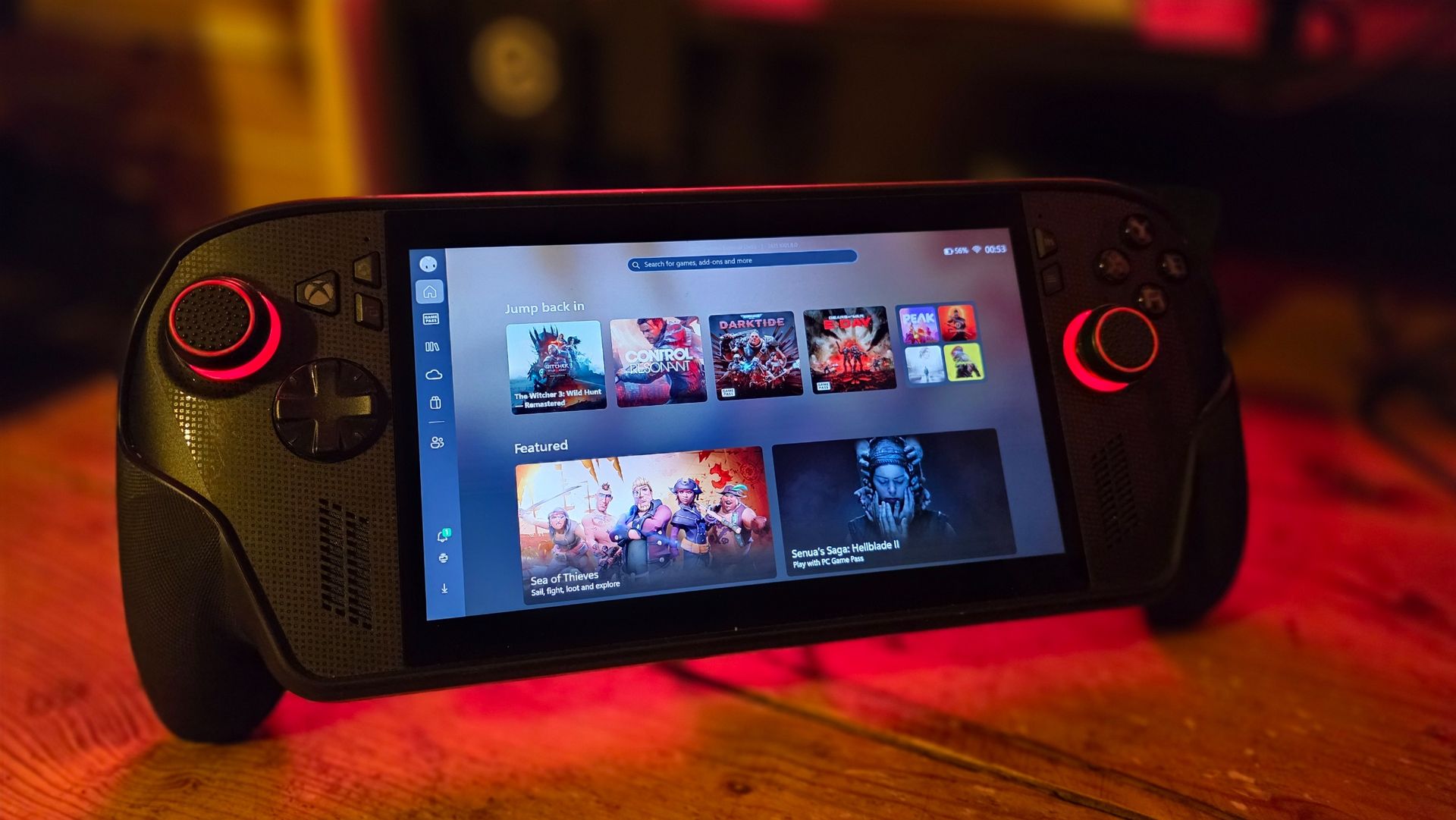
Games like Warhammer 40K Darktide and Control Resonant benefit from huge image quality boosts from FSR 4.1. (Image credit: Windows Central | Jez Corden)
The Xbox Ally X launched around this time last year (depending on your market) in partnership between Microsoft and ASUS. I'll do a write-up and a video on its less powerful Xbox Ally Z2A cousin in the future too. But we're looking at the $1,000 Xbox Ally X today. It was the first device to sport the Z2 Extreme chipset from AMD, making it the most powerful handheld at the time. AMD's new FSR 4.1 tech has given it a further boost on top of that as well.
FSR 4.1 is a heavier upscaling model than FSR 3, but it's all about boosting image quality, giving you more flexibility over how you play. You can now run quality modes that would previously look too ugly and blurry to bear, and still maintain a good level of performance. This extends to very graphically intensive games like Control Resonant, Cyberpunk 2077, Gears of War: E-Day, and games like Warhammer 40K Darktide, which have lots of enemies on-screen at any one time. FSR 4.1 will be adopted natively by more games over time, potentially extending the lifespan of the device even further. AMD has a list of games that already support it over here.
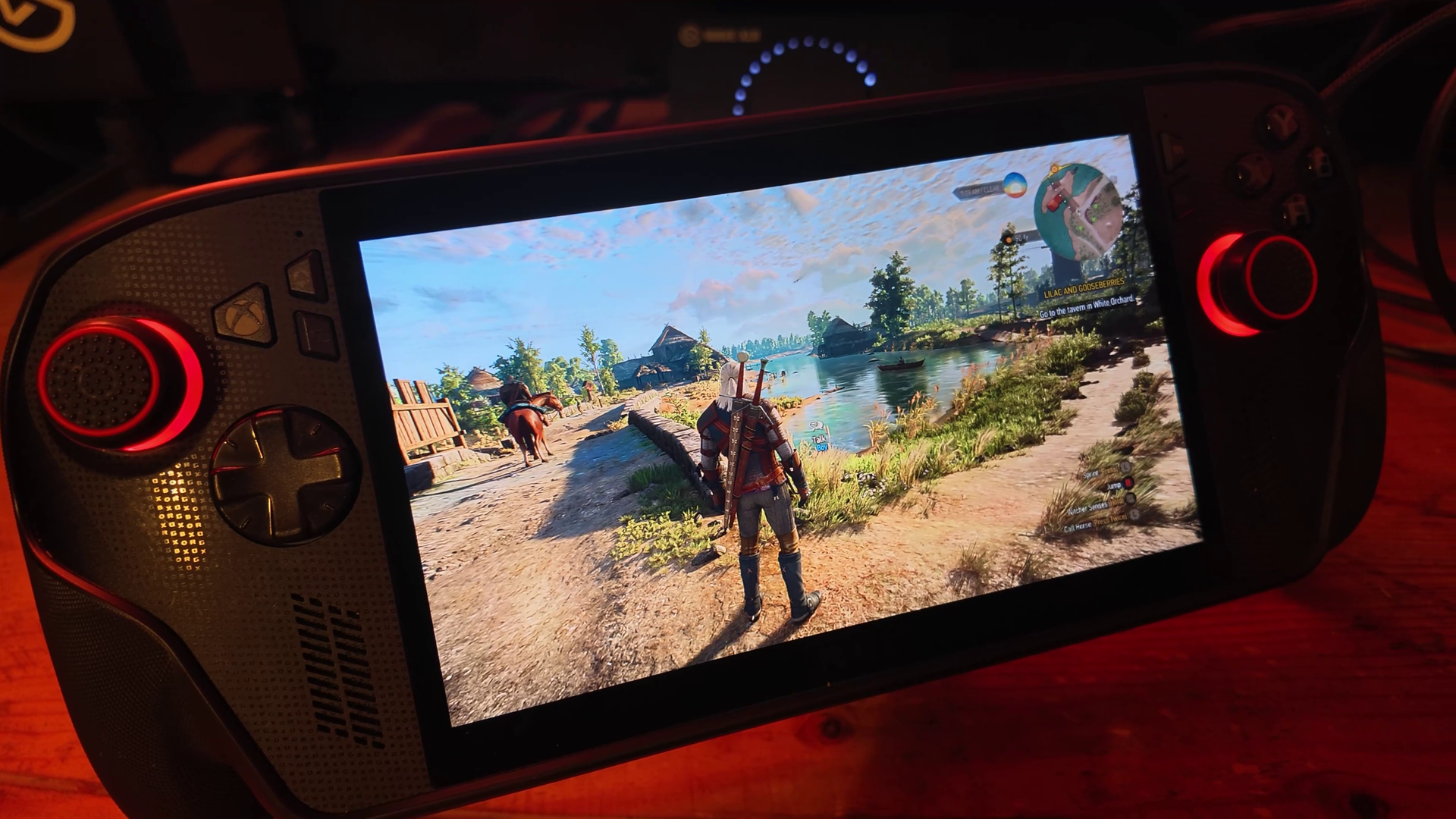
Annoyingly our website system compressed the pictures here, but in the video above you can get a good look at how crisp and smooth Witcher 3 looks on devices like this now. (Image credit: Windows Central | Jez Corden)
Using Performance and Turbo modes for maximum power, you're easily getting anywhere between 40 and 60 FPS at 1080p for most games out of the box. Heavier games will benefit more from FSR 4.1 being set to performance mode, which appears as crisp as quality mode did on FSR 3 models. I find FSR Frame Generation is also a good way to loop in more frames at the cost of some latency, although in most games I tried it was barely perceptible.
Heavily-optimized games like Death Stranding and the new Witcher 3 enhanced edition look absolutely stunning on this device, both in high and low power modes. Games with FSR 3 automatically benefit from FSR 4.1, which are presently in beta testing on the Xbox Ally X here. Witcher 3 absolutely sings on this device, although games with heavy reliance on ray tracing, like Silent Hill 2, still struggle a bit.
Either way, FSR 4.1 is going to vastly improve the lifespan of compatible devices like this, and it'll be interesting to see how it boosts the base Xbox Ally Z2A model (and Xbox Series X|S platform) in the future.
The hardware holds up, but Windows 11 still needs work
Absolutely no issues with the hardware on my end, but I have seen other pronble (Image credit: Windows Central | Jez Corden)
On the topic of lifespan, I'm someone who uses this handheld very regularly, at least every other day before bed. I've been using it mostly to grind Darktide recently, but I will also be using it for WoW: Forever in the coming weeks since it now supports a controller.
The hardware itself has held up incredibly well for me, but it would be neglectful not to mention the quality issues I've seen with the thumbsticks online and on Reddit. I think ASUS could've done a bit more to reinforce the sticks here, but if you go gently on it, I guess, like I do, perhaps you'll be okay. The most wear I have is that the paint on some of the buttons is beginning to wear off, but besides that, my Xbox Ally X seems rock solid.
I find that even a year in, the battery life is still decent on the Xbox Ally X too. I use Battery Care mode religiously to keep the charge topped off at around 80% to protect the lifespan of the cell, but when fully charged at 100% you're easily getting 4-5 hours in 13w silent mode in 2D games, and maybe 2-3 hours in 17w performance mode in a more intensive game, with trade-offs. If you go turbo mode, then yes, the battery will drain out in an hour or so. However, I find that when traveling these days on planes or trains, there's usually an outlet available to give you some extra juice.
There are a lot of games that offer a solid 3D experience even in silent 13w mode, if you're willing to compromise on visual quality and performance to maximize the Ally's longevity.
What is perhaps less solid is the operating system experience. This isn't ASUS' fault, of course, but more on Microsoft and Windows. Xbox and the Windows teams have been collaborating to improve the experience for users on devices like this, but the results have been mixed. The Xbox Ally X is particularly painful to use when hooked up to a TV in a Switch-like "docked" setting. Sometimes the controller loses the focus window, and there's no way to get it back without tapping the screen.
Basic parts of Windows still aren't navigable without a mouse, and the Xbox PC app still leaves a lot to be desired whether docked or not. Luckily, Microsoft is shipping a big update to the Xbox PC app in the coming weeks, and Windows 11 itself is picking up further refinements. It still feels overall like you're a bit of a beta tester for the OS itself, but you do get the full power of Windows as a trade-off, able to turn this device into a work laptop if you so desire (as I've done while traveling myself). You can run any launcher without hassle, like Steam or GOG, and you can connect any accessory that's compatible with Windows, including gamepads, mice, keyboards, and even printers.
The bottom line: I still adore the Xbox Ally X
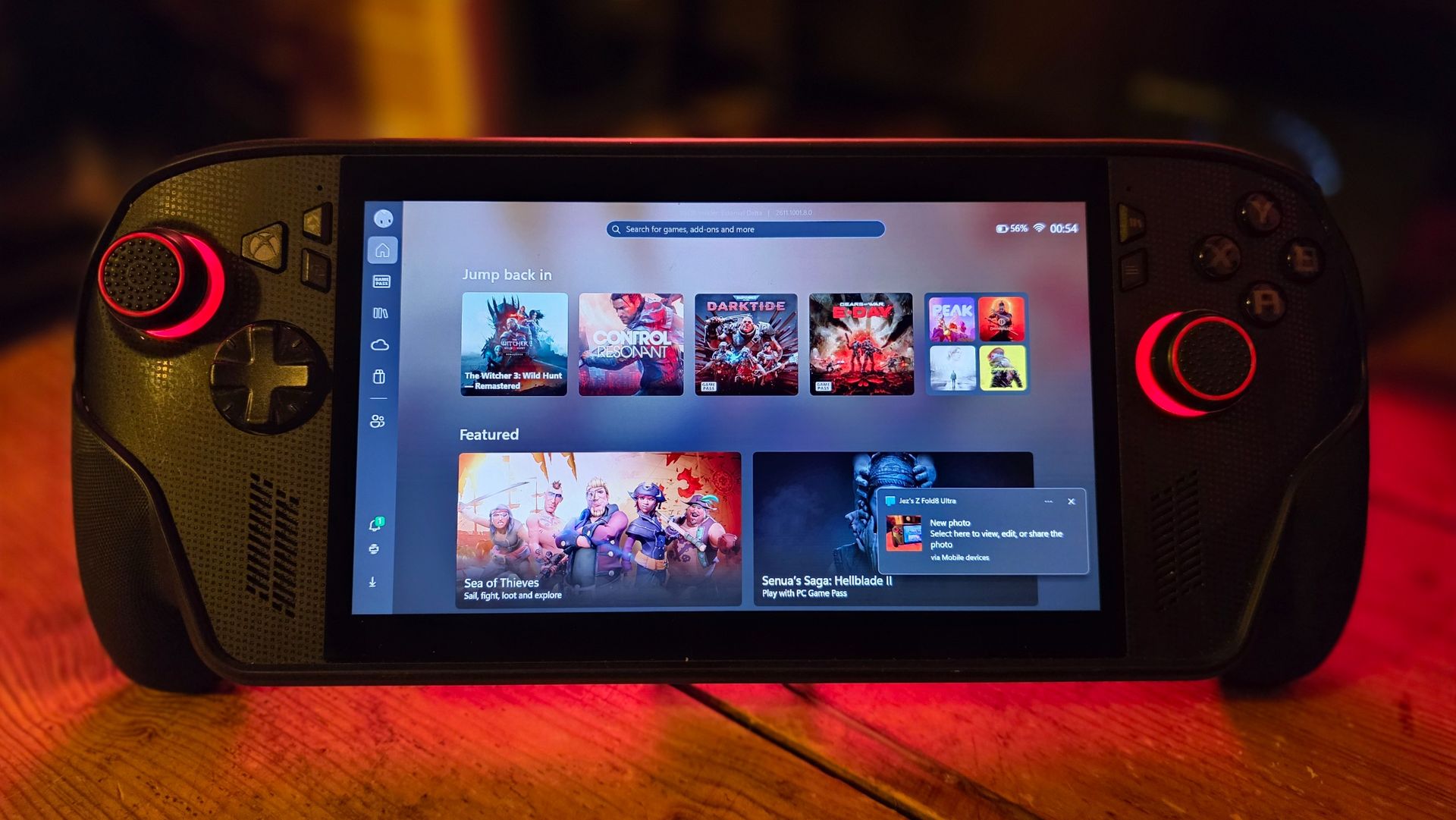
My favorite piece of tech (Image credit: Windows Central)
But the bottom line is this: when you're actually in a game, this device absolutely sings. In Turbo mode at 35W, it will provide a solid 1080p 30~ish experience in the heaviest AAA games, even on a medium or even high quality setting, particularly with FSR 4.1 tweaks injected. You can get up to 60 FPS if you're willing to compromise on quality, generally speaking. There are many higher-end games that have been well-optimized for handhelds that deliver a 1080p 60 FPS experience too, such as The Witcher 3 Enhanced Edition.
I've never encountered a scenario where I couldn't get a satisfactory experience from a game, which cannot be said about the Steam Deck and other older or lower-end handhelds.
Given the state of the RAMpocalypse and component market in general, I expect it might be a while before developers push their visuals beyond what is available today. The Xbox Series X|S, PS5, Switch 2, and devices like this are probably going to be the baseline for a longer period than usual. If you were to buy the Xbox Ally X today, I expect you're going to get at least 3 to 4, maybe 5 years of solid use out of it before it might start feeling obsolete.
This is a fantastic device, a perfect companion for any Xbox player with a big Xbox Play Anywhere library. Even if you're dedicated to Steam, you can set Big Picture Mode as your default launcher and skip the Xbox ecosystem entirely if you fancy it.
For gaming evenings in bed, portable co-op with friends, or even as an emergency workhorse, the Xbox Ally X is a fantastic PC companion that I hope will be a staple of my gaming experience for a long time to come. And I would absolutely recommend it — as long as you think you'll get a good amount of use out of it.
Join us on Reddit at r/WindowsCentral to share your insights and discuss our latest news, reviews, and more.

 Connexion