❌

Vue normale

  • ✇Yanko Design
  • Pillowy Steel Furniture Without a Stitch of Upholstery
    The steel in Sarah Naghawi’s JAWF collection looks caught halfway between a box and a balloon. Surfaces bulge, dip, and crease, giving rigid metal the appearance of something you might squeeze. I like that moment of confusion, especially because the material remains so obviously metallic. Presented at Amman Design Week 2026, the Jordanian designer’s experimental collection explores how pressure can turn stainless-steel sheets into sculptural objects with their own internal spaces. The problem b
     

Pillowy Steel Furniture Without a Stitch of Upholstery

4 novembre 2026 à 06:07

The steel in Sarah Naghawi’s JAWF collection looks caught halfway between a box and a balloon. Surfaces bulge, dip, and crease, giving rigid metal the appearance of something you might squeeze. I like that moment of confusion, especially because the material remains so obviously metallic. Presented at Amman Design Week 2026, the Jordanian designer’s experimental collection explores how pressure can turn stainless-steel sheets into sculptural objects with their own internal spaces.

The problem being explored belongs to the workshop rather than the living room: how to give sheet metal volume, depth, and an interior through the forming process itself. Naghawi uses hydromechanical forming, introducing hydraulic fluid pressure into welded sheet assemblies so the metal expands and deforms. Pressure becomes a shaping tool, pushing the steel beyond its original flat condition. The attraction is that the resulting surface helps define both the object’s exterior and the space within it.

Designer: Sarah Naghawi (photos by ASPIRE Ali Saadi Photography)

That industrial terminology sounds less approachable than the result. Think of the principle of inflation, except the steel permanently retains the deformation created during fabrication. Outward curves and inward hollows remain as evidence of the forces applied to the material. This gives the objects a physical history you can read in their surfaces. The process hasn’t been hidden beneath a decorative finish; its effects supply much of the visual character.

The name helps explain why those hollows matter. JAWF comes from an Arabic word referring to an inner chamber or protected cavity. Naghawi treats that interior space as a starting point for design, with recesses suggesting possibilities for storage and enclosure. I appreciate that emphasis because sculptural furniture can sometimes ask us to admire its silhouette while leaving its practical purpose unresolved. Here, the cavity is central to the investigation, even if everyday usefulness still needs closer examination.

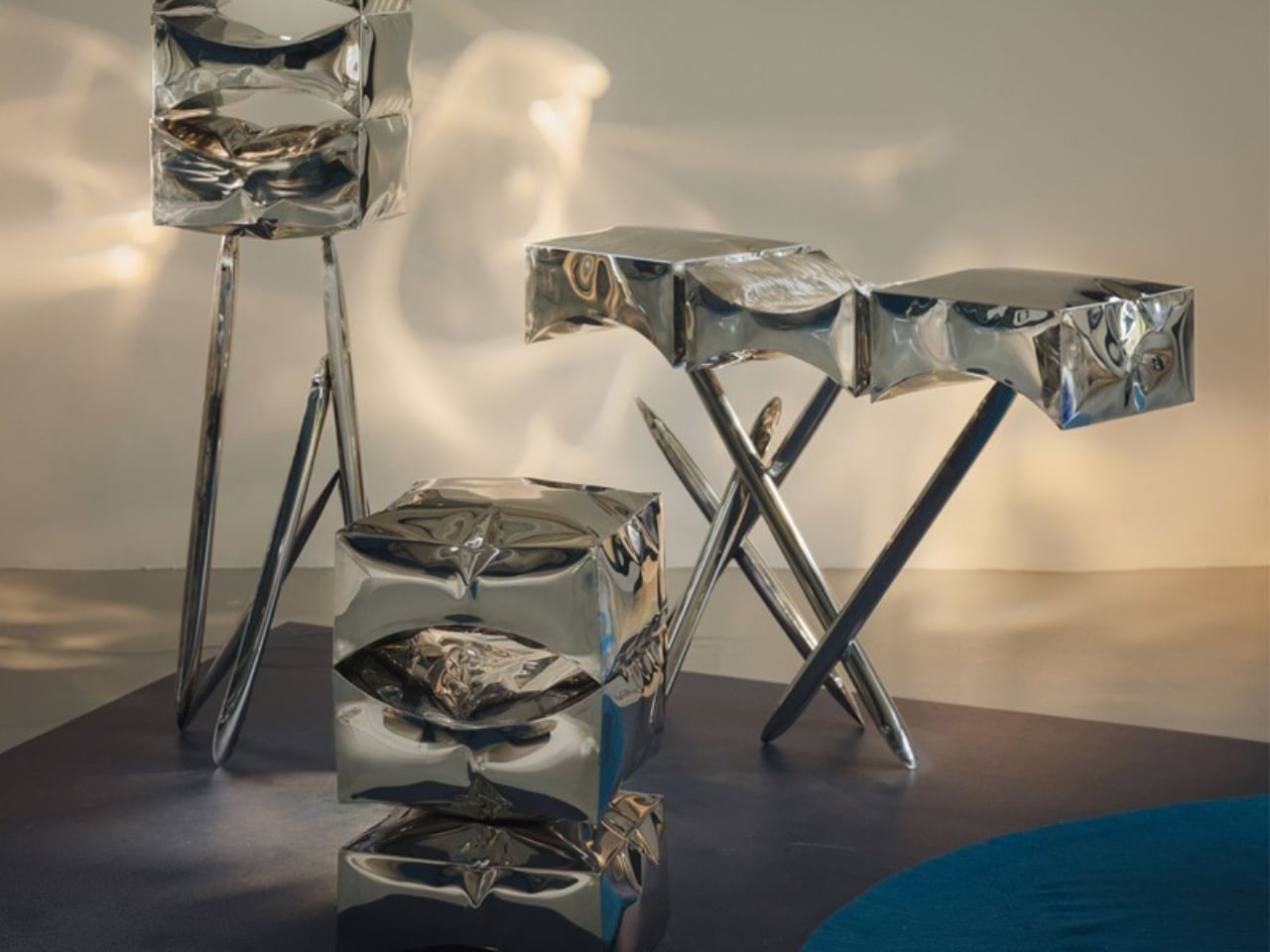
In the exhibition photographs, a tall rectangular piece stands on slender, splayed legs, with three pronounced recesses arranged vertically across its face. Nearby, a horizontal piece stretches across angled supports, its upper surface rising and falling rather than settling into a conventional flat plane. A smaller stacked form brings the same swelling geometry closer to the floor. The family resemblance comes through clearly, but each silhouette gives the pressure-shaped surfaces a different setting.

The reflective finish makes those shapes particularly animated in photographs. Blue from the exhibition floor and bright patches of window light break across the steel, making some edges easy to follow and others surprisingly difficult to locate. To my eye, the pieces sit somewhere between furniture and oversized, crumpled silver packaging. That comparison is affectionate. The familiar shine draws you in, while the uneven geometry prevents the objects from becoming another exercise in polished metallic perfection.

The studio’s balloon reference feels especially useful here. A balloon’s skin and its interior volume develop together under pressure; JAWF translates that relationship into a material that holds the resulting shape. The resemblance stops short of literal imitation, which is a good choice. These aren’t novelty balloons recreated in steel. Their boxy outlines, compressed areas, and deep cavities give them a more awkward, interesting presence. They look like objects negotiating with the force that made them.

I’d want dimensions, weight, pricing, and evidence of everyday usability before treating JAWF as a furniture recommendation. A striking recess doesn’t automatically make a convenient shelf, and an expressive surface doesn’t establish how comfortably an object fits into a home. Those questions don’t diminish the experiment. They establish where the next stage of development would become interesting: translating a compelling material study into pieces whose proportions and functions feel equally considered.

For now, I’m persuaded by the decision to leave the steel’s deformation visible. JAWF gives the eye plenty to enjoy, but it also makes fabrication part of that enjoyment. You can follow a bulge into a hollow and understand that the two belong to the same event. That’s a satisfying reason to look twice, even before deciding where the object might live.

The post Pillowy Steel Furniture Without a Stitch of Upholstery first appeared on Yanko Design.
  • ✇Yanko Design
  • A Bamboo Armchair Glows After Dark Without Electricity
    Crocheted flowers usually belong on a blanket or a cardigan, not in a conversation about lighting. Peiyang (Camille) Li gives them another job with She Blooms in the Dark, a sculptural seating project that combines a woven bamboo armchair with hand-crocheted blossoms that glow after dark. I like the premise immediately: familiar craft doing something unexpected, without needing to look like a gadget. The problem it addresses is a small but recognizable one: finding a sense of personal space wit
     

A Bamboo Armchair Glows After Dark Without Electricity

3 novembre 2026 à 18:30

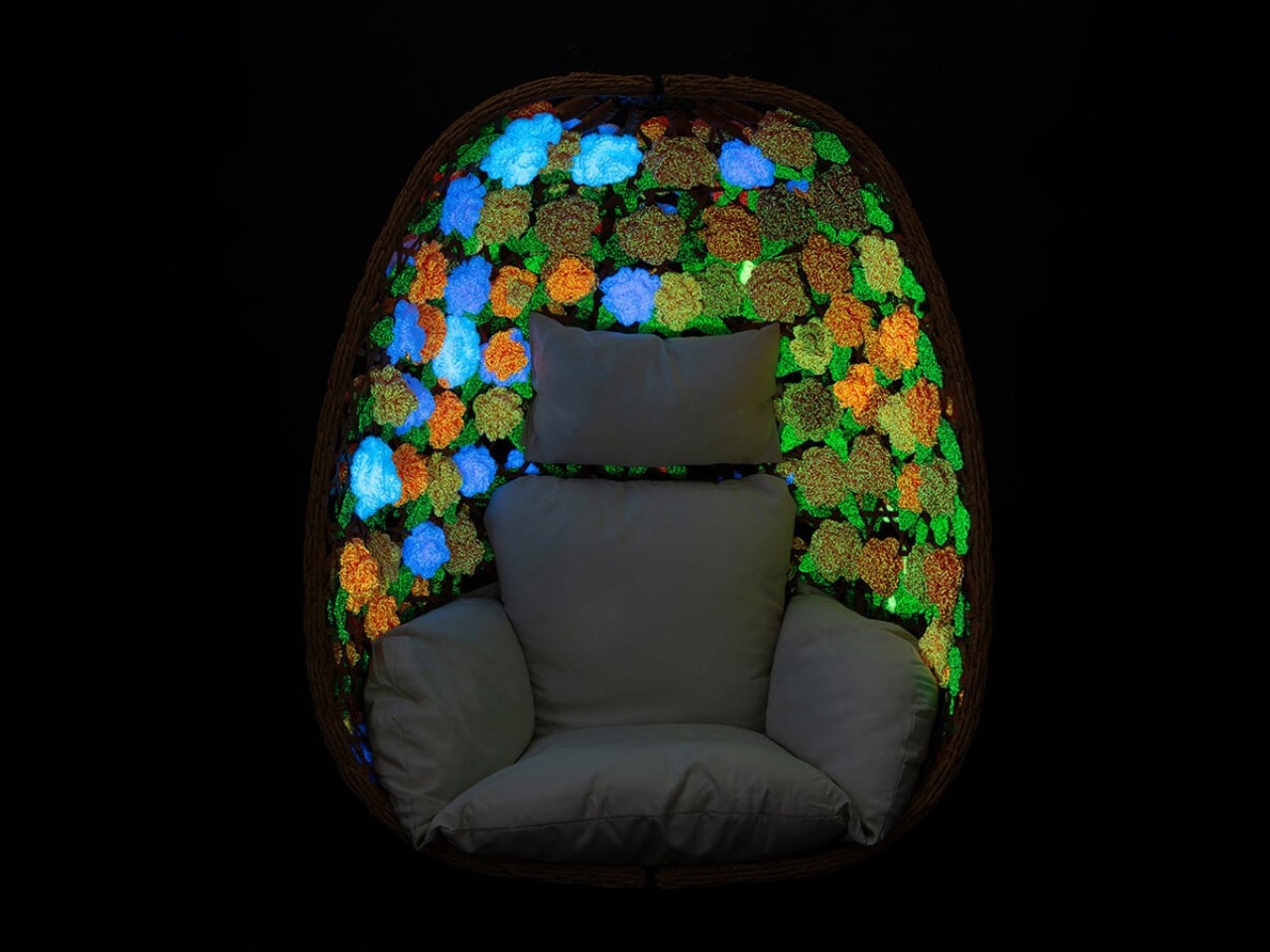
Crocheted flowers usually belong on a blanket or a cardigan, not in a conversation about lighting. Peiyang (Camille) Li gives them another job with She Blooms in the Dark, a sculptural seating project that combines a woven bamboo armchair with hand-crocheted blossoms that glow after dark. I like the premise immediately: familiar craft doing something unexpected, without needing to look like a gadget.

The problem it addresses is a small but recognizable one: finding a sense of personal space without having a separate room to escape into. Li frames the project around emotional vulnerability and protection. I read that as an attempt to make a seat feel like a boundary, a place where being alone might feel intentional rather than awkward. That’s a worthwhile ambition for a piece of furniture, even before the flowers start glowing.

Designer: Peiyang (Camille) Li

The curved, basket-like bamboo framework partially encloses the sitter, while its open lattice stops short of creating a solid shell. That balance matters. For a shared living room, I’d want a retreat that still lets me feel connected to the room, rather than a miniature booth. The shape suggests that possibility, although an open weave shouldn’t be mistaken for actual privacy. Think of it as a visual boundary, not a substitute for a door.

The glow comes from phosphorescent yarn, described in the project write-up as absorbing daylight and releasing a low-intensity glow in darkness, without electric fixtures. That’s an appealingly direct material choice: the flowers themselves provide the effect, instead of hiding a strip of LEDs underneath. I’m more drawn to that decision than I would be to a color-changing chair controlled through an app. The material gets to carry the surprise, and the premise is easy to understand.

It would be a mistake to treat it as a reading light, though. The published description doesn’t give brightness measurements or say how long the glow lasts. For me, the useful way to understand it is as an atmospheric effect, not a replacement for the lamp beside your favorite book. That distinction actually strengthens the idea. It lets the light remain intimate and decorative, rather than making a practical lighting promise the available information can’t support.

Crochet also makes sense here beyond the novelty of glowing yarn. A flower carries associations with care, growth, and decoration, at least in my reading, and working it by hand adds another layer to that impression. I appreciate that Li hasn’t chosen an abstract luminous panel. The floral language gives the project a slightly storybook quality. It could be too whimsical for a restrained living room, but I wouldn’t want that personality edited out.

That doesn’t mean the chair can promise calm on command. I’m wary of furniture being asked to solve an emotional condition simply because it wraps around a person. A more reasonable ambition is to offer an invitation: sit here, give yourself a moment, let this particular corner have a different purpose. She Blooms in the Dark makes sense to me on that modest scale. It doesn’t need a therapeutic claim to justify its existence.

There are everyday questions I’d want answered before imagining it at home. The published project information doesn’t include dimensions, a price, or purchasing details, and it isn’t enough to judge comfort or upkeep. I’d want to know how the flowers are attached and how you clean around them. Those aren’t objections to a sculptural project. They’re the questions that separate admiring a piece of furniture from deciding where it could live.

Still, I’m glad this chair takes such an idiosyncratic route to a familiar desire. I don’t need every quiet corner to look like a spa, and I don’t need every interesting light effect to arrive with another charger. A bamboo seat dressed in glowing crochet offers a more playful possibility. The appeal is being allowed a little enchantment at home, with enough recognizable craft to keep it from feeling like a special effect.

The post A Bamboo Armchair Glows After Dark Without Electricity first appeared on Yanko Design.

❌