Vue normale

  • ✇Yanko Design
  • This 60g Titanium Pen Doubles as a Pocket Repair Station With a Detachable Flashlight and 3-Slot Toolbox
    The humble pen is one of the most perfectly designed objects in everyday human history. It’s a simple, durable, pocket-friendly cylinder that most of us carry without a second thought, right up until the moment we actually need it. Its form is so familiar that we rarely stop to question its potential as anything other than a writing instrument. But what if the pen’s silhouette was actually the perfect chassis for something far more ambitious? What if its main job wasn’t to record problems, but
     

This 60g Titanium Pen Doubles as a Pocket Repair Station With a Detachable Flashlight and 3-Slot Toolbox

2 août 2026 à 21:45

The humble pen is one of the most perfectly designed objects in everyday human history. It’s a simple, durable, pocket-friendly cylinder that most of us carry without a second thought, right up until the moment we actually need it. Its form is so familiar that we rarely stop to question its potential as anything other than a writing instrument. But what if the pen’s silhouette was actually the perfect chassis for something far more ambitious? What if its main job wasn’t to record problems, but to solve them?

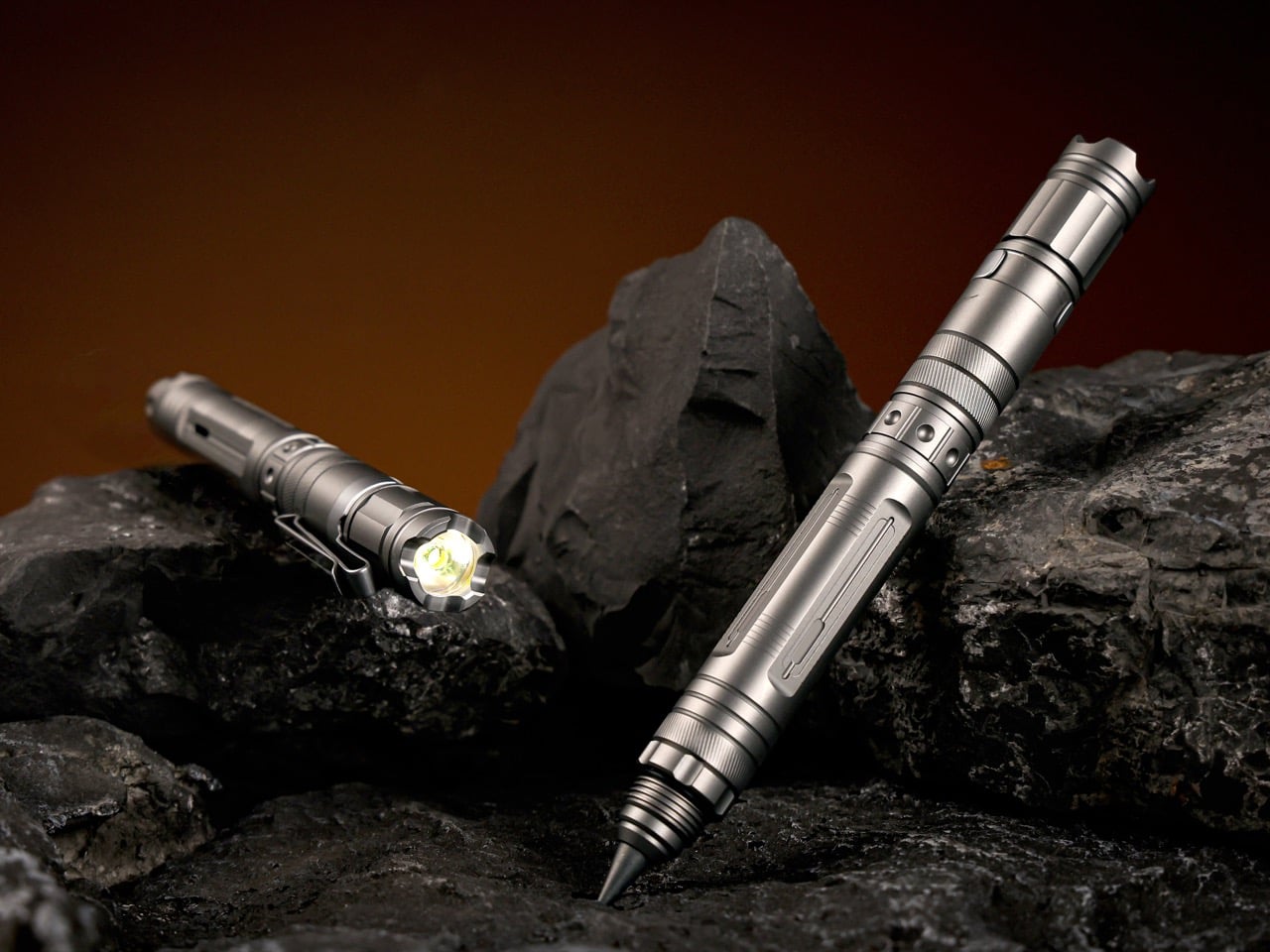
TiMate, the Redwood City-based EDC team behind the BoltLite and CoreLite, spent three design generations building toward exactly this: a Grade 5 titanium pen organized around a four-step repair workflow of illuminating, marking, cutting, and repairing. The body is CNC-machined, IPX-8 waterproof, and houses a detachable flashlight, a three-slot magnetic toolbox, a dual-tip marking system, and a utility blade, all in a 60-gram, 5.31-inch frame. The VeroLite also writes. That’s almost a punchline. But genuinely, it writes well.

Designer: TiMate

Click Here to Buy Now: $85 $119 (30% off) Hurry! Only 69 of 100 units left.

The flashlight module runs a Cree XPG4 LED at a neutral 5000K color temperature with 70+ CRI, which is the difference between reading a wire’s color accurately and just guessing. Three modes cover the range: 9 lumens for close inspection, 150 lumens for repairs and outdoor use, and a strobe for emergencies. IPX-8 waterproof, it charges over USB-C in 40 minutes, running 12 hours on low from a 100mAh lithium cell. The module detaches completely from the pen body via a magnetic joint rated at 3.8 kilograms, redesigned after users flagged the earlier version as too loose. Clip it standalone to a carabiner, rotate the dual-direction clip to aim the beam, or separate it so both hands are free for the repair.

Previous TiMate pens dedicated this midsection to a fixed blade; the VeroLite converts it into a three-slot magnetic platform for standard 4mm screwdriver bits. The compartment is sealed, waterproof, and ships with a Y3, PH2, and PZ1 set. Any standard 4mm bit fits, so your existing collection is already compatible. Three working modes follow: quick-fix with a bare bit in hand, full precision with the pen body as a handle, and two-handed work with the flashlight detached and aimed. Swapping bits is fast.

A single twist of the gear-textured tip selector switches between a graphite core and a tungsten carbide scribe. The graphite is rated for 10 miles of writing, needs no ink or refills, and will outlast the pen in most people’s hands. The tungsten carbide scribe marks metal, ceramic, glass, and stone cleanly and permanently, surfaces where a marker would just skid. One twist separates a quick note from a precise cut line on tile, without looking down. The tactile texture means you can switch mid-repair without losing your grip.

The utility blade is a 1/6-inch chrome steel cutter that loads into the magnetic storage like any other bit, making blade swaps meaningfully safer than a standard box cutter. On a traditional utility knife, the swap puts your fingertips millimeters from the fresh edge; on the VeroLite, the blade handles identically to a screwdriver bit. The clip end functions as a pry tool for paint cans, stuck lids, and loose nails. The tungsten carbide tip doubles as an automotive side-window breaker, so the same tool scribing tile in the morning can shatter a car window later. TiMate calls it a pocket repair station, and the label earns itself.

The body is CNC-machined Grade 5 titanium, 134.9mm long and 14.6mm wide, available in Titanium Gray (sandblasted matte) and Tactical Black (PVD-coated, scratch-resistant). At 60 grams, it’s 15% lighter than the CoreLite, a change driven directly by user feedback about hand fatigue. A recessed contour at the grip zone gives your fingers a natural landing spot, so it feels like a tool rather than a tube. Both finishes share the same machining process, so structural quality is identical. A leather sleeve option swaps the clip for a cleaner desk-carry profile.

The VeroLite retails at $119 and is currently available at a discounted $85 for a single unit. Add-ons include a 20-piece alloy bit set, extra graphite and tungsten tips, replacement blades, a stainless steel necklace for neck carry, and a leather pouch. A Leatherman Skeletool costs around $90 with seven tools, but lacks an integrated light, a marking system, or modular storage. TiMate’s argument is simple discipline: fewer tools, all of which you’ll actually use, organized around a clear workflow. If you’ve ever wished your pen could fix the problem you’re staring at, this one finally does.

Click Here to Buy Now: $85 $119 (30% off) Hurry! Only 69 of 100 units left.

The post This 60g Titanium Pen Doubles as a Pocket Repair Station With a Detachable Flashlight and 3-Slot Toolbox first appeared on Yanko Design.

  • ✇Yanko Design
  • This Glowing Jello Table Lamp Balances Softness and Structure
    There is something inherently temporary about jello. It trembles, folds, and gives way under the slightest pressure. Balloon sculptures behave much the same way, holding their shape only until the air begins to escape. MAJU’s Jello Lamp takes these fleeting forms and gives them permanence. Designed by Hyu Lim, the sculptural table light translates the soft wobble of gelatin desserts and the inflated curves of balloon animals into a 3D-printed object. The result is playful without becoming novel
     

This Glowing Jello Table Lamp Balances Softness and Structure

2 août 2026 à 18:30

There is something inherently temporary about jello. It trembles, folds, and gives way under the slightest pressure. Balloon sculptures behave much the same way, holding their shape only until the air begins to escape. MAJU’s Jello Lamp takes these fleeting forms and gives them permanence.

Designed by Hyu Lim, the sculptural table light translates the soft wobble of gelatin desserts and the inflated curves of balloon animals into a 3D-printed object. The result is playful without becoming novelty-driven, balancing generous proportions and rounded edges with the visual precision of digital fabrication. The lamp’s form is built around repetition. A fluted shade expands outward in soft, scalloped volumes, while the base continues the same inflated geometry below. Together, the two elements create a silhouette that appears almost compressible, despite being printed as a rigid, continuous body.

Designer: MAJU

That tension gives the lamp much of its character. Its shape suggests movement, softness and instability, while its construction fixes those qualities in place. MAJU uses one of the most controlled contemporary production methods to capture something loose and unpredictable. When illuminated, the object begins to soften again. Light passes through the translucent shade, diffusing into a warm 2700K glow that gathers along the ridged surface. The flutes become less defined, and the lamp takes on a fluid, almost edible quality.

It is here that the Jello Lamp moves beyond a visual reference. Rather than simply resembling a moulded dessert, it recreates its translucency and sense of suspended volume. The light source becomes part of the form, turning the lamp into an illuminated sculpture rather than a fixture with a decorative shade. Each piece is 3D printed to order in MAJU’s workshops in California and Singapore using plant-based, biodegradable PLA. The process allows the studio to produce the lamp’s curved geometry without conventional moulds, while also reducing excess inventory and material waste.

The visible texture of additive manufacturing is not concealed. Fine printed ridges run across the surface, catching light and revealing how the object was made. Instead of disrupting its softness, they add another layer of detail, sitting somewhere between the grooves of a dessert mould and the traces of a machine-built object.

The lamp is also designed as a modular system. Its shade and base can be replaced or upgraded independently, extending the life of the object rather than treating it as a sealed product. An integrated cord organiser is built into the base, keeping the cable from interrupting the lamp’s compact silhouette. Measuring 9.5 × 9.5 × 12.25 inches and weighing approximately half a pound, the Jello Lamp is light enough to move easily through domestic spaces. Its 2.9W bulb is intended to produce ambient illumination, positioning it as a quiet atmospheric object rather than a primary source of light.

Shown in Cottage Core Pink, the design leans into its confectionery associations. The colour, rounded profile and luminous surface recall something sweet and familiar, while the printed construction keeps the object rooted in contemporary production.

The Jello Lamp forms part of MAJU’s broader collection of plant-based home objects, shaped by the studio’s position between Singapore and California and by a combination of Eastern and Western design influences. Its most compelling quality, however, lies in a simpler contradiction. The lamp gives durability to forms that are usually defined by their impermanence. A balloon loses air. Jello collapses. Here, their softness is held in place, glowing quietly on a table.

The post This Glowing Jello Table Lamp Balances Softness and Structure first appeared on Yanko Design.

  • ✇Yanko Design
  • 3D-Printed Ukulele Transforms Into an Electric Guitar In Just 2 Seconds
    Every kid who grew up watching cars turn into robots has a soft spot for things that are not what they seem. Musician and maker Mattias Krantz never quite grew out of that phase, except instead of turning a truck into Optimus Prime, he set his sights on something smaller and arguably harder to pull off without CGI. He wanted a ukulele that could become a full size guitar on command, without falling apart in his hands. That meant solving three problems at once: growing the neck by roughly ten in
     

3D-Printed Ukulele Transforms Into an Electric Guitar In Just 2 Seconds

2 août 2026 à 16:45

Every kid who grew up watching cars turn into robots has a soft spot for things that are not what they seem. Musician and maker Mattias Krantz never quite grew out of that phase, except instead of turning a truck into Optimus Prime, he set his sights on something smaller and arguably harder to pull off without CGI. He wanted a ukulele that could become a full size guitar on command, without falling apart in his hands. That meant solving three problems at once: growing the neck by roughly ten inches, keeping the strings in tune through that change, and expanding the body into a real guitar shape instead of a symmetrical blob. Each one turned out to be its own small nightmare.

The motivation was refreshingly petty. Ukulele players get less respect than guitar players no matter how good they get, and Krantz wanted to flip that on its head. Getting there took months of failed prototypes and a collaboration with mechanical engineer Adam Damato, who stepped in once the physics of a growing, string bearing neck got too gnarly to solve alone. What began as a joke became a real feat of mechanical design, borrowing tricks from telescoping tools, fishing reels, and an obscure folk instrument. By the end, the ukulele fit in a backpack and unfolded into a stage ready guitar in seconds.

Designers: Mattias Krantz, Adam Damato

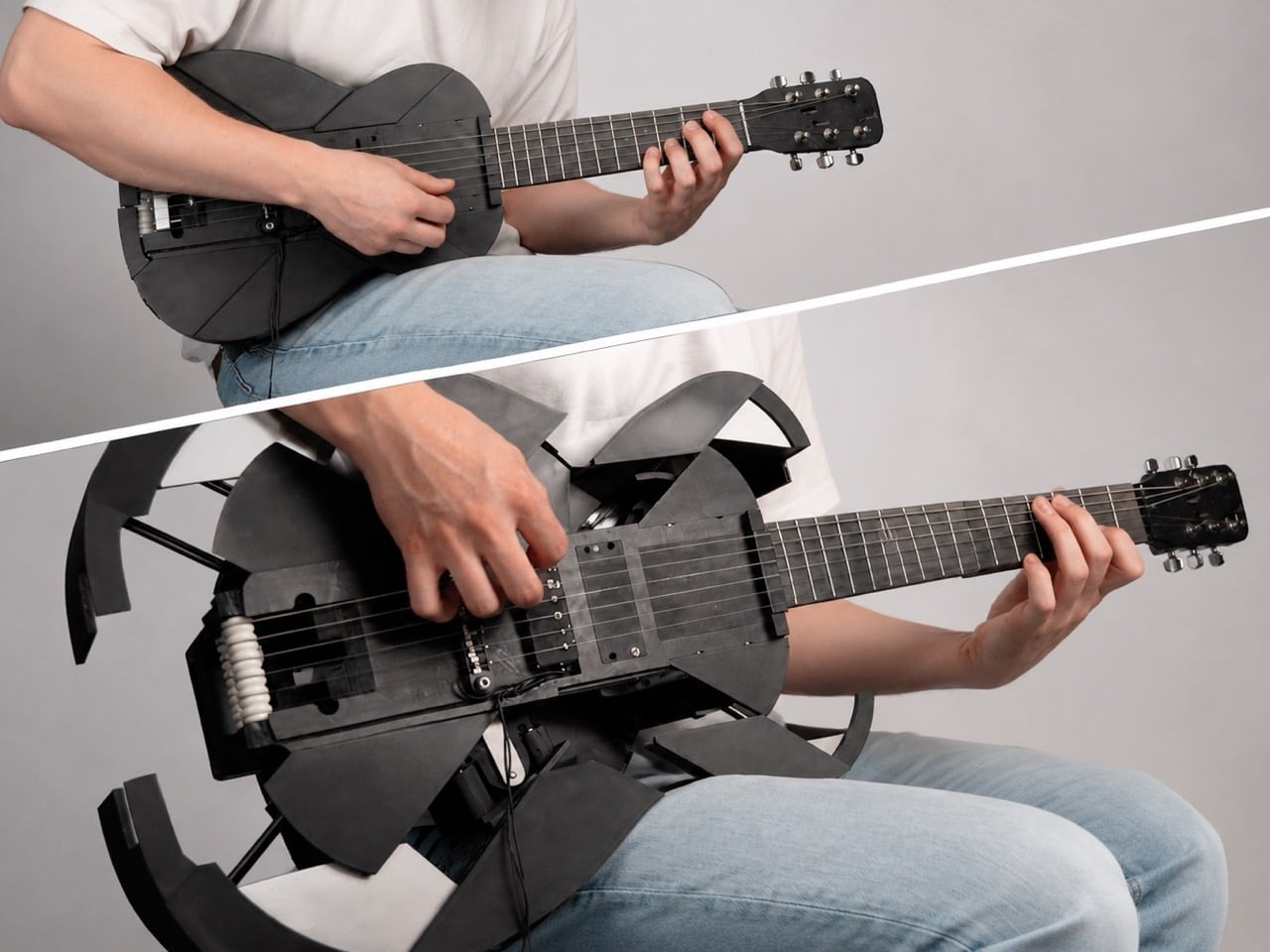
The neck telescopes straight out of the ukulele’s tiny frame, sliding one section into the next until it locks at full guitar length, gaining roughly ten inches without ever detaching from the body. A steel core runs through the sliding sections, and the joints are cut so they interlock and brace against each other the instant the neck reaches full extension. That bracing is what lets it survive eighty pounds of string tension without bowing like a fishing rod. Getting there took two failed attempts first. A folding neck, borrowed from an old instrument called the cithara orbo, worked fine on a full size guitar but was useless on a ukulele, since half a neck sat exactly where a hand needed to grip. The telescoping version solved the length problem right away, but only stopped bending once Damato worked in the steel core and reinforced joints.

The strings are custom made, roughly twice the length of a normal set, and thread onto strategically placed rollers hidden inside the neck and body. Pull the neck out and the rollers feed slack forward, push it back in and they wind the excess back up, so the same six strings carry the instrument through both tunings without coming off. That roller system only exists because everything simpler failed first. Rubber bands solved the stretch problem but sounded worse than the ukulele they replaced. A fishing reel style rig using rope worked until the rope itself stretched, turning every transformation into tuning roulette, and swapping in non stretch rope traded that for a rope that kept snapping, once badly enough to take the guitar apart. Custom strings, ordered special and worth a twenty day wait, were the fix that finally held.

The body expands through six independently moving panels that fan outward from the ukulele’s compact shell, each one traveling a different distance and angle so the outline settles into a real guitar’s curves instead of a bloated circle. An early version of that mechanism grew symmetrically in every direction, fine for something like a banjo but wrong for an instrument with a pinched waist. Getting six panels to move independently instead of in lockstep turned one mechanical problem into six. The first panel alone took three attempts before it worked reliably, and even then only about ninety percent of the time. Adding the rest of the panels made things worse, since a hub inside was quietly blocking outward movement and jamming the whole assembly. Swapping plastic components for metal fixed it, and two days assembling hundreds of parts produced a body that finally held its shape.

None of this would matter if the transformation felt gimmicky in person, but the reception says otherwise. Onlookers at Krantz’s street performances wrote it off as just another ukulele until it unfolded mid song and changed their opinion of him. A band let him bring it on stage, and the transformation held together well enough to draw applause rather than confusion. Transforming gadgets are nothing new, but the engineering here, steel joints, custom rollers, six moving panels, earns real attention over a gimmick label. Krantz and Damato spent months on problems most builders would abandon, and the payoff works under tension, every time.

The post 3D-Printed Ukulele Transforms Into an Electric Guitar In Just 2 Seconds first appeared on Yanko Design.

❌