Vue normale

  • ✇Yanko Design
  • These Old Bike Frames Upcycled Into Armchairs Are The Coolest Thing You’ll See Today
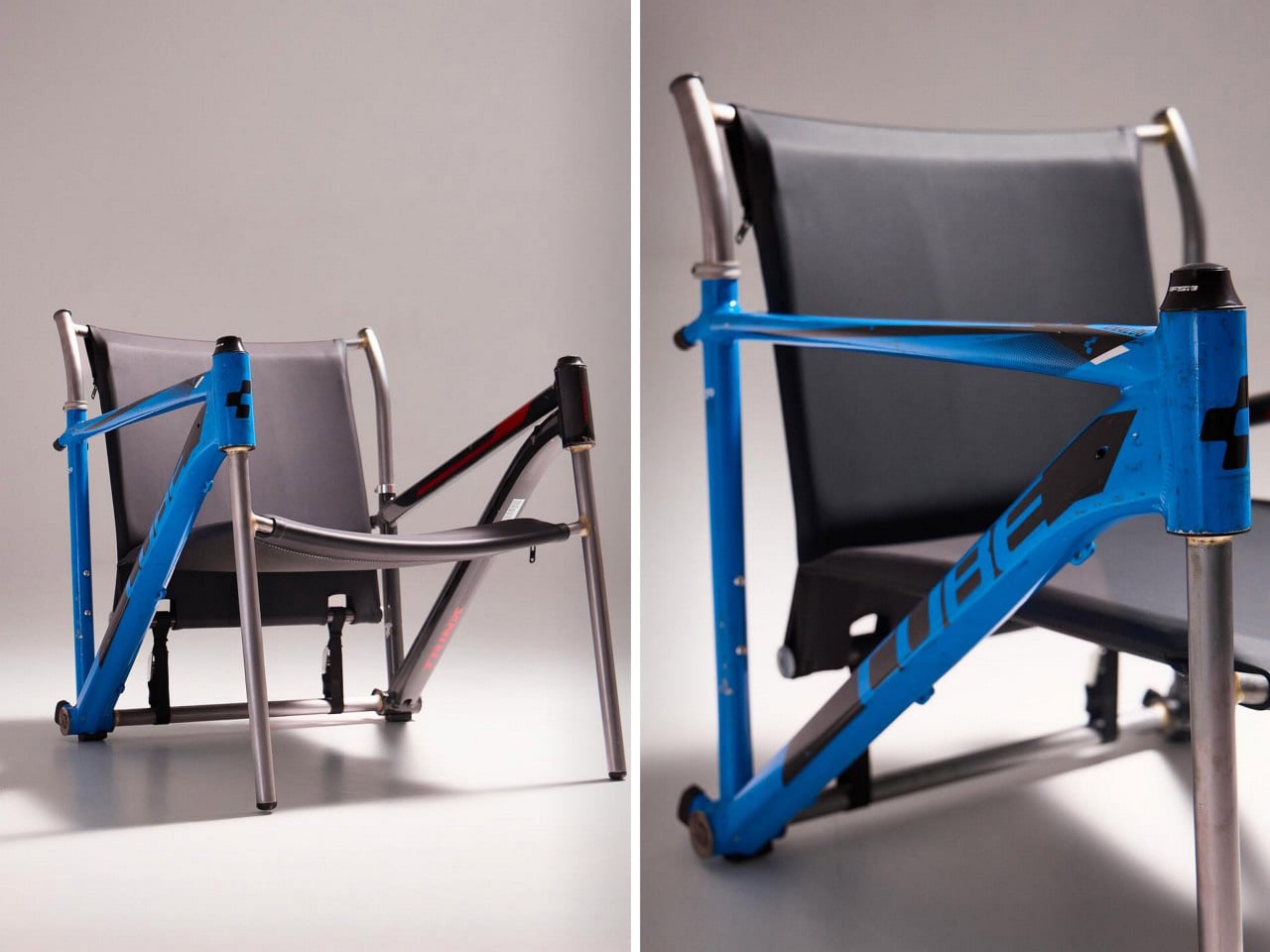
    Most upcycling projects ask you to forget what something used to be. Omri Piko Kahan’s bike frame chairs ask the opposite. The geometry is still unmistakably a bicycle frame, the head tube, the top tube, the triangulated rear triangle, all of it present and accounted for, just oriented sideways and asked to hold a person instead of propel one. Kahan, an industrial designer based in Israel, builds lounge chairs from pairs of retired frames, and the whole point is that the donor material remains
     

These Old Bike Frames Upcycled Into Armchairs Are The Coolest Thing You’ll See Today

7 avril 2026 à 19:30

Most upcycling projects ask you to forget what something used to be. Omri Piko Kahan’s bike frame chairs ask the opposite. The geometry is still unmistakably a bicycle frame, the head tube, the top tube, the triangulated rear triangle, all of it present and accounted for, just oriented sideways and asked to hold a person instead of propel one. Kahan, an industrial designer based in Israel, builds lounge chairs from pairs of retired frames, and the whole point is that the donor material remains fully readable, repurposed without being disguised.

Structurally, the approach is clean and considered. Each frame pair is positioned symmetrically, fork and chainstay ends touching the floor as legs, the top tube running horizontally as an armrest. A slung seat and backrest in leather or canvas complete the form. The result has the relaxed posture of a Barcelona chair and the material honesty of something that was clearly built, not styled.

Designer: Omri Piko Kahan

Bicycle frames are absurdly overbuilt for what Kahan is asking them to do. A modern aluminum road frame is engineered to survive repeated impact loads from a rider pushing 300 watts through rough tarmac, and it does that while weighing somewhere between 1,000 and 1,400 grams. The structural surplus in that kind of engineering is enormous, which is why two of them positioned as a chair frame and asked to support a seated adult is, from a load-bearing standpoint, almost comically within spec. The geometry does the rest. Bicycle frames already resolve forces through triangulated sections, and a lounge chair asks for exactly that kind of lateral and compressive stability.

What Kahan has figured out is the orientation problem. Flip a frame on its side and the existing tube angles don’t automatically produce a useful chair geometry. The fork legs and chainstay ends need to hit the floor at the right height relative to each other, the top tube needs to land at armrest height, and the whole thing needs to produce a seat rake that doesn’t pitch you forward or swallow you whole. The matched top tube angles across both frames in the Cube and Trek build suggest this took real iteration, because they align with a precision that reads as deliberate rather than lucky. Filed fillets at the junctions and a custom setback upper support holding the sling confirm someone was paying close attention to finish quality.

The two builds photographed so far, one pairing a blue Cube road frame with a Trek, another combining a GT Transeo 3.0 with what appears to be a Supreme-branded MTB frame, show how much the donor bikes drive the final character of each piece. The GT build in particular has a longer wheelbase geometry that gives the chair a wider, more reclined stance than the Cube version. Kahan is taking custom orders, with pricing worked out per commission, which makes sense given that no two donor frame combinations will produce the same structural or ergonomic outcome.

The post These Old Bike Frames Upcycled Into Armchairs Are The Coolest Thing You’ll See Today first appeared on Yanko Design.

  • ✇Yanko Design
  • Semicircular Wings give this Hybrid eVTOL an 800 Mile Range with 30% Less Power Consumption
    Could the most efficient VTOL design of the 21st century have been sitting in a patent office since 1928? Willard Ray Custer thought so, and spent decades trying to prove it. His channel wing concept, which set propellers into semicircular cutouts in each wing to blast high-velocity air across the lifting surface at low forward speeds, worked well enough that his team demonstrated near-vertical liftoff decades before the term eVTOL existed. Aviation’s mainstream never adopted it, partly because
     

Semicircular Wings give this Hybrid eVTOL an 800 Mile Range with 30% Less Power Consumption

7 avril 2026 à 17:30

Could the most efficient VTOL design of the 21st century have been sitting in a patent office since 1928? Willard Ray Custer thought so, and spent decades trying to prove it. His channel wing concept, which set propellers into semicircular cutouts in each wing to blast high-velocity air across the lifting surface at low forward speeds, worked well enough that his team demonstrated near-vertical liftoff decades before the term eVTOL existed. Aviation’s mainstream never adopted it, partly because the aircraft of that period were too heavy and partly because the jet age arrived and swept most unconventional configurations off the table. The concept sat in aerospace history books, occasionally surfacing in academic papers and NASA wind tunnel tests, never finding its way into a production aircraft.

HopFlyt is the company making the argument that the wait is finally over. Founded in 2016 by Rob Winston, a former NASA engineer and Marine Corps test pilot, the Maryland-based startup has built the Cyclone, a hybrid VTOL drone that pairs Custer’s channel wing geometry with pivoting mounts, modern composites, and a hybrid electric-fuel drivetrain. The channels orient rearward for vertical takeoff, pivot beneath the wing for forward cruise, and can even act as aerodynamic brakes on descent. HopFlyt claims the configuration cuts climb power consumption by a third compared to conventional VTOLs, holds fuel burn to under three gallons per hour, and enables cargo runs of 250 lbs across 800-plus miles of range. A 2027 commercial launch is the target, aimed squarely at naval resupply, offshore energy logistics, and medical delivery markets.

Designer: HopFlyt

The engineering logic behind the channel wing is cleaner than it might first appear. A conventional fixed wing generates lift by moving through air fast enough for pressure differentials to do their work, which means you need significant forward velocity before the wing becomes useful. Custer’s insight was to bring the air to the wing instead, using a propeller seated inside a curved half-channel to accelerate flow across the lifting surface regardless of forward speed. HopFlyt’s pivoting channel takes this further, allowing the geometry to optimize for hover and cruise independently rather than compromising between them. Chief Engineer Neil Winston, whose background spans NAVAIR flight test, puts it plainly: the ideas were always there, but the digital control systems, electric motors, and lightweight materials needed to execute them simply did not exist until now.

The hybrid drivetrain is what gives the Cyclone its range credentials and separates it from the crowded field of pure-electric eVTOLs currently chasing urban air taxi certifications. Battery power handles the vertical takeoff and hover phases, where the channel wing’s efficiency advantage is most pronounced, while a turbogenerator takes over for forward cruise, extending endurance far beyond what any battery pack realistically supports today. HopFlyt puts the operational cost savings at 90 percent compared to helicopters performing equivalent missions, a figure that, if it holds up under real-world conditions, makes the Cyclone genuinely disruptive in sectors where helicopter logistics are currently the only viable option. Offshore energy platforms and naval resupply operations run on helicopter economics right now, and those economics are punishing.

HopFlyt has reached this point on a fraction of the capital that comparable advanced air mobility startups have burned through, operating out of a private hangar in Maryland with a team whose combined aerospace experience runs to over a century. The company is currently in a Series A raise to fund hybrid-electric prototype development and initiate flight demonstrations ahead of that 2027 target. Whether the Cyclone becomes the aircraft that finally vindicates Willard Ray Custer’s century-old intuition depends on what those demonstrations produce. The aerodynamics have always been sound. Now the rest of the technology has caught up.

The post Semicircular Wings give this Hybrid eVTOL an 800 Mile Range with 30% Less Power Consumption first appeared on Yanko Design.

  • ✇Yanko Design
  • 100-Meter A100 concept yacht redefines luxury sailing with massive interior volume
    Modern sailing superyachts often struggle to balance two competing priorities: the elegance and efficiency of wind-powered travel and the expansive living spaces typically associated with large motor yachts. The A100 sailing yacht concept approaches this challenge with a bold rethink of traditional yacht architecture. Developed through a collaboration between Van Geest Design and Rob Doyle Design, the 100-meter vessel proposes a layout that delivers the interior volume of a motor yacht while ma
     

100-Meter A100 concept yacht redefines luxury sailing with massive interior volume

7 avril 2026 à 15:15

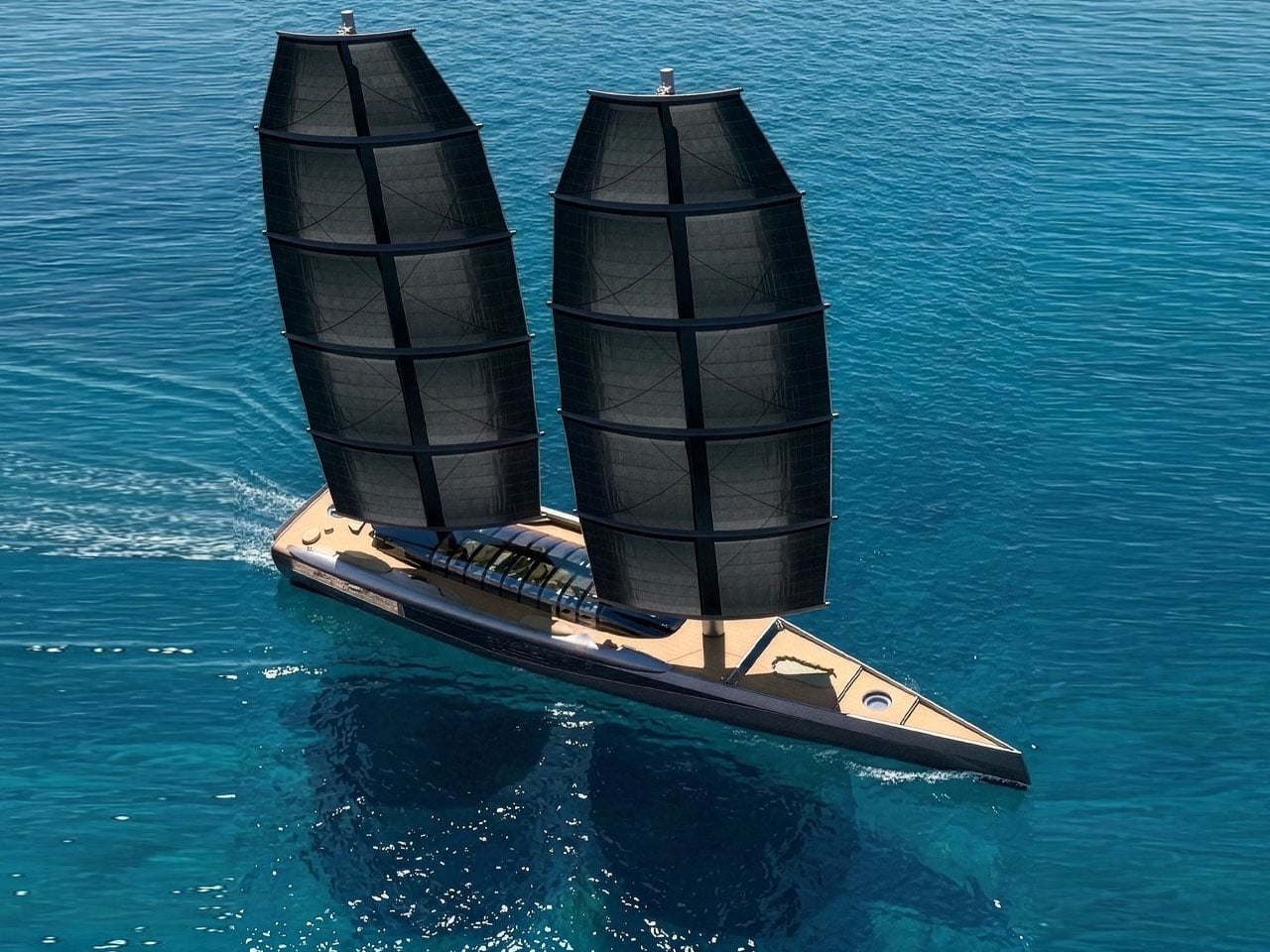
Modern sailing superyachts often struggle to balance two competing priorities: the elegance and efficiency of wind-powered travel and the expansive living spaces typically associated with large motor yachts. The A100 sailing yacht concept approaches this challenge with a bold rethink of traditional yacht architecture. Developed through a collaboration between Van Geest Design and Rob Doyle Design, the 100-meter vessel proposes a layout that delivers the interior volume of a motor yacht while maintaining the identity and performance of a sailing superyacht.

At the core of the concept is a design strategy that maximizes usable space. Traditional sailing yachts require wide side decks for crew movement and sail handling, which limits interior width. The A100 concept reduces the width of these side decks, allowing the main deck to stretch nearly the full beam of the yacht. This architectural shift creates significantly larger interior spaces than typically found on sailing yachts of comparable size.

Designer: Van Geest Design and Rob Doyle Design

The main deck is designed as the primary social and living area. Here, the owner’s suite occupies a substantial portion of the deck, offering a level of space rarely seen on sailing yachts. Adjacent to the suite is a central lounge and formal dining area intended for gatherings and entertaining. An additional space can function as a library or a private cinema, adding flexibility to the interior layout. Large sections of glass surround these living areas, filling the interior with natural light and offering uninterrupted views of the ocean.

Below deck, the yacht accommodates guest cabins along with a variety of leisure-focused facilities. This level also houses a dedicated diving room and storage for water toys such as jet skis and e-foils, allowing guests to transition between onboard relaxation and water activities easily. The layout is designed to maintain a strong visual connection with the surrounding seascape while ensuring privacy and comfort for those on board.

Outdoor areas play an equally important role in this larger-than-life superyacht design. The upper deck includes the navigation and steering stations, along with flexible lounge spaces for relaxation or wellness activities. At the stern, a large beach club spans the full width of the yacht, creating a welcoming space for guests to gather close to the water. Toward the bow, storage areas accommodate tenders and recreational equipment without disrupting the clean lines of the deck.

The sailing system is based on two free-standing DynaRig masts, a modern configuration used on some of the world’s largest sailing yachts. The system employs curved yards that support multiple sails, all of which can be deployed and adjusted electronically at the push of a button. The rotating masts simplify sail handling while maintaining efficient propulsion for a vessel of this scale.

Beyond its layout and sailing system, the A100 concept also reflects growing interest in more sustainable superyacht designs. By relying heavily on wind propulsion supported by advanced onboard energy systems, the concept explores ways to reduce reliance on conventional engine power. If brought to life, the A100 would stand among the largest sailing yachts ever built!

The post 100-Meter A100 concept yacht redefines luxury sailing with massive interior volume first appeared on Yanko Design.

❌