❌

Vue normale

  • ✇Korben
  • Mighty DOOM - Bethesda l'a éteint mais ses joueurs l'ont rallumé
    Mighty DOOM, le petit shoot roguelite que Bethesda avait sorti sur mobile en mars 2023, tourne de nouveau !! Alors bien sûr pas sur les serveurs officiels, qui sont éteints depuis deux ans, mais sur un serveur monté et hébergé par des fans, qui ont refait tout le boulot à la main. Mais avant, pour ceux qui ont raté un épisode, en fait, le jeu est mort parce
     

Mighty DOOM - Bethesda l'a éteint mais ses joueurs l'ont rallumé

22 septembre 2026 à 06:00

Mighty DOOM, le petit shoot roguelite que Bethesda avait sorti sur mobile en mars 2023, tourne de nouveau !! Alors bien sûr pas sur les serveurs officiels, qui sont éteints depuis deux ans, mais sur un serveur monté et hébergé par des fans, qui ont refait tout le boulot à la main.

Mais avant, pour ceux qui ont raté un épisode, en fait, le jeu est mort parce que Microsoft a fermé Alpha Dog Games, le studio qui le développait, en mai 2024, c'est-à-dire en même temps qu'Arkane Austin et Tango Gameworks (le studio de Redfall et celui de Hi-Fi Rush... tout ça le même jour, l'hécatombe). Et ce qui devait arriver arriva, puisque trois mois plus tard, le 7 août 2024, les serveurs de Mighty DOOM se sont arrêtés.

Et ce n'est pas rien parce que le jeu avait quand même été téléchargé 7,6 millions de fois sur mobile...

C'est pour ça que le projet Mighty Resurrection a décidé de redistribuer lui-même un APK Android du jeu. Il nécessite Android 10 minimum et il pointe directement sur le serveur de la communauté, dont le compteur annonçait déjà au moment d'écrire ces lignes, 449 comptes enregistrés.

Au-delà de l'APK "client", ce qui est cool, c'est qu'en face, il y a un logiciel serveur dont le code est public et que vous pouvez également lancer chez vous, si vous le souhaitez.

Ce qui est impressionnant surtout, c'est le taf. Parce qu'il a fallu régler l'authentification, les chapitres du jeu, l'inventaire des objets, les talents, la boutique, le battle pass, et même tout ce qui était achats intégrés et gestion de l'identité Xbox. En gros, chaque morceau que le jeu Android réclamait au serveur officiel, il a fallu entièrement le recoder.

Le truc un peu fou, c'est qu'Alpha Dog Games a retrouvé son indépendance cet été. Le studio est donc de nouveau entre les mains de ses fondateurs, sauf que la licence DOOM, elle, ne lui appartient pas. Donc impossible pour eux de rallumer leur propre jeu. Par contre, ils ont les sources, donc je me dis que s'ils étaient un petit peu sympas, ils pourraient aider les développeurs de Mighty Resurrection en leur offrant le code.

On verra bien si ça leur traverse l'esprit.

Merci à Maxime pour l'info.

Source : le site de Mighty Resurrection et le dépôt du serveur sur GitLab .

  • ✇Yanko Design
  • Poco F9 Ultra Review: Great Sound, Grown-Up Design
    PROS: Bose-tuned speaker remains a genuine standout big , bright 185Hz display Huge 8,050mAh battery Great performance CONS: Relatively large and heavy body will not suit everyone Ultrawide still does not feel especially wide RATINGS: AESTHETICSERGONOMICSPERFORMANCESUSTAINABILITY / REPAIRABILITYVALUE FOR MONEYEDITOR'S QUOTE:The F9 Ultra feels like Poco growing into its strengths, with Bose-tuned sound still leading the experience. The Poco F8 Ultra f
     

Poco F9 Ultra Review: Great Sound, Grown-Up Design

Par : Aki Ukita
19 septembre 2026 à 18:30

PROS:


  • Bose-tuned speaker remains a genuine standout

  • big , bright 185Hz display

  • Huge 8,050mAh battery

  • Great performance

CONS:


  • Relatively large and heavy body will not suit everyone

  • Ultrawide still does not feel especially wide

RATINGS:

AESTHETICS
ERGONOMICS
PERFORMANCE
SUSTAINABILITY / REPAIRABILITY
VALUE FOR MONEY

EDITOR'S QUOTE:

The F9 Ultra feels like Poco growing into its strengths, with Bose-tuned sound still leading the experience.

The Poco F8 Ultra felt like a turning point for Poco. Up to that point, the brand had always been easy to understand. You bought a Poco for speed, sharp pricing, and a bit of swagger. The F8 series added something new to that formula with Bose-tuned speakers, and that changed the feel of the phone in a way a faster chip or brighter screen usually does not.

It was not just about volume or clarity. The whole device felt more built around entertainment. Games had more punch, films had more room to breathe, and even everyday audio felt less like an afterthought. The denim-inspired rear panel helped give the F8 Ultra a bit of tactile identity too, even if the finish was more denim-adjacent than truly fabric-like, but the thing that stayed with you was the sound.

Designer: POCO

The Poco F9 Ultra takes that idea and pushes it further. Rather than treating the Bose-tuned system as a one-off flourish, Poco seems to be building on it with more confidence this time, wrapping that sound-first approach in a package that feels bigger, more polished, and more ambitious. If the F8 Ultra introduced a new side of Poco, the F9 Ultra feels like the phone that tries to make it stick.

Aesthetics

If the Poco F8 Ultra leaned young and fashionable, the Poco F9 Ultra leans sophisticated. It keeps the brand’s taste for visual confidence, but expresses it in a more restrained way, swapping tactile playfulness for cleaner lines, flatter surfaces, and a more polished sense of control.

That shift is obvious the moment you look at the back. The denim-inspired treatment from the F8 Ultra is gone, replaced by a finish that feels more metallic and more architectural. The overall silhouette is simpler, but it does not come across as plain. Instead, it feels like Poco has traded novelty for composure, letting shape and proportion do more of the work.

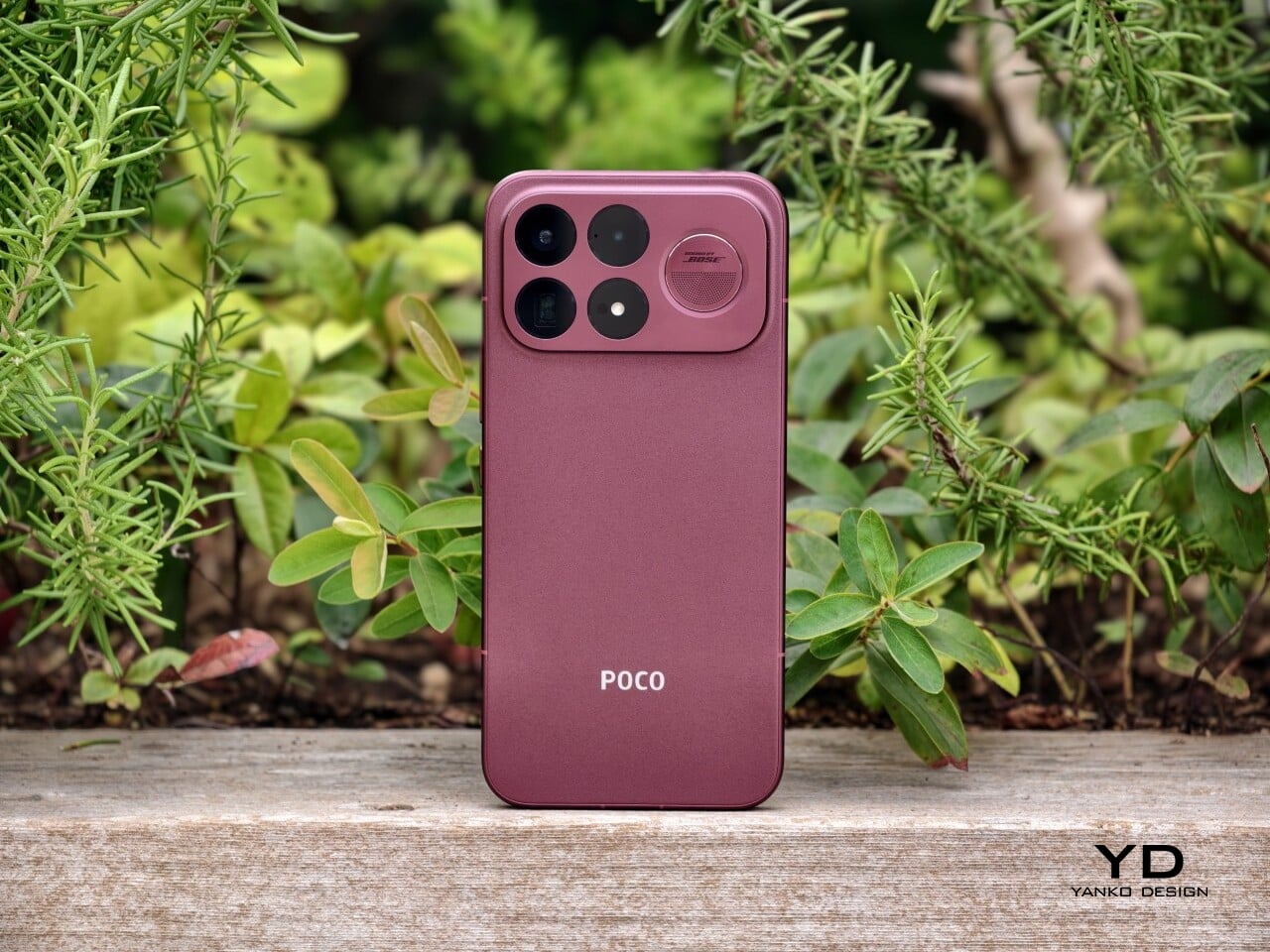
The camera island design remains largely the same as its predecessor, but it feels more resolved here. A large rectangular module sits across the top portion of the phone, housing three cameras and an LED flash in a neat 2 by 2 arrangement, with the speaker grille set off to the right. It is still a bold layout, but one that now feels less experimental and more like a defining part of the phone’s identity.

New to the F9 Ultra is a dynamic light ring built around the speaker grille. It supports personalized visual effects for incoming calls, games, and music. The effect itself appears to be fairly simple, closer to a clean white LED accent than anything overly flashy, but that may be exactly the point. It feels like Poco’s way of keeping a hint of gaming-phone energy alive without letting it overwhelm the more sophisticated direction of the design.

The two colors also tell slightly different stories. The Dark Cherry finish is the more expressive option, bringing warmth and a bit of drama without tipping into flashiness. The Black version feels more understated and technical, especially with the red side-button accent adding a small but effective point of contrast. Both work, but they speak to different moods. One is richer and more characterful, while the other is cooler and more controlled.

Ergonomics

That more sophisticated look does come with a more substantial physical presence. At 235g, the Poco F9 Ultra is about 15g heavier than the F8 Ultra, and you feel that extra weight immediately. It sits firmly on the heavier side, especially in one-handed use, where its size and mass are hard to ignore.

Its dimensions, 163.49 x 77.94 x 8.74mm, are broadly in line with its predecessor, so the overall footprint will feel familiar if you are coming from the older model. It is still a wide phone, though, and not the easiest to manage with one hand. The curved edges do help soften the grip and make it feel less severe than the numbers suggest, but this is still a device that feels more at home in two-handed use.

The matte finish does its part as well. It feels premium, pleasant to touch, and better at disguising smudges than a glossier surface would be. Add in the familiar button placement and unchanged in-display fingerprint scanner, and the F9 Ultra ends up feeling less like a phone you need to relearn and more like one you simply need to get used to carrying.

Performance

The F9 Ultra runs on Qualcomm’s Snapdragon 8 Elite Gen 5, the same flagship platform used in the F8 Ultra. Poco has also retained the VisionBoost D8, a dedicated chip aimed at improving gaming and video performance. In practice, that makes the F9 Ultra feel less like a leap in raw power and more like a refinement of an already capable performance formula.

The F9 Ultra pairs that gaming focus with a 6.9-inch 1.5K AMOLED display, and it is exactly the kind of panel you would want on a phone built around entertainment. It is large, sharp, and vibrant, with a refresh rate that gives the phone a clear performance edge in games that can actually take advantage of it. Outside of gaming, that same smoothness carries over into scrolling, animations, and general navigation, even if the practical difference becomes less dramatic in everyday use.

Brightness is another clear strength. Poco says this is the first global lineup to use the new M11 luminescent material, which helps the panel reach up to 4,500 nits in peak brightness and as high as 10,000 nits for HDR highlights. The numbers are extreme, but the more practical takeaway is that the screen stays very readable outdoors and gives bright scenes a stronger sense of punch and contrast without losing too much detail.

The F9 series is also Poco’s first to push to 185Hz, with support for 24 games running at a native 185fps. That sounds more dramatic than it always feels in practice, because the benefit depends heavily on the kind of game you are playing. In faster titles like Blood Strike, Crossfire: Legends, and Brawl Stars, the higher refresh rate does make a difference. Motion looks cleaner, visual updates come faster, and the game feels a little more immediate under your fingers. In slower games like Clash of Clans, Clash Royale, or Hearthstone, the gain is much smaller. You still get smoother animations and interface movement, but not the same kind of gameplay advantage.

In an hour-long session of Blood Strike at the highest graphic settings, the F9 Ultra was able to hold 185fps without any obvious frame drops. Just as importantly, it did not get uncomfortably hot, staying at around 40 degrees Celsius on the surface. There is clearly enough cooling here to keep performance from falling off over time, but the more important takeaway is that the phone stays consistent under load.

Main Camera, 1x

Portrait mode, Main Camera, 3.1x

The F9 Ultra is the second phone to come out of Poco’s partnership with Bose, which makes the collaboration feel less like a one-off experiment and more like part of the series identity. The Bose-tuned speaker system remains one of its most distinctive features, and also one of the easiest to appreciate in daily use. Poco says it has redesigned the acoustic port and upgraded the dual speakers for clearer sound and richer bass. It also keeps the sound profile presets and 10-band EQ introduced on the F8 Ultra, which means there is still plenty of room to tailor the sound to your liking.

Telephoto Camera, 5x

Telephoto Camera, 10x

In use, the speakers are easy to like. Just like the F8 Ultra, the F9 Ultra delivers some of the best smartphone audio you can get. The sound is fuller and more open than what most phones manage, with enough bass presence to give games, films, and music a bit more body. Dialogue comes through clearly, and the overall presentation feels less cramped than the average smartphone speaker setup.

Main Camera, 1x

Telephoto Camera, 5x

Telephoto Camera, 10x

The F9 Ultra upgrades the main camera from 50MP on the F8 Ultra to 200MP here, though the sensor itself is smaller, dropping from 1/1.31-inch to 1/1.56-inch. That makes it less a straightforward upgrade and more a different kind of tradeoff. The rest of the setup remains familiar, with a 50MP 5x telephoto, a 50MP ultrawide, and a 32MP front camera.

Poco has also made a subtle but useful change to the focal lengths. The F9 Ultra uses a 24mm-equivalent main camera and a 17mm-equivalent ultrawide, compared with 23mm and 18mm on the F8 Ultra. The shift is small, and the ultrawide still does not feel especially expansive, but the added separation between the two lenses makes the jump from main to ultrawide feel a little more purposeful.

Ultrawide Camera, 0.7x

Main Camera, 1x

Telephoto Camera, 10x

In use, the main camera captures photos with good detail, solid dynamic range, and vibrant color. The 5x telephoto is also capable, though it tends to produce images that look a bit more saturated and contrast-heavy. Video is solid too, with crisp footage and enough consistency to make the camera system feel dependable for everyday shooting.

Night Shot, Ultrawide Camera, 0.7x

Night Shot, Main Camera, 1x

Night Shot, Telephoto Camera, 5x

Night Shot, Telephoto Camera, 10x

Battery life remains one of the F9 Ultra’s biggest strengths. The 8,050mAh battery is enormous even by flagship standards, and it gives the phone a clear advantage in the kind of heavy use it is designed for. In my use, it was easy to stretch the phone across two days on a charge, which suits the F9 Ultra’s media-heavy, gaming-friendly character especially well.

Charging is just as capable, with 100W wired and 50W wireless support, plus 27W wired reverse charging and 22.5W wireless reverse charging. It is a battery setup that feels as well-rounded as the rest of the phone.

Sustainability

The F9 Ultra is not a phone that talks much about sustainability in the material-driven sense, but it does make a decent case for longevity. Its IP68 rating and Corning Gorilla Glass 7i should help it stand up to everyday wear, which is still one of the most practical ways a phone can stay useful for longer.

Poco also promises four major Android OS updates and six years of security patches, which gives the F9 Ultra a fairly credible long-term support story. That matters because software support plays a big role in whether a phone remains worth keeping. Poco may not be leading the conversation around recycled materials or repairability here, but the basics of durability and usable lifespan are in place.

Value

The F9 Ultra starts at $799 for the 12GB/256GB version, which puts it $70 above the F8 Ultra. That is still an increase, but not an especially aggressive one in the current climate, where similar phones have seen price jumps closer to $100. Some of that restraint may come from Poco reusing the same Snapdragon 8 Elite Gen 5 platform, which likely helped balance out the rising cost of RAM and other components.

As an upgrade, though, the case is less convincing. If you already have the F8 Ultra, moving to the F9 Ultra does not make a lot of sense unless you specifically want the new design, the 185Hz display, or the 200MP main camera. As a fresh buy, however, it remains one of the best affordable flagship-level phones around. Poco may be edging upward in price, but it still knows how to deliver a lot of phone for the money.

Verdict

The Poco F9 Ultra feels like Poco settling into a formula that actually works. The design is more mature, the gaming side is still strong, and the Bose-tuned speakers remain one of the best reasons to care about the series in the first place. Add the huge battery and the 185Hz display, and you end up with a phone that feels very sure of what it wants to be.

If you already have the F8 Ultra, I do not think this is the upgrade to chase. The older phone is still good enough that the differences here feel more iterative than urgent. But if you are buying fresh, the F9 Ultra is still one of the better affordable flagship-level phones around, especially if you care as much about sound and gaming as you do about the usual specs.

The post Poco F9 Ultra Review: Great Sound, Grown-Up Design first appeared on Yanko Design.

  • ✇Yanko Design
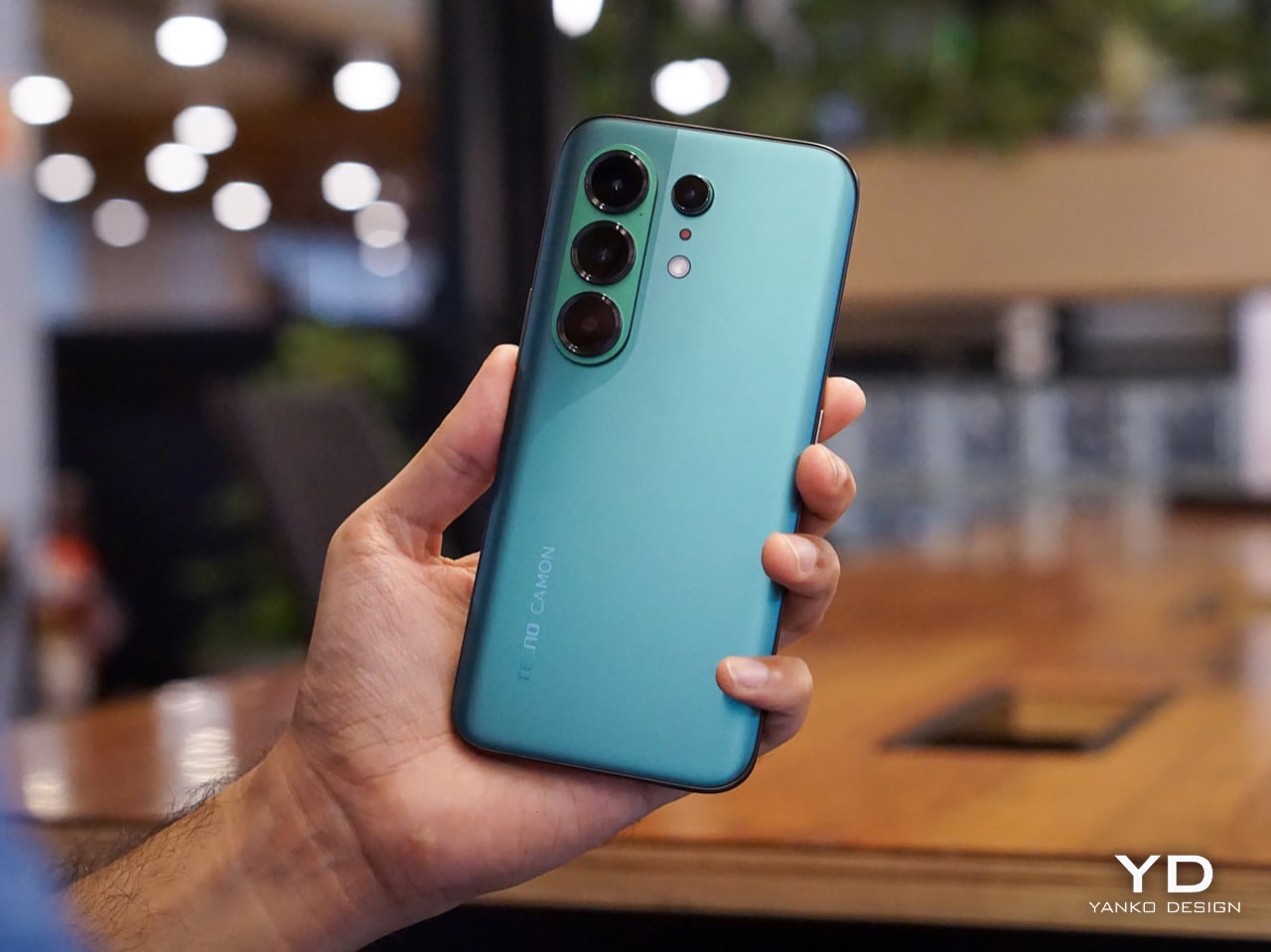
  • TECNO CAMON Slim 5G Review: Thinner than a Pencil, Tough as a Tank
    PROS: Unbelievably slim and lightweight design Striking and stylish art-inspired finish Large 6,000mAh battery despite slim profile Exceptional durability with quad-IP rating, supporting underwater photography CONS: Modest hardware specs No dedicated telephoto camera RATINGS: AESTHETICSERGONOMICSPERFORMANCESUSTAINABILITY / REPAIRABILITYVALUE FOR MONEYEDITOR'S QUOTE:Slim, art-inspired, and tougher than it looks, the TECNO CAMON Slim 5G packs a 6,000mA
     

TECNO CAMON Slim 5G Review: Thinner than a Pencil, Tough as a Tank

Par : JC Torres
18 septembre 2026 à 11:20

PROS:


  • Unbelievably slim and lightweight design

  • Striking and stylish art-inspired finish

  • Large 6,000mAh battery despite slim profile

  • Exceptional durability with quad-IP rating, supporting underwater photography

CONS:


  • Modest hardware specs

  • No dedicated telephoto camera

RATINGS:

AESTHETICS
ERGONOMICS
PERFORMANCE
SUSTAINABILITY / REPAIRABILITY
VALUE FOR MONEY

EDITOR'S QUOTE:

Slim, art-inspired, and tougher than it looks, the TECNO CAMON Slim 5G packs a 6,000mAh battery into a body thin enough to turn heads.
award-icon

Slim phones have always come with a catch. Shave down the body and something else usually gets sacrificed: usually the battery, sometimes the durability, occasionally both. The TECNO CAMON Slim 5G doesn’t play by that old rulebook. At just 6.39mm thick, it still packs a 6,000mAh battery, 5G connectivity, and a durability rating most phones twice its thickness wouldn’t dare claim.

This review spent real time with the phone away from spec sheets, mostly to see if the design holds up once the initial wow wears off. That meant handling the Neo Mondrian finish TECNO sent for testing, carrying it through a normal week, testing the camera in situations that actually matter, and checking whether the durability claims survive contact with water and everyday clumsiness. The design conversation comes first.

Designer: TECNO

Aesthetics

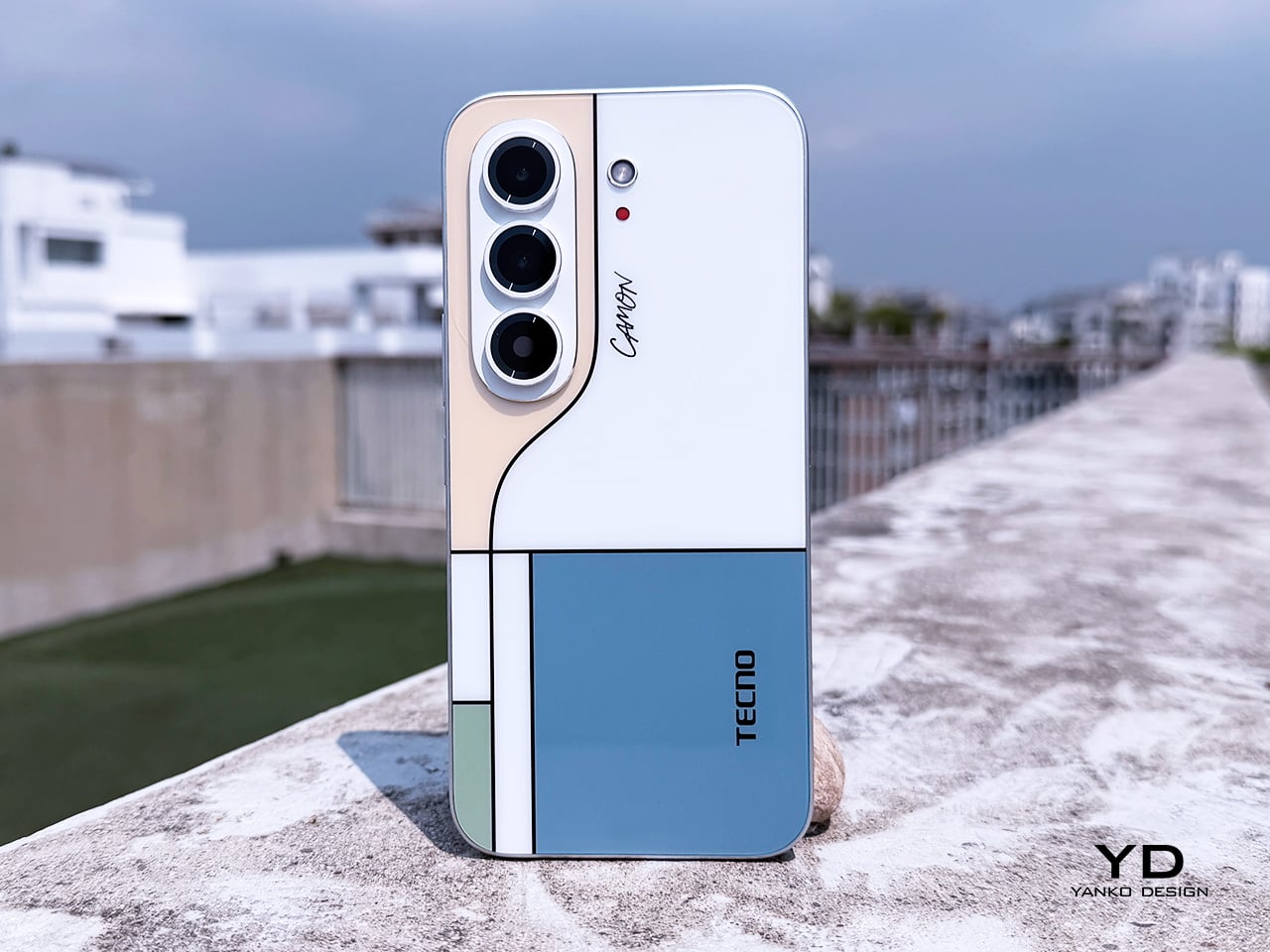
Pull the CAMON Slim 5G out in public and watch what happens. People notice a phone this thin the way they’d notice a watch too elegant for its price tag, usually with a double take and a request to hold it. TECNO carried over the swan-neck curve from the CAMON 50 series, and on a body this slender, that curve reads like a signature rather than a spec sheet footnote.

TECNO sent the Neo Mondrian colorway for this review, and it’s the strongest argument for treating a phone back as an actual canvas. Expose the panel to sunlight and yellow, green, and cyan blocks slowly bloom out of white, forming the grid Piet Mondrian made famous a century ago. It’s a photochromic trick, but watching it happen feels less like a gimmick and more like a magic show.

Neo Mondrian isn’t the only finish doing something interesting. Van Gogh Blue uses similar light-reactive techniques to make its swirling nebula pattern look like it’s actually rotating as shadows shift across it, closer to a painting than a phone back. Matisse Black leans into fluorescent green or pink color blocks that echo the artist’s cut-out work, while Burgundy Red blends fiberglass and matte texture into a warm, understated finish. Rebel Pink keeps things simpler, pairing a black body with sharp pink accents for something a little more playful.

Phone backs used to be an afterthought, something to protect rather than admire, which is why so many people slapped an opaque case on day one without a second thought. That’s changing. As manufacturers invest more in finishes, textures, and light-reactive coatings, more owners are leaving their phones bare, treating the back panel the same way they’d treat a piece of art they paid good money to display.

Ergonomics

Carrying the CAMON Slim 5G is where the thin body actually pays off day to day. It slides into a front pocket without that telltale bulge, sits flat against a jacket without pulling on the fabric, and feels lighter in hand than the display size suggests. After a few days, reaching for a thicker phone almost feels like picking up a brick by comparison.

Those flat edges aren’t just a style choice borrowed from boxier design trends. They give fingers something to actually grip onto, instead of sliding off a rounded rim the way slippery slab phones tend to do. The matte texture on the Neo Mondrian panel adds even more confidence, and TECNO’s wet and oily finger recognition keeps the touchscreen responsive when hands aren’t exactly dry or clean.

Performance

The 6.78-inch AMOLED display runs at 1.5K resolution and 144Hz, and both numbers translate into a screen that looks sharp and feels fast under a thumb. Photos pop with the kind of contrast only AMOLED delivers, video looks great for a lunch break binge, and scrolling through a feed never feels like it’s fighting the hardware. TÜV Rheinland’s low blue light certification is a nice bonus for long reading sessions.

Under the hood sits a MediaTek Dimensity 7300e, a processor built for balance rather than benchmark bragging rights. It handles social apps, photo editing, and everyday multitasking without hiccups, though demanding 3D games will ask more of it than it’s built to give. The 8GB of RAM stretches to 24GB with virtual memory extension, which covers most multitasking habits without needing to close every open app.

The 50MP Sony LYTIA 700C handles most of the photography workload, and it earns that responsibility. A 1/1.56-inch sensor paired with an f/1.8 lens pulls in plenty of light for evening shots, while the closed-loop ball motor keeps focus locked even when subjects won’t sit still. The 8MP ultra-wide feels more like a footnote, and there’s no telephoto here, but the main camera rarely leaves you wanting one.

The real showstopper is the 6,000mAh battery, a number that seems almost impossible once you remember this phone measures 6.39mm thick. It comfortably carries a full day of camera use, video, and scrolling without the battery anxiety that usually comes with slim designs. That same waterproofing also unlocks a dedicated underwater photography mode, one that kicks in automatically the moment the phone senses it’s gone for a swim.

Sustainability

TECNO rates the CAMON Slim 5G at IP69K, IP69, IP68, and IP66, a combination that’s rare even among phones that don’t have to worry about staying thin. That covers everything from high-pressure water jets to dust particles to full submersion, which is a lot of technical armor for a phone this delicate-looking. Finding this rating on a 6.39mm body is the kind of detail that quietly impresses.

There’s also a MIL-STD-810 rating covering shock and drop resistance, which pairs nicely with features like Rain Touch and Waterproof Case Touch that keep the screen usable in a downpour or behind a case. This doesn’t read like a feature bolted on at the last minute. It feels like TECNO wanted this phone to survive actual daily chaos, not just look good sitting still on a shelf.

Longevity extends past the hardware, too. TECNO promises three major OS upgrades and five years of security patches, plus a 60-month smoothness certification from TÜV SÜD. That’s a meaningful commitment in a market where phones often get abandoned after two update cycles. A well-built object is worth keeping around, and TECNO seems to be betting that owners will want to hold onto this one for a while.

Value

TECNO hasn’t confirmed global pricing yet, but early indications point to somewhere around $400. At that number, buyers get a phone with genuine art-inspired finishes, a 6.78-inch 144Hz AMOLED screen, a Sony-backed 50MP camera with real stabilization, a 6,000mAh battery, and a durability rating that most phones twice the price don’t bother chasing. That’s a fairly generous list for a phone that costs less than most flagships.

Most phones in this price range make you pick a lane. Go thin, and the battery usually suffers, or the body skips water resistance entirely, or the software support runs out after a couple of years. TECNO’s five-year update promise and its layered durability ratings quietly add up to lower long-term cost, since a phone built and supported to last half a decade doesn’t need replacing as often.

This phone makes the most sense for people who are tired of carrying an identical black slab and want something that says a little more about them. It’s not the right pick for hardcore mobile gamers chasing max frame rates, or photographers who need optical zoom on tap. For nearly everyone else, it covers daily needs while looking like it belongs on a gallery shelf.

Verdict

After a few days of actual use, the 6,000mAh battery and the quad-IP rating stop feeling like marketing footnotes and start feeling like the whole point. TECNO built a phone that looks like it belongs in a design museum and still survives a rainy commute or a splash at the sink. The Neo Mondrian panel alone gives it a personality that’s genuinely hard to find anywhere near this price.

Plenty of phones ask you to choose between something beautiful and something dependable, and most buyers have quietly accepted that trade-off as the cost of owning a nice-looking device. The CAMON Slim 5G makes a strong case that the choice was never as necessary as the industry made it seem. It’s a phone that looks good on a café table and still works fine after falling off of one.

The post TECNO CAMON Slim 5G Review: Thinner than a Pencil, Tough as a Tank first appeared on Yanko Design.

  • ✇Korben
  • RistOS - L'Android sans applis dont le cerveau reste chez vous
    C'est l'histoire d'un smartphone Pixel de Google sur lequel il n'y a absolument rien... Vous l'allumez, pas une icône d'application, rien à faire défiler, pas de widget météo et ce genre de conneries... Non, vous avez juste l'heure, un gros bouton "micro" au milieu de l'écran et une ligne de saisie tout en bas pour ceux qui préfèrent taper. L'écran d'accueil au complet
     

RistOS - L'Android sans applis dont le cerveau reste chez vous

10 septembre 2026 à 07:04

C'est l'histoire d'un smartphone Pixel de Google sur lequel il n'y a absolument rien... Vous l'allumez, pas une icône d'application, rien à faire défiler, pas de widget météo et ce genre de conneries... Non, vous avez juste l'heure, un gros bouton "micro" au milieu de l'écran et une ligne de saisie tout en bas pour ceux qui préfèrent taper.

L'écran d'accueil au complet : l'heure, le bouton à maintenir pour parler, et la ligne de saisie pour ceux qui préfèrent taper.

Ce truc ça s'appelle RistOS, et c'est un firmware pour Google Pixel 10a qui a pour objectif de remplacer le lanceur d'Android par un assistant vocal. Tout ce qui reste ensuite du téléphone tient dans un menu qui apparaît sur le côté : Téléphone, messages, appareil photo, galerie, cartes hors ligne (c'est Organic Maps, embarqué dans l'image), lampe torche et réglages.

Sept accès, et c'est fini. Pas d'app store, pas de navigateur, pas de compte Google, et évidemment aucun moyen d'ajouter quoi que ce soit.

Le menu sorti sur le côté, ses sept entrées, et rien d'autre à faire glisser.

Le projet repose sur GrapheneOS, sans être affilié ni à celui-ci ni à Google, et il ne tourne que sur le Pixel 10a (lien affilié), que Google vend encore la "modique" somme de 389 €.

Bref, par défaut, si vous appuyez sur ce gros bouton micro, absolument rien n'écoutera ce que vous avez dit, parce que l'image publique ne contient aucune adresse de serveur. Pour que cela fonctionne, vous devrez aller dans les réglages et remplir le champ dédié afin de lui indiquer l'URL de votre backend Rist. C'est donc le serveur, que vous devez installer comme ceci , qui récupèrera l'audio encodé et qui ensuite vous répondra au travers du téléphone.

L'idée, c'est que comme ça, on peut changer de téléphone sans souci, puisque tout est centralisé sur le serveur. C'est donc assez tranché comme usage, surtout que l'install efface tout ce qui est sur l'appareil. Mais bon, c'est peut-être ça le futur... Une coquille vide qui discute avec un serveur IA personnel, qui se trouve chez vous.

Par contre, n'espérez plus pouvoir utiliser votre téléphone pour appeler, par exemple, un service d'urgence, ça ne fonctionnera pas. Et si vous préférez simplement virer l'emprise de Google de votre téléphone sans avoir à vous monter un serveur entier derrière, /e/OS fera le travail .

Source : RistOS sur GitHub

  • ✇Yanko Design
  • An Android Drawing Tablet With 127 Layers That Still Feels Like Paper
    Most Android drawing tablets make you choose between a screen that feels like paper and hardware fast enough to keep up with a real workflow. The Kamvas Pad 12 refuses that trade-off. Huion built a 12.2-inch standalone tablet around a textured, paper-like display and paired it with enough processing power to hold 127 layers open without stuttering, treating the screen as a genuine canvas rather than a stylus afterthought. That screen runs a 3:2 aspect ratio instead of the usual 16:9, and the di
     

An Android Drawing Tablet With 127 Layers That Still Feels Like Paper

Par : JC Torres
8 septembre 2026 à 09:20

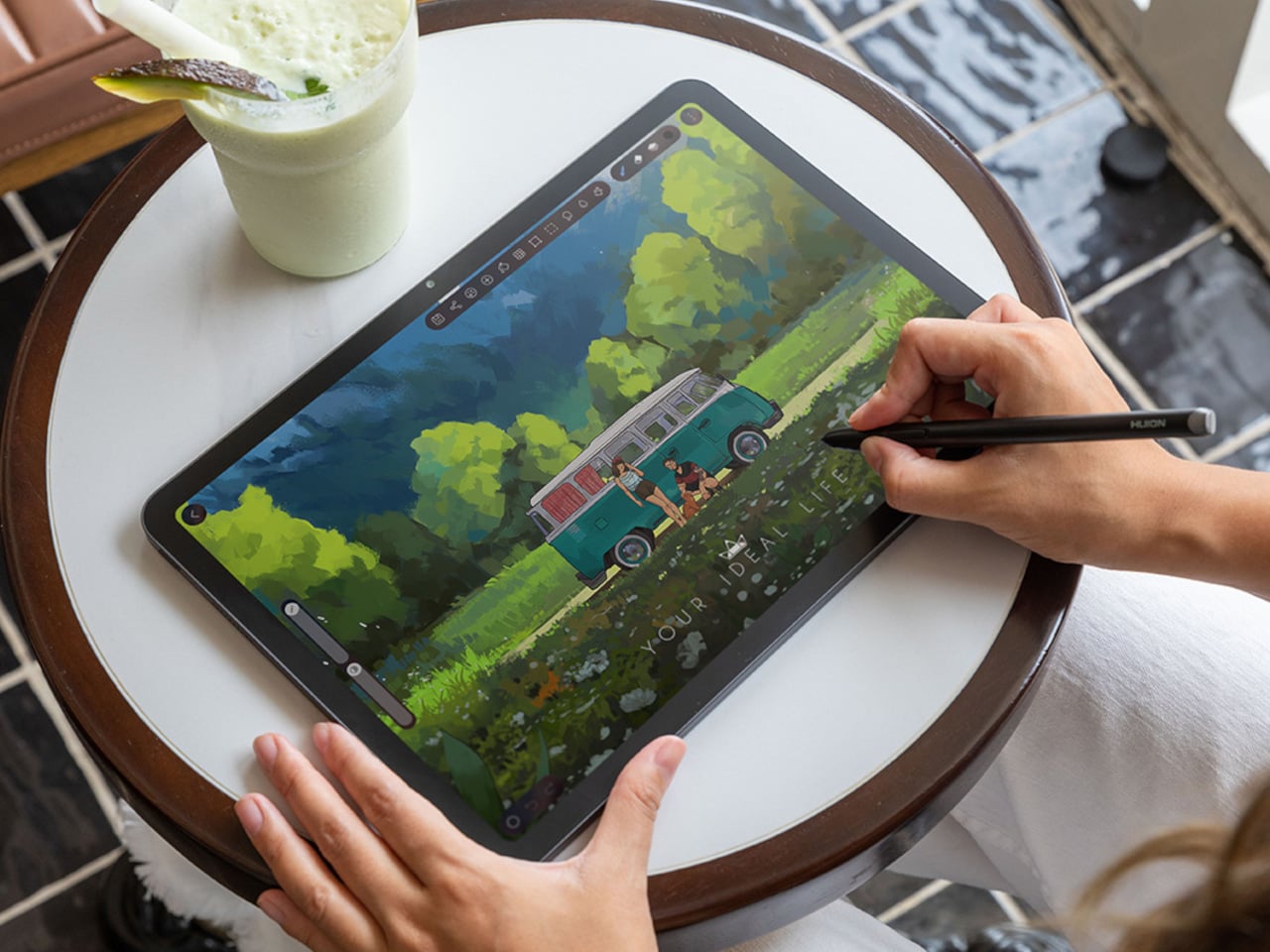
Most Android drawing tablets make you choose between a screen that feels like paper and hardware fast enough to keep up with a real workflow. The Kamvas Pad 12 refuses that trade-off. Huion built a 12.2-inch standalone tablet around a textured, paper-like display and paired it with enough processing power to hold 127 layers open without stuttering, treating the screen as a genuine canvas rather than a stylus afterthought.

That screen runs a 3:2 aspect ratio instead of the usual 16:9, and the difference shows up the moment you start sketching. A wider canvas means fewer awkward crops when composing a portrait or a page layout, and it doubles as a better shape for reading documents or comics without letterboxing. Combined with a 90Hz refresh rate, linework tracks the pen smoothly instead of lagging a beat behind your hand.

Designer: Huion

Canvas Glass 3.0 does the quieter work here. The surface is nano-etched for texture, so the pen tip grips the way it would on actual paper, while a soft-light treatment and anti-glare coating keep long sessions from turning into eye strain. Setting up near a window or working outdoors doesn’t wash out the display, which matters more than most spec sheets give it credit for.

The PW600C pen leans into that same philosophy of getting out of the way. It’s battery-free, weighs just 12 grams, and snaps magnetically onto the tablet body instead of needing a separate case or loop. Someone sketching on a train can toss the pen against the tablet’s edge between stops and trust it’ll still be there, without fishing through a bag for a charging cable or a lost cap.

Underneath, an eight-core MediaTek Genio 720 chip and 8GB of RAM handle the kind of multitasking that used to choke budget Android tablets, running multiple layers and apps without the frame drops that make digital painting frustrating. At 16,384 pressure levels and 60-degree tilt support, the stylus itself translates a feather-light highlight or a bold ink stroke with the kind of nuance that used to be reserved for pricier displays.

Storage tops out at 256GB onboard with room to expand to 1TB, so a growing library of finished pieces, reference photos, and half-done sketches doesn’t force anyone into constant cleanup. Android 16 and full Google Play access mean the tablet isn’t locked into a single app either. Clip Studio Paint, ibisPaint X, MediBang Paint, and Huion’s own HiPaint all come preloaded, ready for whichever workflow fits the project at hand.

Battery life rounds out the case for treating this as a genuine mobile setup instead of a tethered accessory. An 8,000mAh cell inside a 7.8mm metal body keeps the Kamvas Pad 12 running for roughly eight hours, long enough for a full day of sketching at a café or a cross-country flight without hunting for an outlet. That kind of stamina turns a drawing tablet into something closer to a sketchbook you never outgrow.

The post An Android Drawing Tablet With 127 Layers That Still Feels Like Paper first appeared on Yanko Design.

  • ✇Korben
  • GrapheneOS verrouillera bientôt le presse-papiers d'Android
    Il y a 2 jours, GrapheneOS que vous connaissez tous parce que c'est l'Android que la police déteste, a détaillé une fonction baptisée secure paste, qui change la façon dont Android sert le contenu du presse-papiers aux applications. Le principe c'est qu'une application peut relire ce qu'elle a copié elle-même, mais rien de ce que les autres ont copié. Android dans sa version de base n'est pas resté les bras croisés sur ce sujet, mais il s'est arrêté en chemin et depuis Android 10, seules l'appli
     

GrapheneOS verrouillera bientôt le presse-papiers d'Android

8 septembre 2026 à 01:10

Il y a 2 jours, GrapheneOS que vous connaissez tous parce que c'est l'Android que la police déteste, a détaillé une fonction baptisée secure paste, qui change la façon dont Android sert le contenu du presse-papiers aux applications. Le principe c'est qu'une application peut relire ce qu'elle a copié elle-même, mais rien de ce que les autres ont copié.

Android dans sa version de base n'est pas resté les bras croisés sur ce sujet, mais il s'est arrêté en chemin et depuis Android 10, seules l'application affichée à l'écran et le clavier par défaut peuvent lire le presse-papiers, ce qui a fermé la porte à celles qui tournent en arrière-plan. Puis Android 12 a ajouté une notification à la première lecture d'un contenu venu d'ailleurs, et enfin Android 13 vide le presse-papiers au bout d'un moment.

Mais depuis, plus rien...

Le trou qui reste, Microsoft l'a documenté en mars 2023. La version 7.9.2 de l'application SHEIN (oui, le site de fringues), téléchargée plus de cent millions de fois, lisait périodiquement le presse-papiers, et si elle y trouvait en même temps un signe dollar et un "://", elle expédiait le contenu vers un serveur distant.

Et la restriction d'Android 10 n'a rien empêché, tout simplement parce que l'application tournait au premier plan. Le comportement problématique de l'app SHEIN a ensuite disparu en mai 2022, après un signalement à Google, mais le problème de fond n'a jamais été réglé. Et j'imagine que d'autres apps actuellement sur le PlayStore appliquent la même technique sans que personne ne l'ait encore remarqué.

Secure paste de GrapheneOS s'attaque donc à ça en changeant la règle plutôt qu'en ajoutant un avertissement, et cette fois être affiché à l'écran ne donne plus droit à rien. Une application privée d'accès sait toujours qu'un élément est disponible, et peut en inspecter le type, l'horodatage de copie et la présence de mise en forme. Mais le contenu lui-même, son libellé et ses données annexes ne lui sont plus offerts sur un plateau d'argent.

Et le "collage" continue de marcher lui, parce que c'est vous qui l'autorisez. Que vous colliez depuis la barre de sélection de texte, depuis le clavier, depuis un service d'accessibilité ou avec un raccourci clavier, le système délivre une autorisation courte, liée à l'application qui reçoit et à l'élément en cours. Et pour les applications qui dessinent leur propre barre de sélection, comme celles codées en Flutter, un bouton "Coller" est visible dans le clavier par défaut.

Le plus vif d'esprit qui me lisent sont déjà debouts sur leur chaise et hurlent à travers leur écran : Et comment ça se passe pour "couper" ? Qui décide ?? Hé bien le réglage existe en version globale et par application, et il est autorisé par défaut, pour ne rien casser des applications déjà installées. Autrement dit, personne ne sera protégé sans l'avoir décidé et c'est à vous d'aller basculer en collage seulement celles à qui vous ne faites pas confiance.

Maintenant, calmez-vous les groupies de GrapheneOS parce que rien de tout ça n'est encore livré. Le code est visible dans une pull request ouverte depuis le 22 août dernier mais toujours pas fusionnée. GrapheneOS dit vouloir l'intégrer bientôt, sans donner de date et le mécanisme ne porte que sur la lecture, donc il ne dira rien des applications qui écrivent dans le presse-papiers pour y remplacer ce que vous venez de copier (coucou les détourneurs de transactions crypto)...

La même annonce parle aussi de l'application Messaging, dont l'interface vient d'être refaite en Compose, et le projet lâche au passage un chantier autrement plus lourd : faire du RCS directement dedans, chiffrement de bout en bout compris, pour ne plus avoir besoin de Google Messages. Héhé... Aujourd'hui, RCS marche très bien sur GrapheneOS, mais uniquement avec l'application de Google et sa couche Google Play isolée et c'est de ça dont ils veulent se passer.

Comme le RCS n'est pas une plateforme ouverte en pratique (pas autant que le SMS et le MMS quoi) et que tout cela repose sur l'infrastructure de Google et des opérateurs, le plan, c'est donc de refaire d'abord la partie que Google Messages assure, en gardant Google Play isolé pour l'activation, puis de s'en passer chez les opérateurs qui le permettent... à condition qu'ils acceptent le client de GrapheneOS, ce qui n'est pas gagné...

Quand je pense que Google, ces grands hypocrites qui ont passé des années à réclamer qu'Apple adopte RCS au nom de l'ouverture, coupe lui-même le service depuis 2024 sur les téléphones rootés et une partie des ROM alternatives. GrapheneOS y échappe mais ça donne quand même l'idée de l'accueil qu'un client maison pourrait espérer... On verra bien.

Mais bon, si vous êtes sur GrapheneOS, je serais vous, je surveillerais cette histoire de presse-papiers sécurisé parce que quand ça arrivera, vous serez encore plus béton face aux apps problématiques.

Source : le fil d'annonce de GrapheneOS et Android Authority

  • ✇Yanko Design
  • TCL’s P80 Pro and Ultra Are the Phones That Replaced Your Kindle Too
    TCL’s P80 Ultra and P80 Pro prove a phone screen doesn’t have to pick one personality and stick with it. Unveiled at IFA 2026 in Berlin, both handsets fold a vivid AMOLED panel and TCL’s paper-like NXTPAPER technology into the same sheet of glass, letting the display shift moods with a flick of a switch instead of forcing a trade-off between color and comfort. Run a finger along the frame, and you’ll find a thin slider, a small physical detail that carries plenty of weight in daily use. Slide i
     

TCL’s P80 Pro and Ultra Are the Phones That Replaced Your Kindle Too

Par : JC Torres
4 septembre 2026 à 04:15

TCL’s P80 Ultra and P80 Pro prove a phone screen doesn’t have to pick one personality and stick with it. Unveiled at IFA 2026 in Berlin, both handsets fold a vivid AMOLED panel and TCL’s paper-like NXTPAPER technology into the same sheet of glass, letting the display shift moods with a flick of a switch instead of forcing a trade-off between color and comfort.

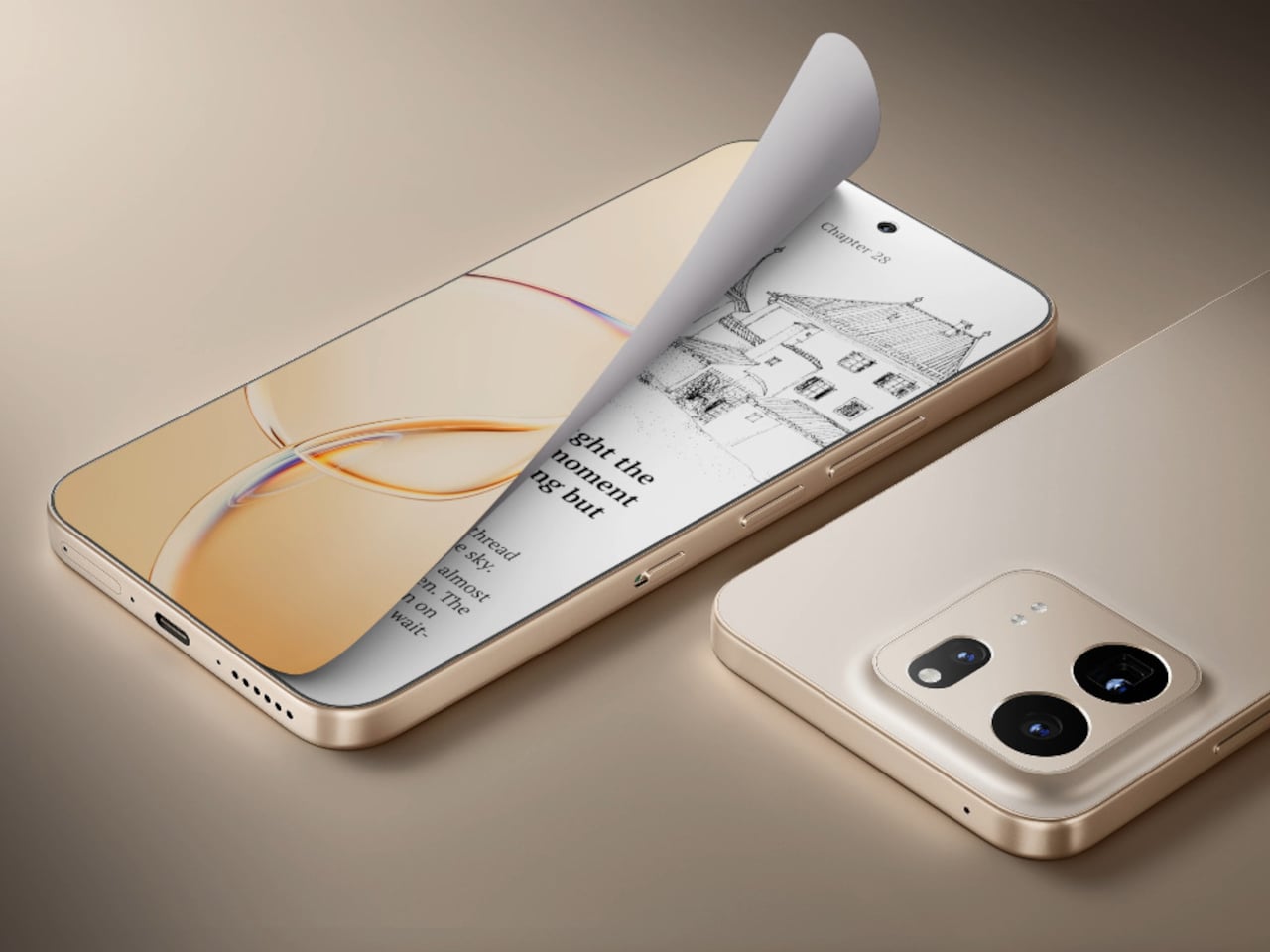
Run a finger along the frame, and you’ll find a thin slider, a small physical detail that carries plenty of weight in daily use. Slide it, and the 6.83-inch panel drops its saturation, taking on a warmer, textured look that mimics a printed page. A commuter buried in a novel or someone proofreading a document late at night gets a screen that behaves like paper, without losing the sharpness underneath.

Designer: TCL

Push that same slider one notch further, and the screen drops color entirely for Max Ink Mode, a stripped layout that silences notifications except for calls and texts. It reads like a design decision as much as a software one, TCL betting people want to quiet their phone rather than mute it completely. The payoff is a battery that can stretch across roughly a week of steady reading.

That reading-first mindset carries into the software too. Both phones can convert e-books into audiobooks or podcast-style narration using on-device AI, giving Max Ink Mode a voice to lean on when eyes need a break instead of ears. It is a small addition, but it treats the slower, paper-like mode as a genuine feature rather than a bolted-on gimmick for a keynote slide.

None of that would matter if the screen looked washed out the rest of the time, so TCL leaned on a 1.5K AMOLED panel that hits 3,200 nits and covers the full DCI-P3 color range. A Nano Crystal Shield coating cuts glare enough to keep the display readable under direct sun, marking TCL’s first pairing of NXTPAPER with OLED rather than the LCD panels it used before.

The frame wrapping that screen is aluminum rather than the plastic often found at this price, giving both phones a sturdier grip without piling on bulk. TCL backs that up with an IP68 rating against dust and water, plus MIL-STD-810H certification for the inevitable drop. Buyers get to pick between Sunlit Gold, Burgundy, and Midnight Blue, three finishes that lean more toward jewelry-box color choices than typical slab-of-glass smartphone palettes.

Where the two models part ways is around the back. The P80 Ultra carries a 50-megapixel main camera next to a 50-megapixel periscope lens for 3x optical zoom, tucked into a housing shaped to avoid throwing off the phone’s balance. The P80 Pro drops the periscope for a simpler dual-camera arrangement, trading reach for a slimmer build that still shares the same main sensor and 8-megapixel ultrawide.

TCL is rolling both phones out across Europe first, with the P80 Ultra priced from €549 (around $635) and the P80 Pro starting at €429 (around $500), before a Latin American launch follows in October. A wider release is expected to reach additional regions afterward. In a category full of identical glass rectangles, these two phones actually behave differently depending on what someone needs from them that day.

The post TCL’s P80 Pro and Ultra Are the Phones That Replaced Your Kindle Too first appeared on Yanko Design.

  • ✇Korben
  • Gadgetbridge - L'appli qui gère votre montre connectée sans Internet
    Gadgetbridge est une application Android libre qui va vous faire zizir parce qu'elle permet de remplacer l'app merdique du fabricant de votre bracelet ou montre connectée ou encore de vos écouteurs Bluetooth. Comme ça, terminé le compte obligatoire pour utiliser vos "wearables" et fini les serveurs du constructeur localisés en Chine ou je ne sais où qui reçoivent vos heures de sommeil ou votre fréquence cardiaque minute par minute... Puis surtout, ça permet de n'avoir plus qu'une
     

Gadgetbridge - L'appli qui gère votre montre connectée sans Internet

18 août 2026 à 04:44

Gadgetbridge est une application Android libre qui va vous faire zizir parce qu'elle permet de remplacer l'app merdique du fabricant de votre bracelet ou montre connectée ou encore de vos écouteurs Bluetooth. Comme ça, terminé le compte obligatoire pour utiliser vos "wearables" et fini les serveurs du constructeur localisés en Chine ou je ne sais où qui reçoivent vos heures de sommeil ou votre fréquence cardiaque minute par minute... Puis surtout, ça permet de n'avoir plus qu'une seule application Android pour tous vos appareils et ça c'est cool aussi !

Surtout que ça fonctionne en OFFLINE... Hé oui, le manifeste de cette app indique bien que jamais, Ô grand jamais, elle ne se connectera au net. Y'a même pas la permission dans l'app, c'est bloqué au niveau du code.

Maintenant, concrètement, Gadgetbridge permet de recevoir vos notifications à votre poignet, de répondre aux appels avec réponses préenregistrées, de paramétrer des alarmes, de lancer une lecture de musique, d'avoir du suivi d'activité et de sommeil, ainsi que vos tracés GPS de vos trop rares séances de sport. Et bien sûr, tout reste en local sur votre téléphone. Notez que AsteroidOS , dont je vous ai déjà parlé, fait pareil mais un cran plus bas, uniquement dans la montre.

Gadgetbridge supporte actuellement 529 modèles de 74 fabricants, d'Amazfit à Garmin, avec Pebble, Sony, Huawei et Xiaomi. Mais prenez le temps de lire la fiche technique de votre modèle car tous ne sont pas supportés en intégralité.

Reste maintenant le prix à payer, et il ne vient pas de Gadgetbridge.

En effet, sur les Amazfit et Xiaomi récents, l'appairage se négocie avec les serveurs du constructeur. Il faut donc appairer une première fois avec l'appli officielle, puis en extraire la clé. Même histoire chez Fossil, dont les montres HR sortent en plus avec un firmware de démo que seule l'appli maison sait remplacer. Chez Nothing aussi, la CMF Watch Pro veut une clé extraite d'un téléphone rooté, alors que les Pro 2 et Pro 3 s'en passent.

Une appli qui aurait la permission d'aller sur Internet irait chercher cette clé toute seule mais comme celle-ci ne peut pas, faudra le faire vous-même (c'est expliqué comment dans la doc).

De leur côté, les Garmin s'appairent directement, sauf quelques modèles qui veulent avoir vu l'appli officielle une fois. Mais la météo, et l'AGPS sur certaines montres, réclament des identifiants à renouveler tous les 90 jours, et Gadgetbridge propose d'y répondre avec de faux jetons OAuth. Après si vous voulez revenir ensuite à celle du constructeur, faudra peut-être relancer une remise à zéro d'usine.

Après pour les irréductibles qui voudraient quand même du réseau, un module séparé, Internet Helper, est arrivé début 2026. Il relaie les requêtes des applications de la montre, s'installe à part, et nécessite sa propre autorisation.

Voilà, tout cela s'installe depuis F-Droid sur tout Android 6.0 ou plus récent, sous licence AGPLv3, et le code est dispo sur Codeberg.

  • ✇Yanko Design
  • Tecno Camon 50 Ultra 5G Review: A $420 AI Phone With Built-in Gemini, ChatGPT, DeepSeek, and Grok
    PROS: EllaClaw is one of the most impressive phone AI experiences available right now Multi-model AI support, including Gemini, ChatGPT, Grok, DeepSeek, Meta AI, and Ella Strong 2-day battery life from the 6500mAh cell Competitive value in the mid-range segment CONS: Single speaker setup sounds tinny and lacks bass Curved waterfall display is prone to accidental palm touches No wireless charging or Qi2 (MagSafe) RATINGS: AESTHETICSERGONOMICSPERFORMANCESUSTAINABILITY /
     

Tecno Camon 50 Ultra 5G Review: A $420 AI Phone With Built-in Gemini, ChatGPT, DeepSeek, and Grok

16 août 2026 à 21:46

PROS:


  • EllaClaw is one of the most impressive phone AI experiences available right now

  • Multi-model AI support, including Gemini, ChatGPT, Grok, DeepSeek, Meta AI, and Ella

  • Strong 2-day battery life from the 6500mAh cell

  • Competitive value in the mid-range segment

CONS:


  • Single speaker setup sounds tinny and lacks bass

  • Curved waterfall display is prone to accidental palm touches

  • No wireless charging or Qi2 (MagSafe)

RATINGS:

AESTHETICS
ERGONOMICS
PERFORMANCE
SUSTAINABILITY / REPAIRABILITY
VALUE FOR MONEY

EDITOR'S QUOTE:

The Camon 50 Ultra 5G feels like Tecno looked at the current AI phone race, skipped the walled garden nonsense, and built the first assistant experience that actually shows you why you’d want to use it in the first place.

Apple has Apple Intelligence. Google Pixel has Gemini. Samsung has Galaxy AI. Tecno has everything else. Packed into its EllaClaw agent is the ability to use Gemini, ChatGPT, Grok, and DeepSeek, because a walled garden never benefited anyone. Tecno’s Camon 50 Ultra 5G is a great phone, but what makes it worth doing a double take for is EllaClaw, an agentic AI built into the phone that offers a phone AI experience I have yet to see on any smartphone so far. EllaClaw is currently an invite-only closed Beta feature limited to just this phone, but seeing it in action gave me everything I needed to understand where other phones are going wrong with their on-board AI, and where they can learn from Tecno.

The wild part is how approachable it all feels. EllaClaw does not sit around waiting for you to guess the perfect command like some moody genie. It actively shows you what it can do, which makes the whole experience feel far less intimidating than Gemini or Apple Intelligence currently do. Within minutes, I was jumping between message summaries, creative tools, settings help, and different AI models without feeling like I needed a tutorial or a prayer.

Aesthetics

The moment I unboxed the Camon 50 Ultra 5G, I was hit with a serious case of déjà vu. The green variant has a gorgeous satin finish that gives it a silky, metallic glow under the light, and it immediately sent me down a memory lane trip to my old OnePlus 8 Pro which I faithfully used from 2020 to 2024. The color, the texture, even the way the camera module is arranged, it all felt so familiar and, frankly, so premium. Tecno absolutely nailed the flagship-esque feel here. The back is smooth to the touch, resists fingerprints reasonably well, and has a subtle elegance that a lot of phones in this bracket just do not bother with.

The front is where the design language gets a little more complicated, at least for me. Tecno went with a waterfall display, which means the screen curves dramatically around the sides. It looks stunning when the phone is off or when you are watching a video, creating an immersive, almost bezel-free experience. But I have always had a love-hate relationship with these displays. They are beautiful, no doubt, but they can be a magnet for accidental palm touches. While the software does its best to ignore them, I still found myself occasionally tapping something I did not mean to. It is a classic case of striking aesthetics meeting the messy reality of how we hold our phones. I do have to say that Tecno’s Liquid Glass homage does look much better on a waterfall display than on a bezel-ridden iPhone.

Ergonomics

That waterfall display has a big effect on how the phone feels in your hand. The curved edges melt away into the frame, making the Camon 50 Ultra 5G incredibly comfortable to hold. There are no sharp, flat corners digging into your palm, which is great for long sessions of scrolling or gaming. The trade-off, of course, is that the phone can feel a little slippery if you are not paying attention. It has that smooth, polished-stone feel that is lovely to touch but always feels one careless gesture away from a gravity experiment. It is a phone that practically begs to be put in a case, even if it feels like a shame to cover up the design.

The button layout is personally feels a little little bit tricky. On the left, you have a dedicated AI key that summons EllaClaw, a shortcut I ended up using constantly. You can remap it, but having a one-press gateway to the AI is a smart touch. The right side, however, is where my muscle memory started to complain. There is a power button and a fairly short, single-piece volume rocker. Because the rocker is slightly compact, I often found myself fumbling, unsure if my thumb was on volume up, down, or about to lock the screen. It is a small pain, but a tiny indent in the middle of the volume button would have made all the difference. The buttons themselves are slightly sharp and textured, a necessary choice for a phone with curved edges, but it does not quite solve the problem of telling them apart by feel alone.

Performance

EllaClaw is where the Camon 50 Ultra 5G earns its stripes. The dashboard (which you access by swiping towards the left – where you’d see Google Discover on most Android phones) keeps surfacing prompts, shortcuts, and suggestions, making the AI feel alive and accessible rather than buried under three layers of settings. Most phone AI treats users like they should already know what they want. EllaClaw meets you halfway, and that changes everything about how you interact with the phone.

The deeper layer, EllaClaw Pro, is genuinely impressive. It reaches into the phone’s apps and system functions in a way that feels ahead of where the conversation currently is. I asked it to summarize my text messages without opening the messages app, and it did exactly that, handling the whole thing on its own. That kind of agentic behavior is the next logical step for phone assistants, and right now, Tecno seems to be ahead of the pack. Nothing reassured me that the AI wasn’t reading my messages to enhance its database though, so the privacy conscious might have a thing or two to worry about.

Tecno’s decision to build EllaClaw as a multi-model hub is one of the smartest software calls I have seen this year. My unit offered access to DeepSeek, Gemini, ChatGPT, Grok, and Meta AI alongside Ella’s own model, all in one dashboard. Claude is conspicuously missing, but everything else is here and free to use (at least during the Beta period). Daily limits are applied on AI use which reset every 24 hours, and you can buy extra credits in case you overshoot. In all my hours of testing, I never needed to purchase extra credits, which means image generation, video generation, and sketch-to-photo tools were all available at no additional cost.

EllaClaw is still being refined, though. The dashboard lagged occasionally, and the AI sometimes took longer to load than felt comfortable. Restarting the app always sorted it out, but it is a reminder that this experience has not fully grown into its ambition yet. Users in certain regions may also need a VPN to get the full experience running, which is worth knowing upfront.

The camera system is built around a 50MP Sony LYT-700C main sensor with OIS, paired with a 50MP telephoto lens offering 3x optical zoom (70mm equivalent) and an 8MP ultrawide. That telephoto is a proper standout for a phone at this price point, and the software leans into it with confidence. You get 60x hybrid zoom, which is mostly digital exaggeration past the 3x mark, but the results between 3x and 10x are still usable in decent light. The main camera performs well across a range of scenarios, especially in good light, and night mode is aggressive without getting too soupy. The front camera is a 50MP sensor with autofocus, which makes a noticeable difference in selfie sharpness compared to the fixed-focus cameras on cheaper phones.

Tecno stuffs the camera app with modes including dual-cam, underwater mode, document scanning, super night mode, and super macro. FlashSnap is the standout, though. It watches your scene and captures the most dramatic moment automatically, so if someone is mid-jump or mid-throw, the phone clicks at exactly the right time without you having to think about it. It made me look like a considerably better photographer than I actually am. Video recording tops out at 4K at 30fps, which is fine but not particularly exciting.

Battery life is one of the phone’s most quietly satisfying qualities. The 6500mAh cell pushed comfortably through two full days of use without needing a charge, which is more than my current flagship iPhone manages. At some point I just stopped thinking about charging altogether, which is the best thing a battery can do. The phone supports 45W wired charging, which is fast enough to feel civilized without being record-breaking.

The display is a 6.78-inch AMOLED panel with a 1.5K resolution (1208 x 2644 pixels, 429 ppi) and a 144Hz refresh rate with LTPO support for adaptive refresh. It is vibrant, sharp, and performs well in low light. The 144Hz refresh makes scrolling and gaming feel smooth, and the high PWM dimming (2160Hz) helps reduce flicker for those sensitive to it. The curved waterfall edges are a design choice I have already aired my reservations about, and this section will not relitigate that argument. It looks great. It catches accidental touches. Moving on.

Speakers are a weak spot, and a noticeable one. There is a single grille at the bottom right, so stereo is off the table, and the audio leans tinny with very little bass to speak of. For a phone this polished everywhere else, it feels like a department that got the budget cut.

Gaming held up well for everything I tried. Tecno’s dedicated gaming software manages frame rates and battery draw sensibly, and the Dimensity 7400 handled casual to moderate sessions without complaint. The 144Hz display helps make fast-paced games feel responsive, and the phone stayed well within comfortable temperature ranges throughout. Nothing I played caused any real issues, thermal throttling never became a concern, and the large battery meant I could game for extended sessions without nervously watching the percentage drop.

Sustainability

Tecno is promising 3 years of Android OS upgrades and 5 years of security patches for the Camon 50 Ultra 5G, which puts it roughly in line with brands like Motorola and slightly ahead of OnePlus, though still behind Nothing’s 6-year security support.That is a meaningful commitment for a phone at this price, especially if you are someone who plans to use the device well beyond the usual two-year upgrade cycle.

Tecno also claims the battery is built for durability, marketing it as a “5-Year Durability Battery” with TÜV certification and a 72-month lag-free guarantee. Whether that holds true in practice is something only time will tell, but the fact that the company is willing to stake that claim suggests they are at least thinking about longevity beyond the usual marketing fluff. The 6500mAh capacity itself helps, because the less frequently you need to charge, the slower the battery degrades. If you are getting two full days of use out of a charge right now, that headroom means the phone should still feel usable years down the line when the cell inevitably loses some of its capacity.

Value

The Tecno Camon 50 Ultra 5G is priced at $420 for the 8GB + 256GB variant (that’s based on its ₹40,000 Indian price, since the phone hasn’t officially launched in the US). For a phone with a 50MP telephoto, a 144Hz AMOLED display, and a 6500mAh battery, that positioning feels competitive in the under-40K segment, especially when you factor in the AI ambitions.

What feels less competitive is the setup experience. When I powered on the phone and began the initial configuration, India was not listed in the countries menu. Hilariously enough, Palestine was available as an option. The world’s most populated country, nowhere on the list. I eventually had to select a different region just to proceed, which immediately felt awkward for a phone launching in India. Later, I also needed a VPN to access EllaClaw, which could have been a software issue tied to my initial region selection, or it could point to broader availability constraints. Obviously this won’t be the case for everyone since mine was a review unit with the EllaClaw beta program probably tied to a certain region. Either way, it is a frustrating first impression for a feature that is supposed to be the phone’s main selling point.

As for EllaClaw Pro and its credits system, Tecno does offer a credit-based structure for premium AI features like image generation and video creation. In my testing, I never hit a paywall or needed to purchase add-on credits, which suggests the included allocation is generous enough for typical use, at least initially. How sustainable that remains over time, or whether Tecno tightens the limits later, is harder to predict. For now, though, the experience feels surprisingly open, which is a rare thing in the AI phone space.

Verdict

The Tecno Camon 50 Ultra 5G delivers a lot of value for $420. The camera is genuinely impressive, with super night mode shots and 60x zoom that feel bonkers for this price range, and the battery life makes it easy to forget about charging anxiety for days at a time. But I am not recommending this phone for its camera, or its battery, or even its design, as much as I enjoyed all of those things. I am recommending it for EllaClaw, because it is the closest I have come to using a phone AI that feels like it was built for actual humans.

EllaClaw is everything Gemini and Apple Intelligence hope to achieve, and a bit more. I did not think I would see a phone that lets me choose the LLM for its AI assistant, swapping between models depending on what I need. I definitely did not expect an AI assistant dashboard to genuinely give me so much insight and value into how I can use the AI, rather than just sitting through a keynote, nodding along to feature lists, and then forgetting half of them the moment I leave the room. Tecno has cracked something here that bigger brands are still struggling with, which is making AI feel approachable, integrated, and genuinely useful instead of intimidating or buried.

The phone has a few tiny flaws that feel manageable if you’re more driven by the AI chops. The speakers are tinny, the curved display catches palm touches, EllaClaw occasionally lags, and the setup process was a bit of a hassle given I needed a VPN to get EllaClaw to work (but that’s just my China-bound review unit). But if you are looking for a phone that shows you what AI on mobile should feel like when it grows up, the Camon 50 Ultra 5G is worth your attention. It is not perfect, but it is ambitious in all the right ways. Google, Apple, and Samsung could surely take notes.

The post Tecno Camon 50 Ultra 5G Review: A $420 AI Phone With Built-in Gemini, ChatGPT, DeepSeek, and Grok first appeared on Yanko Design.

  • ✇Korben
  • Le vieux Pixel de votre tiroir vaut peut-être mieux qu'un serveur
    Des chercheurs de l'université de Californie à San Diego, épaulés par Google, viennent de prouver un truc contre-intuitif : un Pixel mis au rebut il y a trois ans tient encore tête à un serveur professionnel sur certains calculs, au point qu'on peut en assembler un vrai data center au lieu de le foutre à la poubelle. L'idée a été posée sur le blog de recherche de Google . Une fois l'appareil ouvert, les chercheurs retirent tout ce qui ne sert plus, l'écran, la batterie au lithium, les caméras et
     

Le vieux Pixel de votre tiroir vaut peut-être mieux qu'un serveur

17 juin 2026 à 02:53

Des chercheurs de l'université de Californie à San Diego, épaulés par Google, viennent de prouver un truc contre-intuitif : un Pixel mis au rebut il y a trois ans tient encore tête à un serveur professionnel sur certains calculs, au point qu'on peut en assembler un vrai data center au lieu de le foutre à la poubelle.

L'idée a été posée sur le blog de recherche de Google . Une fois l'appareil ouvert, les chercheurs retirent tout ce qui ne sert plus, l'écran, la batterie au lithium, les caméras et la coque, jusqu'à ne garder que la carte mère et sa puce, ce qu'on appelle un SoC, le processeur qui faisait tourner Android avant qu'on le bascule sur une distribution Linux des plus classiques.

Ce système, le même qui anime déjà l'immense majorité des serveurs de la planète, libère la puce des limites pensées pour un mobile, à commencer par ce bridage qui met les applications en pause dès qu'elles passent à l'arrière-plan. Ensuite, il suffit de relier ces cartes mères entre elles via Kubernetes, l'outil que les géants du web emploient déjà pour piloter les milliers de machines de leurs centres de données comme un seul gros ordinateur.

Le plus déroutant arrive là. Sur la plupart des tests ne mobilisant qu'un seul cœur, un Pixel Fold de 2023 dépasse un serveur ASUS RS720A-E11 pourtant équipé de deux gros processeurs AMD, le genre de bête qu'on retrouve dans les baies des entreprises.

Le serveur empile bien plus de cœurs en parallèle, si bien qu'il faut réunir entre 25 et 50 téléphones pour rivaliser avec son débit total. Mais bon. Dès lors que vous ramassez ces appareils gratuitement au lieu d'acheter du silicium neuf, l'équation se renverse.

Le vrai argument est écologique, puisque près de la moitié des émissions de carbone d'un smartphone sur toute sa vie part dans sa seule fabrication, surtout dans l'assemblage de la carte mère et du processeur, ce fameux carbone gris déjà cramé avant même que l'appareil ne s'allume.

On change pourtant de mobile tous les trois ou quatre ans, en balançant une puissance de calcul encore largement bonne à servir, pendant que les entreprises font fabriquer des serveurs flambant neufs pour les mêmes tâches. Le gâchis est énorme.

L'équipe a pour l'instant fait tourner une grappe de 20 téléphones, qui a encaissé sans broncher le pic de rendu des devoirs d'une classe de plus de 75 étudiants avec une latence plus basse que les services cloud du commerce. Elle prépare déjà un cluster d'environ 2 000 Pixel pour la rentrée, capable d'absorber une centaine de cours d'informatique en même temps pour une fraction du prix du cloud habituel.

Reste à rester lucide. Ces puces ont peu de mémoire, donc on les cantonne aux tâches légères, la correction automatisée ou les carnets de code, loin de l'entraînement d'un gros modèle d'IA.

Mais voir une montagne d'e-déchets se muer en salle de classe numérique, ça donne sacrément envie d'y croire. Surtout vu le nombre de Pixel qui dorment au fond de nos tiroirs, même moi j'en ai deux qui traînent pour tout vous dire.

Source : Techspot

❌